
By Zohaib Ahmed | 22 August 2025
Introduction: A Battle Between Fire and Ice
In a world debating whether we’re heating up or freezing over, Pakistan is crushed under the weight of both crises. Home to more glaciers than any non-polar region, Pakistan is a frozen fortress that is now… melting.
And in a bizarre twist of climate chaos, some glaciers are even growing back. This “Karakoram Anomaly” means Pakistan is not just warming, but facing unpredictable bipolar climate shocks. These glaciers feed the Indus River system, lifeline for 90% of agriculture and 70% of the population. But when glaciers misbehave — melting too fast or surging — it’s not weather anymore. It’s national survival.
The Kingdom of Ice: Pakistan’s Glacial Backbone
- 13,000+ glaciers (revised figure by MoCC & EvK2CNR, up from 7,253).
- 7,253 mapped by traditional counts.
- 543 glaciers in Chitral Valley alone.
- Strategic glaciers include: Baltoro, Siachen, Hispar, Panmah, Batura, Rakaposhi, Rimo, Tirich, Gasherbrum, and Nanga Parbat glaciers.
Together, they feed the Indus River system, powering irrigation, hydroelectricity, and drinking water for 231 million Pakistanis.
But this lifeline is turning into a liability: over 3,000 glacial lakes have already formed, of which 33 are classified as dangerous — each capable of triggering a deadly Glacial Lake Outburst Flood (GLOF).
What are GLOFs?
When melting glaciers form unstable lakes, they are often dammed by loose moraine walls. If these natural dams burst, sudden torrents of water sweep away villages, farmlands, and infrastructure downstream.
Pakistan already faces 20–40 GLOF events annually, a number that doubled in 2022. The 2022 floods showed how extreme rainfall + melting glaciers = catastrophic floods, displacing 33 million and costing $30 billion.
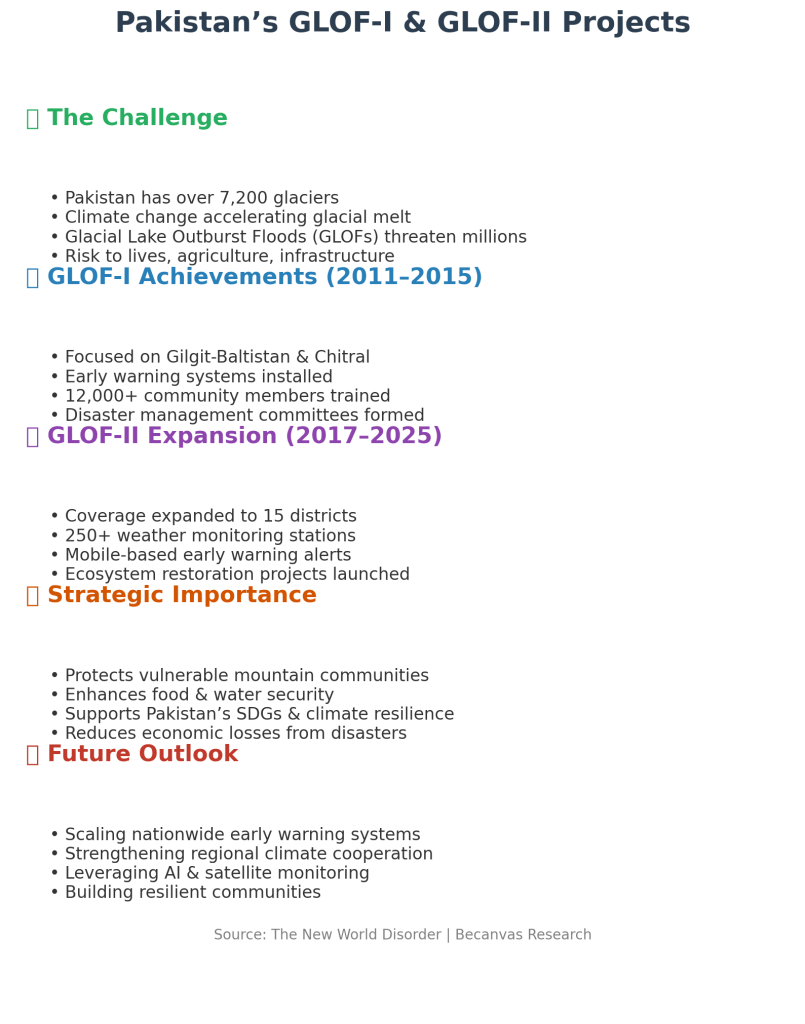
GLOF-I: The Pilot Project (2011–2017)
Launched with UNDP support, GLOF-I was Pakistan’s first serious step toward reducing risks.
Achievements:
- Focused on Bagrot (GB) and Bindogol (Chitral, KP) valleys.
- Installed 2 Early Warning Systems.
- Built protective structures (gabion walls, spillways).
- Trained 5,000+ locals in disaster preparedness.
- Integrated GLOF data into local development plans.
👉 Impact: GLOF-I proved localized interventions could save lives, but also revealed the scale of Pakistan’s challenge.
GLOF-II: Scaling Up (2017–2027)
Backed by a $37 million GCF grant, GLOF-II aimed to expand protection across 24 valleys in GB & KP.
Key Goals:
- Install 28 Early Warning Systems.
- Build 250 small-scale protective structures.
- Train 5 million people in resilience.
- Integrate climate risk into district planning.
- Deploy weather stations & satellite-linked monitoring.
Progress (as of 2025):
| Target | Progress |
|---|---|
| Early Warning Systems (28) | ~20 installed |
| Weather Stations (50+) | ~38 active |
| Protective Structures (250) | ~110 completed |
| Households Trained (500k+) | ~320k |
| Districts Mapped (24) | 22 mapped |
👉 Outcome: In covered valleys, zero GLOF-related deaths were reported recently.
The Raushan Village Incident (Ghizer District, 2025)
Senator Sherry Rehman praised Pakistan’s early warning system for averting disaster in Raushan village. But local accounts reveal a different reality.
- At 1:00 a.m., a shepherd spotted unusual glacial activity and alerted villagers.
- By 3:00 a.m., the floodwaters reached the village.
- Villagers self-evacuated. No automated early warning system was activated.
- Later, alarmist reports circulated, but the truth is: it was human vigilance, not technology, that saved lives.
Technical Analysis:
- Satellite images and hydrological backtracking are still awaited.
- Local experts confirm at least two mapped glacial lakes in the valley.
- If the suspected lake did not burst, the danger is still imminent.
- Highlights the gap between project claims and ground reality.
The Role of Satellite Monitoring
Pakistan’s glacial risk management cannot rely solely on ground sensors.
- Sentinel-2, Landsat-8/9, ICESat-2 can track lake growth and moraine stability.
- AI-enhanced models can predict breach probabilities.
- Real-time satellite data integrated into SMS/mobile alerts could save thousands.
👉 Without satellite-backed monitoring, “early warning systems” risk being just optics.
SWOT Analysis of GLOF Projects
Strengths
- International funding (UNDP + GCF).
- Community training and mobilization.
- Integration of climate discourse into national policy.
- Engineering interventions already reducing local risks.
Weaknesses
- Over-reliance on donor funding.
- Maintenance gaps in installed EWS.
- Poor integration with local disaster management authorities.
- Over-reporting successes while under-reporting failures.
Opportunities
- AI + satellite integration for real-time risk detection.
- Expansion to AJK, Balochistan, and Sindh.
- Climate finance leverage in COP “Loss and Damage” talks.
- Cross-sector use of data (hydropower, agriculture, defense).
Threats
- Rapid glacier retreat = more lakes forming annually.
- Mistrust between locals and officials if EWS fail.
- Underprepared downstream provinces (Punjab, Sindh).
- Climate denial or political instability diverting attention.
Strategic Recommendations
- National Climate Security Doctrine: Treat GLOFs as national security risks.
- Community + Satellite Hybrid System: Combine local shepherd alerts with AI-driven monitoring.
- Independent Audits: Regular third-party verification of GLOF-II outcomes.
- Defense-Climate Partnership: Use FWO/PAF for valley-based monitoring infrastructure.
- Expansion Beyond GB & KP: Climate resilience must cover all provinces.
Conclusion: Between Projects and People
The Raushan village incident is a wake-up call. Pakistan’s GLOF projects show progress, but also weaknesses. While international funding and engineering interventions matter, the true first line of defense remains local communities — people who live with the ice every day.
The battle between fire and ice is not just about melting glaciers — it’s about whether Pakistan can bridge the gap between project claims and ground realities. If it fails, the melting mountains will write the obituary of a nation unprepared.
Read more: The Icy Paradox — Why Pakistan is the Ground Zero of Climate Chaos
Special Edition Blog by Zohaib Ahmed