
By Zohaib Ahmed | 1st October 2025
Axios has revealed how Netanyahu reshaped Trump’s Gaza “peace plan” into something far more one-sided: erasing Palestinian identity, codifying an Israeli “security perimeter,” and inserting Western overseers like Trump and Blair. This triggered resistance from Saudi Arabia, Pakistan, Egypt, Jordan, and Turkey.
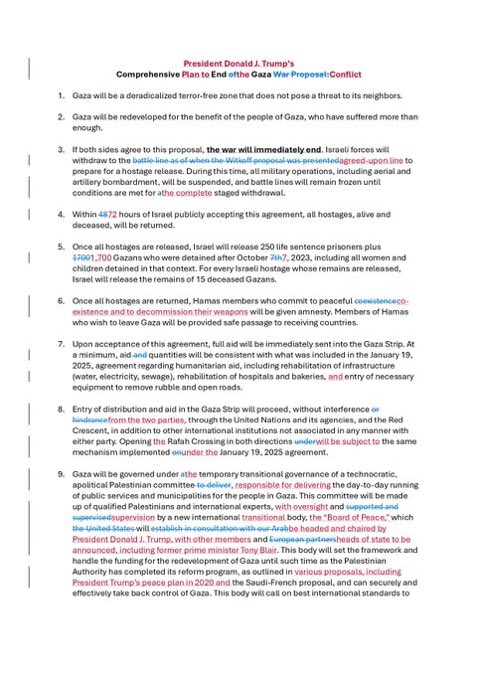
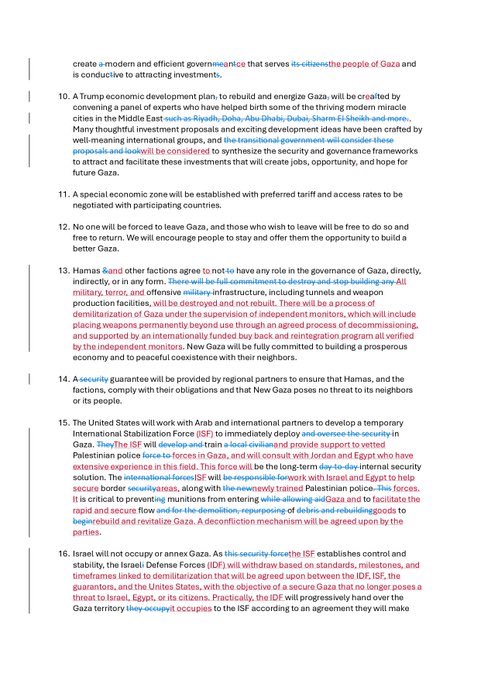
In my earlier analysis, I had already flagged the structural traps in Trump-Netanyahu’s Gaza plan, the risk of repeating Oslo through “time-buying without sovereignty,” the dangers of foreign oversight morphing into external control, and the reputational cost Pakistan would bear if it became the guarantor of a flawed settlement without enforceable redlines. I laid out specific safeguards: UN inscription, independent monitors, Palestinian agency, exclusion of Blair, and operational autonomy for any Pakistani role. What followed, as Ishaq Dar’s official statement revealed, was Pakistan echoing much of this posture: distancing itself from Trump’s 20-point draft by insisting “this is not our document,” reiterating that troop participation remains undecided and must be under UN/Muslim leadership, and drawing explicit red lines on sovereignty, annexation, and foreign command structures. In effect, Pakistan’s cautious positioning mirrors the very warnings I had preempted, showing awareness of the asymmetric risks and signaling that it will not allow itself to be trapped into legitimizing Netanyahu’s edits. Where my recommendations demanded binding guarantees and contingency mechanisms, Dar’s framing demonstrates Pakistan moving in that direction: reluctant ownership, conditional participation, and insistence on enforceable structures that protect both Palestinian rights and Pakistan’s credibility.
Pakistan’s official line, articulated by FM Ishaq Dar yesterday, is equally telling:
“This is not our document… it has been issued by the US. There are some key areas we want covered. If they are not, they will be.”
(Press conference, Islamabad – Sept 30, 2025)
Dar made three crucial clarifications:
- Pakistan owns the joint statement by the eight Muslim countries with Trump, not Trump’s White House draft.
- Ceasefire, aid access, stopping displacement, and reconstruction remain the only legitimate objectives Pakistan signed onto.
- Troops are undecided — Pakistan hasn’t committed, while Indonesia has offered 20,000. Any force must be under UN and Muslim leadership, not Western command.
This distancing shows Islamabad knows Netanyahu’s edits turn the plan into a trap of asymmetric obligations.
What Dar’s Statement Reveals About Pakistan’s Redlines
- No ownership of Trump’s 20-point draft. Pakistan sees it as an American plan, not a Muslim consensus.
- No compromise on West Bank annexation. Dar explicitly flagged this as a red line.
- Two-state solution remains policy. Despite semantic changes (“people of Gaza”), Islamabad still ties Gaza to Palestinian sovereignty.
- Troop deployment conditional. Pakistan insists on a UN-backed, Gaza-specific peacekeeping mandate with Palestinian majority governance.
The Trap: Netanyahu’s Revisions vs Pakistan’s Position
- Netanyahu’s permanent “security perimeter” contradicts Pakistan’s stance on complete withdrawal.
- Replacing “Palestinian citizens” with “people of Gaza” clashes with Islamabad’s two-state policy.
- Blair’s inclusion undermines credibility — a known red flag for Pakistan.
- Expanded Hamas disarmament risks repeating the West Bank model: demilitarization without sovereignty.
Pakistan’s Contingency Playbook
Dar’s words hint at what Islamabad must demand if it proceeds:
- Legal documentation at UN Security Council — binding clauses, not vague promises.
- Independent oversight, not Blair or Trump. Replace them with neutral or Muslim figures.
- Operational autonomy for Muslim-led ISF. Pakistani troops, if sent, cannot be under Israeli/Western command.
- Palestinian agency in governance. Transitional body must be Palestinian-majority with veto powers.
- Snapback mechanisms. Automatic sanctions, aid freezes, and UN escalation if Israel violates.
The Strategic Reading
Dar’s framing — “not our document” — is deliberate. Pakistan is signaling it will not be trapped into defending Netanyahu’s edits. Instead, it’s aligning with the joint Muslim bloc vision that Palestinians themselves can accept: ceasefire, aid, reconstruction, sovereignty.
The risk? If Pakistan steps in without enforceable redlines, it risks becoming the face of a failed Western plan, policing Gaza for Israel while its own credibility collapses.
The opportunity? If Islamabad codifies its conditions — UN guarantees, Palestinian primacy, no Blair, no permanent IDF footprint — it can emerge as the credible guarantor that Palestinians and the wider Ummah trust.
This is the moment where Pakistan must prove it is not a subcontractor for U.S.-Israeli strategy, but a guardian of Palestinian rights.