
Prime Minister Shehbaz Sharif’s praise for President Trump — though instantly controversial — was a masterclass in calculated diplomacy. Beneath the optics of flattery lay a well-measured move rooted in realpolitik: acknowledging a global power’s influence without conceding national principles. Trump’s personal intervention and pressure on Israel were central to forcing a ceasefire — an outcome few could have engineered given Washington’s entrenched pro-Israel ecosystem.
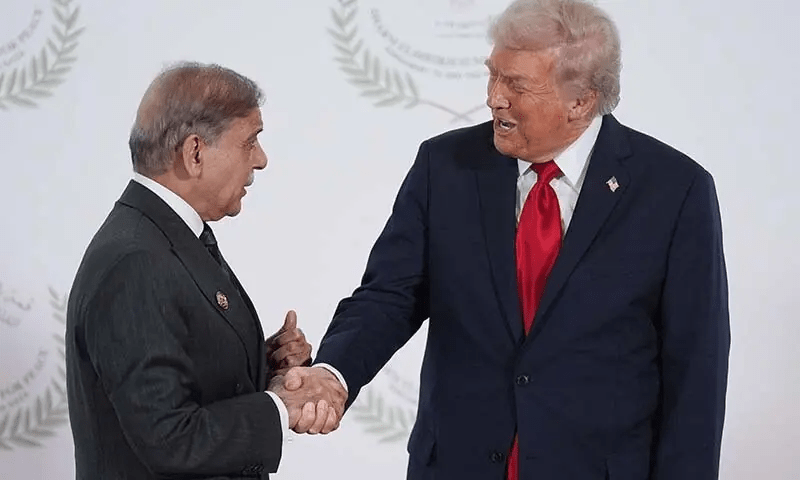
For Pakistan, publicly recognizing Trump’s role was neither impulsive nor symbolic; it was strategic signalling. It projected Islamabad’s maturity — a state that can applaud diplomacy without bending its red lines. In the age of narrative-driven influence, such gestures rebuild diplomatic equity, reintroducing Pakistan as a credible regional stabilizer rather than a reactive observer. It’s a subtle yet potent message to the West: Pakistan is not seeking aid — it is offering relevance.
Strategic Distance from the Abraham Framework
It is crucial to clarify: Pakistan has no intention of joining the Abraham Accords.
Prime Minister Sharif’s post-summit tone — courteous yet cautious — reflects this. Pakistan’s endorsement of the ceasefire and insistence on Palestinian sovereignty came with deliberate abstention from serving as a guarantor in the so-called Trump Peace Framework.
The logic is clear and legal: the deal lacks a contingency framework.
No clause defines consequences if Israel violates terms — a pattern that history makes all too predictable. For Islamabad, joining without an enforcement mechanism would mean political liability without operational authority — a scenario where Pakistan bears the blame but holds no control.
This is where Pakistan’s strategic foresight becomes evident. The country has refused to be drawn into yet another Western-designed framework that collapses under asymmetric trust. This prudence reflects lessons learned from decades of broken accords, from Oslo to Camp David, where commitments crumbled but accountability never reached Tel Aviv.
Red Lines and the Tony Blair Problem
Pakistan’s discomfort with Tony Blair’s inclusion in the process is not cosmetic. Within Islamabad’s policymaking circles, Blair remains a polarizing figure — the architect of Iraq’s devastation, a man whose “peacebuilding” credentials rest on rubble. His deep institutional ties with Western security blocs and Gulf monarchies make him a symbol of structural bias.
By distancing itself from any initiative involving Blair, Pakistan is not opposing peace — it is opposing optical manipulation. A process mediated by those complicit in past destabilizations cannot credibly claim neutrality. This posture preserves Pakistan’s credibility across the Muslim world — a moral and strategic asset more valuable than any temporary Western applause.
A Shift in Pakistan’s Diplomatic Doctrine
In essence, Shehbaz Sharif’s words mark a doctrinal evolution. Pakistan is moving from being a participant to a power broker — no longer bound by frameworks written elsewhere, but shaping outcomes through moral authority and regional balance. Islamabad’s voice now carries dual resonance: as a responsible Muslim power, and as a state that understands the language of deterrence, economics, and diplomacy in equal measure.
This isn’t isolationism — it’s strategic autonomy.
By avoiding entanglement, Pakistan retains leverage with both camps — the West and the Muslim bloc — enabling it to act as a neutral stabilizer in an increasingly polarized order.
Leveraging Opportunity: The Trump Factor
Pakistan’s decision to nominate Trump for the Nobel Peace Prize wasn’t whimsical — it was tactical. Islamabad recognizes that moments of geopolitical flux create openings for influence. Washington’s long experiment with India as its regional counterweight to China is showing structural fatigue. New Delhi’s rigid economic model, erratic politics, and self-serving diplomacy have weakened its reliability.
In contrast, Pakistan’s recent performance — in defense readiness, diplomatic restraint, and industrial modernization — has caught Washington’s attention. Under Trump’s transactional worldview, Pakistan isn’t seen as a risk but a business partner: a nation with the capacity to bridge Beijing and the Muslim world, to supply stability and resources — metals, energy, and influence.
If navigated with patience and discipline, this convergence could mature into a long-term strategic understanding. The real variable lies east of the border. A stable Modi government ironically serves Pakistan’s predictability; chaos in Delhi, however, could reset the calculus overnight.
Conclusion: Realism Over Romance
Pakistan’s stance on the Trump Plan exemplifies strategic realism — supporting peace without surrendering sovereignty, engaging major powers without entering their orbit.
In refusing to rubber-stamp an accord without accountability clauses, Islamabad has reaffirmed two things: that its foreign policy is driven by principle, not pressure, and that its diplomacy has evolved from reactive defense to proactive design.
For the first time in years, Pakistan isn’t being invited to the table — it’s choosing whether to sit.
Strategic Foresight Analysis by Zohaib Ahmed
President Trump’s overt praise for Prime Minister Shehbaz Sharif and Field Marshal General Syed Asim Munir at the Gaza Peace Summit was not a spontaneous gesture — it was a calibrated display of diplomatic theater designed to send multiple signals at once. In strategic foresight terms, it marked a subtle yet significant recalibration of U.S. regional optics: acknowledging Pakistan’s influence without formally binding it to the Trump Plan. By publicly calling Munir his “favorite field marshal” and extending gratitude to Sharif, Trump repositioned Islamabad as an indispensable stabilizer in a fragile geopolitical chessboard. The move hinted at Washington’s recognition that real regional leverage — especially in the post-Gaza reset — lies not in Israel’s hardline allies, but in balanced Muslim powers capable of mediating between camps. Trump’s remarks, delivered with a mix of humor and intent, reinforced a quiet reality: Pakistan no longer needs to demand a seat at the table; its strategic gravity ensures that every table bends subtly toward its presence. In foresight perspective, this moment could mark the early contours of a new diplomatic equilibrium — one where Pakistan’s moral capital and regional influence converge to redefine its global posture without formal alignment.