
By Zohaib Ahmed | 5th November 2025
The Earthquake Nobody Saw Coming
For decades, America’s most powerful city, New York, has been the political mirror of the nation. From Giuliani’s law-and-order era to Bloomberg’s technocratic capitalism and de Blasio’s progressive experiments, every mayor of New York reflected the temper of their times.
Then came Zohran Mamdani, a 34-year-old democratic socialist, a child of immigrants, a Muslim, a Queens-bred idealist who just became the Mayor of New York City.
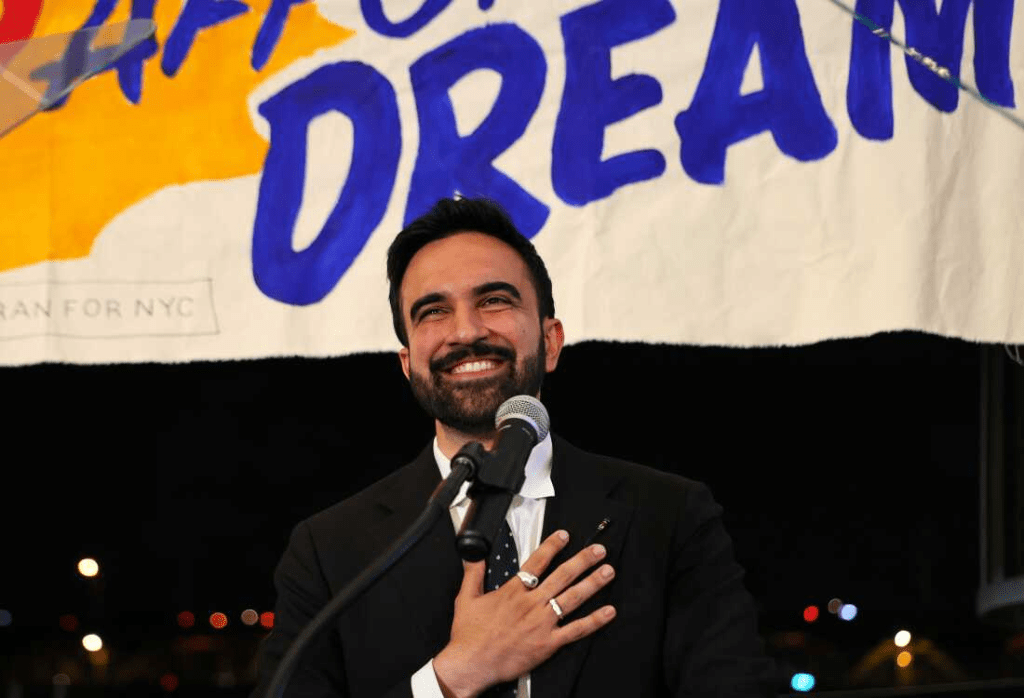
It’s hard to overstate how unprecedented this moment is.
A brown, Muslim democratic socialist has seized control of the financial capital of the world, defeating not only a Republican narrative but also his own party’s establishment.
This isn’t just a local win. This is an ideological rupture, the moment when America’s post-Cold War consensus finally cracked.
Why Mamdani’s Win Is a Big Deal
At first glance, Mamdani’s platform sounds like a radical wish list:
- Free buses and free childcare
- City-run grocery stores
- Rent freezes
- Wealth taxes on millionaires
But what happened on Election Day proved something that polling rarely captures, people are done with survival politics.
In a city where the average rent crossed $4,000 and child-care costs rival college tuition, Mamdani’s promises weren’t utopian; they were common sense. His campaign turned moral urgency into policy clarity, and that hit home.
For the Democratic Socialists of America (DSA), this was their Bernie Sanders 2.0 moment, the first time a DSA candidate won not just a congressional seat, but the biggest mayoralty in the United States.
Mamdani built a movement from the ground up, mobilizing an army of tens of thousands of volunteers and new, young voters. He didn’t rely on PACs or corporate donors, proving that a campaign can defeat immense wealth and decades of political machinery through authentic, tireless, door-knocking, and a masterful command of new media, particularly TikTok. This campaign offers a replicable “playbook” for progressive challengers nationwide.
The Rise of a New, Global Left: As an immigrant-led politician with deep ties to global struggles for justice, Mamdani’s victory confirms that a new, insurgent Democratic Left, represented by figures like Alexandria Ocasio-Cortez and Ilhan Omar, is now a dominant force. His win signals a politics grounded in lived experience and a sharp critique of inequality, one that builds solidarity between Black Americans, new African arrivals, and second-generation migrants. It is a powerful rebuke to the xenophobia of the Trump era.
The Bipartisan Panic
The scale of the backlash explains the magnitude of the victory.
Republicans, led by Donald Trump, went into full-blown meltdown mode. Trump labeled Mamdani a “communist,” threatened to send in the National Guard, and even floated deportation rhetoric. House Majority Leader Steve Scalise claimed Mamdani was “running the Democratic Party.”
It was the old script, Muslim equals threat, socialist equals chaos, dusted off for a new generation.
But here’s what stunned observers: Democrats joined the chorus.
From Cuomo to Suozzi, from Gillibrand’s silence to Schumer’s absence, the establishment’s discomfort was palpable. They feared Mamdani not because he would lose, but because he might win. And he did.
They worried his victory would redefine what “Democrat” means in America, a fear not of extremism, but of relevance.
The Attacks Went Personal, and Revealed the Real Divide
Mamdani wasn’t just called radical. He was othered.
The dog whistles were obvious: questioning his faith, his citizenship, even his right to belong in American politics. When Trump and conservative pundits talked about deporting him or labeling him “illegal,” it wasn’t about policy, it was about identity.
Yet, the ugliest attacks came from within his own party. Cuomo openly claimed a Mamdani win would “invite Trump to take over New York.” Moderate Democrats like Suozzi used phrases like “democratic capitalist” to distance themselves, implying Mamdani’s socialism was un-American.
The most vicious line of attack was the cynical attempt to characterize Mamdani’s progressive politics, and especially his vocal support for Palestinian human rights and opposition to Zionist apartheid, as antisemitism. This smear campaign was orchestrated by opponents who hoped to paint him as a radical extremist unfit for office.
However, this tactic utterly failed. Voters, especially young people, saw through the transparent political opportunism. As one progressive commentator noted, it was a profound realization that “opposing genocide and acknowledging the humanity of Palestinians is not necessarily an electoral dealbreaker.” Instead of crippling his campaign, the attacks inadvertently underscored his authenticity as a candidate willing to challenge entrenched power structures and speak unpopular truths, even in the media capital of the country.
This wasn’t ideological disagreement, it was institutional self-defense.
For the old guard, Mamdani represents something far scarier than the GOP: an end to politics as a career, and the rebirth of politics as a cause.
A Mirror to Trumpism, Without the Cynicism
There’s a fascinating symmetry here.
Mamdani ran as an outsider against a decaying establishment, rallying disillusioned voters who felt unseen by elites, the same populist energy Trump once weaponized.
But where Trump sold grievance, Mamdani offered governance.
Where Trump thrived on division, Mamdani built coalition.
His campaign was digital, diverse, and data-driven, a blend of grassroots mobilization and TikTok-age storytelling that spoke to renters, not realtors.
This wasn’t a rejection of capitalism; it was a referendum on rigged capitalism.
The geopolitical symbolism here is immense: a Muslim-American socialist leading New York City sends a message to the world that America’s democracy still has the elasticity to reinvent itself, peacefully, electorally, and inclusively.
The Washington Fallout: Democrats in Denial
In Washington, reactions were split down predictable lines.
Moderates called it “symbolic but isolated.”
Progressives hailed it as a blueprint.
The GOP turned it into an ad campaign.
CBS polling showed that while only 22% of Democrats nationwide favor socialism outright, 60% want a mix of socialist and capitalist ideas. That middle ground, economic justice without state control, is precisely the space Mamdani occupies.
If the party’s strategists are smart, they’ll realize this win isn’t a threat, it’s a test. A test of whether Democrats can reconnect with working-class voters without selling their souls to Wall Street or their slogans to the far left.
The Trump Effect
Donald Trump may have unintentionally done more to help Mamdani than harm him.
By threatening to withhold federal funds and framing the election as “communism vs. capitalism,” he turned a local contest into a moral showdown.
In a city that long ago rejected Trump’s brand of fear politics, that was the ultimate political gift. Every attack from Trump amplified Mamdani’s authenticity, the kid from Queens standing up to the billionaire from Queens.
When Mamdani ended his victory speech with: “Donald Trump, I know you’re watching, turn the volume up,” it wasn’t just defiance.
It was declaration: New York is no longer yours.
The Global Reverberation, and Pakistan’s Takeaway
Beyond America, Mamdani’s rise is being watched with fascination, especially in Pakistan.
Here, his ascent holds symbolic weight. It challenges the stereotype that Muslims in Western politics must assimilate, not assert. Mamdani didn’t run despite his identity; he ran through it, proudly.
For a generation of young Pakistanis disillusioned by dynastic politics and elite capture, his story resonates: a reminder that policy competence and moral clarity can still defeat wealth and power.
It also subtly recasts the narrative between the Muslim world and the West, proving that democratic socialism, anchored in ethics and equity, is not anti-Islamic but deeply aligned with principles of justice and communal welfare found in Islamic political thought.
If anything, Mamdani’s New York might become the world’s most unlikely case study in how cities, not states, now lead the next moral revolutions.
Strategic Foresight Analysis:
The primary was just the first step. With the former Mayor Eric Adams running as an Independent in the General Election, the city is now set for a definitive, ideological showdown in November: Insurgent Progressive vs. Traditional Moderate vs. Right-leaning Independent. The outcome will not only determine the future of America’s largest city but also provide critical lessons for the entire Democratic party’s national strategy.
Will He Live Up to His Promises?
Will the Promises Become Policy? A Strategic Foresight Analysis
As an analyst looking at the political and fiscal realities, I recognize the sheer ambition and moral clarity of the Mayor-elect’s agenda. He has promised to deliver a “moral city” focused on justice and affordability: freezing rent, universal childcare, fare-free buses, and taxing the wealthy. The central question is not one of desire, but of viability within a complex, constrained governance structure.
The Debate: Will He Live Up to His Promises?
The victory itself proves a mandate for change. The Mayor-elect’s proposals are not radical abstractions but practical, time-tested solutions, a form of “sewer socialism” focused on tangible improvements to working people’s lives. Look at his core policy: Taxing corporations and the 1% to generate $4 billion a year. This isn’t just a revenue stream; it’s a revolution in values that forces the ultra-wealthy to pay their fair share to fund essential services like free bus transit and 200,000 units of affordable housing.
His success hinges on political will, not budgetary arithmetic. The “obstacles” cited by the establishment, the Governor, the State Legislature, are exactly the entrenched powers he was elected to fight. If he runs into roadblocks, we won’t hold him accountable; we will blame the uncooperative forces in Albany and Washington trying to protect the status quo. His authenticity is his armor. He has given the Democratic Party a crystal-clear focus on affordability that resonates with voters of all backgrounds. He can, and must, deliver.
My concern is rooted in fundamental economics and the nature of government. The Mayor-elect’s democratic socialism manifests as incremental interference in the private market, taxes, mandates, and regulations, which historically leads to inefficiencies and crises, not prosperity.
Take the Rent Freeze and the pledge to build 200,000 units of city-managed housing. Rent control suppresses incentives for new construction and necessary maintenance, deepening the housing shortage it is meant to solve. The cost of a 10-year, $100 billion city-led housing program, bound by union mandates, will be enormous and likely mismanaged by bureaucracy. Furthermore, his core funding mechanism, the tax on high earners and corporations, cannot be enacted unilaterally. The State Legislature and the Governor must approve city income tax changes, and the Governor has publicly opposed new income taxes. Pushing for tax hikes risks driving businesses and wealthy residents to relocate, leading to a diminished tax base and further budget gaps. The economic laws of supply and demand are not suspended by populist mandate.
The Mayor-elect’s ability to govern will be critically impacted by forces outside of City Hall.
First, the federal dimension is a major factor. The sitting U.S. President has already threatened to withhold federal funds from the city if the Mayor-elect wins. New York City relies on billions in federal aid. A sustained political war with the White House, combined with the Mayor-elect’s own history of vocal activism on contentious international issues, will create a constant headwind, diverting critical resources and executive focus from core city management.
Second, the governing bureaucracy itself is a threat. New York City’s $115 billion budget and 300,000 employees are notoriously difficult to manage. Translating an ideological platform into practical policy requires an immense level of competency in managing complex agencies (like the NYPD or the MTA, which is State-controlled) and navigating countless legal and political obstacles. The Mayor-elect’s lack of executive experience is a genuine liability that will be aggressively exploited by opponents in the City Council, the business community, and the State Capitol.
The reality is he can deliver on some, but not all. The Mayor-elect must be pragmatic and pick his battles. The most feasible policies are the “low-hanging fruit” and those that can be framed as budget efficiencies or administrative changes:
- Fare-Free Buses: While costly (the MTA is State-controlled), focusing on the city-managed bus system offers a highly visible, tangible win for working-class voters and can be a powerful symbol of his transportation agenda.
- City-Owned Grocery Stores: This is largely a symbolic, non-market-altering proposal that addresses food deserts. It’s achievable but will not solve the underlying affordability crisis.
His highest-stakes promises (Rent Freeze, New Wealth Taxes) will be the toughest to implement because they require the cooperation of a hostile or at least reticent State Legislature in Albany. Every delay will be framed as a failure by the opposition, eroding the patience of the very voters who elected him. If he successfully implements one major, funded initiative, he will be judged a success; if he over-reaches and gets stalemated on everything, the progressive surge will stall. His long-term political star power depends on his ability to make New York a successful “proving ground” for democratic socialism.
Conclusion: The New York Rebellion
The Mayor-elect’s greatest challenge is the “Unilateral Power Gap.” As Mayor, he commands immense administrative power but is fiscally dependent on the State for his most transformative, expensive proposals. His success will be measured by his ability to leverage his grassroots popularity not for grand speeches, but for forcing movement in the State Capitol and managing the delicate balance between his bold, anti-establishment rhetoric and the necessary pragmatism of governance.
In the end, Zohran Mamdani’s victory is not the triumph of socialism over capitalism.
It’s the triumph of belief over resignation.
He didn’t just win an election. He reminded America that politics is supposed to mean something, that mayors should fight for people, not just manage budgets.
And in a democracy choking on cynicism, that’s revolutionary enough.