
By Zohaib Ahmed | 5th March 2026
The Iran–Israel war was never supposed to look like this.
In the initial planning stages inside Washington and Tel Aviv, the conflict was expected to be short, controlled, and decisive. The timeline discussed privately in policy circles suggested a campaign lasting roughly four weeks. In the earliest war planning assumptions, some strategists even believed the core objectives could be achieved in five days through a coordinated air and missile campaign.
Yet the conflict has already stretched beyond those expectations. The war predictions that were meant to last weeks is now approaching two months, and discussions about a possible one hundred day conflict are becoming increasingly common. That shift alone reveals the central strategic story of this war.
The United States and Israel did not miscalculate Iran’s military capabilities alone. They miscalculated the structure of the Iranian state, the resilience of its war system, and the broader geopolitical consequences of confronting a country that has spent decades preparing specifically for asymmetric confrontation with stronger adversaries.
In this conflict, the battlefield extends far beyond missiles and drones. It now includes global energy markets, domestic political tensions in Washington, regional proxy dynamics, and the architecture of global economic stability. What initially appeared as a military campaign against Iranian capabilities is rapidly evolving into a multidimensional contest where economic endurance and strategic patience may prove more decisive than firepower.
The Myth of the Short War
Modern Western military campaigns often begin with the assumption that overwhelming technological superiority will produce rapid political results. That assumption shaped the opening phase of the Iran war.
The United States and Israel entered the conflict with significant operational advantages. Their combined military capabilities include advanced intelligence networks, satellite surveillance, precision strike weapons, stealth aircraft, and integrated missile defense systems. From a purely tactical standpoint, this coalition possesses clear superiority over Iran.
However, tactical superiority does not guarantee strategic victory.
Initial coalition plans appear to have assumed that sustained bombing campaigns targeting Iranian missile launchers, naval vessels, and military infrastructure would quickly degrade Tehran’s ability to continue fighting. The expectation was that once enough military assets were destroyed, Iran would either return to negotiations or face internal political pressure that could destabilize the regime.
Reality has unfolded differently.
Despite weeks of strikes, Iranian military systems continue to function. The coalition claims to have destroyed more than 400 missile launchers, yet available visual evidence suggests far smaller numbers. Even if those numbers were accurate, the scale of Iran’s long-term military preparation complicates the equation.
Iran has been manufacturing missile launchers for three to four decades. A country with Iran’s industrial base, geographic depth, and sustained strategic focus could have produced thousands of such systems over that time. Eliminating them through air strikes alone would require a prolonged campaign far exceeding initial expectations.
The same pattern applies to Iranian naval capabilities.
Iran reportedly lost approximately five missile-capable vessels out of roughly 300 platforms capable of launching missiles. If the focus is limited to larger armed ships, the losses still represent only five out of approximately forty. These losses are operationally significant but far from decisive.
Even Iranian aviation remains active. Iranian aircraft recently carried out a bombing strike on a U.S. base. Although the attacking aircraft were shot down by Qatari fighters, the episode demonstrated that Iranian air power remains operational despite sustained coalition pressure.
These realities illustrate a critical lesson of modern warfare. Destruction of hardware does not automatically translate into collapse of capability.
The Architecture of Iranian Asymmetric Warfare
Iran’s military doctrine has evolved under the assumption that it will face technologically superior adversaries. For decades, Tehran has structured its defense strategy around absorbing initial blows and sustaining long-term resistance.
The result is a layered asymmetric system designed to survive prolonged conflict.
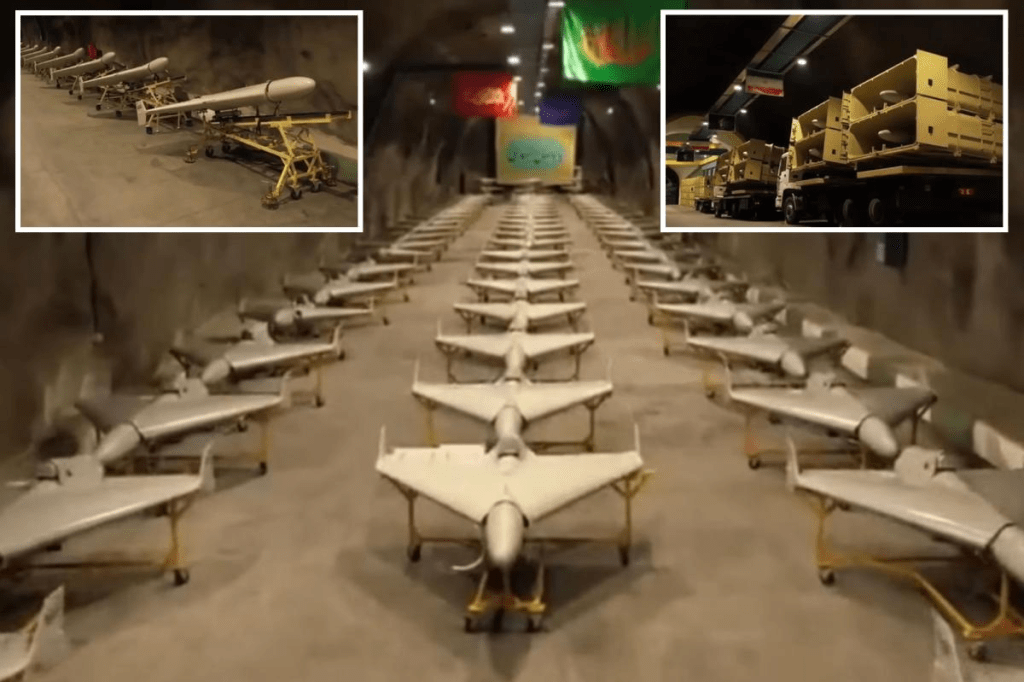
One of the most important elements of this system is Iran’s underground military infrastructure. Iranian authorities recently revealed footage of a large underground drone facility connected through tunnels that allow vehicles to transport and launch drones directly from hardened bunkers.
Western intelligence estimates suggest that at least sixty five such facilities exist. However, confirmed sites rarely represent the full extent of hidden infrastructure. If sixty five installations have been identified, the actual number may be significantly higher.
The scale of these facilities is substantial. Many of them contain kilometers of underground tunnels housing thousands of drones and hundreds of launch vehicles capable of deploying eight to forty drones in a single salvo. These bases are separate from Iran’s missile silos and form part of a wider dispersed network of launch infrastructure.
When the broader military architecture is considered, analysts estimate that Iran may possess between one hundred fifty and three hundred underground bases of varying sizes and operational roles.
This dispersed system makes rapid destruction nearly impossible.
Unlike traditional military forces concentrated in large bases or airfields, Iran’s distributed infrastructure forces an attacker to locate and destroy hundreds of hidden facilities across a vast territory. Each surviving node allows the system to continue operating.
Asymmetric warfare thrives under these conditions. When such systems also enjoy internal political support, they can absorb prolonged bombardment and continue adapting their responses.
The Energy Front: Iran’s Strategic Counterattack
The most significant development in the war has occurred not on the battlefield but within the global energy system.
Iran has moved beyond direct military retaliation and begun targeting energy infrastructure connected to the coalition supporting the war. One of the most notable strikes involved the Baku-Tbilisi-Ceyhan pipeline, which carries Azerbaijani crude across the Caucasus to Turkey’s Mediterranean coast. Approximately thirty percent of Israel’s oil supply flows through this pipeline.
By striking this infrastructure, Iran demonstrated an ability to expand the battlefield far beyond the Persian Gulf.
Tehran’s energy strategy appears deliberate and incremental. Rather than immediately targeting every vulnerable facility, Iranian planners appear to be escalating pressure step by step. The pattern begins with the closure of the Strait of Hormuz and gradually expands outward to pipelines, production facilities, and processing hubs throughout the region.
This approach resembles a calculated siege.
Energy infrastructure represents the economic lifeline of the global industrial system. Disruptions in these networks ripple through financial markets, supply chains, and national economies. Iran’s leadership understands that sustained pressure on these systems could generate economic consequences that eventually outweigh the coalition’s willingness to continue the war.
Energy analysts have already warned that sustained attacks on pipelines and production fields could push global oil prices into the ninety to one hundred dollar range. Some experts believe even that estimate may prove conservative if multiple major facilities are damaged.
Several potential targets remain untouched but strategically significant. These include the Saudi East-West pipeline that bypasses the Strait of Hormuz, Iraqi offshore loading platforms that handle millions of barrels per day, and Saudi Arabia’s Abqaiq processing hub, which processes the majority of the kingdom’s crude exports.
If these facilities were struck sequentially, the resulting supply disruption could exceed the capacity of global strategic petroleum reserves.
Iran’s strategic advantage in this economic battlefield stems from its experience under sanctions. For forty years the Iranian economy has operated under intense financial pressure. Tehran has already absorbed many of the economic shocks that Western economies are now beginning to confront.
The countries facing refinery fires, pipeline disruptions, and liquefied natural gas shortages have not experienced comparable economic stress in recent decades. Iranian planners understand this asymmetry and appear to be leveraging it deliberately.
Washington’s Strategic Divide
The evolving nature of the war is also producing internal divisions within the United States government.
Tensions have reportedly emerged between Secretary of War Pete Hegseth and Secretary of State Marco Rubio regarding the next phase of the conflict. The central issue concerns whether the United States should deploy ground forces inside Iran.
Hegseth reportedly supports the possibility of troop deployment if necessary. Rubio remains deeply cautious about the political and strategic risks associated with a large-scale ground war.
This disagreement reflects broader uncertainty within Washington’s strategic community.
Official U.S. operations have so far focused primarily on air strikes and long-range missile attacks. However, reports indicate that the Central Intelligence Agency has begun training Kurdish fighters to operate inside Iranian territory. Additional discussions have reportedly considered sending special operations teams to target senior members of the Iranian Revolutionary Guard Corps and individuals connected to Iran’s nuclear program.
These proposals illustrate the growing complexity of the conflict. Direct invasion of Iran would represent one of the most difficult military undertakings in modern history. The country’s geography, population size, and defensive preparations make it fundamentally different from previous U.S. campaigns in Iraq or Afghanistan.
Domestic political considerations further complicate the situation. Some officials fear that deploying American troops could trigger significant domestic opposition, particularly if the war appears to serve Israeli strategic objectives rather than U.S. national interests.
The political dimension is already visible. Questions are emerging within segments of the American electorate about why the United States entered the war at all. Some supporters of the administration have begun asking whether the conflict reflects an “Israel First” policy rather than the previously emphasized “America First” approach.
Meanwhile the financial cost of the war continues to rise, reportedly reaching approximately one billion dollars per day.
The Strategic Blind Spot
A deeper problem underlies many of these developments. American policymakers may have fundamentally misunderstood the motivations driving the Iranian political system.
This misunderstanding has appeared repeatedly in U.S. policy toward Iran over the past several decades. Washington often assumes that sustained economic pressure or military threats will eventually produce internal political collapse.
Historical evidence suggests otherwise.
Iranian political dynamics are complex. Many citizens criticize their government and support reform. Yet opposition to the regime does not automatically translate into support for foreign military intervention or state collapse.
In fact, external threats often produce the opposite effect.
When a nation faces direct military attack, domestic divisions frequently narrow as populations rally around national sovereignty. Even individuals who oppose their government may support resistance against foreign intervention.
Iran’s ethnic minorities provide another example of this complexity. Some analysts have speculated that ethnic tensions might fragment the country under sustained pressure. However, most minority groups appear to oppose partition of the Iranian state despite their grievances.
The fear of national disintegration often outweighs dissatisfaction with the central government.
These dynamics complicate any strategy based on regime collapse. Achieving political transformation in another country typically requires sustained political engagement, internal legitimacy, and often a physical presence on the ground.
Air strikes alone rarely produce such outcomes.
The Role of Hezbollah
The regional dimension of the war has expanded further with the involvement of Hezbollah in Lebanon.
The organization’s decision to join the conflict must be understood within the context of recent developments in Lebanon. Between late 2024 and early 2026, Lebanon experienced a period that could be described as “ceasefire warfare.” A U.S.-backed arrangement allowed Israel to continue aerial strikes, targeted assassinations, and limited territorial occupation while maintaining the formal structure of a ceasefire.
More than fifteen thousand violations were recorded during this period, resulting in hundreds of casualties and widespread destruction. Reconstruction efforts were blocked, and Lebanese political institutions struggled to respond effectively.
From Hezbollah’s perspective, the arrangement undermined deterrence while weakening its position inside Lebanon.
When the Iran war began, Hezbollah initially limited its involvement. Iran did not require every member of the regional alliance network to enter the conflict immediately.
However, Hezbollah eventually launched several missile and drone strikes against Israeli targets. Interestingly, the initial wave consisted of only six launches.
This limited attack may have been intentional. By presenting a restrained response, Hezbollah could potentially lure Israeli ground forces into closer engagement zones where the organization possesses significant combat advantages.
If this interpretation is correct, the early strikes may represent only the opening phase of a longer escalation cycle. Over time the frequency and scale of Hezbollah attacks could increase in coordination with Iranian operations.
The Global Economic Battlefield
While military operations dominate headlines, the most consequential front of the war may ultimately be the global economy.
The conflict has already disrupted international transportation networks. Thousands of flights have been cancelled across the region, tourism has collapsed, and embassies in several Gulf states have temporarily closed.
The closure of the Strait of Hormuz has further intensified global market anxiety. This narrow waterway handles a significant portion of the world’s oil exports. Even temporary disruptions create immediate price volatility.
Financial markets react not only to current disruptions but also to expectations of future risk. The possibility that Iranian strikes could expand to additional energy infrastructure creates persistent uncertainty for global energy traders.
This uncertainty places political pressure on governments dependent on stable energy supplies.
Ironically, the coalition that entered the war with overwhelming military superiority may face a strategic vulnerability in the economic domain. Markets respond quickly to uncertainty, and prolonged instability can generate cascading financial consequences.
In this sense the war is not simply a military confrontation between states. It is also a contest between two different forms of strategic endurance.
The United States and Israel possess unmatched military capabilities. Iran possesses the ability to impose economic pain across an interconnected global system.
Escalation Without Resolution
The strategic dilemma facing Washington and Tel Aviv is increasingly clear.
Israel seeks decisive degradation of the Iranian regime’s military and political structures. The United States appears more cautious, seeking to weaken the Revolutionary Guard while avoiding a full-scale invasion similar to the Iraq war.
This difference reflects competing strategic objectives.
Israel views Iran as an existential threat requiring decisive action. The United States must balance its regional commitments with domestic political constraints, economic stability, and global strategic priorities.
The result is a campaign designed to weaken Iran without collapsing the state entirely.
However, escalation without regime collapse may represent the most difficult form of statecraft.
In Iran’s political system, ideological institutions and state structures are deeply intertwined. Weakening the Revolutionary Guard without destabilizing the broader system may prove extremely difficult. At the same time, complete collapse could trigger regional instability far beyond Iran’s borders.
These uncertainties increase the risk of strategic miscalculation.
Wars that begin with limited objectives often expand as each side adapts to unexpected developments. The longer a conflict continues, the more difficult it becomes for leaders to control its trajectory.
Strategic Foresight
The trajectory of the Iran–Israel war suggests that the conflict may evolve into a prolonged struggle shaped as much by economic pressure as by military operations.
Iran’s strategy appears to focus on economic attrition. By targeting energy infrastructure and gradually expanding disruptions across regional supply networks, Tehran is attempting to raise the cost of war for its adversaries. The objective is not necessarily immediate military victory but the creation of conditions in which continued conflict becomes economically unsustainable for the coalition.
This approach reflects long-term planning. Iran appears to be preparing for a prolonged confrontation rather than a short campaign.
If this trajectory continues, the next stage of escalation could involve attacks on Iran’s domestic infrastructure. The United States and Israel may attempt to target Iranian electricity grids, gas production facilities, and other critical systems in order to weaken Tehran’s capacity to sustain the war economy.
Such attacks would represent a significant escalation in the economic dimension of the conflict.
Regional powers must prepare for the consequences.
Pakistan and Türkiye in particular occupy strategically important positions in the emerging geopolitical landscape. Both countries maintain complex relationships with Iran, the United States, and regional energy networks. Instability across these systems could directly affect their security and economic interests.
The early stages of escalation may involve non-kinetic actions. Cyber operations, political interference, and covert sabotage could target strategic infrastructure or political processes in both countries. Turkey’s electoral cycles could become a focus of influence operations, while Pakistan’s strategic position in regional energy and trade networks may attract covert pressure.
Over time, however, the confrontation may extend beyond covert actions.
If the war continues to expand geographically and economically, the probability of direct kinetic incidents involving additional regional actors will increase.