
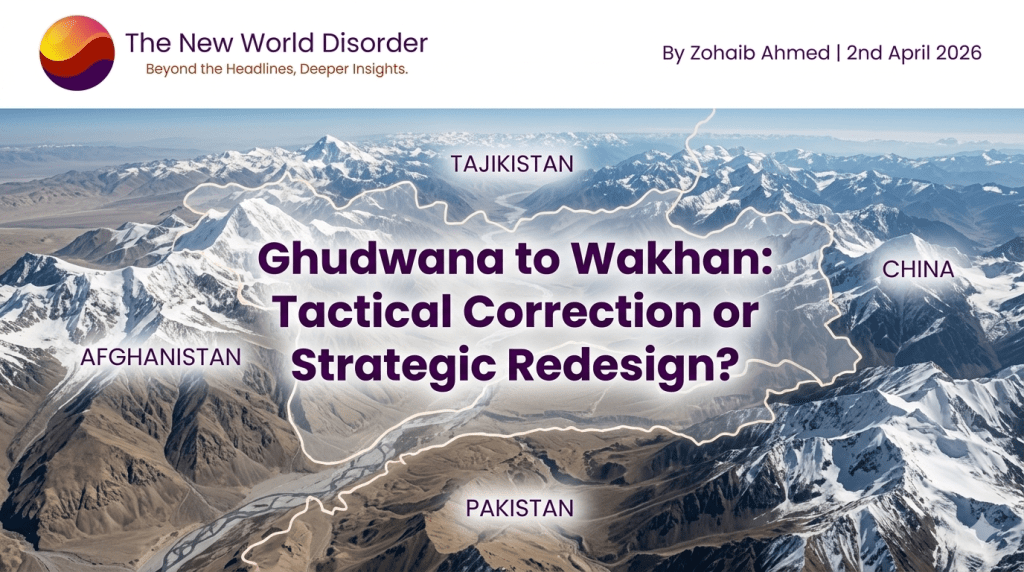
By Zohaib Ahmed | 2nd April 2026
Background: From Ghudwana to Wakhan, How a Tactical Gain Sparked a Strategic Question
The capture of the Ghudwana Enclave during Operation Ghazab lil-Haq did more than eliminate a 32-square-kilometer security vulnerability in the Zhob sector, it fundamentally reframed how Pakistan’s strategic community thinks about borders. What began as a localized “tactical correction,” aimed at sealing a porous indentation exploited by militant networks, quickly evolved into a broader cartographic conversation: if micro-adjustments can stabilize the frontier, can macro-realignments redefine Pakistan’s geopolitical destiny? From a strategic and geographic lens, Ghudwana and the Wakhan Corridor exist in entirely different dimensions of statecraft. Ghudwana was about fixing a leak; Wakhan is about redesigning the entire plumbing system of Eurasia. The former addressed an immediate counterterrorism requirement within an already contested frontier, while the latter introduces the possibility of a civilizational shift, physically linking Pakistan to Central Asia while severing Afghanistan’s narrow access to China. This leap in thinking, triggered by operational success, has pushed policymakers to consider whether incremental border optimization can scale into grand strategy, or whether such ambition risks crossing from stabilization into destabilization.
Comparative Strategic Framework: Ghudwana vs. Wakhan
| Dimension | Ghudwana Enclave (2026) | Wakhan Corridor (Hypothetical) |
|---|---|---|
| Scale | Small, localized (32 sq. km) | Massive, linear (~350 km corridor) |
| Strategic Intent | Tactical correction; sealing infiltration routes | Civilizational realignment; Eurasian connectivity |
| Primary Objective | Counterterrorism, border stabilization | Trade access, regional gatekeeping, geoeconomic expansion |
| Diplomatic Impact | High but containable (bilateral friction) | Extreme; potential multilateral crisis involving major powers |
| Terrain Complexity | Rugged but operationally manageable | Ultra-high altitude (12,000–17,000 ft), extreme climate |
| Legal Positioning | Framed as defensive necessity | Challenges internationally recognized Afghan sovereignty |
| Sustainability | Extension of existing border infrastructure | Requires creation of a “Pamir logistics spine” |
| China Factor | Indirect stakeholder | Direct strategic overlap with Xinjiang frontier |
| Outcome | Enhanced tactical security | Potential transformation into a Eurasian pivot state |
Why the Distinction Matters:
Ghudwana fits within the logic of modern border management, tightening, digitizing, and securing. Wakhan, by contrast, challenges the very architecture created during the Great Game. One is evolutionary; the other is revolutionary. Conflating the two risks strategic overreach.
I. A Strip of Land That Refuses to Stay Irrelevant
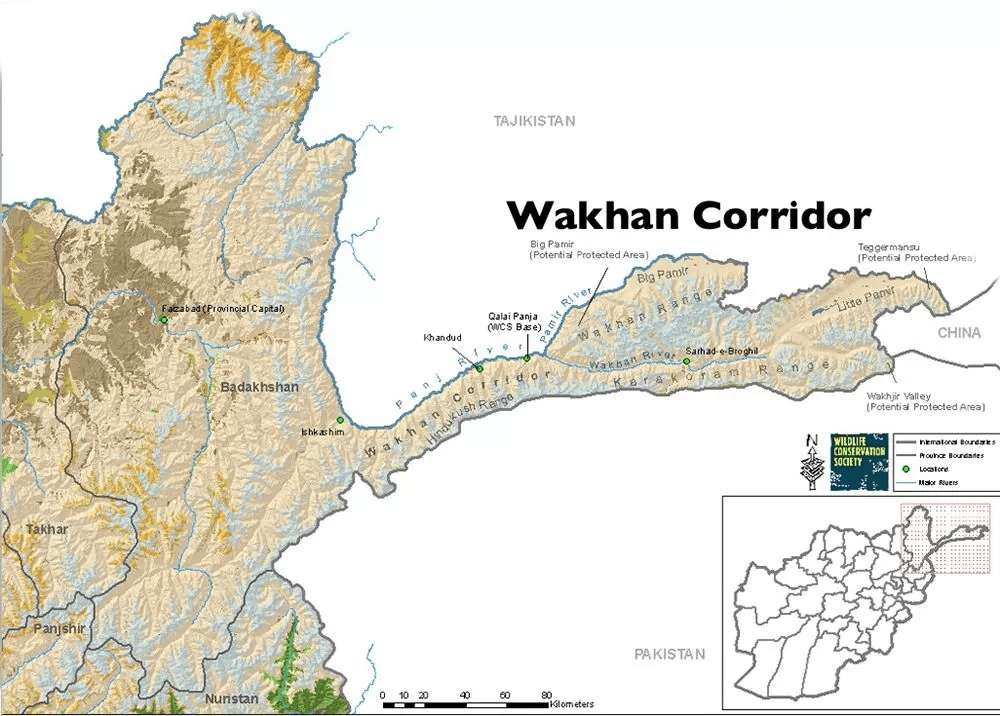
On most maps, the Wakhan Corridor appears as an afterthought, a thin, tapering finger of land stretching eastward from Afghanistan into the high Pamirs, barely clinging to geopolitical relevance. Yet in the evolving geometry of Eurasian power, this 350-kilometer strip has re-emerged as one of the most quietly consequential spaces on Earth.
The Wakhan Corridor is not merely terrain. It is a historical artifact, a buffer engineered in the late 19th century during the Great Game between the British and Russian Empires. Its purpose was simple: keep empires apart. Its unintended consequence, more than a century later, is to keep opportunity apart.
For Pakistan, the corridor represents something far more profound than a geographic curiosity. It is the last missing link in a grand strategic aspiration: direct overland access to Central Asia. In a world increasingly defined by corridors, economic, digital, and military, the Wakhan is less a relic and more a bottleneck.
The question, now resurfacing in policy circles and strategic commentary, is no longer whether Wakhan matters. It is whether Pakistan should seek to control it, permanently.
II. Geography as Destiny, and Constraint
The Wakhan Corridor sits within Afghanistan’s Badakhshan province, wedged between Pakistan to the south and Tajikistan to the north, stretching eastward to China’s Xinjiang region. At points, it narrows to less than 15 kilometers. Its elevation averages above 12,000 feet, with peaks exceeding 20,000 feet. Winter temperatures plunge to -50°C.
This is not terrain that yields easily to ambition.
Yet geography, as ever, is both a barrier and an invitation. The corridor separates Pakistan from Tajikistan by a matter of kilometers, an almost absurdly small distance in strategic terms, given the vast economic implications of closing that gap.
For Islamabad, the Wakhan represents what strategists call a “sovereign shortcut”: a direct land bridge to Central Asia’s estimated $1 trillion-plus economic space. In theory, such access would allow Pakistan to bypass Afghanistan’s unstable core and integrate more tightly into Eurasian trade networks, including China’s Belt and Road Initiative.
But geography imposes its own tax. Building infrastructure through the Wakhan would rival the most complex engineering feats of the modern era. A viable all-weather route, likely through the Broghil Pass or Irshad Pass, would require tunnels, avalanche mitigation systems, and continuous high-altitude maintenance.
In strategic terms, the corridor offers access. In operational terms, it demands endurance.
III. The Strategic Case for Control
Proponents of a more assertive Pakistani posture toward Wakhan frame the argument in three dimensions: connectivity, security, and geopolitical leverage.
1. Connectivity and Economic Integration
Pakistan’s long-standing ambition to connect with Central Asia has been repeatedly frustrated by instability in Afghanistan. Despite decades of planning, trade routes remain unreliable, and transit agreements fragile.
Control, or even long-term leasing, of Wakhan would fundamentally alter this equation. It would provide Pakistan with a direct corridor to Tajikistan and beyond, integrating its economy with Central Asia’s energy-rich republics.
Such a move could transform the China-Pakistan Economic Corridor (CPEC) from a bilateral project into a trans-regional network, a “CPEC-plus” architecture linking South Asia, Central Asia, and western China.
In this vision, Wakhan is not just a road. It is a hinge.
2. Security and Counterterrorism
From a defense perspective, the corridor is less a gateway than a filter. Its narrow valleys and high-altitude passes funnel movement into predictable channels, making it an ideal environment for surveillance and interdiction.
Pakistani strategists argue that controlling Wakhan would eliminate a key transit zone historically exploited by militant groups. By establishing high-altitude observation posts and integrating drone surveillance, Islamabad could extend its security perimeter deep into the Pamirs.
The concept here is not traditional occupation but what might be termed “integrated electronic sovereignty”, a combination of drones, sensors, and limited physical presence.
3. Geopolitical Positioning
Perhaps the most compelling argument lies in geopolitics. Control of Wakhan would place Pakistan at the crossroads of four critical regions: South Asia, Central Asia, China, and the broader Eurasian landmass.
In effect, it would elevate Pakistan from a regional actor to a pivot state, one capable of influencing trade flows, security dynamics, and infrastructure development across a vast arc of territory.
In an era where corridors define power, controlling one of the last unclaimed links carries undeniable appeal.
IV. The Case Against: Law, Cost, and Consequence
Yet for every strategic advantage, there exists a corresponding risk, often of equal magnitude.
1. Sovereignty and International Law
The most immediate obstacle is legal. The Wakhan Corridor is internationally recognized as Afghan territory. Any attempt by Pakistan to “take control,” whether through annexation or coercive leasing, would constitute a direct challenge to Afghanistan’s sovereignty.
Islamabad’s own official position underscores this constraint. The Foreign Office has repeatedly affirmed that Wakhan is part of Afghanistan and that Pakistan has no territorial designs on its neighbors.
Reversing this stance would carry significant diplomatic costs, potentially isolating Pakistan and undermining its credibility in international forums.
Moreover, such a move would create a dangerous precedent. Pakistan’s long-standing position on disputed territories elsewhere in the region relies heavily on principles of sovereignty and self-determination. Any perceived inconsistency could weaken its legal arguments.
2. Diplomatic Fallout and Regional Friction
Beyond legal considerations lies the question of regional stability. Afghanistan, already a fragile state, would almost certainly view any Pakistani move into Wakhan as an existential threat.
This could trigger a cascade of consequences: increased hostility from Kabul, disruption of cross-border cooperation, and potential alignment of Afghan factions with external powers opposed to Pakistan’s interests.
India, too, would likely interpret such a move as an escalation, potentially justifying its own strategic initiatives in the region. China, while a partner, would approach the situation cautiously, wary of instability near its sensitive Xinjiang border.
In short, the corridor could become less a bridge and more a flashpoint.
3. The Cost of Control
Even if legal and diplomatic hurdles could be managed, the physical cost of controlling Wakhan would be immense.
Maintaining a permanent presence in such an environment would require a logistical effort comparable to Pakistan’s deployment in the Siachen Glacier, one of the most expensive and demanding military commitments in the world.
Every supply line would be vulnerable to weather. Every troop rotation would carry risk. Infrastructure would require constant maintenance under extreme conditions.
The question is not whether Pakistan could hold Wakhan. It is whether it could do so sustainably.
V. The Taliban Factor and Strategic Friction
Any discussion of Wakhan must account for the current reality of Afghanistan under Taliban rule.
Relations between Islamabad and Kabul have been strained, particularly over the presence of militant groups such as Tehreek-e-Taliban Pakistan (TTP). Islamabad has long accused Afghan authorities of failing to curb cross-border militancy, while Kabul has rejected these claims.
In this context, Wakhan becomes more than a geographic question. It becomes a bargaining chip.
Some analysts suggest that Pakistan could leverage its influence in the region to pressure the Taliban into greater cooperation, whether on counterterrorism or trade access. Others argue that any attempt to exert control would only deepen mistrust and exacerbate instability.
The corridor, in this sense, reflects a broader dilemma: how to secure national interests without destabilizing a volatile neighbor.
VI. Engineering the Impossible: Broghil vs. Irshad
If Wakhan is to be operationalized, whether under Afghan sovereignty or otherwise, the choice of routes becomes critical.
The Broghil Pass, at approximately 12,460 feet, offers a relatively gentle gradient and a wider plateau, making it the most viable candidate for a commercial corridor. Its development could support heavy logistics and sustained trade flows.
The Irshad Pass, by contrast, is steeper and more rugged but strategically positioned near the China border. It lends itself to specialized use: surveillance, rapid deployment, and electronic monitoring.
A dual-corridor strategy, commercial through Broghil, security through Irshad, would allow for both economic and military objectives to be pursued simultaneously.
But again, feasibility is contingent on stability. Without a cooperative framework involving Afghanistan, such projects remain theoretical.
VII. A Smarter Alternative: Control Without Ownership
Given the risks of outright acquisition, a more nuanced approach is gaining traction among policy thinkers: control without ownership.
This would involve a combination of long-term leasing, joint development agreements, and multilateral security frameworks. Pakistan, China, and Central Asian states could collaborate to develop infrastructure and maintain security, while formally recognizing Afghan sovereignty.
Such an arrangement could be anchored in existing mechanisms like the Shanghai Cooperation Organization (SCO), providing a degree of international legitimacy.
In this model, Wakhan becomes a shared asset rather than a contested prize.
It also aligns with broader trends in global infrastructure, where influence is increasingly exercised through investment and connectivity rather than territorial control.
VIII. The Strategic Verdict
Should Pakistan seek to take permanent control of the Wakhan Corridor?
From a purely strategic standpoint, the answer is tempting. The corridor offers a rare opportunity to reshape Pakistan’s geographic and economic position, transforming it into a true Eurasian hub.
But strategy does not operate in a vacuum. It is constrained by law, diplomacy, and the hard realities of terrain.
Permanent control of Wakhan would likely trigger diplomatic isolation, strain regional relationships, and impose unsustainable costs. It would also undermine Pakistan’s own legal positions on other territorial issues.
The NRF Variable and the Limits of Power Projection
Any serious assessment of Pakistan’s options in the Wakhan Corridor must now incorporate a decisive non-state actor: the National Resistance Front led by Ahmad Massoud. As of 2026, the NRF has transitioned from a peripheral insurgent force into a central variable in northern Afghanistan’s security equation—particularly across Panjshir, Badakhshan, and Takhar, which geographically envelop the Wakhan Corridor.
From a strategic standpoint, the NRF represents both a constraint and an opportunity. On one hand, it acts as the “local gatekeeper.” Any unilateral Pakistani move into Wakhan without NRF alignment would likely trigger resistance from forces deeply embedded in the terrain, transforming the corridor into a high-altitude insurgent trap. On the other hand, the post-2026 recalibration of relations—driven by converging opposition to Taliban policies and militant sanctuaries—has opened the door to a managed partnership. The NRF’s tacit support for Pakistani operations has effectively created a “two-front pressure dynamic,” stretching Taliban control and exposing vulnerabilities in the northern periphery.
This evolving alignment introduces a more sophisticated strategic model: not territorial acquisition, but negotiated control. In this framework, Wakhan would not be annexed but operationalized through a “Joint Security Zone,” where the NRF provides ground intelligence and local legitimacy while Pakistan delivers technological dominance, drones, surveillance systems, and infrastructure. Such a hybrid arrangement transforms the corridor from a contested frontier into a managed trade-security artery.
In contrast, a cooperative, infrastructure-led approach offers many of the same benefits with far fewer risks. By investing in connectivity, leveraging partnerships, and embracing a model of shared sovereignty, Pakistan can achieve its strategic objectives without incurring the liabilities of occupation.
IX. Corridor or Mirage?
In the end, the Wakhan Corridor is less a prize to be seized than a problem to be solved.
Its value lies not in ownership but in access; not in control but in connectivity.
For Pakistan, the challenge is to convert geographic proximity into strategic advantage, without crossing the line that separates ambition from overreach.
The corridor, after all, was created to keep empires apart. In a different century, it may yet serve to bring regions together.
The question is whether those who seek to shape its future can resist the oldest temptation in geopolitics: to mistake a narrow passage for a wide-open opportunity.