
By Zohaib Ahmed | 18th May 2026
The evolution of modern warfare has shifted decisively toward high-tempo, networked mechanized combat where survivability, mobility, and precision firepower define battlefield dominance. In this environment, legacy armored personnel carriers (APCs), while effective in troop transport roles, are increasingly inadequate for frontline engagements against peer or near-peer adversaries.
For decades, the Pakistan Army’s mechanized infantry relied heavily on the M113 series APCs and locally developed variants such as the Talha and Saad platforms. These vehicles fulfilled mobility requirements but lacked integral firepower, forcing infantry to dismount early in contested zones and reducing battlefield cohesion with armored spearheads.
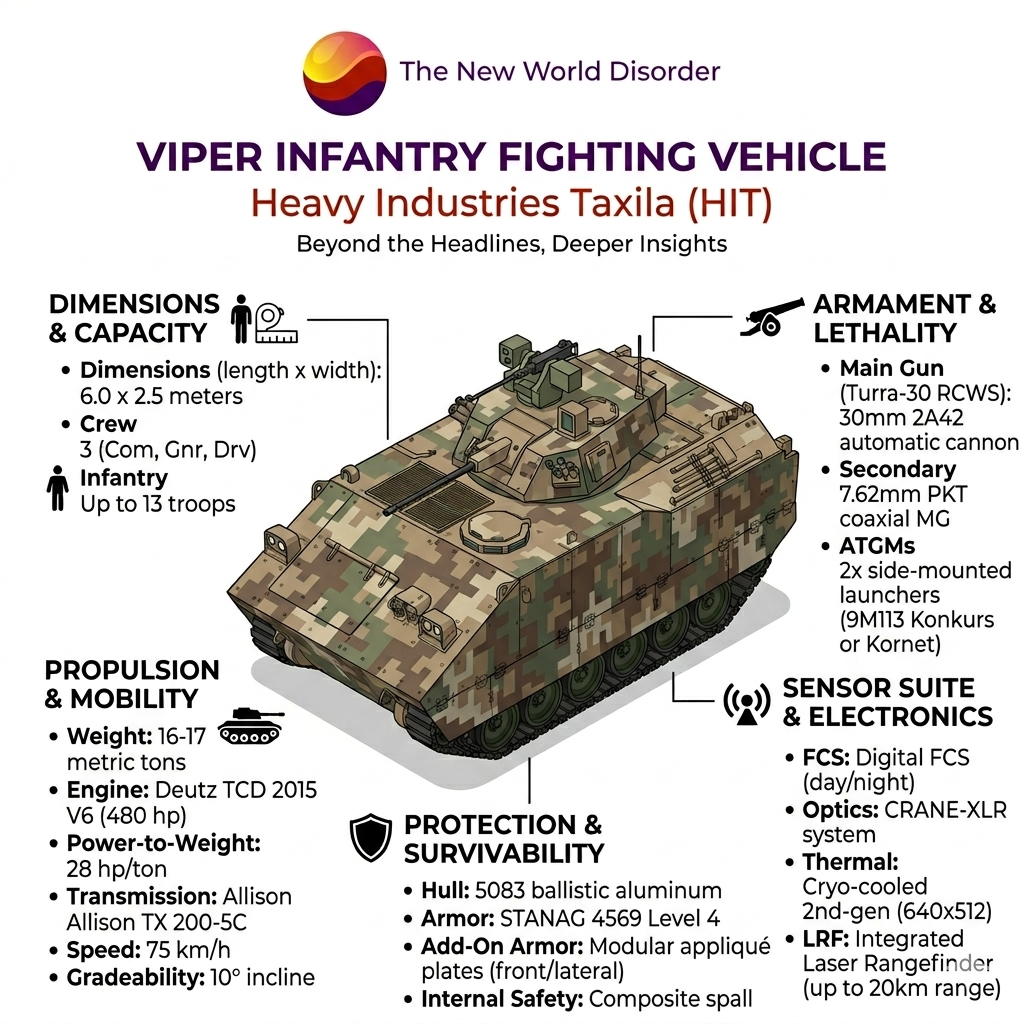
The development of the Viper Infantry Fighting Vehicle (IFV) by Heavy Industries Taxila (HIT) marks a doctrinal transition from protected mobility to integrated combat lethality, where infantry protection and firepower are fused into a single synchronized battlefield system.
1. Strategic Context: Why the Viper IFV Matters
Modern mechanized warfare requires infantry fighting vehicles to perform three critical functions simultaneously:
- Maintain pace with main battle tanks
- Suppress enemy anti-armor teams without dismounting infantry
- Survive first-contact engagements in contested zones
The Viper IFV is designed specifically to address these requirements across multiple operational environments, including:
- High-intensity conventional warfare along the eastern border
- Mountain and asymmetric warfare in the western frontier
- Network-centric joint operations under integrated C4ISR doctrine
Strategically, it represents Pakistan’s effort to close the long-standing gap between APC mobility platforms and true infantry fighting vehicles capable of frontline engagement.
2. Platform Overview and Design Philosophy
The Viper IFV is built around a three-man crew configuration and a fully integrated infantry compartment capable of transporting a mechanized infantry squad.
Its design philosophy prioritizes:
- Blast-resistant survivability architecture
- Roof-suspended seating for mine and IED shock mitigation
- Modular armor scalability for mission-specific threat environments
- Digitally networked battlefield integration
Unlike legacy APC configurations, the Viper is not designed solely for troop transport but for sustained combat participation alongside armored formations.
3. Technical Specifications
Core Platform Characteristics
| Parameter | Specification |
|---|---|
| Crew | 3 (Commander, Gunner, Driver) |
| Infantry Capacity | 9 to 10 troops (up to 13 in alternate configuration) |
| Combat Weight | Approximately 16 to 17 metric tons |
| Length | 6.0 m |
| Width | 2.5 m |
| Height | 2.6 m |
| Hull Material | 5083 Aircraft-grade Aluminum Alloy |
| Protection Level | STANAG 4569 Level 4 with appliqué armor |
| Battlefield Systems | C4ISR enabled Integrated Battlefield Management System |
The aluminum-based hull architecture reflects a deliberate balance between mobility and modular survivability upgrades through bolt-on armor systems.
4. Mobility and Powertrain Architecture
Mobility remains a decisive factor in IFV survivability and tactical relevance. The Viper IFV is powered by the Deutz TCD 2015 V06 turbocharged diesel engine, producing approximately 483 horsepower.
Mobility Performance Metrics
| Performance Metric | Value |
|---|---|
| Power Output | 483 hp |
| Power-to-Weight Ratio | 28.4 hp/ton |
| Maximum Road Speed | 75 km/h |
| Gradient Capability | 10° sustained climb |
| Transmission | Allison TX 200-5C Automatic |
The integration of a German-engineered powerplant with an automatic transmission system significantly enhances cross-country maneuverability and reduces crew workload during sustained operations.
The six-road-wheel extended chassis improves ground pressure distribution, vehicle stability, and firing accuracy during movement over uneven terrain.
5. Firepower System: Turra-30 Remote Controlled Weapon Station
Core Combat Module
The defining combat capability of the Viper IFV is its integration of the Turra-30 Remote Controlled Weapon Station (RCWS) developed by EVPÚ Defence (Slovakia).
This system eliminates crew exposure by removing the need for a manned turret basket, significantly improving survivability and internal space efficiency.
Turra-30 Combat Architecture
y = \text{Turra-30 Integrated Firepower System}
| Subsystem | Capability |
|---|---|
| Main Gun | 30mm Shipunov 2A42 autocannon |
| Fire Modes | Dual-feed (HEI and AP) |
| Rate of Fire | 200 to 500 rounds per minute |
| Anti-Tank Missiles | Kornet or Konkurs (2 ready-to-fire) |
| Effective Engagement Range | Up to 5,500 m |
| Coaxial Weapon | 7.62mm PKT machine gun |
| Optics Suite | CRANE-XLR thermal imaging and HD day sensor system |
| Engagement Mode | Hunter-killer target acquisition system |
Operational Advantages of Turra-30 Integration
The selection of the Turra-30 system reflects a focus on digital integration, survivability, and modular firepower expansion.
Key advantages include:
- Fully unmanned turret reduces crew exposure risk
- Increased internal troop volume due to absence of turret basket
- Lower probability of catastrophic crew loss from turret penetration
- Seamless integration with battlefield digital command systems
The system enables a hunter-killer workflow in which target acquisition and engagement are decoupled between commander and gunner, increasing reaction speed in high-intensity combat.
6. Protection and Survivability Engineering
The Viper IFV employs a layered survivability doctrine combining structural, passive, and active protection measures.
Key survivability features include:
- Aluminum alloy base hull optimized for weight and mobility
- Bolt-on steel appliqué armor for scalable ballistic protection
- Internal spall liners to reduce fragmentation injuries
- Automatic fire suppression systems
- External fuel tank placement to reduce internal fire risk
Protection Philosophy
The design philosophy prioritizes survivability through mobility, modular armor adaptation, and reduced crew exposure rather than relying solely on heavy passive armor.
7. Manufacturing and Industrial Integration at HIT
The Viper IFV program reflects Pakistan’s incremental evolution in armored vehicle manufacturing through hybrid integration of domestic platforms and imported subsystems.
Production Workflow
| Stage | Process |
|---|---|
| 1 | Hull fabrication and chassis stretching based on Saad/M113 lineage |
| 2 | Structural reinforcement using aluminum welding techniques |
| 3 | Installation of appliqué armor packages |
| 4 | Integration of Deutz engine and Allison transmission |
| 5 | Mounting of Turra-30 RCWS system |
| 6 | Integration of C4ISR and IBMS digital systems |
| 7 | Field testing and live-fire validation |
Industrial Significance
The program highlights several key industrial developments:
- Transition from legacy platform refurbishment to modular combat system integration
- Increasing reliance on hybrid procurement models combining domestic and foreign systems
- Development of scalable IFV production capability within existing armored vehicle infrastructure
In strategic terms, the Viper represents a transitional industrial step toward future indigenous IFV designs.
8. Battlefield Role and Operational Employment
The Viper IFV is designed as a force multiplier within mechanized formations, ensuring continuous combat support to armored spearheads.
Primary Roles
- Mechanized infantry support for main battle tanks
- Anti-armor suppression of enemy infantry and ATGM teams
- Urban warfare fire support platform
- Counter-insurgency mobility and protection system
- High-altitude maneuver warfare support platform
Eastern Theater Operations
In conventional warfare scenarios, the Viper provides:
- Suppression of enemy anti-tank positions
- Tree-line and trench clearing fire support
- Escort capability for armored spearheads
- Mid-range anti-armor engagement using integrated ATGMs
Western Theater Operations
In asymmetric or mountainous environments, the Viper provides:
- Ridge-line suppression capability
- Protected infantry mobility in high-risk zones
- Rapid deployment in constrained terrain
- Fire support against elevated defensive positions
9. Comparative Analysis: Peer IFV Systems
| Parameter | Viper IFV (Pakistan) | M2A3 Bradley (USA) | BMP-2 (Russia / India) |
|---|---|---|---|
| Vehicle Type | Infantry Fighting Vehicle | Heavy IFV | Light IFV |
| Main Gun | 30mm autocannon | 25mm chain gun | 30mm autocannon |
| Anti-Tank Capability | Kornet or Konkurs ATGMs | TOW missiles | Konkurs ATGM |
| Turret Design | Unmanned RCWS | Manned turret | Manned turret |
| Armor Protection | STANAG Level 4 modular | Heavy composite armor | Medium steel armor |
| Battlefield Role | Mechanized fire support and infantry assault | Heavy mechanized warfare | Mass infantry assault |
Key Insight
The Viper IFV is positioned within the true infantry fighting vehicle category, emphasizing modular firepower, digital integration, and cost-efficient battlefield scalability.
10. Strategic Assessment
From a defense analytical perspective, the Viper IFV reflects three major doctrinal shifts:
1. Transition in Mechanized Doctrine
From troop transport systems toward integrated combat platforms capable of sustained engagement.
2. Industrial Evolution
From legacy platform dependency toward hybrid systems integration combining domestic chassis development with imported subsystems.
3. Network-Centric Warfare Adoption
From isolated armored units toward digitally integrated battlefield nodes connected through C4ISR systems.
However, limitations remain:
- Dependence on imported propulsion and turret systems
- Incremental chassis evolution rather than entirely new design architecture
- Limited evidence of large-scale production maturity compared to established global IFV programs
FAQs
The high-volume informational queries driving search engine traffic around infantry fighting vehicles center on basic definitions, tactical role design, armor trade-offs, and cost-efficiency.
Below are the top 10 most searched SEO questions regarding IFVs, answered specifically through the engineering and structural lens of the HIT Viper IFV.
1. What is the difference between an APC and an IFV?
An Armored Personnel Carrier (APC) acts as a protected battlefield taxi designed to transport troops to a point safely, leaving them to fight on foot while the vehicle stays back. An Infantry Fighting Vehicle (IFV) is designed to fight directly alongside frontline tanks.
- The Viper Application: While built on Pakistan’s localized Saad APC heritage, the Viper transcends the APC classification by adding the Turra-30 unmanned combat module and heavy steel armor, allowing it to suppress enemy anti-tank teams and engage hostiles without dismounting its squad.
2. Why are modern Infantry Fighting Vehicles so expensive?
IFVs are highly priced due to the convergence of three heavy components: high-output power packs, specialized ballistic armor, and advanced optoelectronic fire-control systems.
- The Viper Application: The Viper balances this cost curve. By leveraging the existing domestic tooling and manufacturing lines of the Saad/M113 chassis at HIT, Pakistan significantly lowered baseline structural costs, spending its budget where it matters most: the Western Deutz-Allison power pack and the advanced digital Turra-30 targeting system.
3. Can an Infantry Fighting Vehicle destroy a Main Battle Tank (MBT)?
Yes, modern IFVs utilize Anti-Tank Guided Missiles (ATGMs) to defeat heavy armor at ranges exceeding traditional tank guns.
- The Viper Application: The Viper features dual missile rails on the Turra-30 turret capable of firing Kornet or Konkurs ATGMs. This allows it to target and defeat modern Main Battle Tanks at standoff distances of up to 4,000 to 5,500 meters, well before the Viper enters the enemy tank’s direct fire zone.
4. What is the optimal caliber for an IFV main gun?
The global defense standard has shifted from 20mm/25mm rounds to the 30mm caliber, which provides the necessary kinetic energy to penetrate older armor, crack concrete bunkers, and deliver effective high-explosive fragmentation (HE-FRAG) against dug-in infantry.
- The Viper Application: The choice of the Slovakian Turra-30 arms the Viper with a 30mm Shipunov 2A42 dual-feed autocannon. It can rapidly alternate between armor-piercing (AP) and high-explosive (HE) rounds depending on the target profile.
5. Are tracked IFVs better than wheeled 8×8 IFVs?
Tracked IFVs offer superior cross-country mobility, lower ground pressure in mud or sand, and can carry heavier armor configurations. Wheeled 8×8 platforms excel in operational range, road speed, and reduced maintenance overhead.
- The Viper Application: Pakistan opted for a tracked chassis for the Viper to match the off-road, rugged maneuverability profiles of its primary strike corps tanks (VT-4 and Al-Khalid) across irrigation canals, muddy plains, and rough terrain.
6. How many troops can a modern IFV carry?
Unlike large APCs that can carry up to 14 troops, true IFVs must reduce squad size to accommodate the turret basket, internal ammunition storage, and advanced electronic subsystems.
- The Viper Application: The Viper optimizes space by utilizing an unmanned turret. Because the Turra-30 is mounted entirely on the exterior roof ring, it does not occupy space inside the cabin, enabling the vehicle to carry a 3-man crew alongside 9 to 10 fully geared dismounts.
7. What is STANAG armor protection level on an IFV?
STANAG 4569 defines standardized protection levels for logistic and light armored vehicles. Level 1 protects against basic small arms, while Level 4 or 5 protects against heavy 14.5mm armor-piercing rounds and artillery shell fragments.
- The Viper Application: The base hull of the Viper uses 5083 aircraft-grade aluminum alloy. To survive frontline threats, HIT fits bolted high-hardness appliqué steel plates onto the front and side profiles, upgrading its defensive rating to a resilient STANAG 4569 Level 4.
8. Why are unmanned turrets becoming popular on IFVs?
Unmanned turrets keep ammunition and weapon mechanisms separated from the crew cabin. If the turret is hit and suffers an ammunition cook-off, the explosion vents outward rather than entering the passenger compartment.
- The Viper Application: The Slovakian Turra-30 integrated onto the Viper is entirely remote-controlled. The gunner and commander sit safely inside the armored hull structure, operating the turret via digital links and joysticks.
9. How do IFVs coordinate with drones and artillery?
Modern IFVs act as mobile network nodes within a wider C4ISR battlefield architecture, passing data smoothly across multiple assets.
- The Viper Application: The Viper is fully integrated with Pakistan’s indigenous Integrated Battlefield Management System (IBMS). Targets detected by the vehicle’s CRANE-XLR thermal sights can be digitally tagged and broadcast immediately to overhead loitering munitions or rear-echelon artillery batteries.
10. Can an IFV operate in urban warfare environments?
Urban terrain is highly dangerous for light armored platforms due to close-range RPG threats from upper-story windows. An IFV requires high weapon elevation angles and rapid observation optics to survive.
- The Viper Application: The Turra-30 module on the Viper provides an elevated weapon tilt angle of up to $+30^\circ$, allowing it to engage targets on high mountain ridges or upper floors of urban buildings, supported by automatic smoke deployment and laser warning receivers to disrupt incoming anti-tank threats.
Conclusion: A Transitional but Strategically Significant Platform
The HIT Viper Infantry Fighting Vehicle represents a critical transitional platform in Pakistan’s armored warfare evolution. It does not signify a final-stage IFV doctrine but rather a structured step toward modern mechanized combat capability.
Its strategic value lies in:
- Introducing unmanned turret-based warfare concepts into Pakistan’s armored forces
- Enhancing survivability and firepower continuity for mechanized infantry
- Enabling networked battlefield integration under C4ISR frameworks
- Establishing a scalable foundation for future indigenous IFV development programs
In the broader South Asian armored context, the Viper signals a doctrinal evolution where mechanized infantry is no longer merely transported to the battlefield but is increasingly equipped to actively shape it through integrated firepower, mobility, and digital coordination.