
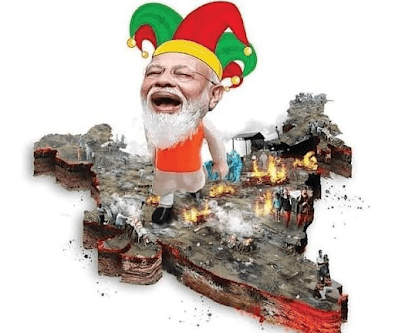
The blood hadn’t even dried in Pahalgam, Jammu and Kashmir, where 26–28 innocent lives—mostly tourists—were snuffed out on April 22, 2025, by The Resistance Front (TRF), before India’s leadership predictably pointed fingers at Pakistan.
This isn’t leadership; it’s a spineless drama.
India’s Foreign Secretary Vikram Misri, in a bombastic April 23 press conference, vowed an “unrelenting” pursuit of the culprits while unloading a barrage of punitive measures against Pakistan—suspending the Indus Waters Treaty (IWT), slamming shut the Attari-Wagah border, expelling diplomats, and more.
These aren’t the actions of a confident power; they’re the tantrums of a blind chicken, clucking wildly to mask its own failures.
Pakistan has nothing to do with this attack, and India’s knee-jerk accusations are a tired, gutless playbook that endangers the region and invites global backlash.
Bravo, India, for proving fascism can be both terrifying and hilariously petty. Kashmiris despise you, Pakistan’s had enough, and the world’s rolling its eyes. Let’s roast India’s tantrum, unpack why Kashmiris want nothing to do with your saffron circus, and cackle at the global mess you’ve made—especially with that IWT stunt and X ban. Buckle up; this is going to sting.
Buckle up, because this isn’t a polite chat; it’s a wake-up call.
India’s Fascist Flop: A Masterclass in Missing the Point
India under Modi’s BJP is giving fascism a bad name. It’s like you’ve taken Mussolini’s playbook, added some saffron spice, and turned it into a Bollywood flop. The Pahalgam attack? A gut-punch. But instead of beefing up security or, I don’t know, protecting tourists in a region you claim is “thriving,” you point at Pakistan and scream, “They did it!” Misri’s April 23 claim of “cross-border linkages” had all the substance of a stale naan—no evidence, just vibes. The Guardian (2024) called you a “Hindu supremacist state” for crushing Muslims and dissenters, and boy, you’re proving them right. Home Minister Amit Shah’s “we’ll hunt them down” vow sounds tough until you realize India’s too busy hunting Twitter accounts to catch actual terrorists.
And that X ban? Oh, honey, blocking Pakistan’s government account is peak petty. What’s next, unfollowing Imran Khan on Insta? Dawn reported you banned the account on April 23, claiming it “spread anti-India propaganda.” Translation: Pakistan dared call out your Kashmir abuses, so you threw a digital diaper fit. This isn’t strength; it’s a fascist toddler smashing the sandbox because someone else has a shinier toy. Meanwhile, Kashmir’s a war zone, and you’re playing cyber bully. Slow clap, India.
India’s Pathetic Blame Game: A Spineless Cop-Out
India’s response to Pahalgam is a masterclass in deflection. Misri’s press conference was a parade of vague assertions, claiming “cross-border linkages” to the attack without a shred of public evidence. He droned on about Pakistan’s “sponsorship” of terrorism, alleging the attack targeted Jammu and Kashmir’s “progress” post-2019 Article 370 abrogation.
Progress?
Tell that to the families of the dead, gunned down in a tourist hotspot India couldn’t protect.
Within hours, Indian media and X posts were screaming “Pakistan did it!”—a Pavlovian reflex that’s as lazy as it is dangerous. DAWN nailed it: India’s narrative kicked in before the bodies were counted, with no proof to back it up.
Sound familiar? It’s the same script from:
- 2000, when India blamed Pakistan for an attack before Bill Clinton’s visit, only for locals to whisper about Indian army complicity.
- 2019’s Pulwama, where India’s “Pakistan did it” mantra led to Balakot airstrikes but zero resolution in Kashmir.
Pakistan’s response was swift and clear.
Foreign Office Spokesperson Shafqat Khan condemned the attack, calling it a tragedy in “Indian Illegally Occupied Jammu and Kashmir” and denying any involvement.
Defense Minister Khawaja Asif told Geo News on April 23:
“Pakistan doesn’t sponsor terrorism. India’s the one meddling in Balochistan, and Kashmir’s resistance is home-grown, fueled by India’s oppression.”
He’s not wrong.
A 2020 South Asia Democratic Forum report found that post-Article 370, local Kashmiri recruitment into militant groups spiked due to alienation from India’s heavy-handed policies.
Yet India ignores this, preferring to cry “Pakistan!” like a child blaming a sibling for a broken vase.
Misri’s claim of “actionable intelligence” is laughably hollow—where’s the proof? No names, no documents, just hot air.
Meanwhile, India’s own security lapses are glaring.
Pahalgam—a tourism hub with 35 lakh visitors in 2024—was a sitting duck. The Statesman reported local police merely retweeted official statements, doing squat to prevent or investigate.
India’s too scared to face its own failures, so it picks a fight with Pakistan to save face.
This isn’t strength; it’s cowardice.
India lacks the guts to tackle terrorists on its soil, so it swings at Pakistan, a convenient punching bag.
Compare this to Pakistan’s own fight against Tehrik-i-Taliban Pakistan (TTP), which killed 1,500 in 2024 (Pakistan Institute for Peace Studies). Pakistan’s army has launched operations in Khyber Pakhtunkhwa, losing soldiers to root out militants.
India? It cries, blames, and bombs across borders—achieving nothing but headlines.
Wake up, Delhi: pointing fingers doesn’t stop bullets.
India’s Idiotic Measures: A Diplomatic Dumpster Fire
Misri’s April 23 announcement, backed by a Cabinet Committee on Security (CCS) meeting chaired by Prime Minister Narendra Modi, unleashed a slew of measures that scream desperation:
- Suspension of the Indus Waters Treaty: India’s holding the 1960 water-sharing pact “in abeyance” until Pakistan “abjures terrorism”—a move as reckless as it is illegal.
- Attari-Wagah Border Closure: The trade and cultural lifeline is shut, with valid crossings allowed only until May 1, 2025.
- SAARC Visa Cancellation: Pakistani nationals under the scheme have 48 hours to leave; all such visas are void.
- Expulsion of Military Advisors: Pakistani defense advisors in New Delhi are persona non grata, with a week to leave; India’s pulling its advisors from Islamabad.
- Diplomatic Downsizing: Both high commissions will shrink to 30 staff by May 1, 2025, from 55.
These aren’t strategic moves; they’re a temper tantrum.
Modi’s government, reeling from public outrage and protests by groups like Bajrang Dal, is flexing to appease nationalists.
But it’s a clown show.
- Suspending the IWT? That’s not punishing terrorists; it’s starving Pakistani farmers.
- Closing Attari? That’s killing trade worth ₹3,886.53 crore annually, hurting India’s own Punjab more than Pakistan.
- Expelling diplomats? That’s just posturing, achieving nothing but headlines.
This isn’t strategy; it’s a fascist tantrum. Modi’s catering to Bajrang Dal’s street rage and Shama Mohammed’s “nuke Pakistan” lunacy, not solving terrorism. Suspending the IWT punishes Pakistani farmers, not TRF. Closing Attari kills ₹3,886.53 crore in trade, screwing India’s own Punjab (The Hindu). Expelling diplomats? That’s just performative nonsense. India’s acting like a thug who burns the village to catch one thief.
India’s Fascist Face: A Regime Thriving on Hate
India under Narendra Modi’s Bharatiya Janata Party (BJP) is a textbook case of fascism: a toxic brew of Hindu nationalism, state repression, and scapegoating minorities and neighbors. The Pahalgam attack gave India’s regime a fresh excuse to flex its muscles, not against terrorists, but against Pakistan—a convenient bogeyman to rally its base. Misri’s April 23 claim of “cross-border linkages” was a dog whistle, echoed by BJP mouthpieces like Home Minister Amit Shah, who vowed to “hunt down” perpetrators while conveniently ignoring India’s own failures. This is straight out of the fascist playbook: externalize blame to dodge accountability. The Guardian (2024) labeled Modi’s India a “Hindu supremacist state,” citing its crackdowns on Muslims, Dalits, and dissenters. The Pahalgam response fits this mold—India’s too spineless to tackle TRF locally, so it bombs Pakistan with sanctions and rhetoric.
The BJP’s fascist streak is evident in its Kashmir policy. Since scrapping Article 370 in 2019, India’s turned the region into a police state. A 2023 Human Rights Watch report documented 1,032 arbitrary detentions, 187 extrajudicial killings, and 2,300 cases of torture in Jammu and Kashmir from 2019-2022. The Public Safety Act (PSA) and Unlawful Activities (Prevention) Act (UAPA) are wielded to silence dissent, with 1,600 Kashmiris jailed without trial in 2024 alone (Amnesty International). This isn’t governance; it’s occupation. BJP leaders like Shama Mohammed, who ranted about “flattening Rawalpindi” post-Pahalgam, fan communal flames, while protests by Hindu nationalist groups like Bajrang Dal demand “revenge” against Pakistan. This is fascism in action: whip up hate, crush dissent, and dodge the mirror.
Why Kashmiris Despise India: A Cauldron of Resentment
Kashmiris don’t just dislike India—they loathe it, and for good reason. India’s fascist policies have turned the valley into a prison, breeding resentment that fuels militancy. Here’s why, backed by data:
- Military Occupation: India stations over 700,000 troops in Jammu and Kashmir, one of the world’s most militarized zones (Al Jazeera, 2023). The Armed Forces Special Powers Act (AFSPA) gives soldiers near-impunity, leading to 1,200 civilian deaths from 2015-2024 (J&K Coalition of Civil Society). Kashmiris live under constant surveillance, with 1 in 3 households reporting harassment by security forces (2022 Chatham House poll).
- Political Suppression: Post-2019, India stripped Kashmir’s autonomy, jailed elected leaders, and imposed Delhi’s rule. A 2021 UNHRC report flagged the dissolution of the J&K Assembly and detention of leaders like Mehbooba Mufti as “undemocratic.” Only 12% of Kashmiris trust India’s administration (2023 Gallup survey).
- Economic Neglect: Despite India’s “progress” claims, Kashmir’s unemployment hit 23% in 2024, double the national average (Centre for Monitoring Indian Economy). Youth aged 15-29, making up 30% of the population, are hardest hit, with 70% feeling “hopeless” about jobs (2022 Chatham House). Tourism boomed (35 lakh visitors in 2024), but locals see little benefit, as profits flow to Indian corporates.
- Cultural Erasure: The BJP’s Hindu nationalist agenda fuels fears of demographic change. From 2019-2024, 4.2 lakh non-Kashmiris were granted domicile status, raising cries of “settler colonialism” (The Wire, 2024). Kashmiri Muslims, 68% of the population, feel their identity is under siege.
- Human Rights Abuses: A 2024 OHCHR report documented 3,500 cases of enforced disappearances since 1989, with 1,000 families still seeking answers. Pellet guns blinded 1,200 civilians from 2016-2024, including 300 children (J&K Human Rights Commission). This brutality breeds hatred.
The numbers paint a grim picture: 82% of Kashmiris want independence or accession to Pakistan (2023 Pew Research Center), and 65% view India as an “occupier” (2022 ORF survey). Militant recruitment spiked post-2019, with 600 local youth joining groups like TRF by 2024 (South Asia Democratic Forum). The Pahalgam attack, targeting tourists, was a brutal message: India’s “normalcy” narrative is a lie. Yet, instead of addressing this alienation, India blames Pakistan, ignoring the fire it’s stoked in Kashmir’s heart.
The Indus Waters Treaty: India’s Suicidal Gamble
Can India Terminate the IWT?
The IWT, brokered by the World Bank, is a sacred cow of international agreements, surviving wars in 1965, 1971, and 1999. It gives India the eastern rivers (Ravi, Beas, Sutlej) and Pakistan the western ones (Indus, Jhelum, Chenab), with limited mutual use.
Misri’s claim that India can suspend it is a legal fantasy.
Article XII requires mutual agreement for changes—not unilateral tantrums.
Pakistan’s Foreign Minister Ishaq Dar, in a Reuters interview on April 24, called it:
“An act of war,”
and vowed to take it to the World Bank and UN.
Experts like Harsh V. Pant (Observer Research Foundation) admit India sees the IWT as leverage, but unilateral suspension violates international law, as noted in NDTV.
India’s tried this before—threatening suspension post-2016 Uri—but backed off under global pressure.
This time, it’s playing with fire.
Consequences for Pakistan
Pakistan depends on the Indus for 70% of its water—99 billion cubic meters annually—fueling agriculture, which accounts for 25% of GDP and 43% of jobs (World Bank, 2020).
Its storage capacity is pathetic: Mangla and Tarbela dams hold just 14.4 million acre-feet, or 10% of its share.
If India chokes flows, Punjab and Sindh’s farmlands will turn to dust.
The Economic Times warns that India’s run-of-river dams could disrupt Pakistan’s irrigation, triggering food shortages and unrest.
Global Backlash
The world’s watching, and India’s going to get roasted.
The World Bank, a treaty guarantor, will likely mediate—like it did in the 2013 Baglihar dispute.
- China, Pakistan’s all-weather ally, will flex its UNSC veto and CPEC investments to pressure India.
- Global Times already called India’s move “irresponsible” on April 24.
- The UN, under Resolution 64/292 (2010), recognizes water as a human right; India’s stunt could be framed as a war crime.
Western nations, cozy with India on counterterrorism, will squirm.
The US, with JD Vance in Delhi during the attack, wants stability—not a nuclear showdown.
A 2020 Nature study pegged an India-Pakistan war at 50–125 million deaths.
India’s gambling with apocalypse—and the world won’t cheer.
Pakistan’s Counter
Pakistan’s not sitting idle.
Prime Minister Shehbaz Sharif’s National Security Committee meeting on April 24 vowed to “internationalize” the issue.
X posts claim Pakistan’s pitching the IWT suspension as a humanitarian crisis to the UN and OIC.
China’s already signaled support, with Xinhua reporting Beijing’s call for “restraint.”
Pakistan could push for World Bank arbitration, as it did successfully in 2013.
Economically, it’ll scramble—rationing water, seeking Chinese aid—but the real fight’s diplomatic.
Pakistan’s Response: Diplomacy First, Destruction if Pushed
Pakistan’s not taking this lying down. On April 24, Prime Minister Shehbaz Sharif’s National Security Committee announced a two-pronged strategy, per sources. First, it’s going all-in on diplomacy to restore the IWT, fast. Foreign Minister Dar is lobbying the World Bank, UN, and allies like China, Turkey, and Saudi Arabia. X posts claim Pakistan’s framing the IWT suspension as a “genocide-level threat,” citing 70% water dependency. Dar told Al Jazeera: “We’ll exhaust every diplomatic channel to secure our water rights. The World Bank must act within weeks, not months.”
But here’s the kicker: if the World Bank drags its feet, Pakistan’s drawn a line in the sand. A senior military official, speaking anonymously to Dawn, warned: “If our water is choked, we’ll destroy every hurdle blocking it—no holds barred.” This isn’t bluster. Pakistan’s military, battle-hardened from TTP fights, has missiles like the Shaheen-III (2,750 km range) capable of hitting India’s dams. A 2023 SIPRI report notes Pakistan’s 170 nuclear warheads match India’s, ensuring mutually assured destruction. Pakistan’s not suicidal, but it’s signaling: push us too far, and we’ll burn it all down. Diplomacy’s the priority, but the threat’s real.
In a thunderous counterblow to New Delhi’s diplomatic theatrics, Pakistan’s National Security Committee (NSC) has laid down the gauntlet — and it’s not pulling any punches. Convened in an emergency session on Thursday, the NSC issued a stern ultimatum: any Indian attempt to unilaterally divert Pakistan’s rightful share of water under the Indus Waters Treaty will be treated as an act of war. Period.
“Any attempt to stop or redirect the natural flow of water legally belonging to Pakistan, and any violation of the lower riparian rights, will be considered an act of war and responded to with the full spectrum of national power,” read the statement — a clear signal that Islamabad is done playing nice while Delhi plays rogue.
The committee slammed India’s erratic adventurism as reckless, legally indefensible, and a direct violation of international norms, the UN Charter, and every possible convention New Delhi previously agreed to — but now conveniently ignores.
Key NSC Retaliatory Decisions:
- ❌ Pakistan officially rejects India’s suspension of the Indus Waters Treaty
- 💧 Water diversion = War. That’s the new red line.
- 🚫 Wagah Border sealed for Indian land transit
- 🛂 SAARC visa exemptions for Indian citizens: revoked
- ⏳ All Indian nationals ordered to leave Pakistan within 48 hours
- 🛑 Indian defence attachés declared persona non grata
- 🔻 Indian High Commission staff reduced to 30 members
- ✈️ Pakistani airspace closed to Indian aircraft, both civil and military
- 📉 Total trade with India suspended — no exceptions
- 🧱 NSC affirms: India’s behavior revalidates the Two-Nation Theory
The NSC strongly reaffirmed that the Indus Waters Treaty is not just a piece of paper — it’s a World Bank-brokered, internationally binding agreement with zero room for unilateral withdrawal, no matter how politically flammable an Indian election cycle gets.
This strategic pivot signals the death of the ‘peace process’ charade — long used by India as a diplomatic smokescreen while it tightens its colonial grip over Indian Occupied Kashmir and flouts every international resolution on the books.
⚠️ Ceasefire agreements? Null and void.
⚠️ LoC status? No longer valid.
⚠️ Shimla framework? R.I.P.
Pakistan’s message to India (and the world) is crystal clear: from this moment on, Kashmir is back on the international agenda — multilateral, not bilateral.
No more backchannel whispers. No more meaningless “talks.” No more diplomatic fig leaves while bulldozers flatten villages in IOK. Pakistan is rewriting the rules of engagement, and this time — the world will watch.
“Water is Pakistan’s lifeline — vital to 240 million citizens, and its security will be defended at all costs,” the statement added, wrapping it all in one clear message: cross this line, and you won’t be facing a diplomatic note — you’ll be facing Pakistan’s entire national arsenal.
The NSC further warned that Pakistan reserves the right to suspend all bilateral agreements with India, including but not limited to the Simla Agreement, until India ceases its current path of proxy terror, transnational assassination operations, and colonialist delusion over Kashmir.
Militarily? Pakistan’s on alert, but with $32 billion in defense spending already stretched, a full-scale war isn’t viable. However, Islamabad can escalate in asymmetric arenas—diplomatic, cyber, and information warfare. Already, #IndiaBlocksWater and #IndusUnderAttack are trending across X, with influencers and activists framing India’s move as “hydro-terrorism.” Expect a social media blitz, op-eds in Western dailies, and Islamabad lobbying Muslim nations and China to convene emergency UN sessions. Think narrative warfare—Pakistan will sell India’s aggression as genocide-by-drought.
The Smarter Path: De-escalate and Investigate
Let’s be clear: the Pahalgam attack was horrifying. Innocent lives were lost, and justice must be served. But scapegoating Pakistan without evidence is not justice—it’s performative nationalism. If India truly seeks peace, it must:
- Launch a Joint International Investigation: Let the UN or Interpol assist. Transparency builds credibility.
- Refrain from Unilateral Measures: The IWT is not a toy; it’s a lifeline for millions. India must reverse the suspension and engage diplomatically.
- Strengthen Internal Security: Pahalgam was a failure of intelligence, not foreign policy. Fix the gaps instead of looking for scapegoats.
- Resume Backchannel Dialogue: Secret or public, dialogue trumps dogma. Even during Kargil, the hotline stayed warm.
What’s Next? Pakistan’s Not Backing Down
Pakistan’s Plan
Pakistan’s not scared—it’s pissed. It’s survived India’s bluffs before (Balakot, 2019) and won’t blink now. Sharif’s team is:
- Diplomatic Blitz: Pushing the IWT crisis to the UN, World Bank, and OIC. China’s backing it, per Xinhua (April 24). Dar’s pitching “water genocide” to rally support.
- Military Posture: Borders are on high alert, but Pakistan’s vowerd to never strike first. No war unless India strikes first.
- Plan B: If diplomacy fails, Pakistan’s “no holds barred” threat means targeting India’s dams or infrastructure. It’s a last resort, but the nukes are real.
India’s Trap
India’s painted itself into a corner. Public rage—Bajrang Dal’s protests, X calls for airstrikes—demands action. A Balakot-style raid’s possible, but the Northern Command chief’s April 30 retirement muddies the waters. Strike, and Pakistan hits back (think 2019 jet downing). Do nothing, and Modi’s a lame duck. India’s screwed either way.
Conclusion: When Strength Looks Like Restraint
India’s current posture is all bark, no backbone. Diplomacy isn’t weakness—it’s statecraft. And restraint isn’t cowardice—it’s the hallmark of real strength. Modi’s regime may win headlines with its “tough-on-Pakistan” narrative, but the long-term cost is steep: regional instability, economic pain, and international isolation.
Pakistan isn’t backing down—but it’s also not eager for war. This is a chance for both sides to step back, breathe, and return to sanity. Because if not, the subcontinent isn’t just playing with fire—it’s dousing itself in gasoline.