
The Pakistan Armoured Corps stands at the forefront of doctrinal evolution and mechanized warfare modernization under Vision 2030. As regional dynamics shift and hybrid threats emerge, the Corps is pivoting from traditional tank-centric formations to a combined arms, network-centric battlefield approach. This transformation includes the phased induction of cutting-edge Main Battle Tanks (MBTs) like the VT-4, T-90MS (under consideration), and Al-Khalid-I upgrades, alongside next-gen Armored Personnel Carriers (APCs), Active Protection Systems (APS), and integrated C4ISR suites. These developments position Pakistan to achieve operational parity with regional adversaries and enhance strategic depth through rapid mobility, survivability, and real-time battlefield awareness—key for high-intensity conflicts and asymmetrical engagements alike.

Strategic Objective:
Build a “Hybrid Armored Triad” of:
- Quantity (for deterrence and terrain dominance)
- Quality (to match peer threats like India’s T-90MS and Arjun Mk2)
- Digital Supremacy (to interface with UAVs, ISR assets, and C4ISR networks)
Tank Fleet (2,537+ Active Units): Steel Backbone of Pakistan’s Strike Corps
1. Al-Khalid & Al-Khalid I (400+ Units)
Origin: Jointly developed by Pakistan and China, produced at Heavy Industries Taxila (HIT)
Key Features:
- 125mm smoothbore gun with autoloader
- Explosive Reactive Armor (ERA)
- Digital Fire Control System (DFCS)
- Thermal Imaging & Night Vision Capabilities
- Laser Rangefinder
- NBC (Nuclear-Biological-Chemical) Protection
- Upgraded mobility with new transmission and powerpack (1,200 hp)
Strategic Importance:
- Designed for high-speed desert warfare—ideal for Pakistan’s southern front near Rajasthan.
- Symbol of Pakistan’s defense self-reliance.
- Supports network-centric warfare integration, critical for modern joint operations.
- HIT is currently developing the Al-Khalid II (Block-II), expected to feature Active Protection System (APS), next-gen electronics, and modular armor.
Global Comparison:
- Comparable to India’s T-90 Bhishma in terms of firepower and maneuverability.
- Outclassed by Western MBTs like Leopard 2A7 or M1A2 Abrams in terms of armor and digital battlefield integration, but significantly cheaper and faster to produce.
2. T-80UD (315 Units)
Origin: Soviet-era MBT imported from Ukraine (1997–2002)
Key Features:
- 125mm smoothbore gun with autoloader
- Gas-turbine engine (1,000 hp)
- Composite armor + Kontakt-5 ERA
- Thermal sights, laser rangefinders
- High-speed maneuverability (similar to Western MBTs)
Upgrade Program (Ongoing):
- Partnership discussions with Russia and Belarus to integrate:
- Relikt ERA
- APS (Active Protection Systems) like Arena or Drozd
- Upgraded thermal imaging & digital battle management systems
Strategic Importance:
- Deployed with elite armored units in strategic sectors like Sialkot-Chamb and Southern Punjab.
- Enhances balance against India’s armored dominance along the IB (International Border).
- Key asset for blitzkrieg-style breakthroughs and flanking operations.
Global Comparison:
- Comparable to early T-90 variants.
- Less advanced than NATO’s Leopard 2A6 or M1A2 SEP V3, but capable with modern upgrades.
- A bridge capability between Cold War and 21st-century armor.
3. Al-Zarrar (500 Units)
Origin: Indigenous upgrade of the Chinese Type 59 (1950s design), modernized at HIT
Key Features:
- 125mm smoothbore gun with autoloader
- Composite & ERA armor
- Modernized Fire Control System
- Thermal imaging and laser-guided targeting
- Smoke dischargers and laser warning receivers
Strategic Role:
- Primarily used by reserve units, rapid-reaction divisions, and training corps.
- Ideal for urban warfare and static defense roles in Northern Pakistan and AJK regions.
- Provides quantity and battlefield endurance, especially in support roles.
Global Comparison:
- Inferior to most modern MBTs, but cost-effective.
- Comparable in role to India’s older T-72 variants, still in service with the Indian Army.
- Crucial for second-line deployment and support missions.
4. VT-4 “Haider” (44 Delivered, 600+ On Order)
Origin: Chinese third-generation MBT (Norinco); Pakistan’s variant dubbed “Haider”
Key Features:
- 125mm smoothbore gun with autoloader
- GL-5 Active Protection System (APS)
- Thermal imaging, panoramic sights, and hunter-killer capability
- Advanced battle management system (BMS)
- Modular composite and ERA armor
- Automatic fire suppression and NBC protection
- 1,300 hp engine + hydropneumatic suspension
Strategic Importance:
- Represents the future backbone of Pakistan’s armored corps by 2030.
- HIT will locally assemble VT-4s starting 2026, under a technology transfer (ToT) agreement with Norinco.
- Designed for digital battlefield integration, drone coordination, and AI-assisted targeting systems.
Deployment Prospects:
- Will gradually replace older T-59, Al-Zarrar, and aging Ukrainian tanks.
- Forward-deployed along key sectors facing India’s mechanized corps in the Thar and Cholistan deserts.
Global Comparison:
- VT-4 has proven export success (Nigeria, Thailand, Bangladesh).
- Offers capabilities similar to Russia’s T-90MS or South Korea’s K1A2, albeit at a lower cost.
- Lags behind Western MBTs like M1A2 SEP V3 in armor quality, but excels in affordability and ease of production.
Global Standing of Pakistan’s Armored Corps (2025)
| Country | Modern MBT Types | Active Tank Count | APS Integration | Domestic Production |
|---|---|---|---|---|
| Pakistan | VT-4, Al-Khalid I, T-80UD | 2,537+ | Moderate (increasing) | ✔️ (HIT, expanding) |
| India | T-90 Bhishma, Arjun Mk1/2 | 4,500+ | Low (but growing) | ✔️ (OFB, DRDO) |
| China | Type 99A, Type 96A | 5,000+ | High (domestic tech) | ✔️ |
| USA | M1A2 SEP V3 Abrams | 6,000+ | High | ✔️ |
| Russia | T-90M, T-14 Armata | 13,000+ (incl. reserves) | High | ✔️ |
Strategic Insights:
- Modernization over Mass: Pakistan is transitioning from Cold War-era quantity to next-gen quality with VT-4 and Al-Khalid II.
- Self-Sufficiency Goal: HIT’s licensing of VT-4 production marks a key milestone in indigenous defense manufacturing.
- Balancing India: With over 2,000 T-90s and new Arjun Mk2 tanks in Indian service, Pakistan’s emphasis on mobility, APS, and digital systems helps level the playing field.
- Future Force Design: With drone warfare and hybrid threats on the rise, digital integration in tanks like VT-4 and upcoming Al-Khalid II will be crucial.
1. VT-4 Haider MBT (679 Units by 2030)
Origin: NORINCO China | License Production: HIT, Pakistan
Next-Gen Features:
- 125mm smoothbore cannon (autoloader)
- GL-5 APS (intercepts ATGMs/RPGs)
- AI-assisted fire control and drone-targeting interface
- Thermal panoramic sights + Hunter-Killer mode
- Remote weapon stations (RWS)
- Battlefield Network Integration (BNI) with armored drones and artillery
- Modular ERA + Composite Armor
- Indigenous production at HIT by 2026
Strategic Impact:
- Will become the core battle tank for Pakistan’s armored strike divisions
- Rapid production capability strengthens wartime replenishment
- Ability to swarm enemy armor using data-linked drone partners and ISR
Global Comparison:
- Technologically on par with the Russian T-90MS and the Turkish Altay
- Cheaper and faster to produce than NATO MBTs like Leopard 2A7+
2. KF51 Panther MBT (150–200 Units, Negotiation Phase)
Origin: Rheinmetall, Germany | Proposed Variant: “Panther PK”
Planned Features:
- 130mm Future Gun System (50% more penetration than 120mm)
- Integrated reconnaissance drone launcher (UAVs deploy from turret)
- Full AI integration for fire control, threat tracking, and target prioritization
- Optional unmanned turret
- Hybrid propulsion systems (offering quiet mode for stealth approach)
- Remote diagnostics and predictive maintenance AI
- ToT arrangement for local assembly by 2028–2030
Strategic Game-Changer:
- A leap beyond anything India currently fields
- Offers Pakistan a fifth-generation MBT, possibly the most advanced outside NATO by 2030
- Perfect fit for elite armored corps, mountain warfare zones, and expeditionary roles
Global Standing:
- Currently unmatched; only a handful of countries (Germany, US, South Korea) are exploring 130mm-class MBTs
- Puts Pakistan in the elite club exploring AI + Autonomous Armor Warfare
Update 2026: Unlikey to proceed.
3. Al-Khalid II MBT (200 Units, Under Development)
Origin: Pakistan (HIT) | Timeline: Prototypes expected 2026–2027
Planned Capabilities:
- Hybrid propulsion (increased range, fuel efficiency, stealth mode)
- Next-gen APS (possibly integrated with radar/IR hybrid sensors)
- All-digital fire control suite
- Upgraded autoloader, advanced composite armor
- C4ISR integration + UAV uplink
- Potential modular turret design to allow multi-role variants
Strategic Significance:
- Will replace legacy T-59/Al-Zarrar platforms in active units
- Symbol of Pakistan’s defense tech sovereignty
- Could attract exports to Islamic or African defense markets
Global Comparison:
- Sits in the same class as India’s Arjun Mk2 and Iran’s Karrar
- Key testbed for HIT’s future unmanned MBT program (expected post-2032)
4. VT-5 Light Tank (Niche Mountain/All-Terrain Capability)
Origin: NORINCO, China | License Production: HIT, Pakistan (ToT Agreement)
Next-Gen Features:
- 105mm rifled cannon (autoloader-equipped, firing APFSDS, HEAT, and GLATGM)
- High-altitude optimized engine (1,000 hp+ diesel maintaining full power in thin air)
- Adjustable hydro-pneumatic suspension (enabling extreme elevation/depression for mountain combat)
- Integrated Digital Battlefield FCS (high-fidelity EO/IR targeting and network-centric systems)
- Soft-kill countermeasures (Laser Warning Systems and comprehensive ECM suite)
- FN-16 Short-Range AD integration (dedicated defense against loitering munitions and helicopters)
- Modular Lightweight Armor (composite panels + expandable ERA for urban/mountain protection)
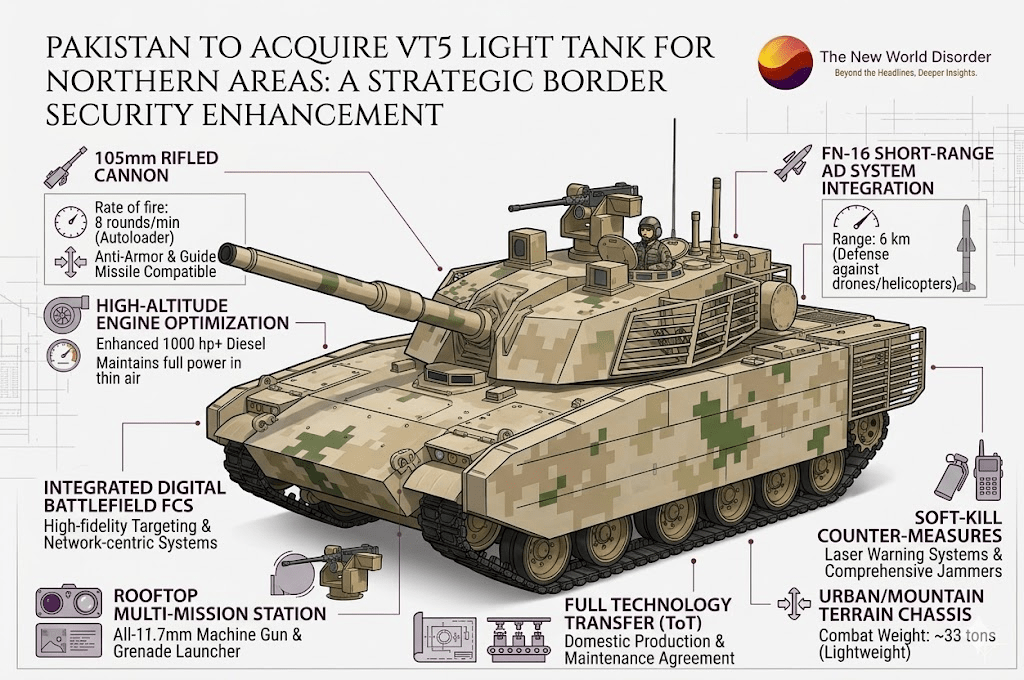
Strategic Impact:
- Provides a dedicated armored punch for the Northern Areas where heavy MBTs cannot maneuver
- Enables rapid deployment across fragile infrastructure and bridges in rugged border regions
- Secures territorial integrity in high-altitude theaters with a platform optimized for thin-air performance
Global Comparison:
- Technologically superior to aging light armor like the SK-105 Kürassier or modified infantry vehicles
- More mobile and specialized for mountain warfare than the heavier Indian T-72 or T-90 fleets
- Offers the lowest logistical footprint in its class while maintaining a digital edge equivalent to the VT-4
Tactical Vision: What This Means for the Pakistan Army
| Capability | VT-4 Haider | KF51 Panther | Al-Khalid II |
|---|---|---|---|
| Generation | 3.5 | 4.5–5th Gen | 4th Gen |
| APS | GL-5 | Rheinmetall Hardkill | TBD (Indigenous Hybrid) |
| Gun Caliber | 125mm | 130mm | 125mm |
| Drone Integration | Partial | Yes (internal launcher) | Planned |
| AI Fire Control | Yes | Full | Planned |
| Hybrid Engine | No | Yes | Yes |
| Domestic Production | Yes | Planned | Yes |
Pakistan’s Global Positioning in 2030 – Armor Race Snapshot
| Country | Main Future MBT | Gen | AI Integration | APS | Indigenous Production |
|---|---|---|---|---|---|
| 🇵🇰 Pakistan | KF51 Panther (negotiated), VT-4 Haider, Al-Khalid II | 3.5–5 | Partial–Full | Medium–High | ✔️ (expanding) |
| 🇮🇳 India | T-90MS, Arjun Mk1A/2, FMBT (under development) | 3–4 | Low–Medium | Low | ✔️ |
| 🇨🇳 China | Type 99A2, Type 096 MBT | 4–5 | High | High | ✔️ |
| 🇷🇺 Russia | T-14 Armata | 5 | High | High | ✔️ |
| 🇺🇸 USA | AbramsX (future), M1A2 SEP V3 | 4–5 | Medium–High | High | ✔️ |
| 🇩🇪 Germany | KF51 Panther | 5 | Full | High | ✔️ |
Armored Evolution Beyond Tanks: Pakistan Army’s Expanding Mechanized Web
While tanks dominate headlines, modern warfare is won through the silent workhorses—APCs, IFVs, MRAPs, and artillery platforms—that deliver troops, provide cover, and reshape the battlefield dynamically. Pakistan’s defense planners have embraced this doctrine, aggressively modernizing the Army’s mechanized backbone, support vehicles, and infantry force multipliers in parallel with tank development.
APCs, IFVs & MRAPs: Pakistan’s Expanding Mechanized Warfare Ecosystem
The Strategic Evolution of Pakistan’s Mechanized Forces
Pakistan’s mechanized doctrine is undergoing a major transformation from legacy armored troop transport toward integrated, high-survivability, network-centric maneuver warfare. Traditionally, platforms such as the M113 family and its indigenous derivatives served primarily as battlefield mobility assets designed to transport infantry under armored protection.
However, the emergence of:
- Precision-guided anti-tank systems
- Loitering munitions
- Drone swarm warfare
- Network-enabled battlefield engagement
- Mobile electronic warfare threats
has fundamentally changed mechanized warfare requirements.
In response, Heavy Industries Taxila (HIT) has initiated a layered modernization strategy focused on:
- Indigenous tracked APC production
- Frontline Infantry Fighting Vehicles (IFVs)
- High-mobility wheeled 8×8 systems
- Mobile SHORAD integration
- Transfer of Technology (ToT)-driven industrial expansion
- Digital battlefield interoperability
Pakistan’s future armored ecosystem is no longer centered purely on troop transport. It is evolving into a modular, survivable, and domestically sustainable combat mobility framework.
APCs & MRAPs: Core Mobility Platforms (4,000+ Units)
Origin and Industrial Base
Pakistan’s tracked APC backbone is built around indigenous derivatives of the legendary M113 armored platform, heavily modified and localized by Heavy Industries Taxila (HIT).
The core platforms include:
- Talha APC
- Saad APC
- Al-Qaswa support variants
- Specialized command, engineering, anti-aircraft, and anti-tank modules
Critically, Pakistan achieved full Transfer of Technology (ToT) for the M113 ecosystem decades ago. HIT now possesses:
- Complete rebuild capability
- Structural manufacturing rights
- Chassis engineering control
- Domestic upgrade infrastructure
- Indigenous variant development capability
This legacy ToT achievement remains one of Pakistan’s most strategically valuable defense-industrial successes.
Talha APC
Platform Overview
The Talha APC is a locally developed tracked armored personnel carrier derived from the M113 architecture and optimized for Pakistan’s operational requirements.
It remains the primary workhorse of Pakistan’s mechanized infantry fleet.
Technical Specifications
| Parameter | Details |
|---|---|
| Type | Indigenous tracked APC |
| Troop Capacity | 12 soldiers + crew |
| Operational Range | ~515 km (320 miles) |
| Maximum Speed | ~64 km/h |
| Engine Options | 275 hp Detroit Diesel / 330 hp Ukrainian UTD-20 |
| Hull Composition | All-welded aircraft-grade aluminum alloy |
| Protection | Enhanced sloped armor against small arms and fragmentation |
Specialized Combat Variants
The Talha platform has evolved into a highly modular combat ecosystem.
Maaz Variant
- Equipped with indigenous Baktar-Shikan ATGM
- Dedicated anti-armor role
- Mobile tank-hunter configuration
Mouz Variant
- Integrated with RBS-70 MANPADS
- Mobile short-range air-defense role
- Supports mechanized formations against low-altitude aerial threats
Strategic Role
The Talha continues to serve as:
- The backbone of mechanized infantry mobility
- A low-cost modular battlefield platform
- A flexible logistics and support vehicle
- A highly sustainable tracked APC fleet
Its modularity enables rapid adaptation for:
- ATGM operations
- Air defense
- Battlefield command
- Engineering support
- Reconnaissance missions
Global Comparison
Operationally, the Talha occupies a role similar to:
- Early M2 Bradley support variants
- Legacy M113 modernization programs
- Older Chinese ZBD-family support carriers
Although lighter than modern IFVs, its affordability, simplicity, and domestic production capacity provide major logistical advantages.
Saad APC
Evolution Beyond Talha
The Saad APC represents a major structural evolution of the Talha platform.
Unlike the five-roadwheel Talha, the Saad incorporates:
- A stretched chassis
- Six-roadwheel tracked configuration
- Larger internal volume
- Improved payload capacity
- Enhanced mobility under heavier combat loads
Technical Enhancements
| Parameter | Details |
|---|---|
| Chassis | Extended tracked APC |
| Suspension | Reinforced for heavier payloads |
| Engine Output | Approximately 483 hp |
| Internal Volume | Increased troop and systems capacity |
| Tactical Utility | Multi-role support platform |
Operational Payload Modules
The Saad serves as the foundation for several advanced combat systems.
Maaz ATGM Variant
- Equipped with Baktar-Shikan missile systems
- Dedicated armored warfare support
Mouz Air Defense Variant
- RBS-70 MANPAD-based mobile SHORAD system
Command & Control Platform
- Battlefield networking suite
- Communications relay systems
- Digital tactical management
Combat Engineering Platform
- Mine-clearing systems
- Breaching support
- Combat mobility assistance
Strategic Importance of the Saad Platform
The Saad is particularly important because it became the structural foundation for Pakistan’s next-generation tracked IFV program:
Viper IFV
The larger chassis footprint and improved load-bearing capability enabled integration of:
- Heavier armor packages
- Remote unmanned turrets
- Advanced optics
- Battlefield electronics
- Fire-control systems
This transformed the platform from a traditional APC into a genuine mechanized assault vehicle ecosystem.
Confirmed & Active Transfer of Technology (ToT) Programs
1. Viper IFV Program (High-Level Indigenization)
The Viper Infantry Fighting Vehicle (IFV) is Pakistan’s most important active tracked combat vehicle modernization initiative.
Chassis Ownership and Local Manufacturing
The Viper is based on the indigenous Saad APC chassis, meaning HIT already possesses:
- Full production tooling
- Manufacturing rights
- Structural engineering authority
- Local sustainment capability
This provides Pakistan with significant strategic autonomy compared to imported IFV platforms.
Turret Integration
The Viper integrates the Slovakian Turra-30 Unmanned Remote Weapon Station, developed by EVPÚ Defence.
Pakistan’s partnership includes localized integration and increasing domestic maintenance capability for:
- Fire-control systems
- Remote weapon stations
- Optics servicing
- Electronic calibration
- Battlefield systems integration
Core Combat Features
| System | Details |
|---|---|
| Main Gun | 30mm 2A42 autocannon |
| Secondary Armament | 7.62mm coaxial MG |
| Missile Systems | Kornet / Konkurs / Baktar-Shikan integration |
| Turret Type | Unmanned remote turret |
| Optics | Day/night thermal targeting suite |
| Armor | STANAG Level 4 equivalent upgrades |
Strategic Role
The Viper represents Pakistan’s transition toward:
- True mechanized assault warfare
- Tank-infantry integrated formations
- Network-centric battlefield operations
- Counter-drone survivability
- Precision mobile firepower
It directly addresses capability gaps against modern regional IFVs such as India’s BMP-2M modernization programs.
2. Taimas 8×8 / ARMA Program (Turkey-Kazakhstan-Pakistan Framework)
A major trilateral armored cooperation initiative has emerged between:
- Pakistan
- Turkey
- Kazakhstan
centered around the Taimas 8×8, derived from the Turkish Otokar ARMA platform.
ToT Structure
Unlike conventional imports, the agreement includes:
- Local assembly plans
- Technical assistance
- Maintenance infrastructure
- Industrial cooperation
- Future co-production pathways
Kazakhstan’s industrial participation also acts as a secondary production and logistics hub.
Strategic Importance
The Taimas/ARMA family is expected to support:
- Rapid maneuver brigades
- High-speed wheeled infantry formations
- Future SHORAD systems
- Battlefield networking units
- Mobile command structures
3. Legacy M113 ToT Ecosystem
Pakistan’s M113-derived fleet remains one of the most successful long-term ToT outcomes in the country’s defense sector.
Current Indigenous Variants
| Platform | Status |
|---|---|
| Talha | Fully indigenous |
| Saad | Fully indigenous |
| Al-Qaswa | Fully indigenous |
| Engineering Variants | Fully localized |
| Command Platforms | Domestically integrated |
Strategic Advantages
The program enables Pakistan to:
- Sustain large armored fleets independently
- Conduct complete rebuilds domestically
- Modernize legacy systems at lower cost
- Develop specialized variants without foreign dependency
MRAPs & Wheeled Light Armor
Chaiseri First Win 4×4
Status
- 100-unit acquisition framework
- ToT agreement signed with HIT
- Local assembly roadmap established
Technical Highlights
| Feature | Details |
|---|---|
| Hull Type | Welded monocoque V-hull |
| Ballistic Protection | STANAG Level 2–3 |
| Mine Resistance | Level 3 |
| Engine | ~300 hp Cummins diesel |
| Transmission | Allison automatic |
| Maximum Speed | ~110 km/h |
| Operational Range | ~600 km |
| Additional Features | Run-flat tires, fire suppression, self-recovery winch |
Strategic Role
The platform significantly improves:
- Counter-IED survivability
- COIN mobility
- Rear-echelon protection
- High-risk patrol capability
Its ToT package also strengthens Pakistan’s domestic MRAP manufacturing ecosystem.
Global Comparison
Comparable in operational role to:
- MaxxPro
- Kirpi
- Other NATO MRAP families
while offering flexible modular integration at lower procurement cost.
Hamza 6×6 / 8×8 (Cavalier Group)
Overview
Developed by the Cavalier Group in cooperation with HIT, the Hamza series represents Pakistan’s indigenous wheeled armor initiative.
Features
| Parameter | Details |
|---|---|
| Armor | STANAG Level 1–2 |
| Troop Capacity | Up to 13 personnel |
| Armament | RCWS, heavy MGs, optional 30mm systems |
| Role | Internal security, peacekeeping, mobile patrol |
Strategic Importance
The Hamza platform demonstrates Pakistan’s long-term ambition to establish:
- Domestic wheeled armor manufacturing
- Indigenous modular MRAP development
- Flexible export-capable armored vehicles
Global Comparison Table: APCs & MRAPs
| Platform | Units / Status | Key Features | Strategic Value | Global Peer Comparison |
|---|---|---|---|---|
| Talha / Saad | ~2,300 tracked units | Modular variants, ATGM/MANPAD integration | Backbone of mechanized infantry | Comparable to upgraded M113 ecosystems |
| Chaiseri First Win | 100-unit framework + ToT | V-hull MRAP, high survivability | Counter-IED and COIN operations | Similar to MaxxPro / Kirpi |
| Hamza 6×6 / 8×8 | Limited deployments | Indigenous wheeled MRAP | Local armored mobility solution | Comparable to regional MRAP programs |
| Viper IFV | Prototype / pre-production | Turra-30, tracked IFV, ATGMs | Next-generation mechanized warfare | Comparable doctrinally to BMP-2M class IFVs |
| Taimas 8×8 / ARMA | ToT framework active | Wheeled maneuver platform | Future strike brigade mobility | Comparable to PARS / Patria-class systems |
Legacy Carriers & Next-Generation Replacements
Aging Platforms Being Phased Out
Older Chinese-origin platforms such as:
- Type-63
- ZTZ-59-based support systems
are gradually being replaced by:
- Modern wheeled 8×8 systems
- Digital command platforms
- High-survivability IFVs
Future 8×8 Programs Under Evaluation
PARS 8×8
Expected capabilities include:
- Amphibious operations
- Hydropneumatic suspension
- RCWS integration
- Rapid maneuver warfare support
Patria AMV XP
Potential future roles include:
- Heavy troop carrier
- Mobile mortar system
- Command vehicle
- Fire-support platform
- Battlefield networking node
Anti-Tank & Infantry Support Systems
Baktar-Shikan
| Parameter | Details |
|---|---|
| Range | ~4 km |
| Warhead | Tandem HEAT |
| Platforms | Shoulder-fired, APC-mounted, vehicle-mounted |
HJ-12 (Emerging Requirement)
Pakistan’s anti-armor doctrine is increasingly shifting toward:
- Top-attack systems
- Fire-and-forget capability
- APS-defeating munitions
The Chinese HJ-12 is particularly important in this transition.
Next-Generation Anti-Tank Firepower
| System | Origin | Type | Estimated Quantity |
|---|---|---|---|
| HJ-12 | China | Fire-and-forget ATGM | 5,000+ |
| NLAW | UK/Sweden | Disposable top-attack ATGM | ~2,000 |
| Kornet-E | Russia | Laser-guided heavy ATGM | ~1,000 |
Final Operational Takeaway
Pakistan’s mechanized ecosystem is evolving into a layered combat mobility architecture built around:
- Indigenous APC production
- Localized IFV development
- Advanced wheeled maneuver systems
- Mobile SHORAD integration
- Expanding ToT frameworks
- Long-term industrial self-reliance
The Talha and Saad continue to provide mass, affordability, and operational sustainability, while systems such as the Viper IFV and future 8×8 programs represent Pakistan’s transition toward modern high-intensity mechanized warfare.
Mobile SHORAD and Drone Warfare Integration
Modern armored columns are highly vulnerable to drone swarms and loitering munitions. To protect its mechanized infantry and heavy armor from these asymmetric overhead threats, Pakistan has initiated a crucial doctrinal pivot: the induction of China’s highly advanced Type 625E Mobile Short-Range Air Defense (SHORAD) system.
Type 625E “Drone Killer” Systems
- Chassis & Tactical Mobility: The system is built onto a highly agile, rugged 8×8 wheeled tactical armored vehicle chassis, allowing it to perform “shoot-and-scoot” maneuvers directly alongside fast-moving mechanized formations in desert or rough terrain, filling the critical “last-mile” defense gap that larger static systems cannot cover.
- Dual-Layer Kinetic & Missile Lethality:
- The Gatling Cannon: The centerpiece of the platform is a large, center-mounted six-barrel 25mm Gatling automatic cannon boasting a blistering selectable rate of fire between 3,000 and 5,000 rounds per minute. This creates a dense, inescapable kinetic “kill zone” capable of shredding incoming drone swarms, loitering munitions, and low-flying helicopters within a 2.5 km envelope.
- Missile Pods: The turret features short-range surface-to-air missile rails on both flanks, typically loaded with FN-16 or FB-10 light infrared-guided missiles, extending its air-defense intercept range out to 6 to 10 kilometers.
- Sensor Fusion & Jamming Resilience: The system carries a top-mounted, foldable X-band search and tracking radar. To maintain absolute tracking capabilities in heavy electronic warfare (EW) environments where radar frequency jamming is persistent, the Type 625E integrates a completely capsule-sealed, passive electro-optical/infrared (EO/IR) tracking apparatus and precise laser rangefinders, allowing fully autonomous, jam-resistant targeting.
Updated Mechanized Warfare Comparison Table
| Platform | Primary Role | Mobility Type | Main Armament | Strategic Function |
|---|---|---|---|---|
| Talha / Saad | APC & support mobility | Tracked | HMG / ATGM variants | Core infantry transport |
| Viper IFV | Frontline IFV | Tracked | 30mm + ATGMs | Mechanized breakthrough warfare |
| Taimas / ARMA | Wheeled maneuver platform | 8×8 Wheeled | RCWS / autocannon | Rapid maneuver brigades |
| Chaiseri First Win | MRAP | 4×4 Wheeled | Light RWS | COIN & protected patrol |
| Hamza 6×6 / 8×8 | Indigenous MRAP/LAV | Wheeled | HMG / 30mm options | Internal security & peacekeeping |
| Type 625E SHORAD | Counter-drone & low-altitude air defense | 8×8 Wheeled | 25mm Gatling + SAMs | Protection of mechanized formations |
Precision Fire Support: Artillery Modernization
SH-15 Self-Propelled Howitzer (56+ Units)
- 155mm truck-mounted howitzer
- Range: 53 km (rocket-assisted)
- GPS-guided fire control, rapid redeployment time
- Ideal for mountain and desert operations
Fatah-I & Fatah-II Guided MLRS
- Indigenous precision MLRS with GPS/INS guidance
- Extended range: 140+ km
- Multiple warhead options: HE, cluster, fuel-air explosive
Impact:
- Strategic strike capability at corps and division level
- Counterbalance to India’s Pinaka and Smerch systems
Armored Recovery, Support & Engineering Vehicles
Al Hadeed ARV
- Indigenous ARV developed on Saad chassis
- Features: Winch system, crane, towing assembly
- Future use in mechanized battalions
Chinese VT4-Based ARV
- Likely co-procurement alongside VT4 tanks
- Higher weight class recovery, crew protection, and auto-diagnostics
Modern Bridging Systems
- Expected imports or co-production of Armored Vehicle Launched Bridges (AVLBs)
- Needed for:
- Supporting VT4, Panther, and AMV XP
- Riverine operations
- Rapid mechanized crossings during war
Support Enablers Under Consideration
| System Type | Expected Role |
|---|---|
| Armored Mortar Carriers | Mobile fire support, indirect suppression |
| Armored Command Vehicles | C4ISR nodes for digitized formations |
| Unmanned Ground Vehicles (UGVs) | Recon, logistics, or decoy missions (future concept) |
Final Thought: Armor in the Age of Autonomy
By 2030, Pakistan’s armored corps will no longer be defined by tonnage alone—it will be judged by how well steel, AI, and sovereignty fuse into a digitally empowered, survivable, and lethal battlefield force. With platforms like KF51 Panther and Al-Khalid II, Pakistan is not just catching up—it’s positioning itself to leapfrog into a new armored era, redefining the battlefield across South Asia.
Pakistan’s armored modernization isn’t just about tanks. The emergence of networked, modular, and multi-role APCs, IFVs, and support vehicles shows that the Army is investing in terrain dominance, tactical flexibility, and survivability.
With the Viper IFV, PARS 8×8, First Win MRAP, and Fatah-II rockets, the Pakistan Army is evolving into a force that blends speed, protection, and precision—ready for both conventional war and hybrid threats.
Final Word by Zohaib:
As the world pivots toward AI-enabled and drone-saturated warfare, steel alone is no longer enough; strategy must evolve with the machine. Pakistan’s Armoured Corps is not just acquiring hardware; it is crafting a doctrine of deterrence, survivability, and battlefield dominance. Vision 2030 is more than a modernization drive; it’s a declaration that Pakistan will shape, not follow, the contours of 21st-century warfare.
Read More:
PAF Vision 2030
Pakistan Navy Vision 2030
POF Vision 2030
Human-Centric Warfare and Defense Robotics