
Turning a Diplomatic Window into an Economic Breakthrough: How Pakistan Can Maximize Shehbaz Sharif’s Tokyo Visit
Special Report By Zohaib Ahmed
Prime Minister Shehbaz Sharif’s upcoming visit to Japan marks a milestone in Pakistan’s diplomatic calendar — the first by a Pakistani leader since 2005.
While the symbolism is important, symbolism alone will not pay the bills or reduce our trade deficit. This trip must be about locking in hard deals, creating irreversible economic linkages, and reintroducing Pakistan as a reliable partner for Japanese investment.

If managed strategically, the visit could reshape Pakistan’s trade profile, industrial base, and foreign investment pipeline for the next decade.
Executive summary
Leverage Japan’s concessional finance (JICA/JBIC/PSIF), private capital and supply-chain reshoring push into targeted flagship projects: (A) EV & automotive components + battery value chain, (B) ports & logistics upgrade (trade facilitation + export hubs), (C) skills & tech / IT services uplift for export markets. Back these with investor-grade project dossiers, a Pakistan-Japan Investment Taskforce, political-risk mitigation (NEXI/JBIC/PII), and fast, transparent implementation KPIs. (Context: JICA has recently dispatched macroeconomic missions and is actively expanding Pakistan programming — this is a live window of opportunity.)
From Diplomacy to Deliverables
Japan is not just a G7 economy; it’s a global leader in technology, industrial manufacturing, clean energy, and high-quality consumer brands. It is also a country with deep-pocketed public finance institutions like JICA (Japan International Cooperation Agency) and JBIC (Japan Bank for International Cooperation) — capable of extending long-term, low-interest financing for projects that other lenders might find too risky.
For Pakistan, this visit must move beyond photo-ops and focus on three priorities:
- Sign binding economic agreements — with clear timelines and accountability.
- Target sectors where Japan’s strengths match Pakistan’s needs.
- Bring flagship Japanese brands back into the Pakistani market.
Strategic Objective of the Visit
Japan is not just a donor — it is one of the world’s most sophisticated sources of:
- Long-term concessional financing (via JICA, JBIC)
- Cutting-edge industrial technology
- High-quality consumer brands with emotional pull in Pakistan
- Trusted supply chains seeking diversification away from China
The key is to walk away from Tokyo not just with goodwill but with:
- Signed MoUs in priority sectors
- Fast-track feasibility studies
- Political risk guarantees for Japanese corporates
- Visible commitments from flagship Japanese brands
Concrete deals Pakistan should seek in Tokyo (priority-ranked)
- Concessional financing & co-financing MOUs
- Ask JICA/JBIC for a defined package: concessional loan lines for transport corridor upgrades, port/rail transshipment, and grid stability projects. Request co-financing with ADB / World Bank to lower perceived project risk. (JICA/PSIF mechanisms explicitly target infrastructure and private-sector mobilization.)
- PSIF / JICA private-sector investment facility commitments
- Secure PSIF (or similar JICA scheme) commitments for Japanese private equity or corporate JVs to invest in: EV assembly, automotive components, and consumer electronics manufacturing in Pakistani SEZs. Provide anchor incentives (land, tariff stability) in exchange for technology transfer and local procurement targets.
- Political risk insurance & export credit lines
- Negotiate NEXI / JBIC political risk insurance guarantees for large Japanese investors and lines of credit with JBIC for project finance. This is decisive for attracting multi-bn USD private capital.
- Industrial cooperation MOUs
- Sign MOUs with major Japanese industrial groups (Toyota/Indus partners, Mitsubishi, Sumitomo/Toyota Tsusho) for:
• EV & e-2W assembly + battery local-assembly hub.
• Automotive electronics & wiring harness plants (tier-1 suppliers).
• Joint R&D on climate-resilient supply chains. (There has already been interest in EV investment potential.)
- Sign MOUs with major Japanese industrial groups (Toyota/Indus partners, Mitsubishi, Sumitomo/Toyota Tsusho) for:
- Skills & human capital agreements
- Expand JDS (Japan’s scholarship / HRD) and JICA technical-training MOUs for vocational training tied to anchor investors (e.g., EV battery assembly, electronics). Small grant financing for training centres in SEZs.
- Trade facilitation / market access talks
- Open a Japan-Pakistan commercial dialogue to explore tariff concessions, rules of origin for textiles/IT-services, and possibilities for preferential access (or sectoral market opening) for Pakistani export goods. Use a staged roadmap rather than full FTA immediately.
High-value sectors Pakistan must push (why + what to ask)
- Electric vehicles (EVs) & automotive supply chain
- Why: Japan is re-orienting investment to GX (green transformation) and resilient supply chains. Pakistan can be competitive in low-cost assembly, wiring harnesses, basic power electronics, and two-/three-wheel EVs for regional markets. Ask for tech-transfer clauses, battery-assembly JV, local content targets, and concessional finance for CAPEX.
- Logistics, ports and trade facilitation
- Why: Japan has expertise + capital for port automation, rail-linked logistics hubs, and catastrophe-resilient infrastructure. Target upgrades at Karachi port hubs and feeder-logistics to make exports competitive. Ask for JICA technical assistance + JBIC financing.
- Electronics manufacturing & auto-electronics
- Why: Shifting supply-chains in Asia create openings for tier-1/2 suppliers (PCB assembly, sensors). Seek Japanese anchor tenants in SEZs with ready land and guaranteed power. Use PSIF to reduce upfront risk.
- IT services, export scaling & nearshoring
- Why: Pakistan already has IT exports ambitions (PM roadmap to boost IT exports). Japan needs software/outsourcing partners with local language and time-zone overlap for B2B services. Propose joint Japan-Pakistan IT parks and corporate R&D linkages.
- Climate resilience & water/agri tech
- Why: Japan’s ODA priorities include disaster risk reduction and resilient infrastructure. Ask for grant-plus-loan packages for flood protection, irrigation modernization and climate-resilient agriculture tech.
What “implementation” must look like — investor-grade plumbing
- Preparation of investment-ready dossiers (0–60 days pre-visit)
- For each flagship project produce: financial model, land & permit due-diligence, EIA summary, procurement route, and projected jobs/local procurement. Japan signs when it sees bankable, staged deals.
- Pakistan-Japan Investment Taskforce (PJIT)
- Dual-secretariat body (Pak PMO + Japanese embassy/JETRO) to fast-track approvals, answer investor queries, manage incentives, and report weekly. Publish a 90-day checklist for project triggers.
- Anchor SEZ productization
- Offer 2–3 Japan-ready SEZs (power, dedicated customs, one-stop shop, transparent tariffs, arrears relief) with anchor tenant commitments and land-title clarity.
- Transparent KPIs & public dashboard
- Publish cost/benefit, disbursement timelines, and anti-corruption safeguards. Transparency builds trust and unlocks further Japanese funding.
- Regulatory guarantees & dispute resolution
- Provide stabilization clauses, a transparent tax timetable, bilateral investment protection, and quick arbitration channels (e.g., ICSID or neutral commercial arbitration).
Risk mitigation & incentives Japan will demand (and Pakistan must offer)
- Political risk insurance (NEXI) + partial JBIC guarantees.
- Tax stabilization for 5–10 years for greenfield projects, with clawbacks for non-performance.
- Local content and skills transfer milestones (not open-ended, measurable).
- PPP / revenue-share models for ports and logistics to avoid sole-state fiscal burden.
Quick wins vs medium / long term (sequenced)
- Quick wins (0–12 months): JICA technical grants (scholarships, feasibility), JICA mission follow-up to green-light 1–2 feasibility studies; MOUs with Japanese firms for plant feasibility; launch PJIT; sign political-risk guarantee intent.
- Medium (12–36 months): Break ground on EV assembly / battery-assembly JV; upgrade port logistics; operationalize SEZs with anchors.
- Long (36+ months): Full export scaling, localized tier-1 supply chains, higher value electronics manufacturing.
Institutional asks to put on the table in Tokyo
- A JICA/JBIC multi-year country program linked to measurable reforms (customs modernization, energy reliability index, single window for investors).
- PSIF / JICA private sector co-investment commitment of >$200–500m as seed for Japanese anchor investments (negotiable by sector).
- Technical cooperation: expanded JDS scholarships + vocational training MOUs for targeted sectors.
Governance, reform & signaling Pakistan must accept (non-negotiable)
- Stable, credible energy supply plan for investor sites (50–100 MW blocks with PPA/backup).
- Faster land titling & environmental clearances — create an expedited channel for Japan-backed projects.
- Transparent procurement & anti-corruption commitments for all Japan-backed projects (external monitoring).
- Trade & export competitiveness measures — logistics performance steps (customs digitization), tariff rationalization for inputs.
Measurable KPIs to report back to public and investors
- Number/value of signed financing commitments (USD).
- Time between MOU signing and financial close (target: <12 months for flagship).
- Jobs created (direct / indirect).
- Local content percentage in year-1, year-3.
- Volume increase in exports to Japan (12-24 months baseline). (Pakistan→Japan exports have been volatile recently; concrete export uplift must be tracked.)
Political / diplomatic choreography (soft power)
- Include a business delegation of CEO-level Japanese-industry targets (auto suppliers, logistics, JV financiers) and line-ministers for finance, commerce and planning.
- Offer a state guarantee + credibility package: a public project dashboard, parliamentary briefing, and a bilateral monitoring group to reassure investors.
Final realistic caution
Japan will invest where it sees predictable rules, credible counterparties and measurable local capacity. The Tokyo trip should aim to convert goodwill into: (1) immediate JICA feasibilities + PSIF expressions of interest, (2) one or two signed MoUs with Japanese corporates that contain clear milestones, and (3) a joint taskforce to take projects from LOI → financial close inside 12 months. JICA’s recent macro mission and ongoing Pakistan programming make now a live window — but Pakistan must deliver the investor-grade dossiers and the governance commitments to convert offers into cash and factories.
Deals Pakistan Must Lock Immediately
A. Infrastructure & Logistics
- Karachi Port & Gwadar Logistics Upgrade
- Deal: JICA/JBIC-funded modernization of container terminals, port automation, and cold-chain storage.
- Why: Japan has global leaders like Mitsui OSK Lines and NYK Line in maritime logistics.
- Ask: Public-Private Partnerships (PPP) with revenue-sharing, Japanese tech integration, and workforce training.
- Rail & Urban Transport
- Deal: Karachi–Lahore freight rail corridor upgrade with Japanese signaling and rolling stock.
- Ask: Hitachi Rail & Kawasaki Heavy Industries as technology partners.
B. Industrial & Manufacturing
- EV and Hybrid Vehicle Assembly
- Deal: Bring Toyota, Honda, and Nissan into long-term EV/Hybrid production lines in Pakistan.
- Ask: Establish EV battery assembly plants and wiring harness manufacturing for exports to ASEAN & Middle East.
- Electronics & Consumer Appliances
- Deal: Bring back Sony with a joint venture manufacturing plant for TVs, audio systems, and cameras.
- Why: Sony still has massive brand loyalty in Pakistan; relaunch could dominate premium electronics.
- Ask: Offer SEZ incentives for local manufacturing and re-export to Central Asia.
- Home Appliances
- Deal: Attract Panasonic and Sharp to set up assembly units for refrigerators, washing machines, and solar-powered appliances.
- Ask: Duty-free import of core components for 5 years in exchange for gradual local content increase.
- Rare Earth Metals & Critical MineralsJapan is one of the world’s largest importers of rare earth metals (REMs) but has been actively diversifying away from Chinese supply chains since the 2010 China–Japan rare earth dispute. Pakistan’s Balochistan belt (Reko Diq, Chagai, Saindak) and Khyber Pakhtunkhwa deposits hold untapped reserves that Japan desperately needs for EV batteries, advanced semiconductors, renewable energy, and defense tech.Action Plan:
- Pak–Japan Critical Minerals Development MoU: Invite Japanese firms like Sojitz Corporation, Sumitomo Metal Mining, and JOGMEC (Japan Oil, Gas and Metals National Corporation) to sign long-term exploration & processing agreements.
- Joint Rare Earth Processing Zone (Gwadar or Karachi Port Qasim): A tax-exempt industrial park where Japanese technology is used for non-Chinese export-grade processing.
- Pakistan Critical Minerals Stockpile Agreement: Similar to Japan’s strategic petroleum reserve model, Pakistan can supply an annual quota of REMs directly to Japan’s strategic stockpile.
- Eco-friendly Extraction Tech Transfer: Japan leads in low-environmental-impact rare earth extraction; we can demand technology transfer in exchange for mineral access.
- Rare Earths–for–Tech Swap: Secure Japanese AI robotics systems, high-tech CNC machinery, and advanced mining safety equipment in exchange for mineral access rights.
C. Energy & Sustainability
- Renewable Energy (Solar, Wind, Hydro)
- Deal: Joint development of large-scale solar farms and onshore wind parks.
- Ask: Engage JGC Corporation and ITOCHU for EPC + financing.
- Incentive: Guaranteed Power Purchase Agreements (PPAs) with currency risk safeguards.
- Nuclear Power Cooperation
- Deal: Feasibility talks for small modular reactors (SMRs) with Hitachi-GE Nuclear Energy under IAEA safeguards.
- Why: Long-term base-load clean energy.
D. IT & Digital Economy
Japan is a global leader in precision manufacturing, robotics, clean energy, and semiconductor equipment—all areas where Pakistan lags but can leapfrog with the right partnerships.
Key Moves:
- Bring Back Sony, Panasonic, Toshiba
- Reopen manufacturing and assembly units in Pakistan, leveraging our love for these brands. Offer SEZ tax holidays and profit repatriation guarantees.
- Semiconductor Ecosystem Development
- Invite Tokyo Electron and Renesas Electronics to set up chip packaging/testing plants in Pakistan.
- AI–Robotics Partnership
- Collaborate with Fanuc and Yaskawa Electric to create industrial robotics assembly plants in Karachi/Lahore.
- High-Speed Rail Feasibility
- Involve Hitachi Rail in planning a Karachi–Lahore–Islamabad passenger & freight corridor using Japanese rail safety tech.
- Green Energy Tech Transfer
- Partner with Sharp for solar panel manufacturing and Mitsubishi Electric for large-scale energy storage solutions.
- Japan-Pakistan Tech Corridor
- Deal: Set up Japanese-backed IT parks in Islamabad, Lahore, and Karachi with tax-free zones for software export.
- Ask: Partnership with Fujitsu, NEC, and SoftBank.
- Outcome: Offshore development centers for Japanese clients, AI & robotics collaboration.
- Skills & Language Training
- Deal: Japanese government–funded vocational and language training centers in Pakistan for engineers, IT professionals, and healthcare workers.
- Ask: Link to Japan’s Technical Intern Training Program (TITP) to channel Pakistani talent into Japan’s aging workforce gaps.
E. Agriculture & Food Security
- Agri-Tech Collaboration
- Deal: Import of Japanese precision agriculture technology (drones, irrigation systems, hybrid seeds).
- Ask: Joint R&D farms with Kubota, Yanmar, and Mitsubishi Agricultural Machinery.
- Outcome: Boosted yields, climate-resilient crops, and export-grade produce.
- Fisheries Modernization
- Deal: JICA-funded seafood cold-chain and processing plants in Gwadar & Karachi.
- Ask: Japanese seafood companies to buy directly from Pakistani suppliers under quality protocols.
F. Healthcare & Pharma
- Medical Equipment & Hospitals
- Deal: Set up manufacturing for diagnostic equipment with Canon Medical Systems and Olympus.
- Ask: Japanese financing for 3–5 advanced hospitals in Pakistan with telemedicine links to Japan.
- Pharmaceutical R&D
- Deal: Partnership with Takeda Pharmaceuticals for local production of essential drugs.
G. Defense & Dual-Use Technology
(Sensitive, but doable under peaceful cooperation frameworks)
- Maritime Security Cooperation
- Deal: Supply of Japanese coast guard vessels, maritime drones, and surveillance systems.
- Ask: Training programs for Pakistan Navy in anti-piracy and maritime domain awareness.
- Disaster Response Equipment
- Deal: Helicopters and rescue tech from Kawasaki Heavy Industries and ShinMaywa Industries.
- Why: Japan’s disaster-response tech is world-class and fits Pakistan’s flood/earthquake needs.
H. Trade and Market Access
Pakistan’s trade deficit with Japan has historically been one-sided. The solution lies in securing preferential market access and improving our export readiness.
- Preferential Trade Agreement (PTA): A bilateral PTA to slash tariffs on Pakistani textiles, leather goods, and other high-value exports.
- Technical Assistance for Quality Upgrades: Japan’s quality standards are world-class but tough to meet. We need Japanese-funded labs, certification facilities, and training to ensure our surgical instruments, seafood, mangoes, and Basmati rice pass their inspections without delay.
I. Infrastructure & Concessional Finance
Japan is one of the world’s largest providers of concessional financing for public infrastructure — a resource Pakistan must fully leverage.
- Urban Mass Transit: Electric BRT systems in Karachi, Lahore, and Islamabad with Japanese engineering.
- Railway Modernization: Upgrade main freight corridors with Hitachi Rail technology and modern signaling.
- Renewable Energy Parks: Secure Japanese investment in large-scale solar and wind farms, with JGC Corporation and ITOCHU as EPC partners.
J. Industrial & Manufacturing Cooperation
To escape the cycle of imports and dependency, Pakistan must pitch itself as Japan’s manufacturing partner for South Asia, the Middle East, and Africa.
- Automotive Expansion: While Suzuki, Toyota, and Honda are present, the focus should shift to electric vehicles (EVs), hybrid models, and localized component manufacturing.
- EV Battery Assembly: A Japanese-led battery manufacturing hub in a Pakistani SEZ could supply both local and regional markets.
- Mineral Joint Ventures: Partner with Japanese firms for exploration, extraction, and value addition in copper, gold, and rare earths — vital for Japan’s electronics and EV industries.
K. Defense & Security Cooperation
Japan’s constitution limits offensive military exports, but its 2014 reinterpretation allows defense sales for “peacekeeping, maritime security, and regional stability.” Pakistan can target dual-use tech, maritime assets, and cybersecurity cooperation without triggering alarms in Beijing.
Priority Deals:
- Coastal Defense
- Acquisition of Japanese-built OPVs (Offshore Patrol Vessels) and anti-submarine warfare (ASW) corvettes from Mitsubishi Heavy Industries and Japan Marine United.
- Pakistan Navy–Japan MSDF joint exercises in counter-piracy & disaster relief (aligning with AMAN exercises).
- Aerospace Collaboration
- Components for advanced avionics, UAV navigation systems, and long-range surveillance radars from NEC Corporation and Fujitsu.
- Joint R&D on next-gen trainer aircraft avionics with Kawasaki Heavy Industries.
- Cybersecurity Alliance
- Pakistan’s growing IT/security sector can collaborate with Japan’s NTT Data and Trend Micro to create cyber threat intelligence exchanges.
- Defense Electronics
- Procure Japanese EO/IR targeting systems, maritime drones, and electronic warfare jamming modules—these don’t breach China red lines but significantly enhance Pakistan’s situational awareness.
3. Doors Pakistan Must Tap
Strategic Market Entry Requests to Japan
If Pakistan is serious about deepening ties, we must actively ask Japan to bring specific companies to Pakistan, not just wait for them.
Target List:
- Electronics & Consumer Goods: Sony, Panasonic, Sharp, Toshiba, Casio
- Automotive: Toyota (EV assembly), Honda (EV motorbikes), Suzuki (hybrid cars), Yamaha (marine engines & bikes)
- Mining & Heavy Industry: Sumitomo Metal Mining, Komatsu (heavy equipment), Hitachi Construction
- Food & Retail: Aeon Co., Lawson, 7-Eleven (logistics-heavy convenience retail network)
- Pharma & Medical Tech: Takeda, Otsuka, Terumo (medical devices)
- Defense & Maritime: Mitsubishi Heavy Industries, Kawasaki Heavy Industries, Japan Marine United
- Japanese ODA & Concessional Finance
- JICA: Infrastructure, education, and climate projects.
- JBIC: Co-financing for industrial projects.
- JETRO (Japan External Trade Organization)
- For matchmaking Pakistani exporters and Japanese buyers.
- Keidanren (Japan Business Federation)
- To pitch Pakistan as a supply-chain diversification hub.
- Regional Hubs
- Osaka, Nagoya, Fukuoka — not just Tokyo — where mid-tier industrial firms are based.
A. Information Technology
Japan’s aging population and labor shortages create opportunities for Pakistan’s young tech talent.
We should pitch Islamabad, Lahore, and Karachi as offshore software development hubs for Japanese firms like Fujitsu, NEC, and SoftBank.
B. Agriculture & Food Processing
With Japanese precision agriculture tech, Pakistan can triple yields and improve quality for export.
Opportunities include:
- Cold chain logistics with Mitsui OSK Lines.
- Drone-based farming with Yanmar and Kubota.
- Export-ready processing plants for rice, mangoes, and seafood.
C. Vocational Training & HR Development
Japan’s JDS scholarship program is an excellent foundation, but we need Japanese-style vocational centers inside Pakistan.
These centers would:
- Train workers in Japanese production standards.
- Supply skilled labor to both Japanese factories in Pakistan and the Japanese domestic market.
4. Priority Brands to Invite / Re-Invite to Pakistan
| Brand | Sector | Why It Matters for Pakistan |
|---|---|---|
| Sony | Electronics | Nostalgic trust + premium product demand; potential for local assembly of TVs, audio, and PlayStation. |
| Panasonic, Mitsubishi Electric | Appliances & Energy Solutions | Industrial machinery, home electronics, and clean energy tech. |
| Uniqlo, Muji | Retail | Signals market stability; high-quality lifestyle products for Pakistan’s growing middle class. |
| Toyota, Honda | Automotive | Expansion into hybrid & EV production. |
| NEC, Fujitsu | IT & Telecom | Advanced software, cloud, and AI services. |
| Kubota, Yanmar | Agriculture | Mechanization and high-yield farming solutions. |
Implementation & Follow-Up
- Pakistan-Japan Economic Taskforce: Joint secretariat for project tracking.
- Flagship SEZs: Reserve space for Japanese investors with power reliability guarantees.
- Investor Protection Agreements: Stabilization clauses + arbitration options.
- 90-Day Deliverables:
- Signed feasibility studies (EV assembly, port upgrade, Sony plant)
- MoUs with at least 3 Japanese corporations
- JICA grant for skills & vocational centers
Making It Happen: Strategy for Success
- Create a “Japan Desk” in Islamabad
- Dedicated to follow-up, investor facilitation, and removing bureaucratic hurdles.
- Investor Protection & Transparency
- Political risk guarantees, arbitration agreements, and public progress dashboards for Japanese-funded projects.
- Cultural & Educational Diplomacy
- Expand Japanese language programs in Pakistan.
- Host joint exhibitions, film festivals, and student exchange programs to build trust — a vital part of Japanese business culture.
- Fast-Tracked SEZ Development
- Offer 2–3 fully serviced SEZs with guaranteed power, customs facilitation, and tariff stability for Japanese investors.
Diplomatic & Soft Power Channels
Economic strategy without cultural soft power won’t sustain in the long run.
- Japan–Pakistan Rare Earth & Tech Summit (Islamabad 2026): Showcase Pakistan as a minerals-tech-energy partner.
- Pakistani Cultural Centers in Tokyo, Osaka: Promote art, Sufi music, and food to build public sentiment.
- Scholarship Surge: Negotiate a 10x increase in MEXT scholarships for Pakistani students in engineering, mining, robotics, and material sciences.
- Media Diplomacy: Co-produce docuseries on Pakistan’s mineral wealth, aired on NHK Japan.
How This Fits Japan’s Interests
Japan will like this roadmap because:
- It diversifies their critical mineral supply away from China.
- It gives them secure, long-term raw material access.
- It opens a low-cost industrial base for Japanese companies facing rising labor costs in Southeast Asia.
- It builds soft influence in a strategically important Muslim-majority country.
- It avoids direct military provocation to China by staying in dual-use, maritime security, and tech fields.
The Stakes
If handled correctly, Shehbaz Sharif’s Tokyo visit could:
- Attract $2–3 billion in new Japanese FDI over the next five years.
- Reduce the trade deficit through better export market access.
- Lay the foundation for Pakistan as Japan’s regional supply-chain partner.
But if it remains a ceremonial trip with vague statements and no binding agreements, it will be another missed opportunity in a long list.
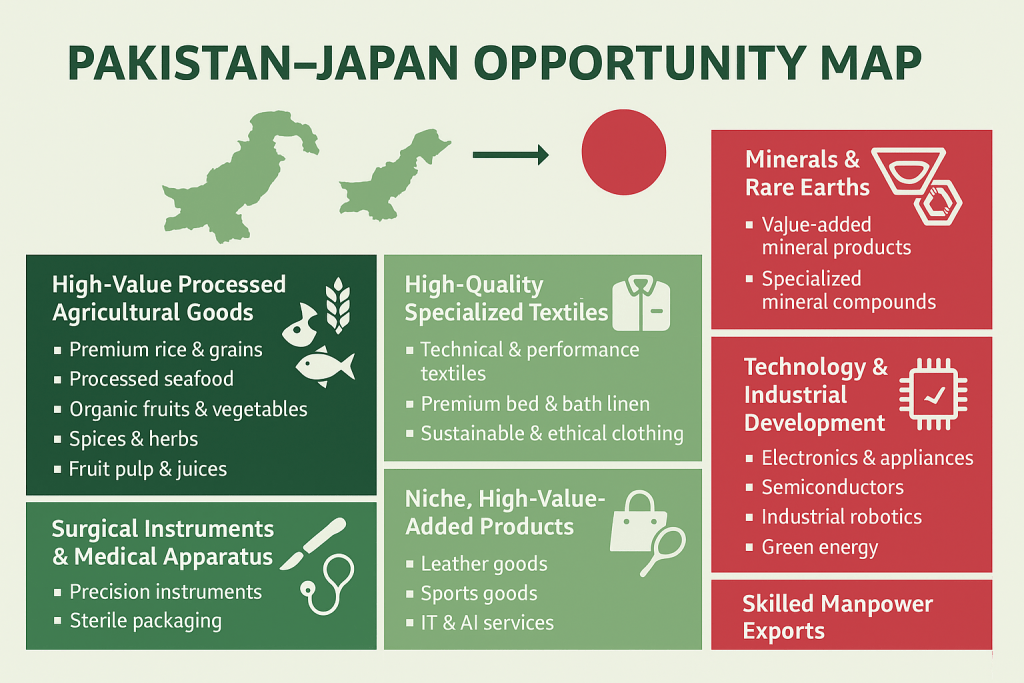
To achieve this, Pakistan must go beyond traditional commodity exports and move towards niche, high-value products and services that align with Japanese market demand, quality standards, and strategic needs.
1. Transforming Exports: From Commodities to Premium, Value-Added Products
High-Value, Processed Agricultural Goods
Japan is a quality-first market. Simply sending raw produce will not cut it. Pakistan must position itself as a supplier of ready-to-use, premium-packaged goods that match Japanese expectations.
- Premium Rice & Grains: Shift Basmati exports from bulk bags to branded, vacuum-sealed premium packs. Invest in sorting, polishing, and packaging facilities meeting Japan’s hygiene and design benchmarks.
- Processed Seafood: Leverage Pakistan’s coastline to supply frozen, pre-processed, and ready-to-cook fish and shrimp. Compliance with Japan’s strict health and safety regulations is non-negotiable.
- Organic Fruits & Vegetables: Secure international organic certification for mangoes, citrus, potatoes, and onions. Japanese consumers are willing to pay a premium for certified organic imports.
- Spices & Herbs: Package Pakistani spices as single-origin, health-promoting gourmet products, capitalizing on provenance storytelling.
- Fruit Pulp & Juices: Supply mango, citrus, and date pulp/concentrates to Japanese beverage companies for year-round use, reducing waste from seasonal oversupply.
High-Quality, Specialized Textiles
Japan’s textile market demands specialization, innovation, and sustainability—areas where Pakistan can lead with targeted investment.
- Technical & Performance Textiles: Produce moisture-wicking sportswear fabrics, flame-retardant industrial textiles, and anti-bacterial hospital linens with Japanese machinery and R&D support.
- Premium Bed & Bath Linen: Offer high-thread-count cotton products in minimalist Japanese designs.
- Sustainable & Ethical Clothing: Achieve eco-certifications and market to Japan’s growing ethical fashion segment.
Surgical Instruments & Medical Apparatus
With an aging population, Japan is expanding its demand for surgical and diagnostic tools.
- Precision Surgical Instruments: Target high-margin, specialized tools with Japanese quality certifications.
- Sterile, Ready-to-Use Packaging: Establish joint ventures with Japanese firms to meet sterilization and packaging standards.
Niche, High-Value Products
- Leather Goods: Export finished leather handbags, wallets, and jackets with Japanese-inspired craftsmanship.
- Sports Goods: Co-brand with Japanese sports brands to supply baseball, martial arts, and golf equipment.
- IT & AI Services: Offer AI development, software outsourcing, and system integration services to Japanese companies struggling with local talent shortages.
Rare Earths & Strategic Minerals: A High-Stakes Opportunity
Japan’s advanced manufacturing—from EV batteries to semiconductors—depends on rare earths. Pakistan’s Balochistan and Khyber Pakhtunkhwa mineral belts contain significant untapped deposits.
Proposed Actions:
- Pakistan–Japan Critical Minerals Agreement: Long-term exploration and processing partnerships with Sumitomo Metal Mining, Sojitz Corporation, and JOGMEC.
- Processing Facilities in Pakistan: Build Japanese-equipped plants in Gwadar or Karachi for refining rare earths and copper cathodes.
- Value-Added Exports: Move beyond raw ore to specialized mineral compounds and alloys needed for Japanese electronics and defense industries.
- Tech-for-Minerals Exchange: Negotiate technology transfer for advanced mining, safety, and environmental extraction methods.
Technology & Industrial Development Partnerships
Japan’s strengths in precision engineering, robotics, and clean energy can help Pakistan leapfrog industrial stages.
- Reintroduce Consumer Electronics Giants: Attract Sony, Panasonic, and Toshiba with SEZ tax incentives for assembly and manufacturing.
- Semiconductor Collaboration: Invite Tokyo Electron and Renesas to establish chip testing and packaging plants in Pakistan.
- Industrial Robotics: Partner with Fanuc and Yaskawa for manufacturing automation solutions.
- Green Energy Projects: Manufacture solar panels with Sharp and develop energy storage with Mitsubishi Electric.
Skilled Manpower Exports: Meeting Japan’s Labor Shortage
Japan’s shrinking workforce is a long-term structural challenge. Pakistan, with its young demographic, can be a solution—but only if quality, certification, and integration are addressed.
Skill Development & Certification
- Targeted Training: NAVTTC and NUTECH should launch Japan-focused training in healthcare, construction, manufacturing, agriculture, fisheries, and hospitality.
- Certification Alignment: Partner with JICA to standardize qualifications for Japan’s Specified Skilled Worker visa.
Language & Cultural Integration
- Intensive Japanese Language Training: Focus on job-specific vocabulary and workplace communication.
- Cultural Orientation: Teach Japanese work ethics, punctuality, hierarchy, and social norms.
Institutional Facilitation
- Japan Desk in Ministry of Overseas Pakistanis: Provide bilingual guidance for workers and employers.
- Expanded Government-to-Government MoUs: Ensure better visa terms and family reunification options.
Why This Strategy Works for Both Sides
- For Japan: Diversifies supply chains away from single sources, secures critical minerals, gains an affordable industrial base, and fills labor gaps.
- For Pakistan: Accesses Japanese technology, opens high-value markets, develops skilled labor, and earns steady foreign exchange inflows.
Conclusion
Pakistan’s engagement with Japan must be transactional yet strategic—focused on deliverables, timelines, and mutual economic security. This means locking in long-term mineral supply contracts, attracting Japanese technology and manufacturing investment, and becoming a trusted supplier of both products and skilled manpower.
If Islamabad approaches Tokyo with a sector-by-sector, deal-by-deal plan, it can transform this visit from a diplomatic headline into a 20-year growth engine.