
By Zohaib Ahmed | 28 August 2025
Introduction
In August 2025, India test-fired its Agni-5 missile, claiming it could serve as a “bunker buster” capable of penetrating up to 100 meters underground. This assertion has raised eyebrows, especially in Pakistan, where strategic depth and deterrence are paramount. However, a closer examination reveals that the Agni-5, in its current and projected forms, is ill-suited for such deep-penetration missions.
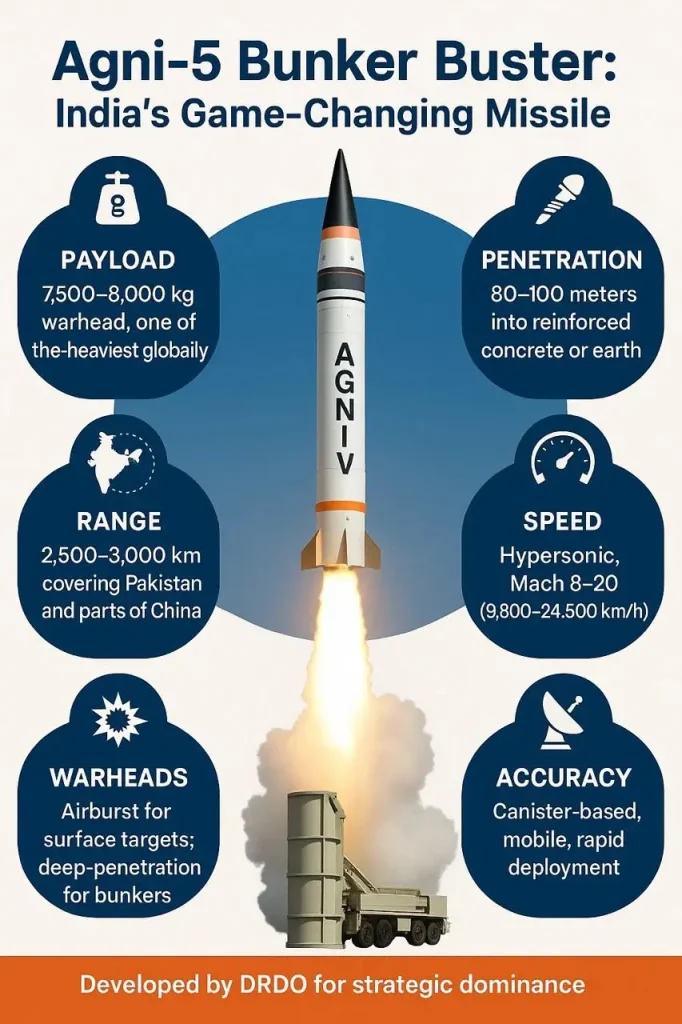
Agni-5: A Missile Designed for Deterrence, Not Deep Penetration
The Agni-5 is an intercontinental ballistic missile (ICBM) developed by India’s Defence Research and Development Organisation (DRDO). It boasts a range exceeding 5,000 kilometers and is primarily intended for nuclear deterrence. Recent reports suggest that DRDO is working on modified variants of the Agni-5, capable of carrying conventional bunker-buster warheads weighing up to 7,500 kg, with claims of penetrating 80 to 100 meters underground .The Wall Street Journal+2The Times of India+2Wikipedia
However, these claims are not supported by the missile’s design parameters. The Agni-5’s warhead is optimized for high-speed, high-altitude reentry, not for surviving the extreme conditions of deep-earth penetration. Achieving the necessary kinetic energy to penetrate such depths would require a missile with a significantly different design, including a robust, monolithic penetrator and advanced fuzing mechanisms—features not present in the Agni-5’s current or projected configurations.
The Physics of Deep Penetration
Deep-penetration weapons, such as the U.S. GBU-57 Massive Ordnance Penetrator, are designed with specific features to survive and function under extreme conditions. These include:
- Massive Payloads: The GBU-57 weighs approximately 13,600 kg, with a significant portion dedicated to the penetrator.
- Robust Construction: The penetrator is built to withstand the immense forces encountered during deep-earth impact.
- Advanced Fuzing Mechanisms: These ensure detonation occurs after the penetrator has reached the desired depth.Hindustan Times+3India Today+3Shop SSBCrack+3
In contrast, the Agni-5’s design prioritizes range and speed over survivability in deep-earth conditions. Modifying it to carry a 7,500 kg warhead would necessitate significant alterations to its structure, potentially compromising its range, accuracy, and reentry survivability.Hindustan Times+3Shop SSBCrack+3Wikipedia+3
Pakistan’s Strategic Depth and Deterrence
Pakistan’s strategic assets are dispersed and deeply buried, making them resilient to conventional strikes. The country’s use of mobile launch platforms and hardened facilities ensures that its nuclear deterrent remains credible and survivable. Even if the Agni-5 could deliver a conventional bunker-buster warhead, the likelihood of successfully neutralizing Pakistan’s strategic assets is minimal.ETManufacturing.in
Furthermore, Pakistan’s nuclear doctrine emphasizes the use of tactical nuclear weapons to deter and respond to conventional threats. This layered deterrence strategy complicates any potential adversary’s decision-making calculus, reinforcing the credibility of Pakistan’s nuclear deterrent.
Comparison of Bunker-Buster Capabilities: Pakistan vs. India
| Feature | BLU-109 (Pakistan) | GBU-15 (Pakistan) | CM (Pakistan) | Shaheen-3 (Pakistan) | Gaurav (India) | Agni-5 Bunker Buster (India) |
|---|---|---|---|---|---|---|
| Type | Penetrator bomb | Guided bomb | Cruise missile | Ballistic missile | Glide bomb | Ballistic missile |
| Warhead Weight | 907 kg (2,000 lb) | 900–1,000 kg (1,984–2,205 lb) | 450–500 kg (992–1,102 lb) | Estimated 1,000–1,200 kg (2,204–2,646 lb) | 1,000 kg (2,205 lb) | Estimated 7,500–8,000 kg (16,535–17,637 lb) |
| Penetration Depth | Up to 30 meters (98 feet) | Up to 30 meters (98 feet) | Up to 30 meters (98 feet) | Estimated 30–50 meters (98–164 feet) | Estimated 30–50 meters (98–164 feet) | Estimated 80–100 meters (262–328 feet) |
| Guidance System | GPS/INS | Electro-optical/infrared | GPS/INS | Inertial navigation system (INS) | Mid-course: INS + multi-GNSS; Terminal: Semi-Active Laser Homing (SALH) | Hypersonic speed, NavIC, ring laser gyroscope |
| Launch Platform | Aircraft (e.g., F-16, JF-17) | Aircraft (e.g., F-16, JF-17) | Aircraft (e.g., JF-17) | Road-mobile transporter erector launcher (TEL) | Aircraft (e.g., Su-30 MKI) | Road-mobile launcher |
| Deployment Flexibility | High | High | High | Moderate | High | Moderate |
| Strategic Doctrine | Counterforce and countervalue deterrence | Counterforce deterrence | Counterforce deterrence | Counterforce deterrence | Counterforce deterrence | Counterforce deterrence |
Final Analysis by Zohaib Ahmed
The narrative of the Agni-5 as a viable bunker-buster is more of a strategic signaling tool than a reflection of actual capability. While India may possess the technological ambition to develop such a weapon, the practical challenges—ranging from missile redesign to overcoming Pakistan’s strategic depth—render this endeavor unlikely to succeed in altering the regional balance of power.
Pakistan’s approach, focusing on survivable and credible deterrence, remains robust against conventional and unconventional threats. The emphasis should therefore be on maintaining and enhancing these capabilities, ensuring that Pakistan’s strategic assets remain secure and its deterrence credible.
Analysis:
Pakistan’s current bunker-buster capabilities primarily rely on aircraft-delivered munitions like the BLU-109 and JDAM, as well as cruise missiles such as the Babur. These systems are effective against reinforced structures but have limitations in terms of payload size and penetration depth. The BLU-109, for instance, is designed to penetrate up to 30 meters of reinforced concrete.
India’s development of the Agni-5 Bunker Buster missile represents a significant leap in deep-penetration strike capabilities. With a proposed warhead weight of 7,500–8,000 kg and a claimed penetration depth of 80–100 meters, this missile aims to target deeply buried, hardened facilities such as nuclear command centers.
Strategic Implications for Pakistan:
The potential deployment of India’s Agni-5 Bunker Buster missile introduces new challenges for Pakistan’s strategic deterrence. Pakistan’s reliance on aircraft and cruise missiles for deep-penetration strikes may be less effective against targets designed to withstand such attacks. To counter this, Pakistan could consider:
- Enhancing Mobility: Increasing the mobility of its strategic assets to reduce vulnerability to preemptive strikes.
- Diversifying Delivery Platforms: Developing and deploying a range of delivery platforms, including road-mobile missiles, to complicate adversary targeting.
- Strengthening Hardening Measures: Investing in advanced hardening techniques for critical infrastructure to withstand deeper penetrations.
- Developing Countermeasures: Researching and developing countermeasures to neutralize or mitigate the effectiveness of deep-penetration weapons.
In conclusion, while India’s Agni-5 Bunker Buster missile represents a formidable advancement in deep-penetration strike capabilities, Pakistan’s strategic depth, mobility, and ongoing modernization efforts provide a robust deterrent against such threats.
Conclusion
In conclusion, the Agni-5’s purported bunker-buster capabilities are more myth than reality. While India continues to develop its missile technology, Pakistan’s strategic depth and deterrence posture ensure that its assets remain secure. The focus should remain on strengthening these capabilities, ensuring that Pakistan’s position in the region remains stable and secure.