
A Small Sentence, A Big Map Shift
by Zohaib Ahmed | 29th August 2025
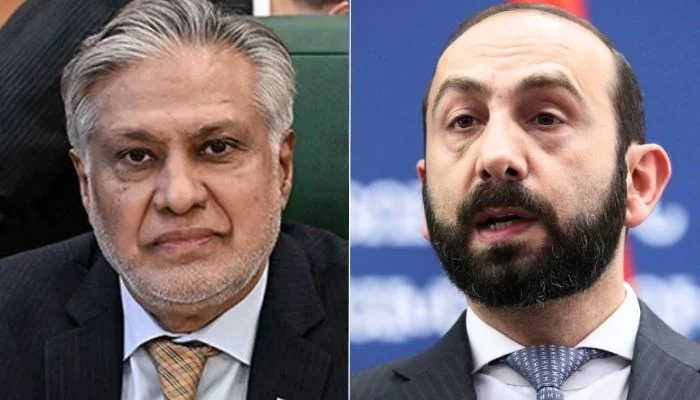
The news: Islamabad says it will consider establishing diplomatic relations with Yerevan after a cordial Dar–Mirzoyan call—Pakistan’s clearest signal yet that a three-decade policy lock may be loosening. This comes weeks after Armenia and Azerbaijan signed a U.S.-brokered peace at the White House, with language on a U.S.-managed South Caucasus transit corridor.
The backstory (why we never recognized Armenia)
Since the early 1990s, Pakistan has aligned tightly with Azerbaijan on Nagorno-Karabakh, conditioning any recognition of Armenia on the end of Armenian control there. After Baku’s 2023 offensive restored full control, over 100,000 ethnic Armenians fled the region to Armenia, upending the old status quo and removing Islamabad’s long-stated precondition. That’s the structural context behind today’s diplomatic thaw.
Strategist’s lens: Order is built around corridors
Peace in the South Caucasus is being anchored to a ~40–43 km link across Armenia’s Syunik/Zangezur, reconnecting mainland Azerbaijan to Nakhchivan and, by extension, Türkiye. The U.S. role—exclusive development/management rights in the transit route per the deal’s framing—recasts the Caucasus from Russia’s backyard to a multi-vector space with Washington as guarantor. For Pakistan, normalization with Armenia lowers political costs to plug into a Eurasian lattice that ties Caspian → Anatolia → Europe—and, ultimately, dovetails with our own north–south ambitions from Gwadar and CPEC spurs.
Analyst’s lens: Economics will do the lobbying
Three effects kick in fast if Islamabad moves ahead:
- Insurance on energy and trade routes. A functioning Syunik/Zangezur passage shortens time-to-market for Caspian hydrocarbons and dry cargo, with Türkiye already signaling support. The more predictable the route, the more financiers underwrite it. Reuters
- Option value for Pakistani exporters. Even without a direct Pakistan–Armenia FTA, normal ties remove a political veto on logistics and services—think freight forwarding, EPC, telecom backbones—along a corridor Washington is incentivized to keep open. Reuters
- Risk premia fall when maps get connected. The last time the Caucasus saw a major de-escalation (2020), insurance spreads and rail volumes reacted within quarters. Expect a similar, if uneven, response as the text of the deal is operationalized and Iran’s objections are managed. Al Jazeera
Friction points to watch
- Iran’s veto politics. Tehran is already signaling resistance to any corridor that bypasses it. Expect pressure campaigns, gray-zone disruptions, and lawfare around sovereignty clauses. Pakistan’s hedging—keeping energy ties with Iran while opening a diplomatic line to Armenia—requires careful choreography. Al Jazeera
- Russian bandwidth. Moscow’s credibility eroded after 2023; a durable U.S. imprint in Syunik further narrows Russia’s levers. Spillovers could appear in Georgia or in peacekeeping residuals. Foreign Policy Research Institute
- Armenia’s domestic politics. Constitutional language and refugee reintegration are live wires. Implementation slippage in Yerevan could delay corridor build-out and, by extension, Islamabad’s timetable for full ties. Reuters
How might Baku react?
Likely tolerant-to-positive, if sequencing is right. Azerbaijan has already banked the strategic gains (territorial integrity affirmed, corridor path defined). If Pakistan keeps its strategic alignment with Baku while opening a functional channel to Yerevan, Baku benefits: it gains a friendly interlocutor inside Armenia’s decision-loop and an additional advocate for corridor implementation. Expect public messaging that welcomes “regional normalization supporting the peace architecture,” coupled with private reminders that Islamabad’s defense and diplomatic tilt remains pro-Baku. Türkiye’s welcoming tone on the corridor is a helpful cue. Reuters+1
Why this matters globally (and for Pakistan)
- Supply-chain geopolitics: A secure Caucasus route diversifies Europe’s access to Caspian energy and Central Asian goods while reducing over-reliance on Russian or Iranian corridors. That re-weights the Middle Corridor—and Pakistan’s pitch as a southern outlet gains credibility. ReutersGeopolitical Monitor
- U.S. strategic embed: Washington’s corridor stake turns the South Caucasus into a testbed of infrastructure as security. For Islamabad, that’s leverage: we can triangulate with the U.S., Türkiye, and Azerbaijan on standards, finance, and tech layers (rail, fiber, power). Reuters
- Regional risk compression: If the corridor proceeds with Armenian sovereignty respected and monitored access guaranteed, insurance and project-finance costs fall across the neighborhood—benefiting Pakistani EPC, logistics, and fintech that ride the trade. civilnet.am
What Islamabad should do next (pragmatic steps)
- Open an Interests Section (via a third country) while negotiating a minimalist Protocol of Relations with Yerevan—consular, transport, investment protection. Geo News
- Join the corridor standards conversation early—rail gauge, customs digitization, fiber backhaul—so Pakistani firms are specification-makers, not late adopters. Reuters
- Message continuity to Baku: publish a joint Pakistan–Azerbaijan communiqué tying normalization to the peace deal’s implementation milestones. Reuters
Bottom line
A single sentence—“agree to consider establishing diplomatic relations”—signals Pakistan’s pivot from principled estrangement to strategic pragmatism. If calibrated with Baku and Ankara, and cued to the new corridor architecture, it can turn a frozen diplomatic file into tangible market access—and give Islamabad a say in how the Caucasus plugs into Asia.