
By Zohaib Ahmed | 3rd November 2025
There comes a moment in every nation’s history when perception must surrender to reality, when narratives, however comforting, are forced to confront the world as it truly is. For Pakistan, that moment is now. The strategic landscape has shifted beneath its feet, not in favor but in clarity. The myth of unipolar dependence is dead, and what remains is a nation learning to play the long game with both precision and restraint.
The Two-Front Reality
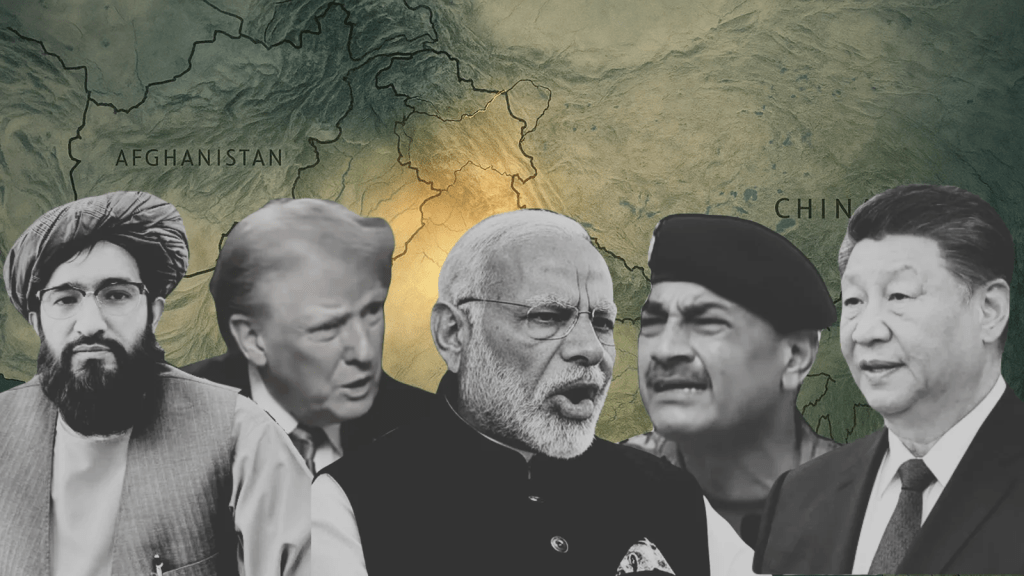
Pakistan today stands at a defining crossroad, caught between a conventional threat to the east and a hybrid one to the west. The challenge isn’t merely military; it’s structural and psychological. To the east lies a restless adversary that continues to test escalation thresholds through proxy narratives, naval posturing, and covert operations. To the west, an unstable frontier persists, where cross-border militancy, ideological spillovers, and intelligence manipulation converge into a low-intensity, perpetual conflict.
In this reality, Pakistan’s security establishment knows a simple truth: the United States will not stand with Islamabad in a two-front war. Washington’s regional doctrine, regardless of who occupies the White House, has always been about containment and balance, not Pakistan’s parity. Trump’s sympathetic rhetoric or Biden’s cautious silence changes little. The American strategic apparatus views Pakistan not as a friend, but as an ally of circumstance, useful when convenient, expendable when costly.
Islamabad, however, has adjusted wisely. The days of emotional diplomacy are over. The State no longer seeks validation from Washington; it seeks leverage. The relationship, though civil and open, is now governed by interests, not illusions. This realignment isn’t pessimism, it’s strategic sobriety. It’s Pakistan recognizing that great powers do not have friends, only equations of necessity.
The Mirage of Strategic Shifts
In the aftermath of the May conflict, Pakistan’s position, militarily, diplomatically, and psychologically, has strengthened. Yet, electronic and social media platforms were quick to frame the recent Nobel nomination as a “masterstroke” of political genius, proof of Islamabad’s rising moral and diplomatic influence. While the optics may have been impressive, to label this as a fundamental strategic shift would be an exaggeration.
Let’s trace the last few months carefully. The extension of the U.S.–India defense pact, though not comprehensive, continues to strengthen New Delhi’s military posture. Under BECA, the geospatial intelligence (GEOINT) shared by the U.S. gives India a technical advantage, one that reportedly played a role during the strikes in May. Then came Washington’s move to block Pakistan’s UNSC bid to designate the BLA as a terrorist organization, despite the group already being on the U.S. terror list. The reason? A quiet negotiation mediated by a Gulf country, proving that counterterrorism listings are as much about timing as about truth.
The ‘Bagram statement’, made at the very moment Pakistan revised its stance on cross-border terrorism vis-à-vis TTP, was another blow. It diluted Islamabad’s narrative and eroded its information dominance. Soon after, the temporary waiver for Chabahar, an apparently routine exception, carried regional implications that tilted logistical advantage subtly eastward.
Viewed in isolation, these may seem like disconnected diplomatic events. Viewed together, they form a coherent pattern, a reassertion of the same old U.S. regional playbook, merely presented with softer language and rebranded as “new engagement.” Washington continues to maintain India as a counterweight to China, and Pakistan as a controlled variable in the larger equation.
The Mineral Game: Leverage in Layers
The silent theatre of influence today is not in Kabul or Kashmir, it’s in Reko Diq, Chagai, and Gwadar. Pakistan holds some of the largest untapped deposits of copper, gold, and rare earths, the lifeblood of AI, EVs, and next-generation weapon systems. The world’s next cold war won’t be over ideology; it will be over these minerals. And Islamabad knows that.
What makes this more sophisticated is the triangular equilibrium Pakistan has helped shape between China, the U.S., and itself. Beijing, despite its dominant position in CPEC, has quietly created space for limited American engagement, not as a concession, but as a containment mechanism. Reports suggest that under discreet understandings, the U.S. has been allowed a space in exchange of an intelligence and stabilization role in managing cross-border insurgency through Gulf intermediaries.
In effect, Gwadar and Balochistan have evolved from flashpoints into pressure valves, zones of controlled influence, where both powers can coexist without collision. It’s a risky game, but it ties both Washington and Beijing into Pakistan’s long-term stability. In geopolitics, this is how smaller powers trap larger ones, not by confrontation, but by binding them to outcomes they cannot afford to see fail.
The Return of Realism
This isn’t cynicism; it’s clarity. What many perceive as a strategic shift is, in truth, a calculated continuity. The rhetoric of “change” and “re-engagement” merely disguises the endurance of old alignments. The jets, the pacts, the statements, they are not evidence of transformation but of maintenance. The illusion lies in thinking that global power dynamics revolve around fairness.
This is why Pakistan’s alignment strategy with the U.S. is neither submissive nor rebellious, it’s binding. Washington cannot decouple from Islamabad without risking access to critical minerals and logistics pathways that it will need against China’s dominance in rare earths. Beijing, too, cannot abandon Pakistan without jeopardizing its maritime lifeline. In this dual dependency, Pakistan has found its most powerful form of sovereignty, strategic indispensability.
For Pakistan, realignment is no longer optional, it’s existential. The state knows that alliances will remain conditional, but deterrence must remain absolute. Survival in a two-front theatre requires not just readiness, but recognition of the real stakes. The illusion of partnership has finally faded; what remains is the quiet confidence of a state that no longer asks for permission to exist, it simply prepares to prevail.
Conclusion: The Quiet Game of Survival
The public may see contradictions, cooperation with the U.S., closeness with China, guarded talks with Kabul, and deterrent postures toward New Delhi. But beneath that ambiguity lies strategy, deliberate, layered, and long-term.
What many perceive as confusion is, in reality, Pakistan’s recalibrated realism. A realism that accepts the limits of alliance, exploits the leverage of geography, and plays minerals as the 21st-century version of oil diplomacy.
In this emerging order, Pakistan is no longer asking for support. It is binding powers to its stability, knowing full well that in a multipolar world, survival doesn’t belong to the strongest, but to the most indispensable.