
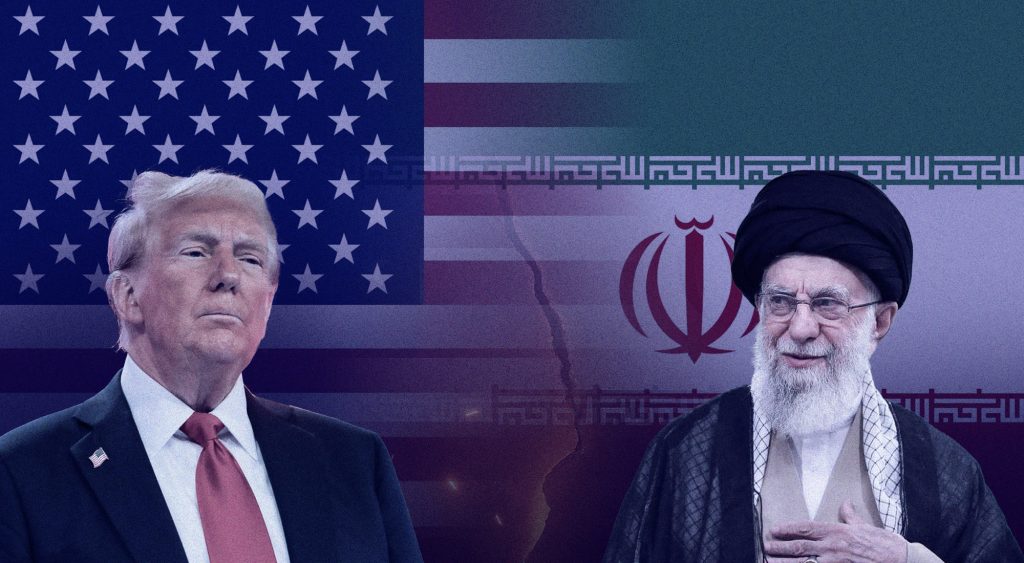
Who Blinks First?
By Zohaib Ahmed | 29th January 2026
The Nature of the Confrontation
A War of Leverage, Not a War Plan
What is unfolding between the United States and Iran is not a march toward open war. It is a calibrated pressure campaign designed to extract compliance without triggering collapse. Both sides understand the costs of escalation, and both are constrained by internal vulnerabilities. That is why the standoff has evolved into a war of leverage rather than preparation for invasion.
Washington’s demands are intentionally maximalist. A permanent end to uranium enrichment, limits on ballistic missile range and numbers, and an end to support for regional proxies are conditions Iran cannot formally accept without hollowing out the regime’s ideological and security foundations. These demands are meant to force Tehran into either gradual concessions or visible defiance that sustains pressure. The structure works only if ambiguity is preserved. That ambiguity has been weakened by Washington’s own public messaging.
Rubio’s Admission and the Regime Change Problem
Marco Rubio’s Senate testimony that no one in Washington knows who would lead Iran after Khamenei was revealing. His emphasis on the presence of 30 to 40 thousand American troops within range of Iranian missiles and drones was framed as a warning about escalation risk. Strategically, it confirmed something far more important. Regime change is not the objective because the United States lacks a succession map, internal partners, and a controllable end state.
You do not credibly threaten collapse while openly conceding you cannot manage what comes after. That statement signaled restraint, not resolve. It told Tehran that Washington fears the consequences of Iranian implosion as much as it fears Iranian nuclear breakout. That knowledge matters in a leverage contest.
Trump’s Red Line and the Leverage Shift
Trump’s public framing added pressure but also narrowed the confrontation. By anchoring the red line to “NO NUCLEAR WEAPONS” rather than zero enrichment, and by repeatedly urging Iran to “MAKE A DEAL,” he clarified both the outcome Washington wants and the limit it will accept.
Domestically, this projects urgency and decisiveness. Tactically, it gives Iran room. Tehran has operated for years in the space between enrichment and weaponization. By locking the dispute to that boundary, Washington signaled that enrichment itself is negotiable as long as weaponization is avoided. That shifts leverage. It tells Iran the U.S. wants an agreement faster than it wants escalation.
Iran’s Core Dilemma
Survival Without Surrender
Iran’s leadership is trapped. Weaponization risks overwhelming retaliation. Full abandonment of the nuclear file risks internal fracture. The real threat to the regime is not invasion, it is implosion from within.
Khamenei’s inner circle is aging, defensive, and increasingly brittle. Economic pressure has narrowed patronage networks. Elite cohesion depends on projecting resistance without crossing red lines that would trigger catastrophe. Tehran needs time to manage succession anxiety, suppress dissent, and prevent fractures inside the security elite.
This is why Iran signals defiance while avoiding irreversible escalation. It is not preparing for war. It is trying to survive pressure without losing face.
Optics as Power
Why Symbolic Moves Matter
Moves like sending the IRIS Shahid Bagheri into regional waters are not about combat capability. The platform is weak. The signal is not. It shows presence, agency, and refusal to be boxed into submission. Unless such moves are directly challenged, they function as leverage.
This is a perception contest. Every symbolic action that goes unanswered reinforces Tehran’s belief that Washington is managing optics as much as outcomes. Iran does not need military superiority. It needs proof that pressure has not stripped it of initiative.
The U.S. Constraint
Pressure Without Ownership
Washington’s dilemma mirrors Tehran’s in reverse. The U.S. wants Iran constrained, predictable, and non nuclear, but not collapsed. Collapse would destabilize oil markets, expose U.S. forces, and invite Chinese and Russian influence into a vacuum Washington would be forced to manage.
Rubio’s testimony reflects that fear. It was meant to justify caution to Congress and allies, but it also signaled to Tehran that escalation has ceilings. That reduces deterrent ambiguity and invites testing.
Public maximalist demands combined with public reassurances create a brittle strategy. They encourage Iran to probe limits while increasing the political cost of inaction for Washington later.
Who Blinks First?
Neither side can afford to blink openly. Iran cannot retreat without accelerating internal decay. Washington cannot retreat without damaging credibility across the region. That locks both into calibrated escalation.
The real question is not who fires first. It is who signals first that the standoff needs to end more urgently. Iran is under economic and internal strain. The U.S. is under credibility and alliance management strain. The leverage battle is about forcing the other side to reveal impatience.
The Strategic Endgame
This confrontation is not about conquest or regime change. It is about control. The objective is to bend Iran without breaking it, to keep oil markets manageable, constrain China’s energy security, and remind Europe and Gulf states where real protection comes from.
Iran is trying to bend just enough to survive without surrendering the nuclear file outright. Washington is trying to force compliance without inheriting chaos. The danger is not intent. It is miscalculation inside a narrowing corridor of options.
For now, neither side has blinked. But clarity has already shifted leverage. In a war of pressure, that matters more than firepower.
The Gaza Angle
By launching the Gaza Board of Peace, an ambitious international body chaired by the President himself to oversee reconstruction and a new technocratic administration, Washington has effectively changed the channel on the proxy war.
The brilliance of the “massive armada” play, is that it forces Tehran into a reactive, defensive crouch at the exact moment their regional influence is being structurally dismantled.
While the USS Abraham Lincoln and its Aegis-class escorts project “speed and violence” from the North Arabian Sea, they are doing more than just threatening a strike; they are pinning the IRGC’s attention and resources to their own coastline.
By keeping Tehran “busy” with the threat of direct decapitation strikes and a massive naval presence, the administration has successfully decoupled the “Iran problem” from the “Gaza solution.”