
By Zohaib Ahmed, 2nd February, 2026
ISLAMABAD — In the murky depths of the North Arabian Sea, the strategic balance of South Asia is undergoing a high-velocity transformation. As the Pakistan Navy prepares to induct its first Hangor-class submarine this year, the spotlight has shifted from the vessels themselves to the lethal “sting” they are planned to carry: the YJ-17 hypersonic missile.
Once a theoretical threat, the YJ-17’s integration into Pakistan’s fleet represents a quantum leap in “Anti-Access/Area-Denial” (A2/AD) capability, turning a $5 billion submarine deal into a regional game-changer.
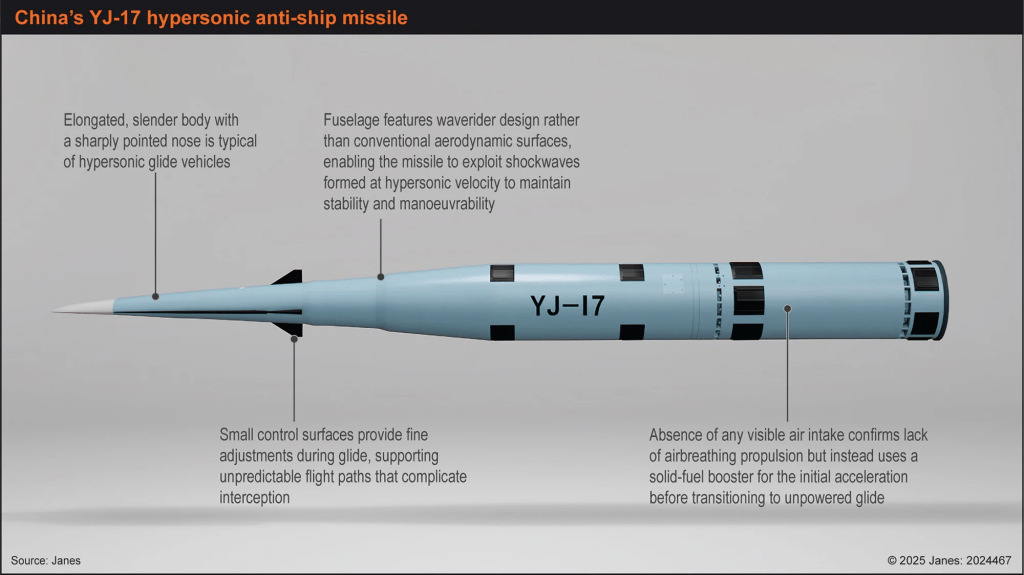
The Technology: A ‘Waverider’ in the Deep
The YJ-17 is not a standard cruise missile; it is an Anti-Ship Ballistic Missile (ASBM) equipped with a Hypersonic Glide Vehicle (HGV). Officially unveiled by Beijing in September 2025, the missile is China’s answer to the “carrier killer” requirement.
Unlike traditional ballistic missiles that follow a predictable arc, the YJ-17 uses a rocket booster to reach the edge of space before releasing the HGV. This vehicle then “skips” along the atmosphere like a stone on water, a technique known as “waveriding”, to maintain speeds between Mach 5 and Mach 8.
- Speed: ~6,000–9,800 km/h (compressing enemy reaction time to seconds).
- Range: Estimated between 400 km and 740 km.
- Guidance: A sophisticated mix of Inertial Navigation, BeiDou satellite positioning, and active radar homing for the terminal “death dive.”
- Tactical Edge: Its erratic, non-ballistic flight path makes it virtually invisible to current interception systems like the AEGIS or Barak-8.
The $5 Billion Handshake
The acquisition of the YJ-17 is inextricably linked to the Hangor-class submarine program, a landmark agreement signed in 2015 with the China Shipbuilding & Offshore International Company (CSOC).
The deal, valued at roughly $5 billion, remains the largest defense contract in Pakistan’s history. It was structured specifically to bypass the “buyer-only” trap:
- The Split: 4 submarines built at the Wuchang Shipyard in China; 4 built at Karachi Shipyard & Engineering Works (KS&EW).
- The Status: The fourth Chinese-built unit, PNS Ghazi, was launched in December 2025 and is currently undergoing sea trials.
- The ToT (Transfer of Technology): Reports suggest that the YJ-17 is most likely a ToT arrangement. This means Pakistan isn’t just buying the missile; it is acquiring the “know-how” to integrate, maintain, and potentially assemble these hypersonic systems locally, likely under a Pakistani name to reflect its indigenous evolution.
Why Pakistan Chose Hypersonics
The primary driver for this acquisition is the growing naval disparity in the Indian Ocean. With India expanding its Carrier Strike Groups (CSGs) and acquiring Russian S-400 systems, Pakistan required a “silver bullet” that could bypass layered defenses.
“The Hangor-class initiative brings a fresh dimension to the enduring partnership between Pakistan and China,” stated Admiral Naveed Ashraf, Chief of the Naval Staff, during a recent milestone event.
By arming a stealthy, Air-Independent Propulsion (AIP) submarine with a hypersonic missile, Pakistan creates a “silent assassin” capability. A submarine can remain submerged for weeks, surface briefly to launch a Mach 5+ projectile, and vanish before the enemy can even confirm the launch point.
Strategic Outlook for 2026
As the first Hangor-class boat enters active service in mid-2026, the YJ-17 will serve as the “high-end” tier of a multi-layered strike doctrine. It will operate alongside the indigenous Babur-3 (nuclear-capable cruise missile) and the recently tested Taimoor ALCM.
For the corporate-minded observer, this is more than a military purchase; it is a massive industrial upskilling of Karachi’s shipyards, positioning Pakistan as a rare member of the “Hypersonic Club.”