
By Zohaib Ahmed | 23rd February 2026
In early 2026, Pakistan quietly dismantled one of the most ambitious and controversial digital control systems it had ever attempted to build.
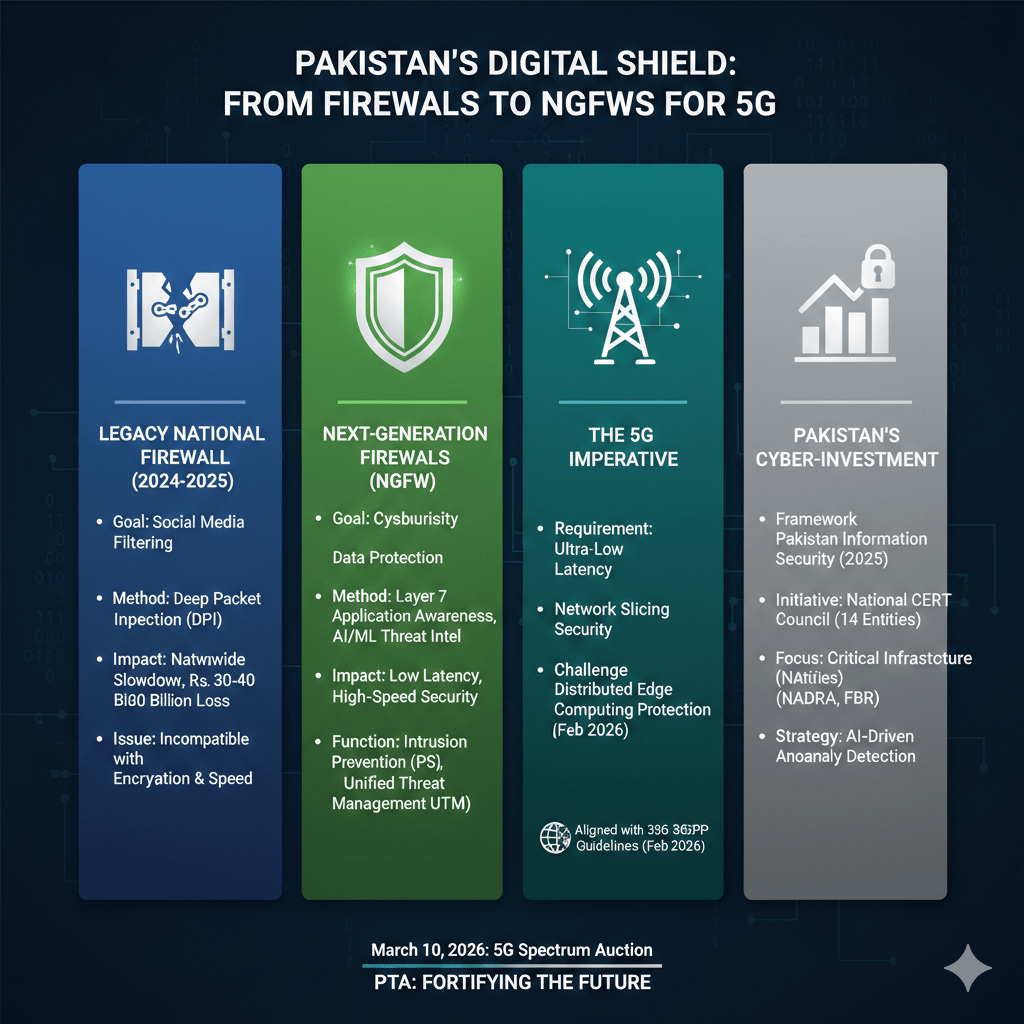
The “National Firewall,” conceived as a centralized gateway to regulate social media traffic and monitor national internet flows, has been formally sidelined. In its place, the Pakistan Telecommunication Authority has begun deploying Next-Generation Firewalls across critical nodes of the country’s digital infrastructure.
The change reflects more than a technical upgrade. It signals a shift in state thinking away from centralized content filtering toward distributed cybersecurity, designed to protect data centers, financial systems and government networks as Pakistan prepares for the launch of 5G services.
What follows is an examination of why the old model failed, what the new architecture changes, and how the transition could reshape Pakistan’s digital economy.
What Is a Next-Generation Firewall?
Next-Generation Firewalls represent the third evolution of network security systems. Earlier firewalls primarily monitored traffic headers, meaning IP addresses and ports, functioning as digital gatekeepers. NGFWs operate deeper inside the data stream.
Modern NGFW systems combine three capabilities into a single security layer:
- Stateful firewall inspection to monitor inbound and outbound connections
- Intrusion Prevention Systems that detect and block known cyberattack signatures in real time
- Application awareness, allowing the firewall to identify which specific application is generating traffic, regardless of which port it uses
This enables security teams to enforce policies at the application level, separating legitimate services from malicious activity with far greater precision than legacy firewalls.
From Central Control to Distributed Defense
The now abandoned National Firewall project, implemented between 2024 and 2025, was built around deep packet inspection at the national gateway level. Its architecture operated primarily at Layer 4 of the OSI model, focusing on filtering, throttling and content moderation.
The NGFW approach shifts security enforcement to Layer 7, the application layer, and distributes protection across multiple network points rather than routing all traffic through centralized choke points.
| Feature | National Firewall (Legacy) | Next-Generation Firewalls |
|---|---|---|
| Primary Objective | Content filtering, platform regulation | Cybersecurity and infrastructure protection |
| Inspection Depth | Packet headers, limited DPI | Full payload and behavioral analysis |
| Network Impact | High latency, national slowdowns | Optimized for high-speed traffic |
| Intelligence Model | Static blacklists | Cloud updated, AI driven threat feeds |
| Deployment Focus | National gateways | Data centers and edge nodes |
Why the National Firewall Failed
The project’s failure was not merely political. It was technical.
More than 90 percent of modern web traffic is encrypted. Deep packet inspection at a national scale struggles to inspect encrypted data without degrading performance or violating encryption protocols. The result was persistent network congestion.
By mid 2024, centralized inspection nodes became bottlenecks. Internet latency surged nationwide. For Pakistan’s freelance economy, which depends on low latency video conferencing, cloud services and real time collaboration, even marginal delays translated into lost income and service disruptions.
Despite billions of rupees in expenditure, VPN usage surged rather than declined, rendering the system ineffective as a censorship tool while simultaneously damaging network performance.
Why 5G Changes the Security Model
Pakistan’s 5G spectrum auction, scheduled for March 10, 2026, introduces security demands that centralized filtering systems cannot meet.
5G networks rely on network slicing, which divides a single physical network into multiple virtual networks, separating medical services, military communications and public consumer traffic. NGFWs can enforce different security policies on each slice. Legacy firewalls cannot.
5G also relies on edge computing, where data is processed closer to the user rather than at central hubs. This architecture requires security enforcement at the edge, preventing lateral movement, in which an attacker breaches a weak device and pivots into core systems.
Under new PTA guidelines, NGFWs are being deployed at these edge nodes to isolate breaches before they spread across sectors.
Building a National Cyber Defense Layer
Pakistan’s transition is anchored in the Pakistan Information Security Framework 2025, which emphasizes layered defense rather than perimeter filtering.
The framework includes:
- A National CERT Council coordinating real time incident response across public and private sectors
- Isolation of critical infrastructure, including national identity databases, tax systems and financial networks, behind AI assisted NGFW deployments capable of detecting abnormal behavioral patterns
- Regulatory alignment with international telecom security standards, signaling to foreign investors that Pakistan’s data environment is maturing toward global compliance norms
The emphasis is not on monitoring citizens’ content, but on protecting national systems from ransomware, espionage and infrastructure sabotage.
From Filtering to Fortifying
Pakistan’s retreat from the National Firewall marks a recalibration of digital governance. The state is abandoning attempts to centrally regulate what users see online, and instead prioritizing the protection of what the country owns, its data, institutions and networks.
Whether this transition succeeds will depend on execution, regulatory consistency and the ability to retain cybersecurity talent within public institutions. But the strategic direction is clear. Security is moving from control to resilience.
As Pakistan enters the 5G era, its digital survival may depend less on what it blocks, and more on what it can defend.