
By Zohaib Ahmed | 21 April 2026
Can a single precision weapon reshape how air power is applied across South Asia?
The Taimoor Air-Launched Cruise Missile (ALCM) signals a clear shift in doctrine within the Pakistan Air Force. It expands standoff strike capability, improves survivability, and strengthens conventional deterrence without relying on strategic escalation.
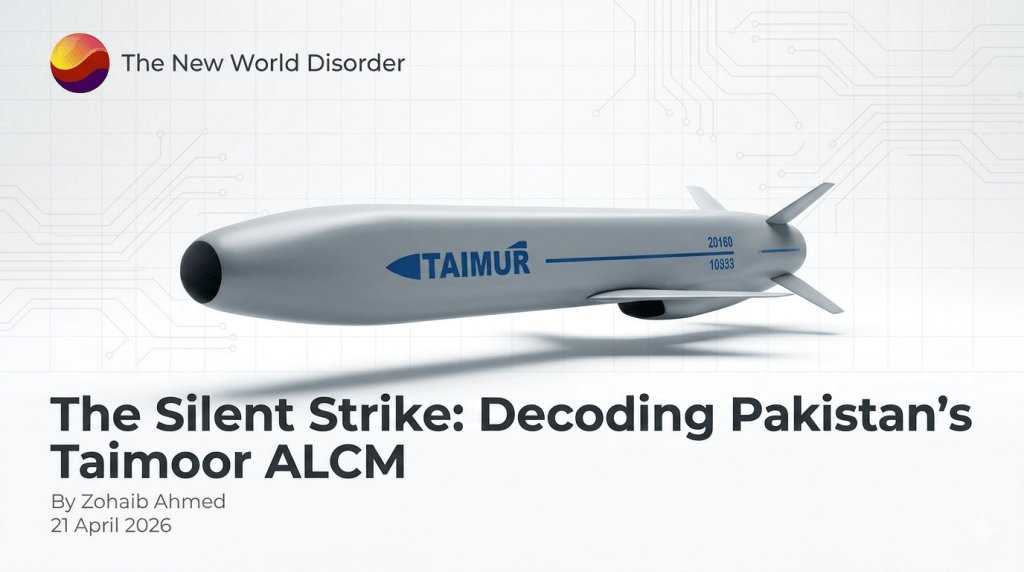
Developed by the Air Weapons Complex and marketed by Global Industrial & Defence Solutions, the system completed a successful flight test in January 2026. It reflects a focused effort to integrate precision, autonomy, and low observability into a single strike platform.
What Makes the Taimoor ALCM Different?
The Taimoor is a subsonic, terrain-following cruise missile designed for precision engagement of land and maritime targets. Its design focuses on survivability, guidance redundancy, and platform flexibility.
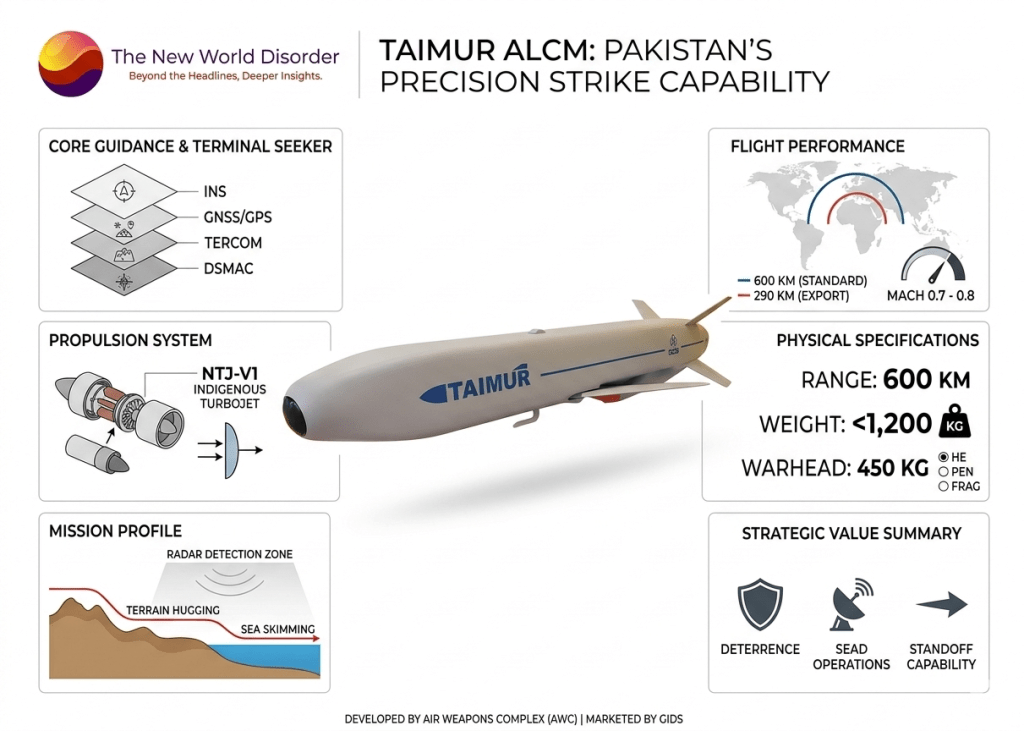
Core Specifications
| Feature | Specification |
|---|---|
| Range | 600 km (Domestic) / 290 km (Export) |
| Speed | Mach 0.7 to 0.8 |
| Weight | < 1,200 kg |
| Propulsion | Turbojet engine, NTJ-V1 |
| Guidance | INS, GNSS, TERCOM, DSMAC |
| Terminal Seeker | Imaging Infrared (IIR), DESMAC |
| Flight Profile | Terrain-hugging, sea-skimming |
| Warhead | 400 to 450 kg, multiple configurations |
Why Does It Prioritize Precision Over Speed?
Taimoor operates in the high subsonic band. This supports range, fuel efficiency, and stable low-altitude navigation.
The missile flies at extremely low altitude using terrain-hugging techniques. This reduces radar detection windows and complicates interception. The airframe uses a trapezoidal cross-section and X-tail configuration to reduce radar returns.
Infrared signature is also managed through exhaust design and flight profile.
What Powers the Taimoor? Inside the NTJ-V1 Engine
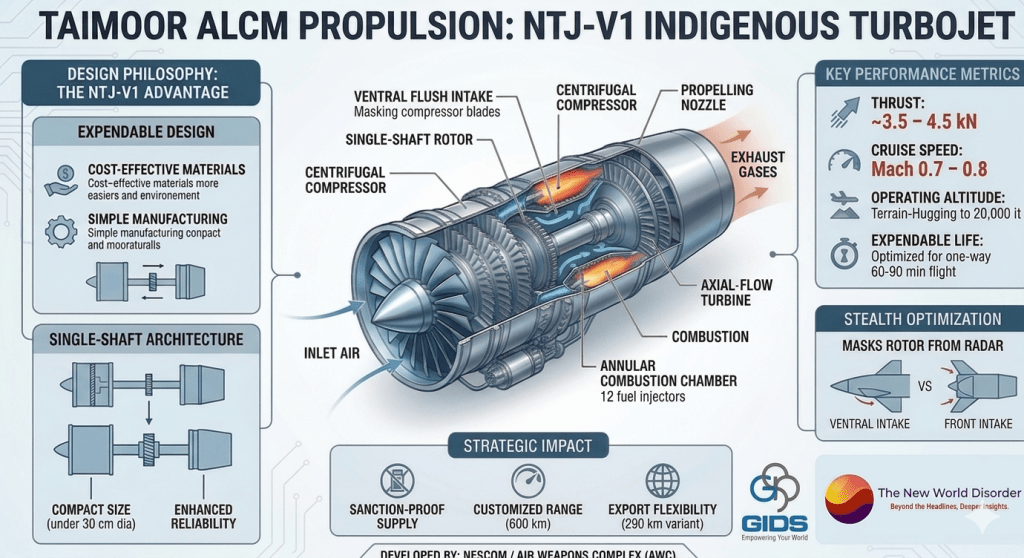
The NTJ-V1 is the core propulsion system behind the Taimoor ALCM. Developed by National Engineering and Scientific Commission and the Air Weapons Complex, it is a miniature turbojet built for cruise missile operations.
Technical Architecture
The NTJ-V1 is optimized for sustained high-subsonic cruise at Mach 0.7 to 0.8. It follows a compact, efficient design suited for expendable systems.
- Ventral Flush Intake
The engine uses an underside intake. This masks compressor blades from radar exposure, which reduces detectability from forward and elevated radar positions. - Single-Shaft Configuration
The engine likely uses a single-shaft design with a compact compressor system. This keeps diameter under 30 cm and simplifies manufacturing. - Thrust-to-Weight Balance
Estimated thrust ranges between 3.5 to 4.5 kN. This supports sustained flight for a missile carrying a 400 to 450 kg warhead.
Why a Turbojet Instead of a Turbofan?
- Efficiency at Operating Speed
Turbojets perform well at Mach 0.8. They provide consistent thrust without the added complexity of a bypass system. - Expendable Design Logic
The engine is built for a single mission cycle of 60 to 90 minutes. Materials are selected for short-duration endurance rather than long-term use. - Low-Altitude Optimization
The engine is tuned for dense air conditions at very low altitude. This improves performance during terrain-following flight.
Strategic Independence Through Propulsion
The NTJ-V1 reduces reliance on foreign engines. This has direct implications:
- Supply security under sanctions
- Full control over performance tuning
- Export freedom without third-party approvals
This marks a key milestone in Pakistan’s indigenous missile development capability.
How Does Taimoor Navigate and Hit Its Target?
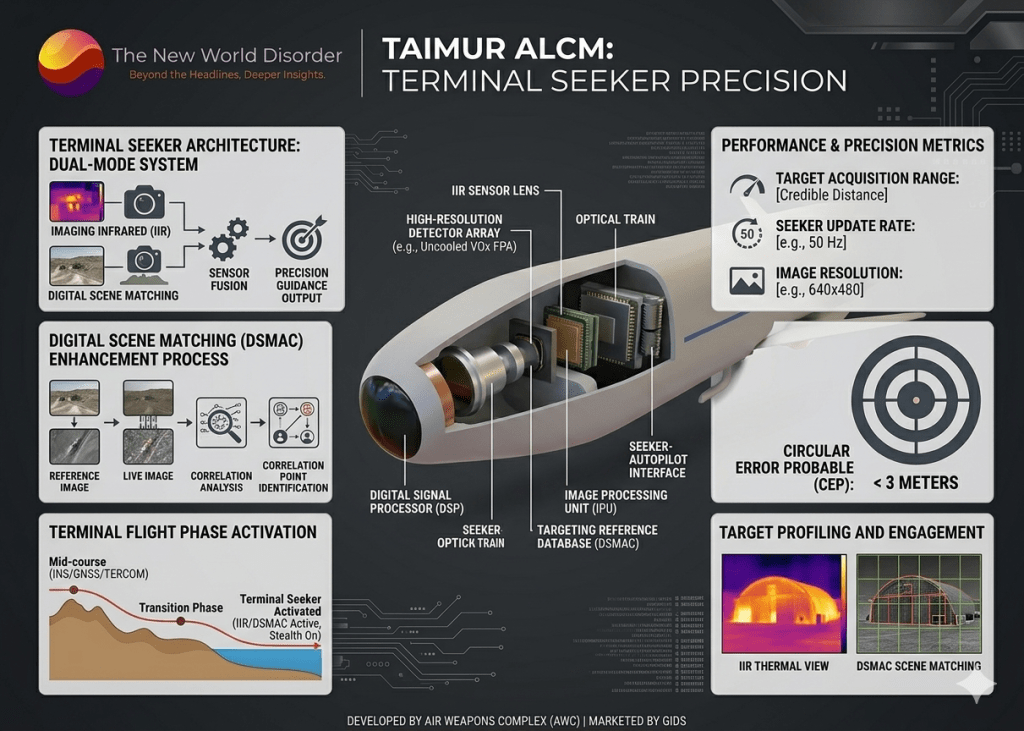
Taimoor uses a layered guidance system designed for accuracy under contested conditions.
Midcourse Navigation
- INS provides baseline navigation
- GNSS updates correct drift
- TERCOM matches terrain data with onboard maps
TERCOM allows navigation even when GPS signals are disrupted.
Terminal Phase Targeting
- DSMAC compares real-time imagery with stored references
- IIR seeker identifies targets through thermal imaging
This allows the missile to recognize targets visually. It improves accuracy against fixed and semi-mobile targets.
What Targets Can It Engage?
The payload supports multiple warhead configurations:
- High explosive for general targets
- Penetrator for hardened structures
- Fragmentation for area targets
Target categories include:
- Air defense radar systems
- Command centers
- Ammunition depots
- Naval assets and port facilities
Precision targeting reduces collateral damage and supports controlled escalation.
Which Platforms Will Carry the Taimoor?
Taimoor has been tested on the Dassault Mirage III. Future deployment focuses on modern platforms:
- JF-17 Thunder Block 3
- Chengdu J-10CE
What Does This Mean for Operations?
- Aircraft remain outside hostile air defense range
- Strike missions extend deeper into contested territory
- Reduced pilot exposure during high-risk missions
Can It Penetrate Modern Air Defense Systems?
Taimoor is designed to operate against layered air defense networks.
Survivability Factors
- Low-altitude flight reduces radar visibility
- Shaped airframe lowers radar cross-section
- Reduced infrared signature limits heat tracking
- Autonomous navigation resists GPS jamming
These features increase the probability of reaching defended targets.
How Does It Compare to China’s AKF-98?
The closest equivalent is the AKF-98.
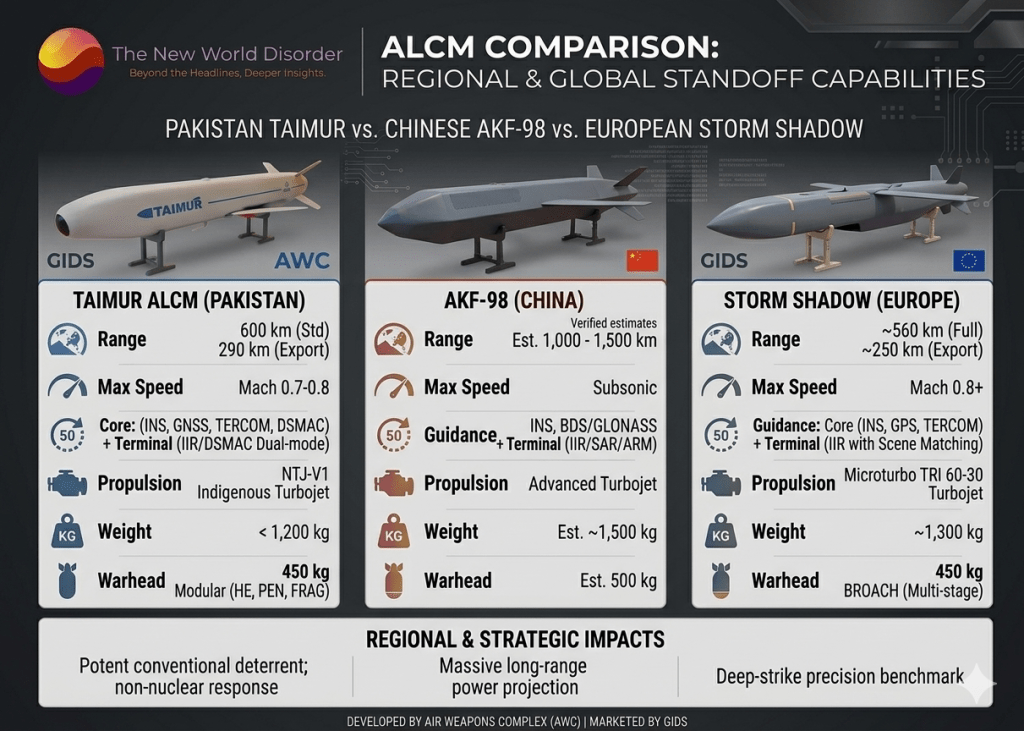
Key Similarities
- Subsonic cruise profile
- Stealth-oriented shaping
- Precision conventional role
Design Alignment
Both systems use trapezoidal bodies and X-tail layouts. These features support low observability and stable flight.
How Does It Compare to the Ra’ad Missile Series?
Pakistan’s Ra’ad missile series focuses more on strategic roles.
| Feature | Taimoor | Ra’ad-II |
|---|---|---|
| Role | Conventional strike | Strategic deterrence |
| Guidance | Multi-mode, IIR, DSMAC | INS, GPS |
| Stealth | Improved shaping | Moderate |
| Targeting | Visual scene matching | Coordinate-based |
Taimoor introduces stronger terminal targeting and improved survivability.
How Does It Compare to the Fatah Series?
The Fatah missile series operates in a different category.
| Feature | Taimoor | Fatah-1/2 |
|---|---|---|
| Type | Air-launched cruise missile | Guided rocket |
| Launch Platform | Aircraft | Ground launcher |
| Flight Path | Low altitude, maneuvering | Ballistic or semi-ballistic |
| Propulsion | Turbojet | Solid rocket motor |
| Role | Deep precision strike | Tactical battlefield fires |
Will It Be Part of Pakistan’s Rocket Force?
No. Taimoor is designed for air-launched operations and remains under the Pakistan Air Force.
Why Not?
- Air-launched systems require aircraft integration
- Mission planning depends on airborne targeting
- Flexibility aligns with air force strike doctrine
Pakistan’s land-based missile forces focus on ballistic and ground-launched systems.
What Role Does It Play in Conventional Deterrence?
Taimoor strengthens conventional strike capability.
Key Roles
- Standoff strike from 600 km
- Suppression of enemy air defenses
- Precision targeting in limited conflict scenarios
It allows calibrated responses without escalation to strategic weapons.
What About Export Potential?
The 290 km export variant aligns with guidelines similar to the Missile Technology Control Regime.
Export Implications
- Access to international defense markets
- Compliance with global norms
- Reduced dependency on foreign subsystems
How Cost-Effective Is It Compared to Western Systems?
Systems like the Storm Shadow are expensive and tightly controlled.
Taimoor is designed for local production. This supports:
- Larger inventory
- Sustained operational use
- Feasibility of multi-missile strike packages
Where Does Taimoor Fit in Future Warfare?
Taimoor reflects a shift toward precision, survivability, and autonomy in air-delivered weapons.
Likely Development Areas
- Improved engine efficiency
- Enhanced seekers with better image processing
- Data-linked targeting updates
- Integration with unmanned systems
Final Assessment
Taimoor strengthens Pakistan’s conventional strike architecture. It extends reach, improves survivability, and increases targeting precision. Its design supports modern air warfare requirements where detection avoidance and accuracy define mission success.