
By Zohaib Ahmed | 6th May 2026
Why Pakistan Is Turning Toward the VT5 Light Tank:
In modern armored warfare, the idea that “one tank fits all terrains” is increasingly outdated. Nations with diverse geography are now shifting toward layered armored fleets instead of relying on a single heavy platform. Pakistan’s growing interest in the Chinese VT5 light tank fits directly into this global trend. Designed for mobility in extreme terrain rather than brute-force engagement, the VT5 represents a tactical shift in how armored power is projected in mountainous and high-altitude environments.
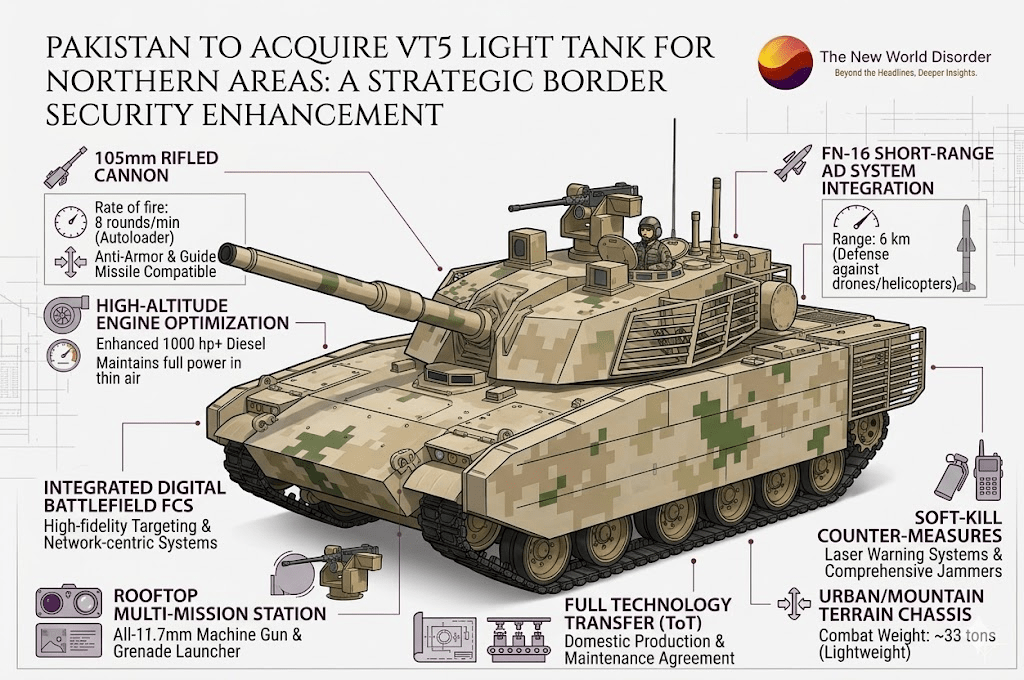
For Pakistan, this is not just a procurement decision. It is a terrain-driven necessity shaped by the unique geography of the northern regions, evolving battlefield doctrine, and the need to balance modernization with cost-effective industrial development.
The Strategic Need: Why Pakistan Needs a Light Tank
Pakistan’s armored doctrine has historically revolved around heavy and medium tanks optimized for plains warfare, particularly in the Punjab and Sindh corridors. Platforms like the Al-Khalid series and future developments such as the Al-Khalid II and Haider MBT are designed for high-intensity armored engagements in open terrain.
However, the northern areas present a completely different battlefield reality.
Regions like Gilgit-Baltistan and parts of Azad Kashmir feature:
- Narrow mountain roads
- High-altitude passes with thin air
- Weak bridge infrastructure
- Sudden elevation changes and steep gradients
- Limited logistics support chains
In such environments, a 50-ton main battle tank becomes a liability rather than an advantage. Bridge load limits, recovery constraints, and mobility restrictions severely reduce operational effectiveness.
This is where light tanks like the VT5 become strategically relevant. Instead of replacing heavy armor, they fill a critical operational gap: mobility-first armored warfare in terrain where weight is the enemy.
VT5 Technical Profile: Designed for Mountains, Not Megabattles
The VT5 is built around a very different philosophy compared to traditional main battle tanks. It prioritizes speed, agility, and adaptability over raw armor thickness.
Key technical features include:
The tank is equipped with a 105mm rifled gun, which is lighter than the 125mm smoothbore guns found on heavier MBTs but still highly effective against light armor, fortified positions, and older generation tanks. Modern advanced ammunition types, including APFSDS and high-explosive rounds, allow it to remain relevant on the battlefield despite the smaller caliber.
Its fire control system is fully digital, integrating thermal imaging, laser rangefinding, and advanced ballistic computation, enabling accurate fire in low-visibility and high-altitude environments.
One of its most critical features is its hydro-pneumatic suspension system. This allows the tank to adjust its ride height dynamically, improving stability on steep inclines and uneven mountain terrain. This is not just a comfort feature; it is a battlefield mobility advantage that allows engagement in areas where traditional tanks simply cannot operate.
Weighing around 33 to 36 tons depending on configuration, the VT5 is significantly lighter than main battle tanks. This reduced weight directly improves its bridge-crossing capability and air transport feasibility.
Armor protection is modular, combining composite armor with optional reactive armor packages. While it does not match heavy MBTs in frontal protection, it is optimized for survivability through mobility and reduced battlefield exposure.
VT4 vs VT5: Two Tanks, Two Different Wars
To understand why Pakistan may integrate the VT5, it is important to compare it with its heavier counterpart, the VT4 main battle tank.
The VT4 is a 52-ton class main battle tank designed for traditional armored warfare. It carries a 125mm smoothbore gun, heavy composite armor, and advanced targeting systems intended for head-to-head engagements against other modern MBTs. It is essentially an export-adapted version of China’s high-end armored philosophy, built for dominance in open terrain warfare.
In contrast, the VT5 is not a scaled-down VT4. It is a completely different design optimized for terrain mobility rather than armored dueling.
Where the VT4 excels in firepower and protection, the VT5 excels in maneuverability, deployment flexibility, and operational access in difficult terrain.
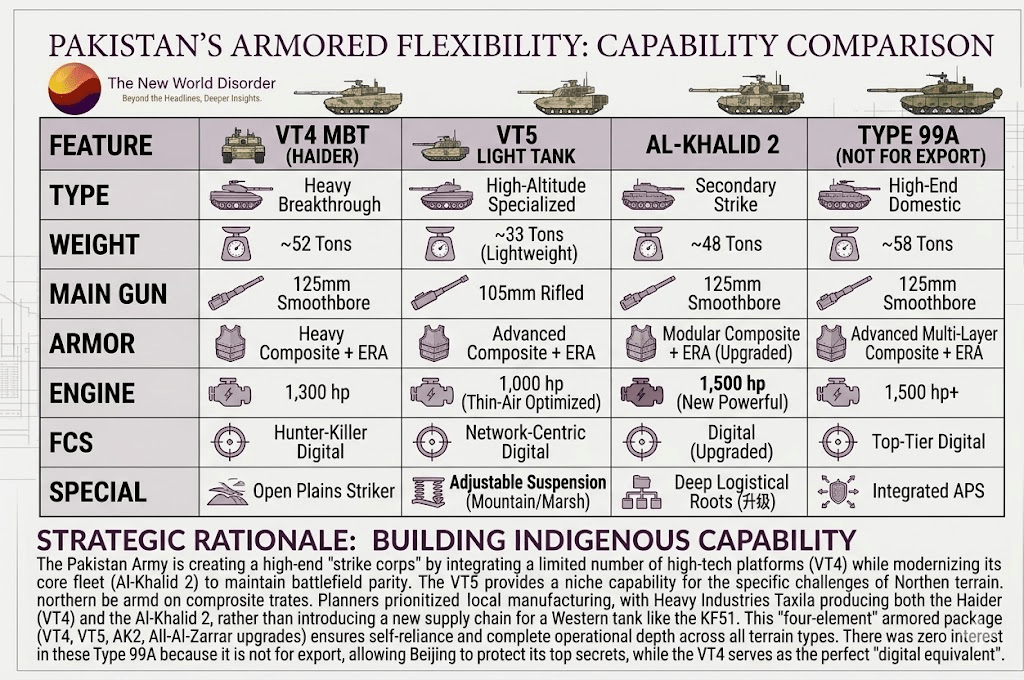
The key difference lies in doctrine:
- VT4 is a breakthrough tank designed for armored offensives in plains
- VT5 is a tactical support tank designed for mountains, valleys, and restricted terrain
This distinction is critical for Pakistan, where geography divides operational requirements almost like two separate wars within one country.
Why Heavy Tanks Struggle in Northern Pakistan
Pakistan’s northern military theaters are not ideal for traditional heavy armor operations. The physical limitations are real and often underestimated in public discussions.
A 50-ton tank places extreme stress on bridges, many of which in mountainous regions are not designed for such loads. Even when structurally possible, movement becomes slow and risky.
Recovery operations also become complex. If a heavy tank gets stuck in narrow valleys or high-altitude terrain, extraction becomes a major logistical challenge requiring specialized equipment.
Engine performance is another issue. At high altitude, thinner air reduces combustion efficiency, directly affecting heavy engine output. While modern engines compensate to some extent, lighter vehicles naturally perform better under these conditions.
This is where the VT5’s design advantage becomes clear. Its lower weight and adaptive suspension allow it to navigate terrain that would restrict or immobilize heavier MBTs.
Pakistan’s Armored Ecosystem: Integration, Not Replacement
Pakistan is not abandoning its existing armored doctrine. Instead, it is evolving it into a multi-layered structure.
The Al-Khalid series continues to serve as the backbone of armored formations, with upgrades leading toward the Al-Khalid II standard. Reports suggest improvements such as a 1,500 horsepower engine, upgraded digital fire control systems, and enhanced modular armor to keep the platform competitive.
At the same time, the newer Haider MBT program introduces a more modern heavy platform, likely aligned with Chinese design philosophy.
Within this structure, the VT5 does not replace anything. It complements everything.
It fills the “light mobility gap” that neither Al-Khalid nor future MBTs are designed to address.
This creates a three-tier armored ecosystem:
- Heavy MBTs for breakthrough operations
- Medium upgraded MBTs for balanced engagements
- Light tanks like VT5 for high mobility and terrain-specific missions
Technology Transfer and Local Manufacturing: The TOT Factor
One of the most significant aspects of any major defense procurement for Pakistan is technology transfer. In the case of Chinese-origin systems, there is a strong historical pattern of assembly and partial localization at Heavy Industries Taxila (HIT).
The VT5 deal, if confirmed or expanded, is likely to include some level of technology transfer (TOT), potentially involving:
- Local assembly of hull and turret components
- Integration of fire control systems
- Maintenance and lifecycle support infrastructure
- Training systems for crews and technicians
This is strategically important because it reduces long-term dependency on imports while strengthening Pakistan’s domestic armored production base.
China’s approach to export systems also makes this more feasible. The VT4, for example, is already positioned as an export-friendly platform rather than a restricted high-end domestic system like the Type 99A, which remains outside export consideration due to its sensitive technologies.
The VT5 follows a similar logic: advanced enough to be battlefield relevant, but structured in a way that allows controlled export and localization.
Conclusion: A Tank Built for the Terrain Pakistan Actually Has
The potential induction of the VT5 reflects a broader shift in military thinking: success is no longer defined by raw firepower alone, but by adaptability to geography.
Pakistan’s northern regions demand a machine that can climb, maneuver, and survive in conditions where heavy armor becomes constrained. The VT5 fits that niche precisely.
It is not meant to compete with main battle tanks like the VT4 in a direct duel. Instead, it exists to ensure that armored capability is not geographically limited.
If integrated with proper training, logistics, and localized production support, the VT5 could become a critical enabler in Pakistan’s layered armored doctrine. In simple terms, it ensures that no part of the country is beyond the reach of armored maneuver warfare, even the mountains where tanks were once considered impractical.