
Special Paper by Zohaib Ahmed | 28th July 2026
Executive Summary
Few political figures in the contemporary history of the Islamic Republic of Iran have experienced a transformation as dramatic as Mahmoud Ahmadinejad. Once regarded as one of the Islamic Republic’s most dependable revolutionary politicians, he gradually evolved into one of its most controversial former presidents, not because he abandoned the ideological foundations of the state, but because he increasingly challenged the concentration of power within unelected institutions. His political trajectory reflects a broader struggle between elected authority and Iran’s entrenched security-clerical establishment.
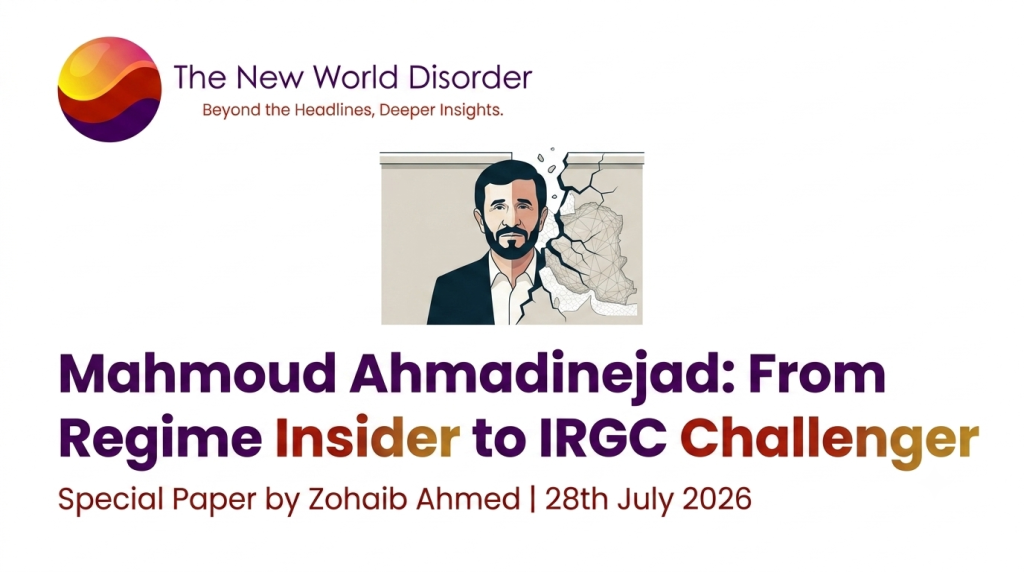
The resurgence of Mahmoud Ahmadinejad in strategic discourse during 2026 follows a series of extraordinary developments. Reports published by international media alleged that Israeli intelligence had spent years attempting to cultivate contacts with Ahmadinejad, while Iranian security circles reportedly accused him of maintaining links with Mossad. His office categorically rejected these allegations, describing them as fabricated, politically motivated, and intended to deepen domestic divisions. Publicly available evidence remains inconclusive, and much of the reporting relies on anonymous intelligence sources operating during an active regional conflict. Consequently, these allegations should be understood within the wider context of information warfare, strategic signalling, and internal political competition rather than as judicially established facts.
Yet the significance of these allegations lies less in whether they are ultimately substantiated and more in why they emerged at this particular moment. Political accusations within the Islamic Republic have historically reflected underlying factional struggles as much as criminal investigations. The accusations directed at Ahmadinejad therefore warrant examination not only as intelligence claims but also as indicators of institutional anxiety surrounding an unpredictable political actor who has repeatedly demonstrated an ability to challenge the prevailing balance of power.
This paper argues that Ahmadinejad’s political importance cannot be understood through simplistic portrayals of either loyal revolutionary or opposition dissident. Instead, his career illustrates the evolution of a populist executive who initially strengthened the security establishment before ultimately confronting many of the same institutions that facilitated his rise. His repeated exclusion from presidential elections, sustained public criticism of corruption within powerful institutions, and willingness to expose structural weaknesses inside Iran’s intelligence architecture have ensured that he remains politically relevant despite more than a decade outside formal office.
The paper further examines the strategic significance of the reported Israeli interest in Ahmadinejad during the 2025-2026 confrontation, the internal power struggle between the presidency and the Islamic Revolutionary Guard Corps (IRGC), and the broader implications of Iran’s succession politics. Rather than treating Ahmadinejad as either an inevitable successor or a politically irrelevant former president, this analysis places him within the continuing contest over the future direction of the Islamic Republic.
Introduction
Iran’s political system has often been characterised through the duality of elected institutions and unelected centres of power. While presidents possess constitutional authority over the executive branch, ultimate authority remains vested in the Supreme Leader, supported by institutions including the Guardian Council, the Assembly of Experts, and the Islamic Revolutionary Guard Corps. Within this framework, presidents frequently operate with considerable influence during their first years in office, only to encounter institutional resistance when their political ambitions begin to overlap with the interests of the permanent state.
Mahmoud Ahmadinejad represents perhaps the clearest illustration of this structural dynamic.
When Ahmadinejad emerged from relative political obscurity to win the presidency in 2005, he was widely viewed as an ideal representative of Iran’s conservative revolutionary movement. Campaigning on promises of social justice, anti-corruption measures, and the redistribution of oil wealth, he successfully mobilised lower-income communities, rural populations, and segments of the revolutionary establishment that viewed previous administrations as increasingly detached from ordinary citizens. His electoral victory represented a decisive shift away from the technocratic and reform-oriented politics that had characterised previous administrations.
During his first presidential term, Ahmadinejad expanded state welfare programmes, increased direct cash transfers, accelerated infrastructure development in underserved provinces, and strengthened the participation of veterans from the Islamic Revolutionary Guard Corps and Basij within government institutions. Simultaneously, Iran pursued a more confrontational foreign policy, accelerated its nuclear programme, and intensified strategic competition with Western powers and Israel. These developments elevated Ahmadinejad into one of the most recognisable political figures in the Middle East.
Ironically, many of the institutions that contributed to Ahmadinejad’s political ascent later became the principal architects of his political isolation.
The turning point emerged during his second presidential term. Disagreements over ministerial appointments, intelligence oversight, and executive authority gradually evolved into a broader institutional confrontation between Ahmadinejad and the Supreme Leader’s political establishment. The dismissal of Intelligence Minister Heydar Moslehi in 2011, followed by Supreme Leader Ali Khamenei’s direct intervention to reverse the decision, exposed a constitutional reality that had previously remained largely implicit. Presidential authority existed only within boundaries accepted by the unelected leadership.
Ahmadinejad’s refusal to immediately accept the Supreme Leader’s decision triggered one of the most consequential political confrontations in the Islamic Republic’s modern history. The eleven-day withdrawal from official duties became a symbolic challenge to the prevailing doctrine of Velayat-e Faqih, prompting a coordinated institutional response from senior clerics, the judiciary, and the IRGC.
It was during this period that the label “Deviant Current” entered Iran’s political vocabulary.
Rather than portraying Ahmadinejad as merely a political rival, influential clerics and IRGC-affiliated media increasingly characterised his inner circle as an ideological threat to the foundations of the Islamic Republic itself. His close associates, particularly Esfandiar Rahim Mashaei, were accused of promoting nationalist interpretations of Islam, reducing the centrality of clerical authority, and encouraging political ideas incompatible with the doctrine of Guardianship of the Jurist. Whether these accusations accurately reflected Ahmadinejad’s intentions remains contested. Their political consequences, however, were profound.
Following the conclusion of his presidency in 2013, Ahmadinejad experienced a gradual but systematic exclusion from Iran’s formal political process. Despite maintaining public visibility and repeatedly seeking a return to electoral politics, he was successively disqualified by the Guardian Council in 2017, 2021, and 2024. Official explanations remained limited, yet the cumulative pattern suggested a broader institutional decision to prevent his re-emergence within the executive branch.
This prolonged marginalisation transformed Ahmadinejad’s public posture.
Freed from the constraints of executive office but denied opportunities for electoral participation, he increasingly directed criticism toward the judiciary, intelligence agencies, and influential political elites. His speeches evolved from defending government policy to questioning institutional accountability, exposing alleged corruption, and highlighting failures within Iran’s security establishment. Among his most consequential interventions were public statements concerning Mossad infiltration of Iranian counter-intelligence structures, allegations that received renewed international attention following subsequent Israeli intelligence successes inside Iran.
The renewed international focus on Ahmadinejad during the regional escalation of 2025 and 2026 therefore should not be viewed in isolation.
Reports alleging Israeli attempts to establish contact with Ahmadinejad, claims regarding strikes near his residence during the opening phase of the conflict, and subsequent accusations from Iranian security circles collectively emerged against the backdrop of one of the most intense intelligence confrontations in the history of the Islamic Republic. Although many operational details remain disputed and rely upon anonymous sourcing, the convergence of these narratives underscores Ahmadinejad’s continuing strategic relevance despite more than a decade outside government.
For analysts of Iranian politics, the central question is therefore not whether Ahmadinejad will necessarily return to power.
Rather, it is why a former president who has remained outside office since 2013 continues to occupy such a prominent position within both domestic political discourse and regional intelligence narratives.
Understanding that question requires examining not merely Ahmadinejad as an individual politician, but the institutional evolution of the Islamic Republic itself. His political career reveals how revolutionary systems often elevate charismatic populists during periods of consolidation, only to constrain them when independent political legitimacy begins to compete with entrenched centres of authority. In this respect, Ahmadinejad’s story offers insights extending well beyond one presidency. It provides a window into the enduring tensions between electoral legitimacy, military influence, clerical authority, and national security within one of the Middle East’s most consequential states.
From Revolutionary Asset to Institutional Rival (2005-2013)
Building a Populist Presidency
Mahmoud Ahmadinejad entered the presidency in August 2005 as one of the youngest and least conventional political figures to occupy Iran’s highest elected office. Unlike many of his predecessors, he did not emerge from the traditional clerical establishment. Instead, his political identity was shaped by municipal governance, revolutionary activism, and an image of personal simplicity that resonated strongly with lower-income Iranians.
His campaign focused on themes that had broad public appeal. He promised to combat corruption, reduce inequality, redistribute oil revenues more equitably, and restore what he portrayed as the revolutionary ideals of social justice. Rather than appealing primarily to Tehran’s political elite, Ahmadinejad concentrated his campaign on provincial cities, rural communities, veterans, and economically disadvantaged segments of society that believed previous governments had neglected them.
The timing of his election also proved significant.
High global oil prices generated unprecedented revenues for Iran during much of his first term. These revenues provided the administration with substantial fiscal flexibility, allowing Ahmadinejad to expand welfare programmes while simultaneously increasing public investment across multiple sectors.
Among his most notable domestic initiatives were:
| Policy Area | Major Initiatives | Strategic Objective |
|---|---|---|
| Social Welfare | Expansion of cash transfers and subsidies | Increase disposable household income |
| Infrastructure | Roads, utilities, provincial development projects | Reduce regional disparities |
| Housing | Affordable housing initiatives | Increase home ownership |
| Provincial Governance | Frequent provincial cabinet meetings | Strengthen local engagement |
| Banking | Expansion of state-directed lending | Stimulate domestic investment |
These policies significantly strengthened Ahmadinejad’s political standing among lower-income constituencies, particularly outside Tehran. His frequent provincial visits reinforced the perception that his administration was more accessible than previous governments.
Although critics questioned the long-term sustainability of many programmes, supporters argued that they represented one of the largest redistributions of state resources toward historically underrepresented populations.
Economic Expansion and Emerging Structural Pressures
Ahmadinejad’s economic record remains one of the most debated aspects of his presidency.
On one hand, elevated oil revenues enabled extensive government spending. New infrastructure projects expanded across provincial Iran, public-sector investment increased substantially, and subsidy reforms attempted to replace inefficient energy subsidies with direct financial assistance to households.
On the other hand, rapid liquidity expansion, extensive subsidised lending, and increasing dependence on oil revenues created structural imbalances that became progressively more difficult to manage.
Several indicators illustrate these competing dynamics.
| Indicator | Positive Developments | Emerging Challenges |
|---|---|---|
| Oil Revenue | Historic government income | Increased fiscal dependence |
| Welfare | Expanded redistribution | Growing subsidy burden |
| Infrastructure | Provincial investment accelerated | Uneven project efficiency |
| Inflation | Consumer demand strengthened initially | Persistent inflationary pressures |
| Employment | Public sector expansion | Youth unemployment remained significant |
Inflation averaged approximately 18 percent during much of Ahmadinejad’s presidency, while independent analysts frequently estimated youth unemployment above official figures. As international sanctions intensified during his second term, these structural weaknesses became increasingly exposed.
Critics argued that excessive state intervention distorted markets, encouraged inefficient allocation of capital, and reduced private-sector competitiveness.
Supporters countered that many macroeconomic difficulties resulted primarily from escalating international sanctions rather than domestic policy decisions alone.
The reality likely incorporated elements of both perspectives.
Foreign Policy and International Confrontation
Ahmadinejad’s presidency fundamentally altered international perceptions of Iran.
His administration adopted an assertive foreign policy that rejected Western pressure regarding Iran’s nuclear programme while framing uranium enrichment as an inherent sovereign right under international law.
Simultaneously, Ahmadinejad became internationally recognised for highly confrontational rhetoric regarding Israel.
Throughout his presidency, he repeatedly questioned the legitimacy of the Israeli state, characterised it as a temporary political entity, and made statements widely interpreted internationally as calling for its eventual disappearance. He also questioned accepted historical narratives surrounding the Holocaust, generating widespread international condemnation.
These statements were accompanied by continued Iranian support for regional armed groups, including Hezbollah and Hamas, organisations engaged in direct confrontation with Israel.
From Israel’s strategic perspective, the combination of ideological hostility, expanding uranium enrichment capabilities, and continued support for Iranian regional proxies elevated Ahmadinejad’s administration into one of the most serious long-term security challenges confronting the Israeli state.
Consequently, Israeli security assessments increasingly viewed Iran’s leadership not solely through the lens of military capability but also through perceived political intent.
Strengthening the Security State
One of the enduring paradoxes of Ahmadinejad’s presidency lies in his relationship with the Islamic Revolutionary Guard Corps.
During his first term, Ahmadinejad substantially expanded the institutional influence of the IRGC across Iran’s civilian economy and administrative structure.
Billions of dollars in government contracts were awarded to IRGC-affiliated companies, including major engineering conglomerates such as Khatam al-Anbiya. Former IRGC and Basij personnel increasingly occupied senior ministerial positions, governorships, and executive appointments across multiple sectors of government.
This process represented one of the most significant institutional expansions of military influence in the post-revolutionary period.
Ironically, the very institutions that benefited most from Ahmadinejad’s administrative reforms would later become central actors in limiting his political influence.
The 2009 Election and Consolidation of Power
Ahmadinejad secured a second presidential term in the highly contested 2009 election.
The announced results immediately generated widespread public demonstrations that evolved into the Green Movement, one of the largest political crises since the 1979 Revolution.
Opposition candidates alleged serious electoral irregularities.
The government rejected these allegations.
Security forces, including the IRGC and Basij, conducted an extensive nationwide crackdown aimed at restoring order and preserving the political system.
During this period, Supreme Leader Ayatollah Ali Khamenei publicly expressed support for Ahmadinejad, reinforcing the perception that the presidency, clerical establishment, and security apparatus remained politically aligned against reformist opposition.
Yet this apparent unity concealed deeper institutional realities.
The IRGC’s primary loyalty was directed not toward the presidency but toward the office of the Supreme Leader.
That distinction would become critically important within two years.
The Moslehi Crisis: The Beginning of Institutional Rupture
The defining political confrontation of Ahmadinejad’s presidency occurred in April 2011.
Seeking to assert greater executive authority over the intelligence apparatus, Ahmadinejad dismissed Intelligence Minister Heydar Moslehi.
Supreme Leader Ali Khamenei immediately exercised his constitutional authority to reverse the dismissal and ordered Moslehi reinstated.
Rather than immediately complying, Ahmadinejad withdrew from cabinet meetings and official duties for eleven days.
Although brief, this unprecedented political protest fundamentally altered perceptions of Ahmadinejad within Iran’s ruling establishment.
For many senior clerics and IRGC commanders, the dispute no longer concerned a ministerial appointment.
Instead, it represented a direct challenge to the doctrine of Velayat-e Faqih and the hierarchical relationship between elected government and unelected authority.
The “Deviant Current”
Following the Moslehi dispute, Ahmadinejad’s political movement underwent a dramatic transformation in official discourse.
Rather than criticising isolated policy decisions, influential clerics and IRGC-affiliated media increasingly portrayed Ahmadinejad’s inner circle as an ideological deviation from the principles of the Islamic Republic.
The label “Deviant Current” became the dominant political narrative used to describe Ahmadinejad’s closest associates, particularly Esfandiar Rahim Mashaei.
According to establishment critics, the movement promoted three interrelated ideas:
| Establishment Allegation | Political Implication |
|---|---|
| Emphasis on Mahdaviyat without traditional clerical mediation | Reduced religious authority of senior clerics |
| Greater focus on Iranian nationalism | Dilution of pan-Islamic revolutionary identity |
| Independent foreign policy messaging | Reduced coherence of official strategic messaging |
Whether these characterisations accurately reflected Ahmadinejad’s intentions remains debated.
Their political impact, however, proved decisive.
The “Deviant Current” narrative legitimised a comprehensive institutional campaign that gradually dismantled Ahmadinejad’s political network through arrests, investigations, and sustained media criticism.
From Ally to Political Adversary
The deterioration of Ahmadinejad’s relationship with the IRGC became increasingly public.
Once regarded as one of the principal beneficiaries of military support, Ahmadinejad began openly criticising corruption, illegal commercial activities, and unregulated economic networks allegedly associated with powerful institutions.
Among his most widely discussed remarks was his reference to influential actors involved in illicit cross-border commerce as “our smuggling brothers,” a statement widely interpreted as criticism of elements linked to the IRGC’s economic activities.
The consequences were immediate.
The institutional alliance that had defined Ahmadinejad’s rise effectively collapsed.
By the conclusion of his presidency in 2013, he no longer represented the preferred political figure of Iran’s security establishment.
Instead, he had become an increasingly independent populist whose political legitimacy derived less from institutional endorsement and more from his continuing public profile.
That transformation would shape every subsequent stage of his political career.
Political Exclusion, Intelligence Allegations, and the Return of Mahmoud Ahmadinejad (2013-2026)
Systematic Political Marginalisation
The conclusion of Mahmoud Ahmadinejad’s second presidential term in 2013 did not merely mark the end of an administration. It marked the beginning of a sustained institutional effort to remove one of Iran’s most recognisable political figures from meaningful participation in the country’s electoral system.
Unlike many former presidents who gradually withdrew from frontline politics, Ahmadinejad consistently sought a political return. Each attempt was met with the same outcome.
Disqualification.
The Guardian Council, constitutionally responsible for vetting presidential candidates, prevented Ahmadinejad from contesting the presidential elections of 2017, 2021, and 2024. While the Council rarely provides detailed legal reasoning for individual decisions, the repeated exclusions occurred against the backdrop of Ahmadinejad’s increasingly confrontational relationship with the Supreme Leader’s political establishment and his public criticism of key state institutions.
Table 1. Ahmadinejad’s Electoral Journey
| Election Year | Status | Political Context | Outcome |
|---|---|---|---|
| 2005 | Approved | Populist outsider backed by conservative coalition | Elected President |
| 2009 | Approved | Incumbent seeking second term | Re-elected amid disputed election |
| 2017 | Disqualified | Defied public advice not to run | Removed from ballot |
| 2021 | Disqualified | Consolidation of hard-line political control | Removed from ballot |
| 2024 | Disqualified | Snap election following President Raisi’s death | Removed from ballot |
Viewed collectively, these decisions reveal more than isolated electoral outcomes. They illustrate the extent to which Iran’s institutional gatekeepers have exercised their constitutional authority to shape the range of candidates presented to the electorate.
For Ahmadinejad, repeated exclusion transformed his political identity. Having once governed with the support of powerful institutions, he increasingly positioned himself as a critic of those same institutions.
From Former President to Systemic Critic
Following his departure from office, Ahmadinejad’s public rhetoric changed significantly.
Rather than focusing primarily on economic policy or foreign affairs, he increasingly criticised institutional governance, judicial accountability, political transparency, and the growing concentration of authority within unelected centres of power.
He publicly questioned corruption among senior officials.
He criticised restrictions on political participation.
He accused elements of the political establishment of suppressing dissent.
Perhaps most significantly, he increasingly directed attention toward the performance of Iran’s intelligence and security institutions.
This evolution distinguished Ahmadinejad from many other former Iranian presidents, who generally adopted more cautious public positions after leaving office.
His willingness to openly challenge powerful institutions ensured that he remained politically relevant despite lacking formal authority.
Intelligence Failures and Mossad Infiltration Claims
One of Ahmadinejad’s most consequential post-presidential interventions concerned Iran’s counter-intelligence apparatus.
Following a series of highly publicised Israeli intelligence successes, including the theft of Iran’s nuclear archive, the assassination of nuclear scientist Mohsen Fakhrizadeh, and later high-profile security breaches inside Iranian territory, Ahmadinejad argued that these incidents reflected structural failures rather than isolated operational mistakes.
In a widely circulated interview, he claimed that senior officials responsible for countering Israeli intelligence operations had themselves been compromised.
According to Ahmadinejad, Iranian authorities had discovered that the head of a specialised counter-intelligence unit responsible for monitoring Mossad activities was himself working for Mossad. He further alleged that a broader network of officials had similarly been compromised, enabling foreign intelligence services to penetrate sensitive institutions.
These remarks generated considerable international attention.
Whether every operational detail can be independently verified remains subject to ongoing debate.
Nevertheless, Ahmadinejad’s statements resonated because they coincided with a period during which Iranian security institutions faced repeated questions regarding their ability to prevent sophisticated foreign intelligence operations.
Table 2. Major Security Incidents Cited in Public Debate
| Year | Incident | Strategic Impact |
|---|---|---|
| 2018 | Removal of Iranian nuclear archive | Demonstrated unprecedented intelligence penetration |
| 2020 | Assassination of Mohsen Fakhrizadeh | Raised questions regarding internal security |
| 2024 | Assassination of Ismail Haniyeh in Tehran | Intensified scrutiny of intelligence coordination |
| 2025-2026 | Regional conflict and intelligence competition | Renewed focus on internal vulnerabilities |
For Ahmadinejad, these events supported a broader argument that political factionalism, institutional rivalry, and excessive emphasis on ideological loyalty had weakened professional intelligence capabilities.
His criticism represented not simply an attack on individual officials but on the structural evolution of Iran’s security architecture.
Structural Competition Within Iran’s Intelligence System
Iran’s intelligence community is characterised by overlapping institutional responsibilities.
The Ministry of Intelligence and Security (MOIS) operates alongside the IRGC Intelligence Organisation, with both agencies possessing substantial domestic and external security responsibilities.
While such institutional overlap may create redundancy, analysts have long argued that it can also generate competition, duplication of effort, and fragmented decision-making.
Ahmadinejad’s criticisms highlighted precisely these concerns.
He argued that political rivalries, repeated organisational purges, and prioritisation of ideological conformity over operational competence had collectively reduced institutional effectiveness.
Whether one fully accepts this assessment or not, the broader strategic context lends significance to his observations.
Repeated Israeli operations inside Iran demonstrated that sophisticated intelligence penetration remained an enduring challenge for the Islamic Republic.
The 2026 Allegations
The political significance of Mahmoud Ahmadinejad increased dramatically during the regional escalation of 2026.
International reporting, citing anonymous American, Iranian, and regional intelligence sources, alleged that Israeli intelligence had spent several years attempting to establish contact with Ahmadinejad.
According to those reports, discussions allegedly included meetings outside Iran, logistical assistance, financial support, and contingency planning in the event of broader political instability.
Among the most widely reported claims was that a meeting allegedly occurred in Budapest involving senior Israeli intelligence officials.
Additional reports suggested that during the opening phase of the February 2026 military campaign, Israeli strikes near Ahmadinejad’s residence in Tehran’s Narmak district formed part of a broader contingency aimed at facilitating his extraction rather than his assassination.
These reports remain contested.
No independently verifiable public evidence has confirmed the operational details.
Much of the reporting relies upon anonymous intelligence sources operating within the context of an active regional conflict.
Ahmadinejad’s office categorically rejected every allegation.
His representatives described the reports as fabricated, politically motivated, “Hollywood-style” stories designed to create division within Iranian society.
Subsequent public appearances by Ahmadinejad further challenged early rumours suggesting he had been killed during the strikes.
Table 3. Competing Narratives Surrounding the 2026 Allegations
| Issue | Public Reporting | Ahmadinejad’s Position |
|---|---|---|
| Contact with Mossad | Reported by anonymous intelligence sources | Completely denied |
| Foreign meetings | Alleged by international reporting | Rejected as fabrication |
| Israeli operational interest | Reported during regional conflict | No acknowledgement |
| Political collaboration | Alleged | Categorically denied |
At present, these competing narratives remain unresolved in the public domain.
No judicial findings, independently verified documentary evidence, or official disclosures have conclusively established the allegations as fact.
Equally, their repeated appearance across multiple intelligence-focused reports illustrates that Ahmadinejad continues to occupy a position of strategic interest within discussions concerning Iran’s political future.
Why Ahmadinejad Continues to Matter
Political relevance is not measured solely by holding office.
More than a decade after leaving the presidency, Ahmadinejad continues to generate significant reactions from both supporters and opponents.
Several factors explain this enduring visibility.
First, he remains one of the few former Iranian presidents who openly criticises influential state institutions rather than limiting disagreement to policy differences.
Second, his repeated attempts to return to electoral politics demonstrate that he continues to view himself as a legitimate participant in Iran’s political system despite institutional exclusion.
Third, his familiarity with the internal functioning of the executive branch, intelligence services, and security establishment provides him with a degree of credibility that distinguishes him from many external critics.
Finally, the recurrence of his name within intelligence reporting during one of the most significant regional confrontations in recent years underscores that his political relevance extends beyond domestic electoral politics.
Whether viewed as an establishment insider turned critic, an unpredictable populist, or a politically marginalised former president, Mahmoud Ahmadinejad remains an important figure through whom broader questions regarding power, legitimacy, and institutional control inside the Islamic Republic continue to be debated.
Strategic Relevance, Succession Politics, and the Future of Ahmadinejad
4.1 Israel’s Perception of Ahmadinejad
During his presidency (2005 to 2013), Mahmoud Ahmadinejad repeatedly rejected Israel’s legitimacy. He referred to it as the “Zionist regime,” quoted Ayatollah Khomeini in calling for it to be “wiped off the map” (or “eliminated from the page of time”), and in 2012 at the United Nations described Israelis as “minimal disturbances” that would be eliminated. He also made statements questioning or denying the Holocaust.
His administration accelerated uranium enrichment and expanded Iran’s nuclear program while framing it as a sovereign right. Iranian policy under his government continued material support, including funding, training, and arms, to Hezbollah and Hamas.
Israeli and Western officials treated the combination of explicit rejection of Israel’s existence, nuclear progress, and proxy support as a strategic threat. Assessments from the period cited both capability development and stated intent.
Reporting in 2026 described an alleged multi-year Israeli intelligence effort to cultivate contacts with Ahmadinejad after he had fallen out of favour with Iranian authorities, including reported meetings and a February 2026 airstrike near his Tehran residence framed by some sources as an extraction attempt. Ahmadinejad’s office denied the claims. These later reports concern post-presidency intelligence activity and do not alter the documented positions of his presidential term.
4.2 From IRGC Ally to Institutional Challenger
Ahmadinejad’s 2005 election and 2009 re-election drew on networks associated with the Islamic Revolutionary Guard Corps (IRGC) and Basij. During his first term and early second term, IRGC personnel received expanded roles in government and economic sectors.
Relations deteriorated in 2011. Ahmadinejad dismissed Intelligence Minister Heydar Moslehi. Supreme Leader Ali Khamenei ordered the minister’s reinstatement. Ahmadinejad briefly absented himself from duties. IRGC commanders and affiliated media labelled elements of his inner circle, including Chief of Staff Esfandiar Rahim Mashaei, a “deviant current” that challenged the principle of velayat-e faqih. Analysts documented IRGC involvement in restricting presidential latitude during this period.
Ahmadinejad later publicly criticised aspects of IRGC economic activity, including allegations of smuggling. His attempts to maintain an independent political base after leaving office contributed to continued friction with institutional power centres.
Table 4. Evolution of Ahmadinejad-IRGC Relations
| Period | Relationship | Key Events |
|---|---|---|
| 2005 to 2009 | Alignment and expansion | IRGC and Basij mobilisation in elections; expanded IRGC roles in government and economy |
| 2009 to 2011 | Conditional cooperation | 2009 election and Green Movement response; growing tension over appointments |
| 2011 to 2013 | Open institutional conflict | Moslehi dismissal and reinstatement; “deviant current” labelling |
| 2013 to 2026 | Political exclusion | Guardian Council disqualifications from presidential races |
4.3 Leadership Succession and Political Constraints
Iran’s constitution provides for a Supreme Leader selected by the Assembly of Experts. The president is elected for a maximum of two consecutive four-year terms. The Guardian Council vets candidates for elected office, including the presidency, on grounds of loyalty and compatibility with the system. The IRGC holds significant institutional influence over security, economic, and political matters and reports to the Supreme Leader.
Former presidents have rarely returned to executive office. Ahmadinejad left the presidency in 2013. He registered as a candidate in 2017 despite reported objections from the Supreme Leader and was disqualified by the Guardian Council. He faced disqualification or did not advance in subsequent cycles, including 2021 and 2024. These outcomes align with the Guardian Council’s established practice of screening candidates across factions.
4.4 Competing Narratives Surrounding Ahmadinejad
| Narrative | Supporting Arguments | Limitations |
|---|---|---|
| Regime / IRGC accounts | Security concerns; reported foreign contacts uncovered by IRGC intelligence (2026) | Publicly available independent evidence limited; relies on anonymous sourcing |
| Ahmadinejad’s accounts | Political persecution; institutional rivalry after challenges to hierarchical control | Difficult to verify independently outside Iranian political discourse |
| External analyses | Power struggle between elected executive and unelected institutions; factional competition within the Islamic Republic | Interpretations vary by source and access to information |
4.5 Strategic Assessment
Ahmadinejad’s career illustrates the constraints on elected executives within Iran’s hybrid system. Constitutional term limits, Guardian Council vetting, Supreme Leader authority, and IRGC institutional power have limited the ability of presidents to operate independently of the core power structure. Populist mobilisation can secure electoral victories but faces barriers when it generates autonomous political bases or challenges hierarchical control.
Internal conflicts, such as the 2011 dispute, demonstrated institutional mechanisms for reasserting control without systemic collapse. Intelligence and elite competition continue to shape the status of former officials. Ahmadinejad’s repeated exclusion from electoral processes and the 2026 intelligence allegations have kept him a figure of attention in analyses of Iranian succession and internal dynamics, despite formal political marginalisation.
Table 5. Timeline of Political Evolution
| Year | Event | Strategic Consequence |
|---|---|---|
| 2005 | Elected president | Entry of populist hardline figure into executive office |
| 2009 | Re-election | Green Movement protests and subsequent crackdown |
| 2011 | Moslehi dispute | Public rupture with Supreme Leader and IRGC |
| 2013 | Presidency ends | Transition to outsider status |
| 2017 | Disqualified by Guardian Council | Formal barrier to return |
| 2021 | Disqualified or non-advancement | Continued institutional exclusion |
| 2024 | Disqualified | Reinforcement of succession controls |
| 2026 | Intelligence allegations and reported restrictions | Renewed external and internal attention |
Threat to Israel: Ideological Hostility, Nuclear Advancement, and Proxy Support
During his presidency (2005 to 2013), Ahmadinejad repeatedly issued statements rejecting Israel’s legitimacy and existence. He quoted Ayatollah Khomeini in calling for Israel to be “wiped off the map” (or “eliminated from the page of time,” depending on translation debates), referred to it as the “Zionist regime” or a temporary “stigma,” and predicted its elimination as historically inevitable. In 2012 at the UN, he described Israelis as “minimal disturbances” that would be eliminated. He also engaged in Holocaust denial or minimisation, framing it as a myth exploited for political ends.
These were not isolated rhetoric. His government accelerated Iran’s nuclear program, expanded uranium enrichment, and framed it as a sovereign right while rejecting Western and Israeli concerns as pretexts. Israeli and Western assessments treated this combination, genocidal-sounding language plus nuclear progress, as an existential-level risk. He also oversaw continued material support, including funding, training, and arms, to Hezbollah and Hamas, groups dedicated to armed confrontation with Israel. Israeli officials and analysts at the time consistently ranked the Ahmadinejad-era Iranian posture among the highest threats, citing both capability development and explicit intent signals.
Even after leaving office, his residual hardline identity and occasional public criticism of accommodation with the West kept him in the category of figures whose return to influence would be viewed by Israel as destabilising. (The 2026 reports of Israeli cultivation attempts, if accurate, would represent a tactical exception aimed at exploiting his later estrangement from the core regime rather than endorsement of his ideology.)
Threat to the IRGC: Challenge to Hierarchical Control and “Deviant Current” Labelling
Ahmadinejad began as a beneficiary of IRGC and Basij networks. His 2005 and disputed 2009 victories drew on their mobilisation. In his second term, however, he clashed openly with Supreme Leader Ali Khamenei and the IRGC over appointments, intelligence control, and independent power centres.
The pivotal 2011 episode occurred when he dismissed Intelligence Minister Heydar Moslehi. Khamenei ordered reinstatement, Ahmadinejad briefly withdrew from duties in defiance, and the IRGC publicly framed his circle, including Chief of Staff Esfandiar Rahim Mashaei, as a “deviant current” that threatened the principle of velayat-e faqih (Guardianship of the Jurist). IRGC commanders and media outlets accused the group of fabricating files, abusing institutions, and challenging the Leader’s authority.
Analysts from RAND, AEI, and others documented how the IRGC used the conflict to expand its own institutional role as final arbiter, restricting Ahmadinejad’s latitude and ensuring civilian challenges did not erode Guard prerogatives. He later publicly criticised IRGC economic activities, including alleged smuggling, and released critical letters to Khamenei.
Post-presidency, the Guardian Council repeatedly blocked his presidential bids in 2017 and later cycles, consistent with regime efforts to sideline figures who develop independent popular bases or question core power arrangements. Recent 2026 reporting that IRGC intelligence placed him under house arrest over alleged foreign contacts further illustrates the perception of him as an internal risk when he operates outside controlled channels.
In short, to the IRGC he represented a populist civilian actor who, once empowered, sought autonomy that diluted Guard and Leader monopoly over key levers, including intelligence, appointments, and narrative. That made him a systemic threat to their model of control even while sharing broad hardline foreign policy goals.
The Political Trajectory, Institutional Conflict, and Counter-Intelligence Exposés of Mahmoud Ahmadinejad
The political trajectory of Mahmoud Ahmadinejad represents one of the most complex institutional evolutions in the history of the Islamic Republic of Iran. Rising from municipal governance in Tehran to serve as president from 2005 to 2013, Ahmadinejad initially acted as the vanguard of a populist, non-clerical principalist coalition supported by Supreme Leader Ayatollah Ali Khamenei and the Islamic Revolutionary Guard Corps (IRGC).
However, his presidency fundamentally altered the internal power dynamics of the Iranian state. By empowering the military-security apparatus through state contracts and administrative appointments, Ahmadinejad fostered an elite structure that ultimately turned against him when he attempted to challenge clerical authority.
The political fragmentation that ensued led to the institutional coining of the term “Deviant Current” (Jaryan-e Enherafi) by regime elites to brand Ahmadinejad’s loyalists. This ideological and organisational rift resulted in his systematic marginalisation, marked by repeated disqualifications by the Guardian Council from presidential elections in 2017, 2021, and 2024.
In his post-presidential tenure, Ahmadinejad transitioned into an outspoken systemic critic, culminating in high-profile disclosures regarding deep Mossad infiltration within Iran’s counter-intelligence apparatus.
1. The Political Nexus: Expansion and Economic Empowerment of the Security Apparatus (2005 to 2009)
Mahmoud Ahmadinejad’s election in 2005 marked a structural shift in Iranian politics, representing the ascension of the first non-clerical president in decades. Campaigning on a platform of anti-corruption, economic populism, and the redistribution of oil wealth to lower socioeconomic strata, Ahmadinejad cultivated a broad base of support among the working-class population.
His political philosophy combined aggressive anti-Western foreign policy with messianic Shia theology, specifically a focus on the imminent return of the Mahdi (Mahdaviyat), alongside appeals to pre-Islamic Persian heritage and economic nationalism.
During his first term, Ahmadinejad facilitated an unprecedented expansion of the IRGC into the civilian economy and state administration. Seeking to bypass traditional economic cartels and the clerical merchant establishment tied to the Tehran Bazaar, his administration awarded billions of dollars in no-bid state contracts to IRGC-affiliated engineering conglomerates, such as Khatam al-Anbiya.
Veterans of the IRGC and the Basij paramilitary force were systematically appointed to cabinet posts, governorships, and municipal management roles, effectively transforming the executive bureaucracy into a nexus of military-civilian governance.
Major Political Factions During Ahmadinejad’s Presidency
| Factional Group | Key Figures | Ideological / Structural Orientation | Position on Clerical Authority (Velayat-e Faqih) | Relationship with IRGC Leadership |
|---|---|---|---|---|
| Traditional Principalists | Ali Larijani, Historical Mo’talefe Coalition | Mercantile conservatism, clerical hierarchy, traditional bazaar alliances | Absolute adherence to institutional clerical oversight | Cooperative, institutional alignment |
| Radical / Isargaran Principalists | Saeed Jalili, JPEE Network | Ideological purism, anti-Western resistance doctrine | Strict doctrinal alignment with the Supreme Leader | Highly aligned with top IRGC commanders |
| Ahmadinejad Circle (“Deviant Current”) | Mahmoud Ahmadinejad, Esfandiar Rahim-Mashaei, Hamid Baghaei | Messianic populism (Mahdaviyat), Iranian nationalism, anti-clericalism | Subordination of clerical mediation in favour of direct messianic guidance | Fractured, hostile toward top commanders following the 2011 rift |
| Reformist / Green Movement | Mohammad Khatami, Mir-Hossein Mousavi | Republican institutionalism, civil society expansion, diplomatic rapprochement | Conditional support or systemic reform of clerical supremacy | Hostile, subjected to security suppression |
The reliance of the executive branch on the security apparatus reached its peak during the disputed 2009 presidential election. Following widespread public demonstrations organised by the opposition Green Movement (Fetneh), the IRGC and Basij executed a security crackdown to secure Ahmadinejad’s second term.
At this juncture, Supreme Leader Khamenei publicly declared that his own political views were “closer to Ahmadinejad,” cementing a temporary united front among the executive branch, the clerical leadership, and the military elite.
However, this coalition was functional rather than institutional. The IRGC’s primary loyalty remained tied to the office of the Supreme Leader rather than the person of the president.
2. The Fracturing of the Axis: The Moslehi Veto and the “Deviant Current”
The political consensus sustaining the principalist coalition collapsed during Ahmadinejad’s second term, triggered by an institutional battle over control of the intelligence apparatus.
In April 2011, Ahmadinejad abruptly dismissed the Minister of Intelligence, Heydar Moslehi. The dismissal was driven by allegations that Moslehi had authorised electronic surveillance of offices belonging to Esfandiar Rahim-Mashaei, Ahmadinejad’s chief of staff and close confidant.
Supreme Leader Ali Khamenei exercised his veto, ordering Moslehi’s reinstatement. In an unprecedented move of political defiance, Ahmadinejad initiated an eleven-day sit-in, refraining from attending cabinet meetings and fulfilling official presidential duties.
This public challenge directly threatened the doctrine of Velayat-e Faqih (Guardianship of the Islamic Jurist), prompting a swift response from the military and judicial establishment.
Following the sit-in, the establishment launched an ideological and political counter-offensive. Clerical authorities and IRGC commanders designated Mashaei, Ahmadinejad, and their inner circle as the “Deviant Current” (Jaryan-e Enherafi). The regime used this label to isolate the faction, framing it as a threat to the Islamic Republic.
The Three Ideological Axes of the “Deviant Current”
1. Messianic Bypass
Mashaei championed a millenarian doctrine suggesting that because the reappearance of the Hidden Imam was imminent, the political mediation of the clerical establishment (ulama) was becoming obsolete.
2. Nationalist Identity
The group articulated the “Iranian School of Islam,” prioritising Iranian nationalist identity and pre-Islamic heritage alongside religious rhetoric, which sparked opposition from traditional seminaries in Qom.
3. Foreign Policy Ambiguity
The faction introduced foreign policy statements, including controversial public remarks by Mashaei indicating that Iran harboured no hostility toward the Israeli people, contradicting official regime posture.
In response to the “Deviant Current” designation, the IRGC leadership, led by Major General Ali Jafari, took charge of neutralising the presidential network. Security forces arrested dozens of Mashaei’s and Ahmadinejad’s key aides.
Ahmadinejad retaliated by leveraging insider knowledge of state corruption. In a televised address, he publicly criticised “illegal” border control points and unmonitored ports, explicitly referring to IRGC operational personnel as “our smuggling brothers” (baradaran-e qachaqchi) who extracted illicit profits through unauthorised jetties.
This public exposure alienated the military elite, ensuring that the IRGC would actively block any future political resurgence by Ahmadinejad.
3. Systemic Exclusion and Counter-Intelligence Exposés (2017 to 2024)
Following the conclusion of his second presidential term in June 2013, Ahmadinejad faced political isolation. The political trajectory of former Iranian presidents, such as Akbar Hashemi Rafsanjani, Mohammad Khatami, and later Hassan Rouhani, demonstrates a systemic pattern wherein former chief executives are sidelined, subjected to security constraints, or barred from returning to high office once they challenge the supreme leadership.
During this period of political exclusion, Ahmadinejad altered his political persona, directing public criticisms against state institutions, focusing particularly on the judiciary, then headed by Sadegh Amoli Larijani, and the intelligence services.
He accused senior officials of systematic corruption, civil rights abuses, and suppressing freedom of speech, operating as an anti-establishment populist.
Ahmadinejad’s post-presidential opposition culminated in dramatic disclosures regarding the structural vulnerabilities of Iran’s national security apparatus. Amid a series of security breaches, including the theft of the Iranian nuclear archive in Tehran, the assassination of nuclear physicist Mohsen Fakhrizadeh, and the assassination of Hamas political leader Ismail Haniyeh inside an IRGC-run compound in Tehran, Ahmadinejad made public statements detailing Mossad penetrations within Iranian intelligence units.
In an interview with CNN Turk, referenced across international and regional media outlets, Ahmadinejad asserted that high levels of Iran’s counter-intelligence infrastructure had been compromised by foreign intelligence services.
He disclosed that in 2021, Iranian security authorities discovered that the senior official heading the specialised counter-intelligence unit within the Ministry of Intelligence, specifically tasked with targeting Mossad operations inside Iran, was himself an agent working for Mossad.
He further alleged that an additional network of approximately twenty agents within that same counter-espionage unit was operating in coordination with foreign intelligence.
According to Ahmadinejad, this compromised network provided Israel with critical operational intelligence, including technical documents concerning the Iranian nuclear programme.
Scenario Analysis: Why Mahmoud Ahmadinejad Could Emerge as the Most Viable Transitional Leader After Regime Change
Institutional Experience Instead of Political Exile
Unlike Reza Pahlavi, Mahmoud Ahmadinejad possesses extensive governing experience within the Islamic Republic. He served as Mayor of Tehran before completing two presidential terms between 2005 and 2013. During that period, he managed the executive bureaucracy, interacted with every major institution of the Iranian state, and built nationwide political recognition.
This experience provides a significant advantage in a post-collapse environment where restoring state administration, maintaining public services, and preventing institutional fragmentation would likely become immediate priorities. A transitional leader familiar with the machinery of government could reduce the risk of administrative paralysis.
Iranian public acceptance
Surveys conducted inside and outside Iran (including GAMAAN and CISSM work covering 2024–2025) show Ahmadinejad polling in the single digits among figures associated with the Islamic Republic. He retains residual support among some lower-income and rural constituencies tied to his earlier subsidy policies, but he is polarizing: reformists and many hardliners view him positively. Multiple surveys indicate majority preference for a democratic system and rejection of the current regime structure, he is among the top contender for that role.
Revolutionary Credentials Without Complete Institutional Loyalty
Ahmadinejad was initially a product of the Islamic Republic rather than an opponent of it. He rose with support from the Supreme Leader, the IRGC, and the Basij before later entering into open conflict with these same institutions.
This trajectory creates a unique political position.
Supporters of the Islamic Republic can view him as someone who understands the revolutionary system.
Opponents can point to his repeated disqualifications, institutional marginalisation, and public criticism of corruption as evidence that he is no longer part of the ruling establishment.
Few Iranian political figures possess credibility with both constituencies.
An Existing Domestic Political Base
Ahmadinejad is having a huge populist appeal.
Unlike many opposition figures living abroad, Ahmadinejad developed his political support through elections, welfare policies, and direct engagement with lower-income and rural communities. Although his popularity declined after leaving office, he retained visibility and continued attracting attention despite systematic exclusion from elections.
This domestic political network represents an asset that cannot be easily replicated by exile movements.
Why Reza Pahlavi Faces Structural Obstacles
Reza Pahlavi would encounter several disadvantages and have zero chances of being taken seriously for any role. He is nothing more than a clown.
He has spent decades outside Iran and has not participated in governing the country since the monarchy ended.
He lacks organisational influence inside the Iranian bureaucracy, security institutions, provincial administrations, and political networks that would be required to govern immediately after regime collapse.
His support is strongest among monarchists, sections of the diaspora, and some urban opposition groups. That coalition does not necessarily translate into broad nationwide legitimacy.
Policy institutes like the Middle East Forum and the Washington Institute note that while Pahlavi serves as a prominent focal point for diaspora mobilization, he lacks an organized internal political apparatus or security footprint on the ground inside Iran to manage civil administration or command military institutions. Furthermore, monarchist restoration faces significant ideological opposition from republican, leftist, and ethnic minority coalitions wary of past autocratic practices.
For many Iranians, restoring the Pahlavi monarchy may also reopen unresolved historical debates surrounding the 1979 Revolution rather than offering a genuinely new political beginning.
Greater Potential Acceptance by Washington
Ahmadinejad remains a controversial figure in Washington because of his presidential record.
However, his later political evolution fundamentally changed his position.
He became increasingly critical of state institutions.
He publicly exposed alleged corruption.
He criticised security organisations.
He alleged significant Mossad penetration of Iranian intelligence.
Most importantly, he evolved from a protected insider into an excluded political actor.
From a strategic perspective, Washington has historically demonstrated a willingness to engage former adversaries when circumstances change. If Ahmadinejad emerged as the leader of a post-regime transitional authority capable of maintaining state stability and preventing civil conflict, his previous hostility would not necessarily preclude pragmatic engagement.
The determining factor would likely be future policy rather than past rhetoric.
Israeli Opposition Would Likely Persist
Ahmadinejad’s presidential legacy remains deeply associated with anti-Israel rhetoric, nuclear expansion, and support for Hezbollah and Hamas.
For that reason, Israeli decision-makers would probably remain deeply sceptical of any political return by Ahmadinejad.
However, international politics often separates ideological preferences from strategic necessity.
If Ahmadinejad emerged as the dominant post-regime authority with broad domestic legitimacy and effective control over the Iranian state, external actors, including Israel, would ultimately have to decide whether continued confrontation served their interests better than limited engagement.
This would resemble other cases where governments have dealt pragmatically with former adversaries once they became the recognised authorities controlling a state.
Why He Could Be Viewed as a Threat by Multiple Actors
Ahmadinejad occupies an unusual political position.
From the perspective of hard-line elements within the Islamic Republic, he became dangerous because he challenged the concentration of authority around the Supreme Leader, criticised IRGC economic interests, and attempted to build an autonomous political movement.
From the perspective of Israel, his presidential record established him as one of the country’s most hostile Iranian leaders.
Consequently, a scenario in which Ahmadinejad returned to power would likely generate opposition from multiple directions. Different actors could oppose him for different reasons, even if those reasons were not aligned with one another.
Strategic Outlook
Ahmadinejad occupies a unique position within Iran’s political landscape. He combines executive experience, revolutionary credentials, populist legitimacy, institutional knowledge, and outsider status in ways that few contemporary Iranian figures can match.
Unlike Reza Pahlavi, whose political legitimacy derives primarily from historical symbolism and exile opposition, Ahmadinejad’s legitimacy stems from participation in the institutions of the Islamic Republic followed by conflict with those same institutions.
In a scenario where regime collapse creates a leadership vacuum, this combination could position him as a more viable transitional figure than either establishment hard-liners or long-term exile politicians.
If Ahmadinejad were to emerge as a serious contender in a post-regime transition, both hard-line elements within the Iranian security establishment and external adversaries would have strong strategic incentives to prevent his return to power. The methods and extent of such opposition are inherently speculative and cannot be established from the available evidence alone.
Competing Narratives Surrounding Ahmadinejad
Analysis of published literature and political reporting reveals distinct perspectives regarding Ahmadinejad’s political identity and actions.
Narrative Supporting Arguments Limitations Regime Narrative Frames Ahmadinejad and his loyalists as a “Deviant Current” seeking to bypass clerical authority (Velayat-e Faqih), promote millenarian doctrines, and destabilise state institutions. Public evidence for criminal conspiracy or foreign collusion remains limited. Critics view the narrative as an instrument for political purging. Ahmadinejad Narrative Presents him as an anti-establishment reformer exposing high-level financial corruption, judicial overreach by ruling elites, and severe Mossad infiltration in state intelligence. Assertions regarding counter-intelligence penetrations and regime corruption are difficult to independently verify and serve self-preservation objectives. External Analysts Narrative Interprets his arc as a classic power struggle between elected executive authority and unelected clerical-military power centres within an authoritarian system. Scholars debate the extent of his remaining domestic base, noting that his popularity is constrained by past economic mismanagement and political isolation.
Strategic Assessment
Ahmadinejad’s long-term political trajectory yields several insights into the mechanics of governance within the Islamic Republic.
Executive vs. Unelected Power
Elected executive officials operate within strict boundaries enforced by unelected institutions, including the Supreme Leader, Guardian Council, Judiciary, and IRGC.
Limits of Non-Clerical Populism
While non-clerical populism can be mobilised to defeat moderate or reformist opponents, it becomes an institutional threat when it generates independent power bases or millenarian doctrines that bypass traditional clerical oversight.
Institutional Resilience
The regime has demonstrated significant resilience in absorbing high-level internal fractures, successfully containing former presidents and insulating core transition processes from elite dissent.
Intelligence Competition and Elite Vulnerability
Public exposés regarding counter-intelligence penetrations highlight how internal security rivalries, particularly between the Ministry of Intelligence (MOIS) and the IRGC Intelligence Organization (SAS), and administrative purges can degrade counter-espionage tradecraft.
Continued Relevance
Despite formal electoral exclusion, Ahmadinejad remains strategically relevant as a prominent voice of internal dissent, leveraging his insider status to expose systemic vulnerabilities and appeal to disaffected voters.
Timeline of Political Evolution
Year Event Strategic Consequence 2005 Elected President Ascension of non-clerical populist conservatism; initial economic integration of the IRGC 2009 Re-election Disputed election triggering the Green Movement crisis; IRGC and Basij secure his second term 2011 Moslehi Dispute Eleven-day sit-in over intelligence leadership; formal break with Khamenei and coining of the “Deviant Current” 2013 Presidency Ends Completion of second term; transition to political outsider and vocal critic of state institutions 2017 Disqualified Barred by Guardian Council from presidential election following public advisory from the Supreme Leader 2021 Disqualified Excluded from the presidential election during the consolidated elevation of Ebrahim Raisi 2024 Disqualified Disqualified from the snap presidential election following Raisi’s death, reinforcing succession barriers 2026 Intelligence Allegations Draws international attention following detailed exposés of Mossad infiltration in Iranian counter-intelligence units
5. Conclusion
The political trajectory of Mahmoud Ahmadinejad illustrates the institutional friction inherent in the political system of the Islamic Republic of Iran. His progression from a regime-backed populist president to an excluded political dissident highlights the structural boundaries of executive power when arrayed against the unelected clerical and military leadership.
The regime’s response to Ahmadinejad, branding his inner circle as the “Deviant Current,” subjecting him to repeated electoral exclusions, and dismantling his political network, allowed the supreme leadership to preserve the existing constitutional hierarchy.
However, this institutional containment carried severe operational costs. The structural fragmentation, administrative purges, and security rivalries that defined his post-2011 trajectory contributed directly to counter-intelligence vulnerabilities, as later detailed in his public exposés regarding foreign espionage inside the state apparatus.
Ultimately, the evolution of Ahmadinejad reflects the enduring tension between populist executive ambition, autocratic clerical oversight, and national security cohesion within the Iranian state.
Sources
- meforum.org
- hudson.org
- en.wikipedia.org
- iramcenter.org
- rand.org
- tesev.org.tr
- britannica.com
- mei.edu
- rasanah-iiis.org
- iranintl.com
- jpost.com
- refworld.org
- dur.ac.uk
- mecouncil.org
- ecoi.net
- youtube.com
- washingtoninstitute.org