
By Zohaib Ahmed | 5th August 2026
For decades, Pakistan’s defense industry has focused on producing reliable, combat-proven systems tailored to its own operational environment. With the introduction of the LIGER Armoured Security Vehicle (ASV), Heavy Industries Taxila has added another platform that deserves international attention. Rather than chasing excessive weight or expensive technology for its own sake, the LIGER delivers what modern military and internal security forces increasingly need, protected mobility, high reliability, and affordable sustainment.
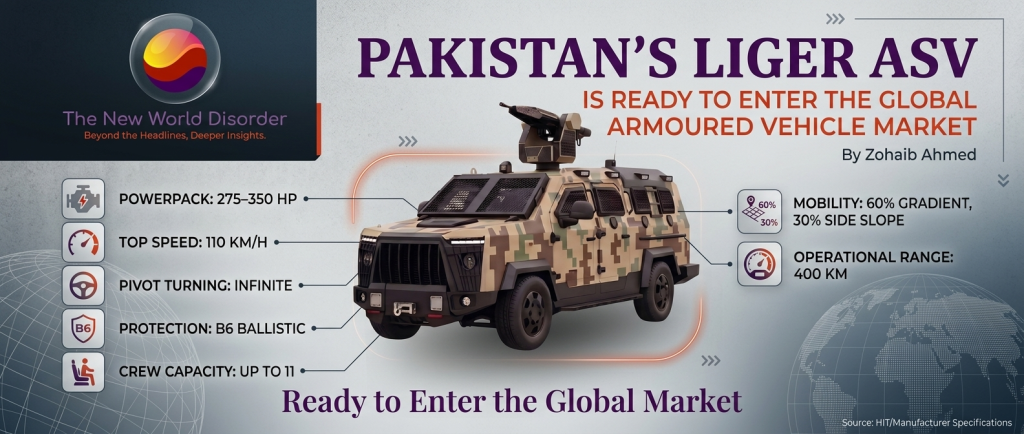
The result is a platform that occupies an important space between lightly protected security vehicles and full-sized Mine Resistant Ambush Protected (MRAP) vehicles. It provides meaningful ballistic protection, high troop capacity, excellent mobility, and domestic production, all while remaining significantly more economical than many Western alternatives.
Designed Around Operational Reality
The LIGER is powered by a 275 to 350 horsepower engine coupled with a six-speed automatic transmission. This combination gives the vehicle an excellent power-to-weight ratio without introducing unnecessary mechanical complexity.
Its mobility figures are competitive with far more expensive international platforms. A maximum road speed of 110 km/h, 60 percent gradient capability, and 30 percent side-slope performance allow the vehicle to operate across deserts, mountains, and broken terrain with confidence.
Unlike many Western tactical vehicles that rely on sophisticated independent suspension systems requiring extensive maintenance support, the LIGER focuses on operational ruggedness. The platform emphasizes modular maintenance, mechanical simplicity, and sustained field availability, attributes that matter far more during prolonged deployments than headline specifications alone.
Perhaps its most unique feature is its pivot-to-infinite turning capability. This dramatically improves maneuverability in narrow urban streets, checkpoints, mountain roads, and confined operating areas where conventional armored vehicles often struggle.
Protection Without Excessive Weight
Heavy armored vehicles continue to dominate discussions about protected mobility, yet many security missions simply do not require a 15 to 20-ton platform.
The LIGER instead delivers B6 ballistic protection on a heavy-duty chassis while maintaining manageable weight, mobility, and logistics. It effectively bridges the capability gap between commercial armored vehicles and heavier MRAPs.
The platform accommodates eleven personnel, allowing military units, police, and paramilitary forces to transport larger teams without sacrificing protection.
Many MRAP designs dedicate substantial internal volume to deep V-shaped hulls optimized against large mine blasts. While effective for specific operational environments, they often reduce usable cabin space and increase vehicle size. The LIGER instead offers a balanced approach that prioritizes crew capacity, rapid entry and exit, structural protection against small arms fire, and fragmentation resistance.
Long Patrol Endurance
The LIGER’s 400-kilometer operational range makes it particularly suitable for extended patrol missions along border regions, internal security corridors, and remote operating areas.
For countries conducting continuous counterterrorism operations, border security, convoy escort, or peacekeeping deployments, reducing refueling frequency directly translates into greater operational flexibility.
International Comparison
| Specification | LIGER ASV | BMC Vuran | Paramount Marauder | Oshkosh JLTV |
|---|---|---|---|---|
| Origin | Pakistan | Türkiye | South Africa | United States |
| Role | Armoured Security Vehicle | Tactical Armoured Vehicle | MRAP | Light Tactical Vehicle |
| Engine Output | 275-350 hp | ~375 hp | ~300 hp | ~340 hp |
| Transmission | 6-Speed Automatic | Automatic | Automatic | Automatic |
| Maximum Speed | 110 km/h | 110 km/h | 120 km/h | 113 km/h |
| Crew Capacity | 11 Personnel | 9 Personnel | 10 Personnel | 4 to 5 Personnel |
| Ballistic Protection | B6 | STANAG Protection | STANAG Protection | STANAG Protection |
| Operational Range | 400 km | ~700 km | ~700 km | ~480 km |
| Primary Strength | High capacity, affordability | Tactical mobility | Heavy protection | Expeditionary warfare |
The comparison highlights that the LIGER competes surprisingly well against globally recognized platforms despite being developed for a fraction of their procurement budgets.
Urban Operations Advantage
One area where the LIGER stands out is urban maneuverability.
| Capability | LIGER | Typical MRAP |
|---|---|---|
| Tight Turning Radius | Excellent | Moderate |
| Urban Checkpoint Operations | Excellent | Good |
| Mountain Road Mobility | Excellent | Moderate |
| Rapid Troop Deployment | Excellent | Good |
| Maintenance Simplicity | High | Moderate to Low |
These characteristics make the platform particularly attractive for internal security forces that operate inside cities, mountainous regions, and densely populated environments.
A Strong Export Candidate
Perhaps the LIGER’s greatest advantage lies beyond its technical specifications.
Because the vehicle is produced entirely by Heavy Industries Taxila, Pakistan controls the complete production chain. This eliminates dependence on foreign suppliers, avoids end-user restrictions that frequently accompany Western defense equipment, and ensures long-term availability of spare parts and upgrades.
For many developing countries, acquisition cost is only the beginning. Maintenance, training, spare parts, and lifecycle support often determine whether a platform remains operational after years of service. The LIGER’s emphasis on mechanical simplicity and domestic manufacturing significantly reduces these long-term costs.
Many nations across Asia, Africa, and the Middle East continue to seek affordable protected mobility platforms that can perform counter-insurgency, border security, convoy escort, and peacekeeping missions without the financial burden of premium Western systems. The LIGER enters this market at exactly the right point.
Pakistan’s Growing Defence Manufacturing Capability
The LIGER represents more than another armored vehicle. It demonstrates the growing maturity of Pakistan’s indigenous defense manufacturing ecosystem.
Rather than attempting to replicate the heaviest or most technologically extravagant Western vehicles, Heavy Industries Taxila has produced a platform tailored for the missions most countries actually conduct. It delivers meaningful protection, impressive mobility, generous troop capacity, and simplified sustainment in a package that remains financially accessible.
If backed by successful domestic induction and an active export campaign, the LIGER has the potential to become one of Pakistan’s most competitive armored vehicle exports, proving that practical engineering and operational efficiency can often outperform expensive complexity.
Heavy Industries Taxila, Pakistan’s Armoured Vehicle Powerhouse
Behind the LIGER stands one of South Asia’s most experienced armored vehicle manufacturers. Established in 1980, Heavy Industries Taxila (HIT) has spent more than four decades developing, manufacturing, rebuilding, and modernizing Pakistan’s armored fleet. Its portfolio includes the Al-Khalid main battle tank, Al-Zarrar upgrade program, APCs, recovery vehicles, engineering platforms, and numerous specialized military systems.
Unlike companies that merely assemble imported kits, HIT possesses deep expertise in steel fabrication, armored hull construction, automotive integration, systems engineering, and lifecycle support. This manufacturing ecosystem enables Pakistan to maintain complete sovereign control over production schedules, spare parts, upgrades, and future modernization programs.
For prospective export customers, this translates into something equally valuable: long-term sustainment. Buyers are not simply purchasing a vehicle, they are partnering with a mature defense manufacturer capable of supporting fleets throughout decades of operational service.
Estimated Procurement Economics
While Heavy Industries Taxila has not publicly released the LIGER’s export pricing, industry comparisons allow a reasonable estimate based on vehicles within the same capability bracket.
| Vehicle | Estimated Unit Cost |
|---|---|
| LIGER ASV | $250,000 to $450,000 (Estimated) |
| Streit Typhoon | $500,000 to $700,000 |
| BMC Vuran | $600,000 to $900,000 |
| Paramount Marauder | $700,000 to $1.2 Million |
| Oshkosh JLTV | $450,000 to $650,000 (without mission equipment) |
Even allowing for variations in configuration, the LIGER is expected to cost significantly less than comparable Western platforms while delivering the protection and mobility required for most counter-insurgency missions.
For many militaries, purchasing 100 protected vehicles instead of 40 often generates greater operational impact than buying fewer premium systems.
Lifecycle Costs Matter More Than Purchase Price
Modern military procurement is increasingly driven by total ownership cost rather than acquisition price alone.
A tactical vehicle purchased today will remain in service for twenty to thirty years. During that period, maintenance, spare parts, training, repairs, and upgrades typically exceed the original purchase cost.
| Lifecycle Factor | LIGER | Western Tactical Vehicles |
|---|---|---|
| Spare Parts Availability | Domestic production | Import dependent |
| Export Restrictions | Minimal | Often subject to government approval |
| Repair Complexity | Moderate | High |
| Field Maintenance | Simple | Specialized |
| Supply Chain Risk | Low | Medium to High |
| Operating Cost | Low | Moderate to High |
This is where the LIGER becomes particularly attractive.
Its engineering philosophy favors ruggedness over unnecessary sophistication. For armies operating with limited maintenance budgets, that can translate into substantially higher fleet availability.
Built for the Post-Ukraine Battlefield
The war in Ukraine has fundamentally reshaped military thinking about protected mobility.
Large, heavily armored vehicles remain indispensable, but they have also become increasingly vulnerable to loitering munitions, FPV drones, precision artillery, and persistent ISR. Modern operations now demand larger numbers of mobile, dispersed, and affordable protected vehicles rather than small fleets of highly expensive platforms.
The lesson has been clear. Survivability no longer depends solely on thicker armor. It also depends on mobility, rapid dispersal, repairability, and the ability to replace combat losses quickly.
Vehicles such as the LIGER fit squarely into this emerging doctrine. They provide protected mobility for troop transport, convoy escort, border security, quick reaction forces, and internal security missions without imposing the financial burden of heavyweight MRAP fleets.
An Export Opportunity Worth Billions
The global market for protected mobility vehicles continues to expand as countries modernize internal security forces, border protection units, and rapid response formations.
Potential customers include:
- Gulf security forces
- African peacekeeping contributors
- Central Asian militaries
- ASEAN internal security forces
- UN peacekeeping contingents
- Police tactical units
- Gendarmerie organizations
- Border guards
Many of these organizations do not require expensive expeditionary platforms like the JLTV. They need reliable armored transport that is affordable, easy to maintain, and immediately available.
The LIGER addresses precisely that market.
Final Assessment
The LIGER is more than another armored vehicle rolling off Heavy Industries Taxila’s production line. It reflects the evolution of Pakistan’s defense manufacturing from licensed production toward indigenous systems designed around operational realities.
Its specifications may not dominate marketing brochures with exotic technologies, but they reflect a pragmatic understanding of modern warfare. High troop capacity, respectable ballistic protection, strong mobility, mechanical simplicity, and competitive pricing combine to create a platform with genuine export potential.
If Heavy Industries Taxila successfully demonstrates the LIGER in international trials and actively pursues overseas customers, the vehicle could become one of Pakistan’s most commercially successful land systems since the Al-Khalid tank. In an era where militaries increasingly prioritize affordability, availability, and operational sustainability over technological excess, the LIGER arrives at exactly the right time.
One additional recommendation would elevate this into a magazine-quality feature: include an infographic-style comparison table with 12-15 parameters, including ground clearance, turning radius, payload, approach/departure angles, fuel capacity, maintenance philosophy, transportability, and mission roles. That would make the article stand out as a genuine defense analysis rather than a standard product overview.