
Intro
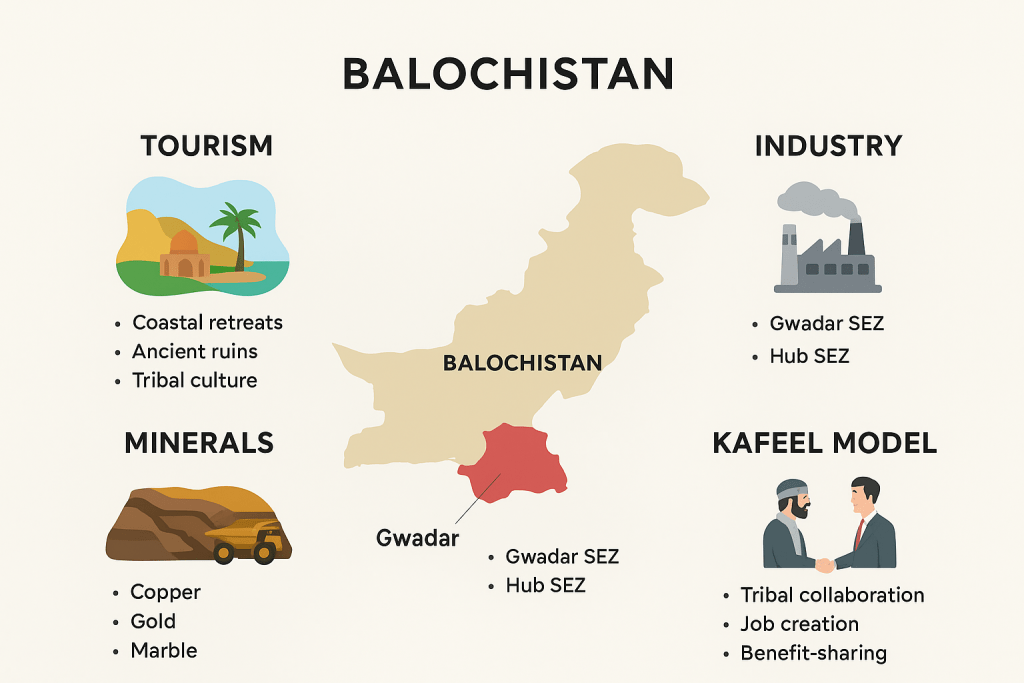
Balochistan—the rugged, resource-rich crown of Pakistan—has long been seen as the country’s untapped frontier. But by 2030, it could be the heart of a $100 billion economic transformation. At the center of this ambitious vision lies the Gwadar–Oman Strategic Corridor, a maritime and economic bridge that links Pakistan’s western coastline directly to the Arabian Peninsula, unlocking unprecedented trade, tourism, and industrial opportunities. Combined with the Kafeel Economic Model, special tourism and industrial zones, and an integrated plan to harness the province’s minerals, myths, and culture, this mega-project aims to rewrite Balochistan’s destiny. This isn’t just infrastructure—it’s a masterplan to make Balochistan Pakistan’s economic powerhouse and a global trade magnet.
This is a mega plan designed by Zohaib Ahmed
Executive Summary
The Mega Balochistan 2030 Plan is a transformative, multi-sector development blueprint that seeks to leverage Balochistan’s geographical, cultural, and mineral advantages into a sustainable $100B+ economic engine. Anchored by the Gwadar–Oman Gateway, the project will establish a high-capacity trade and maritime route connecting Gwadar to Oman, creating a new logistics spine for Pakistan’s exports and imports.
This corridor is reinforced by:
- Kafeel Economic Model: A Gulf-inspired, employer-investor approach to attract GCC capital into Balochistan’s industrial, agricultural, and service sectors.
- Tourism & Heritage Zones: Development of luxury coastal resorts, desert adventure parks, and cultural heritage sites to attract global travelers.
- Mineral Resource Integration: Strategic extraction and value-add processing of rare earths, copper, gold, and other resources, fueling both domestic industries and exports.
- Industrial & Free Trade Zones: Tax incentives, simplified regulations, and shared infrastructure for manufacturing and logistics hubs.
Strategic Benefits:
- Positions Balochistan as the maritime and economic gateway to the Middle East.
- Generates millions of jobs, especially for local communities.
- Diversifies Pakistan’s economy and strengthens its geopolitical position in the Arabian Sea–Indian Ocean trade network.
- Promotes regional stability through economic inclusion and cross-border partnerships.
With strong alignment between federal, provincial, and GCC stakeholders, and the potential for PPP (Public–Private Partnership) financing, Mega Balochistan 2030 stands as one of the most ambitious economic integration projects in South Asia’s modern history.
Snapshot: what Balochistan is right now
- Area & people: Balochistan is Pakistan’s largest province by area (~347,190 km²) and sparsely populated — ~14.9 million people (2023 provisional census). Population growth has been high in parts; household size ~6.4.
- Economy: the province is resource-rich (natural gas, coal, copper, gold, minerals, fisheries, livestock). Agriculture & livestock make up a large share of provincial GDP (estimates vary); nominal GSP often cited around ~$20 billion (2022 figures). Per-capita and human development indicators are low: literacy ≈42% overall (female markedly lower), HDI and poverty indicators are worse than national averages.
- Strategic assets: Gwadar deep-sea port (CPEC/BRI), Reko Diq copper-gold reserves (major international mining project under Barrick involvement), major gas fields and coastline on the Arabian Sea. Recent international financing moves for Reko Diq underscore global interest.
- Security: insurgency and militant attacks continue (Baloch separatist groups like BLA/BRAS), attacks on security forces and infrastructure have increased cycically, complicating investment and mobility; the situation triggers tough security responses (curfews, communications restrictions).
The tribal / social system — how local power actually works
- Tribal hierarchy: power is structured through sardars/mir/maliks (tribal chiefs and sub-chiefs). The traditional Jirga and tribal patronage networks are central to dispute resolution, land/soil access, marriage alliances and local leadership. These are highly local, personal and often pre-modern governance structures that coexist (often uneasily) with the formal state.
- Political economy: historically feudal confederacies (like the Khanate of Kalat) and colonial arrangements left local chiefs with big informal control over resources and people. That creates gatekeepers for development and political bargaining, but also entrenches elite capture and weak public service delivery for ordinary people.
Core problems (short list)
- Resource curse + exclusion: Huge natural wealth but local communities see few benefits; revenues are centralized or captured, feeding grievance.
- Weak governance & elite capture: Formal institutions are weak outside Quetta; tribal elites and patronage limit local accountability.Security and insurgency: Ongoing armed conflict damages commerce, scares off long-term investors, and produces heavy security responses that further alienate civilians.
- Human development deficits: Low literacy (especially for women), poor healthcare, high poverty and food insecurity (exacerbated by floods/drought).
- Infrastructure & connectivity gaps: Few roads, energy constraints, limited industrial base outside extractive projects. Gwadar is an exception but the hinterland remains disconnected.
- Extractives create high uncertainty for local people: long contracts and remote deals are hard to understand and easy to distrust. Locals often prefer immediate cash from middlemen even at a huge discount.
- Where the state fails to translate resource wealth into visible, immediate local benefits, narratives that “the state and outsiders are taking your assets” spread rapidly — especially where literacy and civic knowledge are low.
- Misinformation fills the vacuum: if locals don’t see timely, credible information from trusted channels, outside actors and rumor networks shape opinion.
These dynamics are why frameworks like Free, Prior and Informed Consent (FPIC) and local-content/value-capture mechanisms are repeatedly recommended by IFC, World Bank and mining governance bodies.
Strategic objective
Rebuild a credible, locally owned value proposition so that communities choose to co-develop and profit from mines (and associated jobs/SMEs) rather than sell raw material at a fraction of value — and use community trust-building to remove the informational advantage of external agitators.
1) Institutional & legal fixes (what must change first — months → 2 years)
- FPIC-style participatory process for every major project.
- Require independent, culturally appropriate consultation (use tribal leaders, jirgas, women reps), allow time for local decision-making, and document consent steps publicly. IFC / FAO guidance is the blueprint.
- Outcome: fewer surprises, legal legitimacy, and a recorded social compact.
- Community Development Trust (CDT) + royalty ring-fence.
- Mandate 15–25% of net project profits or a fixed royalty share for the CDT (tripartite board: provincial govt + community reps + independent trustee). Public accounting and real projects (schools, clinics, roads) not discretionary “slush.” Resource Governance bodies recommend clear, enforceable value addition & benefit capture.
- Local-price guarantee & aggregation coop.
- Create government-backed aggregation cooperatives (or licensed buyers) that offer a transparent floor price for mined raw material and guarantee immediate payment — but with a program that converts some of those flows into equity/shares/credits in a local processing JV. This kills the “sell now for cash” logic and creates upward mobility to higher value products.
- Local-content & jobs clause in contracts.
- Legally binding quotas for apprenticeships, on-the-job training, and progressive hire ratios. Tie foreign operator permits to measurable capacity transfer. IFC/BSR local content playbooks show this is feasible if enforced.
- Independent monitoring & grievance redress.
- Independent ombudsman and a hotline (with local-language access, jirga + civil society interface) for rapid complaints plus public monthly dashboards of payments & hiring.
2) Communications & counter-misinformation (first 3–12 months)
Goal: replace rumor + fear with trusted, local voices delivering simple, verifiable facts and visible benefits.
Tactics (operational)
- Trusted-messenger network: recruit and pay local influencers — tribal elders, schoolteachers, mosque imams, female community leaders — to be information partners. Studies show local leaders reduce misinformation faster than distant officials.
- Prebunking & rapid response cell: a small provincial unit that (a) pre-emptively explains contracts in local languages, (b) produces short videos showing the value math (raw vs processed price), (c) responds within 24–48 hrs to viral false claims with evidence and local spokespersons. Evidence-based approaches to countering disinformation recommend fast, clear, and trusted-frame responses.
- Show, don’t tell: early, tangible wins — e.g., the first tranche of CDT money funds a visible mini-project (clinic, school, water well) with signage: “Paid by Reko Diq/Provincial CDT — for [village name].” Visual signs of benefit beat abstract promises.
- Community media: local-language radio bulletins, mosque announcements, town-hall jirgas broadcast via loudspeaker/phone trees (where social media is weak), and SMS updates for registered households with payment & hiring data.
- Transparent “deal book” in plain language: publish a one-page “what they get” and “what you get” sheet for each project in Balochi, Pashto and Urdu, with clear timelines and contact info.
Messaging examples (short scripts you can deploy)
- “The government/partner will pay X per tonne at the aggregation center; if you sell raw privately you get ~Y — compare X vs Y and here’s how we guarantee payment.”
- “15% of profits go into the village development fund — here is last month’s spending (clinic roof, 20 apprenticeships).”
Make messages local, repeated, and delivered by the same trusted person over weeks.
3) Economic fixes and incentives (1–5 years)
Objective: make keeping and processing minerals locally demonstrably more valuable and lower risk than selling raw.
Key moves
- Local processing guarantees & phased local ownership.
- Require major projects to include a roadmap for in-province processing (concentrator → smelter) with timelines and finance. Resource Governance research emphasizes value-capture strategies to retain more benefits locally.
- Aggregation + price-disclosure system.
- State-backed aggregation centers publish daily prices, buy at floor rates, and offer a small premium if miners commit to convert X% into CDT/processing equity. This reduces the role of exploitative middlemen.
- Technical & market linkages.
- Connect cooperatives to export markets and regional smelters; use PPPs or concessional financing to build a mid-size smelter (could be a phased JV with Barrick/Bahri/others), lowering dependence on raw exports. Peru case studies show local supplier development is hard but possible with targeted policy.
- Microfinance + working capital for miners.
- Offer small credit lines for registered miners who channel ore through the aggregation cooperative — so they don’t need immediate cash from middlemen.
4) Social & education investments (3–10 years)
Goal: reduce the “information asymmetry” by raising baseline civic/economic literacy and creating career alternatives.
Actions
- Mining literacy curriculum (local schools, adult training): what royalties are, what value addition does, basic contract literacy.
- Apprenticeships & scholarships to technical universities tied directly to operators (conditional on local hiring quotas).
- Women-centered economic programs: female vocational centers and small enterprise grants funded by the CDT.
Long-term effect: locals understand the math, can weigh options, and see alternative livelihoods beyond quick raw sales.
5) Countering foreign/third-party misinformation & bad actors
- Mapping influence channels: identify which external NGOs/agencies or social actors spread narratives and map their networks (social + physical). Some actors may be legitimate human-rights groups — work with them where possible; others may be malign.
- Third-party credibility: invite trusted international monitors (UN special rapporteurs, MDB audit teams, prominent NGOs) into the oversight process to lend credibility to government claims — transparency reduces the space for outsider misinformation. The Reko Diq debate has been criticized for neglecting local perspectives — involving credible third parties reduces that critique.
6) Pilot package (0–18 months) — the practical test
Launch a cluster of fast, visible actions in 2–3 communities near a planned project to build proof-of-concept:
- Aggregation center + price floor (month 1–6) — open, buy ore at floor price; pay same day; public price board.
- Community Development Trust seed fund (month 2) — first payout funds clinic roof + 20 apprenticeships; signage.
- Trusted-messenger campaign (month 1 onward) — recruiters: 10 elders, 2 women leaders, 3 teachers paid for outreach.
- Skill pipeline — 6-month training course for 50 locals with job guarantees (project-linked).
- Rapid grievance & monitoring — independent observer reports monthly.
If these pilots show a 20–30% shift from clandestine raw sales → aggregation and local enrollment in apprenticeships within 12 months, scale.
KPIs (what you must measure)
- % of ore sold via aggregation vs private middlemen (target +30% in 12 months)
- Local wages/average income change in pilot communities (target +15% year 1)
- Number of apprentices trained & absorbed into projects (target 50+ in pilot)
- Number of misinformation incidents identified & corrected within 72 hrs (target: 90% response rate)
- CDT disbursements visible & matched to projects (audit monthly)
Risks & mitigations
- Security flare-ups: pair community programs with protection of civilians and independent observers. Heavy-handed security alone will fail.
- Elite capture: ring-fence CDT and enforce public accounting + international trustees to reduce capture risks.
- Project secrecy: secrecy breeds suspicion — publish non-sensitive deal terms in plain language.
Global comparisons (what the world learned from similar places)
These comparisons help frame realistic dos and don’ts.
- Niger Delta (Nigeria) — oil wealth + weak local benefit = environmental damage, violence, militancy, and years lost to conflict. Lesson: extractives without local revenue-sharing, remediation and employment = long term instability.
- Peruvian/Andean mining conflicts — community consent, royalties, and local procurement are critical; projects that ignore local voices face protests, legal battles and stoppages.
- Indigenous/remote mineral regions (Australia, Canada) — better outcomes when there are legally enforceable benefit-sharing agreements, local equity, training, environmental standards and independent monitoring.
Takeaway: projects that succeed combine (a) legally binding revenue sharing and local ownership, (b) local jobs and procurement guarantees, (c) environmental and social safeguards, and (d) transparent, independent monitoring and grievance redress. (Examples above are well-documented in mining and development literature.)
A realistic, phased, long-term strategic plan (15 years) — pragmatic & political
Principles: local inclusion, enforceable revenue sharing, layered security→development sequencing, institutional capacity, accountable PPPs, measurable KPIs.
Phase 0 — Immediate (0–12 months) — stabilise and build trust
- Freeze aggressive land/resource dispossessions; set a 12-month moratorium on major new extraction licenses until a provincial-federal audit is done.
- Establish a transparent Incident & Development Communication Cell (federal+provincial+sardars + civil society + donors) to publicly report on new investments and community commitments.
- Launch emergency human-security measures that pair intelligence operations with parallel civic relief (cash/food, health) to avoid “security-only” responses. (Simultaneous “hearts & minds” programs.)
KPIs: reductions in civilian grievances logged, publicized project commitments, baseline HDI/poverty metrics.
Phase 1 — Foundations (1–3 years) — governance, law reform, pilot wins
- Revenue Sharing Law: Provincial law (with constitutional review) to lock in minimum local royalties + community development funds (15–25% of net project profits) ring-fenced and managed by composite boards (local reps, tribal elders, women, technical experts).
- Local Employment & Procurement Rules: New projects must hire and train X% local workforce within 3 years; procurement targets for regional SMEs.
- Land & Environmental Rights Act: Transparent titling streams and independent EIA requirements; community consent (Free, Prior and Informed Consent – FPIC) enshrined for major projects.
- Pilot Projects: Small-scale, high-visibility pilots: solar micro-grids, water harvesting (Mirani-type scaling), vocational training tied to mining/port operations.
KPIs: legislation passed, 2 pilot zones operational, percent local hires, FPIC cases handled.
Phase 2 — Scale & Investment (3–8 years) — infrastructure, industrialization
- Special Economic & Industrial Zones (SEZs): Coastal and inland SEZs (Gwadar-adjacent logistics; Lasbela industrial cluster) with local equity, local hiring covenants, and environmental bonds.
- Value-chain capture: Support smelting/processing (e.g., copper concentrate → domestic smelters) to keep higher value in-province — financed via PPP and multilateral development banks. Barrick/Reko Diq financing example: ensure MoUs include local processing commitments.
- Education & Vocational Push: Technical universities and trade schools aligned with port/mining/renewables; scholarships and apprenticeship quotas for women and rural youth.
KPIs: share of raw material processed in-province, SEZ jobs created, increases in vocational enrolment.
Phase 3 — Consolidation & resilience (8–15 years) — diversified, accountable economy
- Establish sovereign or provincial development fund (SWF-lite) that converts resource revenue into long-term local infrastructure and stabilization (transparent, publicly audited).
- Decentralized local governance: real powers and budgets to district councils; formal role for traditional leaders via advisory boards with checks.
- Environmental restoration and climate adaptation plans (coastal zones, water resilience for agriculture).
KPIs: poverty reduction %, HDI improvement, stable investor inflow w/o security incidents.
Cross-cutting enablers
- Transparent contracts & open data portal for all concessions, contracts and community payments.
- Independent monitoring & grievance redress (ombudsman + international donor observers).
- Anti-corruption & procurement reform using e-procurement and tracked disbursements.
- Inclusion of women & minorities — conditional funding tied to measurable female school enrolment and maternal health improvements.
High-end GCC-style “Kafeel” model — adapted & rights-safe
The GCC kafala is a labor sponsorship model — problematic in migrant contexts because it creates dependence and rights abuses. But the idea of an investor-sponsor that guarantees jobs, housing and local investment can be retooled into a legally binding investor-partnership model for Balochistan. Here’s how to make a high-end, ethical kafeel-style framework that GCC capital could launch (and that avoids kafala abuses):
Core concept: Kafeel = Licensed Investor Partner (LIP)
A Licensed Investor Partner is a private GCC/sovereign/institutional sponsor that signs a binding contract with Pakistan & the Balochistan provincial government and a Community Development Trust (CDT). The contract guarantees development outcomes, local employment, community equity and environmental remediation in return for long-term operational rights.
Key elements
- Contractual guarantees (tripartite): Federal govt + Provincial govt + LIP + CDT (community rep) sign a legally enforceable Development & Social Compact. It specifies revenue shares, local hiring percentages, local procurement targets, training commitments, and remediation obligations. Contracts are public and arbitrable by an agreed neutral forum (e.g., ICSID + Pakistani domestic review).
- Community Development Trust (CDT): Ring-fenced fund (15–25% of profits or fixed royalties) managed by a board with community reps (including women), provincial gov’t, and an independent trustee (donor/MDB). Money goes to health, education, roads, direct cash transfers and small business grants.
- Local employment kafeeling: LIPs guarantee to sponsor and train local workforce—structured apprenticeships, contracts without exploitative control, clear severance and mobility rights (unlike GCC kafala). External specialists are permitted only for highly technical roles and only with parallel local capacity development plans.
- Human rights & labor safeguards: Explicit anti-abuse clauses, independent labor inspections, and freedom for workers to change employers within the province (no tied-veto). This addresses kafala vulnerabilities.
- Local equity & revenue path: Offer subordinated equity to a provincial development vehicle and community share certificates convertible into long-term dividends. This gives locals a stake.
- Environmental bond & closure fund: Upfront bond equal to X% of capex for remediation guarantees.
- Performance-linked visas for expatriate specialists: a limited, time-bound specialist visa system tied to transfer of skills to locals; no labour-sponsorship abuses.
Financing & partners
- GCC sovereign wealth + institutional investors (sound appetite for strategic minerals & port logistics).
- Multilaterals (World Bank, IFC, ADB) provide blended finance and guarantees. Barrick experience shows international lenders can be mobilised for large projects if security & governance risk is mitigated.
Governance & legal safeguards to prevent replication of kafala abuses
- Legislate worker mobility rights in project zones.
- Independent ombudsman with hotline & protection for complainants.
- Conditions for license termination on human rights breaches.
- Why the Kafeel Model Fits Balochistan’s Tribal Economy
- The Kafeel Model, widely practiced in the Gulf, is essentially a sponsorship-based investment and employment framework where an individual or entity (the kafeel) provides capital, infrastructure, and market access, while the local partner contributes land, labor, and community integration.
In Balochistan, this model aligns naturally with the tribal structure, where land ownership, resource control, and community decisions are tied to tribal leaders and elders. Key reasons it works:
Respect for Tribal Land Rights –
In tribal areas, land is a sacred inheritance, often resistant to sale or permanent transfer. The Kafeel model allows landowners to retain full ownership while leasing or partnering for economic activity — making it culturally acceptable.
Local Empowerment with External Capital –
Tribes can maintain control over operations while benefiting from outside investors who provide funds, technology, and markets. This reduces resistance to “outsiders” while still attracting FDI.
Job Creation Without Displacement –
The model encourages on-site employment for locals, meaning jobs stay within the community, preventing rural depopulation.
Cultural Alignment –
Much like the Gulf’s tribal-rooted economies, Balochistan’s tribal society values mutual trust agreements, face-to-face deals, and honor-based contracts, which fit perfectly with the informal-to-formal transition that the Kafeel model allows.
Risk-Sharing –
External investors bear much of the financial risk, while locals provide land/resources — a low-risk, high-return setup for Baloch stakeholders.
What We Can Expect Through It
Rapid Industrial & Tourism Growth – New industrial zones, eco-tourism sites, and mineral-processing hubs without stripping local land rights.
Mineral Extraction Partnerships – Safe, regulated extraction of gold, copper, REEs, and marble under revenue-sharing agreements.
Cross-Border Trade Boost – Integration with the Gwadar–Oman Strategic Corridor would open Gulf markets to Baloch products, fisheries, and livestock.
Women & Youth Employment – Skill programs tied to investor projects can integrate underutilized human capital into mainstream economy.
How It Will Change Pakistan’s Dimensions
If implemented strategically:
GDP Growth Driver – Balochistan could move from contributing less than 4% to over 12% of Pakistan’s GDP within a decade.
New Trade Hub – Gwadar + Oman linkage could shift Pakistan’s economic gravity westward, easing Karachi Port congestion.
Geopolitical Leverage – Control of key energy and trade routes increases Pakistan’s bargaining power in Gulf & Central Asia.
Reduced Separatist Grievances – Direct economic inclusion lowers unrest by offering tangible benefits to local tribes.
SWOT Analysis: Kafeel Model in Balochistan
Strengths
Land ownership remains local
Cultural acceptance via tribal sponsorship
Capital & tech inflow without displacement
Boosts local employment
Weaknesses
Risk of elite capture by a few tribal leaders
Possible lack of legal framework for dispute resolution
Dependence on external investors’ continued interest
Opportunities
Unlocking $1T+ mineral reserves
Expanding fisheries, livestock exports to GCC
Tourism potential in Hingol, Kund Malir, Ziarat
Integration with CPEC & Oman corridor
Threats
Political instability & security challenges
External actors influencing local politics
Over-exploitation of resources without environmental safeguards
Tribal rivalries blocking unified projects
Risks, obstacles & hard truths
- Security risk: insurgent attacks can still disrupt projects; stabilization requires both security and credible inclusion.
- Elite capture & corruption: ring-fencing revenue is politically hard; strong external monitoring and donor conditionality will help but must be politically calibrated.
- Federal–provincial politics: revenue sharing may need constitutional mechanisms and national political buy-in.
- Social trust: decades of exclusion create deep scepticism — early, visible local wins matter more than grand plans.
Concrete KPIs to track (example dashboard)
- Local employment % in major projects (yearly target: 30%→60% over 5 years)
- Share of resource revenue paid into CDT (%) (target: 15–25%)
- Number of apprenticeships completed and converted to jobs
- Literacy (female) increase in target districts (target: +10 pp in 5 years)
- Reduction in violent incidents in project districts (target: 50% reduction in 3 years)
- % of minerals processed in-province (value-added capture)
Quick win project examples (high visibility)
- Gwadar Logistics & Skills Hub: link port jobs to local training; mandatory local hire quotas; housing & transport for local workers.
- Reko Diq Local Processing Fund: require Reko Diq/Barrick project to fund a local processing smelter JV with provincial equity and royalty-backed financing.
- Solar+water micro-grid program for remote districts: immediate household benefits and local construction jobs.
- Community healthcare & girls’ schooling fund financed by a small surcharge on resource revenues.
Why this may work
Works if: political will exists to share power and revenues, international investors accept stricter social conditions, and provincial institutions are strengthened quickly.
Won’t work if: the plan is imposed top-down, deals are secretive, or security operations ignore civilian protection. Visible local benefits and real political voice are the single most important success factor..
Myth vs Fact: “Sui gas means Balochistan gets all the gas, but it doesn’t — only 10–15% of national gas comes from Sui; most is actually from Sindh.”
1. What’s the reality?
- Current production from Sui is much lower than perceived. According to Pakistan Petroleum Limited, Sui’s output averages about 334 million cubic feet per day (MMcfd). In 2007, it accounted for just 17% of the country’s gas production, and likely remains in that range today.
- Provinces like Sindh now produce more. For example, OGRA’s 2019–20 report shows Sindh supplied 45% of Pakistan’s gas, while Balochistan, KP, and Punjab contributed 12%, 11%, and 3%, respectively.
- Production vs consumption mismatch in Balochistan. In 2017, Balochistan produced 22.7% of the national output but consumed only 5.8%.
Quick summary: People think “Sui gas” is everywhere, so Balochistan should get it, but in reality:
- Sui contributes under 20% of national supply.
- Most gas is extracted in Sindh (and other provinces).
- Balochistan consumes only a small fraction of the gas it produces.
Additional myths circulating — and how to counter them
- “Balochistan gets unfairly little gas despite producing most of it.”
- Context: While Balochistan has vast reserves (some estimates previously said ~68% of reserves were there), those fields are declining, and current production is far less dominant. Plus, infrastructure, theft, and distribution issues limit local access.
- “Gas theft is the main problem.”
- Reality: Yes, theft is a huge challenge—SSGPL reported annual losses of Rs 14 billion in Balochistan (not all from Sui) largely due to theft. But there are also deep infrastructure gaps and deliberate undersupply to remote areas.
- “Sui town ironically doesn’t even have gas.”
- True. Sui and many parts of Balochistan have no gas supply despite being central to extraction. Distribution goes outward.
- “’Sui gas’ is just the company name; it doesn’t reflect where gas comes from now.”
- True. Distribution companies (Sui Southern & Sui Northern) inherited the name, but gas sources now include Mari, Qadirpur, Sawan, etc., from Sindh and elsewhere.
Why myth busting matters—and how to do it
Impacts of the myth:
- Breeds resentment: People feel exploited because they “produce Sui but don’t get it.”
- Fuels misinformation: Smug statements like “even Sui town has no gas” go viral.
- Undermines trust: Locals distrust government explanations when the narrative feels inverted.
How to fix it—practical myth-busting strategies:
A. Data Transparency
- Release a plain-friendly infographic, showing:
- Sui’s % of national production vs other fields (Mari, Sawan, Qadirpur).
- Provincial production vs consumption (with actual percentages).
- Publicly circulate via radio, SMS, local influencers.
B. Address the name confusion
- Clarify that “Sui gas” is a historical branding — not where gas is predominantly sourced today.
C. Highlight distribution inequities and theft
- Publicly show which areas share gas pipelines and where they don’t.
- Share data on losses/theft and existing efforts to fix them.
D. Local Info Campaign (myth vs fact)
- Use trusted local leaders (elders, teachers, mosque imams) to relay accurate info.
- Simplify messages:
- Myth: “Sui gas supplies most of Pakistan, so Balochistan gets nothing.”
- Fact: “Sui supplies under 20%; most of our gas now comes from Sindh. Many areas here still have no lines, which we’re fixing, but the misunderstanding fuels anger.”
E. Quick win infrastructure
- Publicly prioritize extending gas lines in pilot districts and show “before/after” visuals.
- When new pipelines become operational, create celebration ceremonies chaired by local figures—an antidote to “always talking but never delivering.”
Sample Myth-Busting Messaging Table
| Myth | Reality |
|---|---|
| “Sui gas is Pakistan’s gas, so Balochistan should get it all.” | Sui’s production is roughly 10–20% of national gas. Sindh and other regions produce more today. |
| “We don’t get gas even in Sui.” | Sadly true—local distribution is poor due to theft, infrastructure, and policy gaps. |
| “’Sui gas’ covers all gas, so people assume it comes from there.” | ‘Sui gas’ is just the name of distribution companies, not the gas origin. Much comes from Sindh (Mari, Qadirpur, Sawan fields). |
Balochistan’s Industrial Landscape: Scale & Potential
1. Natural competitive edge:
Balochistan holds vast mineral, gas, and metal reserves—including massive copper and gold in Reko Diq (expected to generate billions in revenue), lead-zinc at Duddar, plus marble, oil, and gas deposits.
2. Hub Industrial Zone – the powerhouse:
- Contribution: Hub alone accounts for approximately 90% of Balochistan’s industrial output, and generates around 70% of the province’s industrial tax revenues.
- Industrial activity: Hosted by LIEDA, the Hub Industrial & Trading Estate spans ~1,326 acres (established late ’70s/early ’80s) with 135–150+ operational units in sectors like cement, petroleum, power, textiles, and chemicals.
- SEZ upgrade: The Hub Special Economic Zone (SEZ) currently covers 406 acres and is designed to accommodate 211 industrial units, projecting 15,000 direct and 75,000 indirect jobs. With a 10-year tax holiday and machinery import exemptions, it’s a high-priority CPEC-linked project.
- Scale potential: Hub SEZ could expand by another 5,000 acres if demand continues.
3. Emerging zones beyond Hub:
- Bostan SEZ: Located in Pishin district (~200 acres), it’s a priority under CPEC and already attracting investors.
- Marble Cities: Government-branding in Dalbandin, Khuzdar, Loralai aims to develop these areas into marble-processing hubs, with ambitions to create ~30,000 jobs through dedicated carving and trading zones.
4. Infrastructure bottlenecks:
Despite this potential, the province suffers from dilapidated roads, unreliable power and water supplies, and weak logistics—hindering industrial expansion. Businesses and the Chamber of Commerce are calling for urgent infrastructure investment.
Industrial Summary: Why Balochistan Is Mega-Ready
| Feature | Details |
|---|---|
| Natural Resources | Globally significant copper/gold (Reko Diq), major zinc/lead (Duddar), and marble or decorative stone reserves. |
| Current Industrial Backbone | Hub district remains a central engine—90% of provincial output, heavy presence of key industries, and expanding SEZs. |
| Development Momentum | SEZs (Hub, Bostan) packaged under CPEC; workforce and investment incentives in place; marble cities policy framing underway. |
| Gaps & Needs | Infrastructure, human capital, transport linkages, regulatory clarity, and incentive enforcement remain constraints. |
Strategic Path Forward
- Infrastructure uplift: Prioritize energy, utilities, roads, and logistics in Hub, Bostan, and Marble Cities to sustain investor interest.
- Value-add local processing: Leverage zones for extraction-linked industrial clusters—e.g., concentrate → smelting for mines, processed marble, leather, agri-processing.
- Investment targeting: Actively market SEZs to regional auto parts manufacturers, mineral processors, and export-driven firms (Middle East, CPEC corridor).
- Human capital development: Launch vocational and technical training tied to industries in SEZs to build local employment pipelines.
- Governance & incentives: Streamline one-window facilitation, legal clarity, uptime guarantees, and enforce benefit-sharing via CDTs.
Real-Time Developments & Context
- Mineral investment spotlight: Pakistan recently launched a minerals investment forum to attract global capital (US, Saudi, China), emphasizing local processing before export.
- Geopolitical interest rising: Latest reports reveal U.S. outreach to Pakistan for accessing Balochistan’s critical minerals, signaling rising global strategic interest.
- Security caveats: Ongoing insurgency poses real risk; recent attacks (e.g., train hijacking) illustrate instability that could deter investors unless paired with local peacebuilding and community trust initiatives.
1. Why LIEDA & Hub Are Game-Changers for Balochistan
- Autonomous Authority (LIEDA) since 1984 → Enables independent policy-making, faster investor facilitation.
- One Window Operation → Electricity, water, utilities, and plot allocation handled internally.
- Land Lease Model (99 years) → Long-term investment security for both local & foreign companies.
- Hub’s Proximity to Karachi Port → Cost-effective logistics without Karachi’s congestion.
- Multiple Specialized Zones → Diversified industry clusters (Marble City, Agro-based, Mineral Processing, SEZ).
2. The Industrial Cluster Effect in Lasbela
Instead of a scattered approach, LIEDA has created dedicated industrial estates with sector-specific strengths:
| Estate / Zone | Core Industry Focus | Size & Facilities | Unique Advantage |
|---|---|---|---|
| Hub Industrial Estate | Textiles, Engineering, Steel, Chemicals, Food, Auto Assembly | 1,226 acres | Karachi adjacency + 156 operational units |
| Marble City Gaddani | Dimensional Stones, Marble Processing | 600 acres | 90% of Pakistan’s stone exports sourced from Balochistan |
| Winder Industrial Estate | General Manufacturing | 230 acres | Low-cost plots, easy entry for SMEs |
| Uthal Phase-I | Agro-Processing, Marble, Minerals | 2,138 acres | Local raw material hub |
| Uthal Phase-II | Warehousing, Port-linked Industry | 1,000 acres | Linked to Gwadar deep sea port |
| Hub SEZ | Export-oriented, high-tech industries | 406 acres | 10-year tax holiday, zero duty on plant/machinery |
3. Current Industrial Anchors
- Volkswagen/Skoda Auto Assembly – First European auto giant assembling in Pakistan (Amarok & Transporter).
- Gatron-Novatex – Supplies to Walmart, Coca-Cola, Pepsi.
- Glassware, Oil Blending, Electrical Manufacturing – Existing manufacturing diversity creates supply chain synergies.
4. Missed Opportunities & Fixes
Missed:
- Low integration with local tribal workforce → increases mistrust and external influence.
- Poor marketing of fiscal incentives → not enough FDI compared to GCC free zones.
- Limited downstream processing of minerals → still exporting raw form.
- Weak logistics infrastructure in Uthal and Winder → hampers scaling.
Fixes:
- Local Hiring Quotas + skill centers to bridge tribe-industry gap.
- Aggressive international roadshows showcasing SEZ incentives.
- Invest in mineral beneficiation plants (copper smelters, gold refineries, lithium battery units).
- Build industrial freight corridors linking Hub → Gwadar → CPEC highways.
5. GCC-Style Kafeel System Adaptation for Balochistan
The GCC kafeel model can be localized into a “Tribal Industrial Sponsorship Program”:
- Local Tribe = Sponsor for labor & security.
- Investors partner with tribes to hire and train locals, with profit-sharing or royalty agreements.
- State acts as guarantor to ensure compliance, avoiding exploitation.
- Benefits: Tribes gain employment + stakes in projects, while investors gain legitimacy and safety.
6. Strategic Industrial Expansion Plan (2025–2040)
Phase 1 (2025–2030):
- Complete Hub SEZ infrastructure.
- Operationalize Volkswagen plant.
- Launch Marble City Phase-II.
- Create vocational institutes for automotive, stone processing, and agri-tech.
Phase 2 (2030–2035):
- Develop mineral refining hubs.
- Set up export-based agro-processing units.
- Expand port-based warehousing in Uthal Phase-II.
Phase 3 (2035–2040):
- Attract renewable energy manufacturing (solar panels, wind turbines).
- Establish marine industries in Gaddani & Ormara.
- Position Balochistan as Pakistan’s primary export manufacturing province.
7. Why This Works
- Like GCC: Tax incentives, port access, long leases, one-window facilitation.
- Unlike GCC: Stronger integration of local tribal workforce to prevent alienation.
- Creates a triple-win: state revenue, investor ROI, tribal economic uplift.
Hub is emerging as Balochistan’s Karachi-adjacent powerhouse, with close connectivity to Karachi’s ports and supply chains.
Volkswagen & Skoda Auto Assembly
- Premier Motors Limited (PML) is building an auto assembly plant for VW & Skoda.
- Production Capacity: ~30,000 units/year.
- First Models: VW Amarok pickup truck & Transporter van.
- Completion Target: Originally 2024, delayed due to import restrictions & economic slowdown.
- Current Status: Industry insiders reject rumors of project cancellation; plans still in motion.
Why This Is Huge for Balochistan
- First-Ever Volkswagen Entry into Pakistan – brings global attention and investor confidence.
- Skill Transfer: Local workers trained in advanced automotive assembly & quality control.
- Vendor Industry Growth: Boost to local parts manufacturing—batteries, tyres, interiors.
- Export Potential: With right policy, Balochistan could export VW vehicles to the Middle East & Africa.
Industrial Mega Potential Beyond VW
- Mining & Processing
- Move from raw mineral export to value-added processing plants.
- E.g., copper smelters, gold refineries, lithium battery factories.
- Agro-Processing
- Leverage Balochistan’s fruit produce (dates, grapes, apples, pomegranates) with cold storage & packaging industries.
- Shipbuilding & Marine Industry
- Gwadar & Ormara could house ship repair yards & fishing processing zones.
- Renewable Energy
- Solar & wind farms in Makran and Chagai to power industries sustainably.
Industrial Growth Comparison – Balochistan vs. Punjab/Sindh
| Factor | Balochistan | Punjab/Sindh |
|---|---|---|
| Land Availability | Massive, cheap, and coastal in parts | Limited, expensive |
| Proximity to Ports | Direct access via Gwadar, Hub | Karachi port only |
| Natural Resources | World-class mineral deposits | Limited minerals |
| Industrial Ecosystem | Nascent, huge room for growth | Mature but saturated |
| Government Incentives | High under CPEC SEZs | Moderate |
Gwadar-Oman Economic Corridor
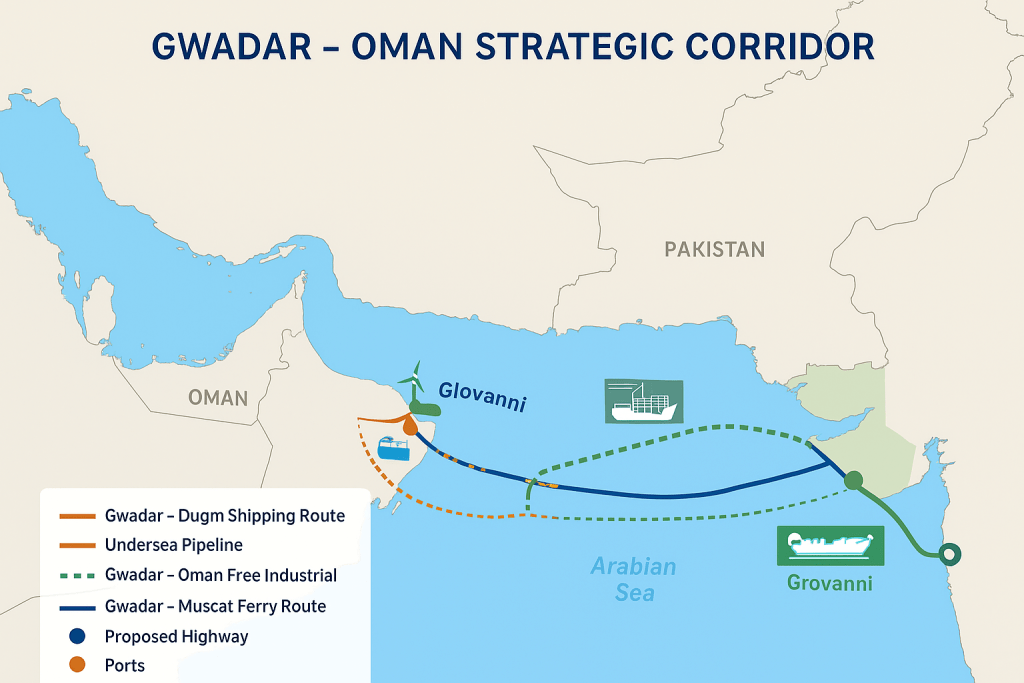
Strategic Plan: Leveraging Oman–Pakistan Partnership for Gwadar’s Growth
1. Historical & Geopolitical Context
- Gwadar remained under Omani control until 1958 when Pakistan purchased it for $3 million.
- Oman is just ~230 nautical miles from Gwadar across the Arabian Sea — shorter than Karachi–Gwadar road distance.
- Oman already has a strong Pakistani diaspora workforce (over 200,000), creating natural people-to-people and business trust.
- While China’s CPEC investments dominate the narrative, Oman can offer a Gulf-facing commercial bridge that complements—not competes—with Chinese interests.
2. Strategic Goals
- Transform Gwadar into a Gulf–South Asia Logistics Hub by integrating Oman’s Duqm Port and Salalah Port with Gwadar Port.
- Position Pakistan as Oman’s closest overland gateway to Central Asia & Western China.
- Secure dual-source investment from both Chinese and Omani partners for industrial diversification.
3. Core Collaboration Areas
A. Maritime & Port Connectivity
- Gwadar–Duqm Direct Shipping Line: Establish a regular Ro-Ro (roll-on/roll-off) and container line between Gwadar and Duqm, reducing shipping times for Gulf-bound goods.
- Joint Port Management Training: Oman’s Port of Salalah is one of the most efficient in the world — Oman can train Gwadar Port Authority staff.
- Ferry & Passenger Service: Launch Gwadar–Muscat fast ferries for both trade and tourism.
B. Industrial & Trade Zones
- Oman–Pakistan Free Industrial Corridor in Gwadar: Allocate a special block in the Gwadar Free Zone for Omani companies.
- Focus industries:
- Petrochemicals (leveraging Oman’s refineries & Pakistan’s industrial base)
- Fisheries processing (Oman + Balochistan coastal fisheries)
- Automotive assembly (synergy with Hub Industrial Zone and Volkswagen plant)
- Renewable energy (wind & solar farms for export power to Oman).
C. Energy & Pipeline Projects
- Undersea/Oil Pipeline Feasibility Study: Oman could supply LNG & crude directly to Gwadar refineries via subsea pipeline — reducing shipping costs.
- Floating LNG Terminal in Gwadar: Co-financed by Oman Oil Company.
D. Tourism & Cultural Links
- Develop a Gwadar–Muscat Tourism Belt with cruise services, heritage tours, and scuba diving routes.
- Joint marketing of Gwadar beaches and Oman’s coastline as “Twin Coasts of the Arabian Sea.”
4. Diplomatic & Governance Steps
- High-Level Bilateral Task Force
- Members: Gwadar Development Authority, Omani Ministry of Transport & Communications, Pakistan’s Ministry of Maritime Affairs, and private sector reps.
- Gwadar–Oman Economic Forum annually alternating between Gwadar and Muscat.
- Investment Security Protocol — Legal framework ensuring Omani investments are protected under CPEC special economic zone laws.
5. Infrastructure Priorities
- Gwadar International Airport’s direct flights to Muscat & Salalah.
- Deepwater berth expansion in Gwadar for Omani petrochemical tankers.
- Upgrade Makran Coastal Highway & Giovanni industrial link to facilitate inland movement.
6. Funding & Partners
- Trilateral Investment Model: China (infrastructure), Oman (energy & trade), Pakistan (land & regulatory facilitation).
- Incentives: 0% customs duties in Gwadar Free Zone for Omani goods re-exported to Central Asia.
- Engage Oman Investment Authority (OIA) and ASYAD Group for port logistics.
7. Strategic Impact
- Cuts Gulf–China shipping time by 4–6 days via Gwadar–CPEC route.
- Diversifies Gwadar’s investment base beyond China, reducing geopolitical overdependence.
- Revives historic Oman–Balochistan cultural ties while generating thousands of local jobs.
- Establishes Gwadar as the third major Gulf logistics hub after Dubai & Salalah.
Strengths (Internal Advantages)
- Geostrategic Location – Gwadar sits at the mouth of the Strait of Hormuz; Oman is just 200 nautical miles away, making maritime and air connectivity cost-effective and fast.
- Historical Linkages – Gwadar was part of Oman until 1958, giving cultural, social, and diplomatic affinity to build trust.
- China–Pakistan Economic Corridor (CPEC) Boost – Chinese infrastructure investments already provide deepwater port capacity, highways, and free zones.
- Economic Diversification for Oman – Oman’s Vision 2040 focuses on reducing oil dependency; Gwadar offers them a logistics and trade expansion hub into South Asia and Central Asia.
- Natural Deep-Sea Port – Gwadar’s port depth allows docking of mega-ships without dredging, giving it a natural advantage over competing ports.
- Hub Industrial Zone Proximity – Balochistan’s Hub area already attracting global players (Volkswagen, Lucky Cement, etc.), providing a manufacturing base near Gwadar.
Weaknesses (Internal Limitations)
- Security Risks – Ongoing insurgency in parts of Balochistan could deter foreign investors without strong security guarantees.
- Underdeveloped Local Workforce – Skills gap in high-tech logistics, manufacturing, and port operations may require heavy reliance on foreign labor initially.
- Limited Existing Oman–Pakistan Trade Volume – Current bilateral trade is small, requiring policy incentives to make the corridor viable.
- Dependence on External Funding – Heavy reliance on Chinese and potential Omani financing could limit Pakistan’s policy flexibility.
- Inadequate Power & Water Infrastructure – Gwadar still faces electricity shortages and water scarcity, which could hamper industrial growth.
Opportunities (External Prospects)
- Dual-Port Model – Linking Gwadar with Oman’s Duqm or Salalah ports creates a two-port logistics chain controlling a major slice of Indian Ocean trade.
- Energy Hub Potential – Oman can supply LNG, oil storage, and refining capabilities to Gwadar’s energy corridor.
- Joint Free Trade Zone (FTZ) – Pakistan and Oman could establish a binational free trade zone attracting Gulf, African, and South Asian businesses.
- Tourism & Cultural Exchange – Cruise terminals and ferry services between Gwadar and Muscat can open up coastal tourism.
- Gateway to Africa – Oman’s shipping links to East Africa could turn Gwadar into the launchpad for South Asian exports into Africa.
- Maritime Security Cooperation – Joint naval patrols could ensure sea-lane safety, boosting investor confidence.
Threats (External Risks)
- Regional Geopolitics – India and Iran may view the Gwadar–Oman link as a strategic threat and counter with rival infrastructure projects (e.g., Chabahar Port).
- US–China Rivalry – American concerns over Chinese military use of Gwadar could create diplomatic friction affecting Oman’s position.
- Economic Volatility – Oil market fluctuations affecting Oman’s budget could slow its investments.
- Climate Change & Sea Level Rise – Could impact coastal infrastructure and shipping schedules.
- Terrorism & Piracy – Arabian Sea shipping routes face piracy threats that may require costly security measures.
Snapshot — why Balochistan can work as a tourism hub
- Big space, small population: ~14.9 million people across ~347,190 km² — low density, huge landscapes to explore.
- Human development gap but strong soft assets: low literacy (~42%) and weak infrastructure, but rich culture, ancient sites, long coastline and unique nature (juniper forests, mud volcanoes, dramatic rock formations).
Flagship places & experiences (province-wide, not Gwadar-centric)
(Each item has tourism hooks, how to package it, and quick conservation notes)
- Hingol National Park — Princess of Hope, mud volcanoes & Makran beaches
- Why: giant coastal-national-park, surreal rock formations (Princess of Hope, Baloch Sphinx), mud volcanoes and array of marine and desert wildlife — great for day trips, photography, eco-safaris and geological tourism.
- Package: coastal drives (Makran Coastal Highway legs), guided photography safaris, protected beach camping, geological tours.
- Conservation note: strict visitor zoning and trained local rangers.
- Kund Malir & Makran coastal drives (Ormara, Pasni, Jiwani)
- Why: long, largely empty beaches, dramatic sea-cliff roads — excellent for road-trippers, surf-lite activities and slow coastal tourism.
- Package: multi-day coastal circuit with homestays, seafood experiences and boat trips to see dolphins.
- Ziarat & Juniper Forests + Quaid-e-Azam Residency
- Why: cool highland valley, historic residency of Pakistan’s founder, and one of the world’s largest ancient juniper forests (biosphere reserve). Great for eco-tourism, birding, cool-season retreats.
- Package: heritage trail, guided forest walks, “juniper and wellness” retreats (local herbal products).
- Conservation note: strict anti-logging controls and visitor limits.
- Bolan Pass, Quetta & Hanna Lake
- Why: cultural/urban anchor (Quetta), dramatic mountain gateway (Bolan), scenic artificial lake (Hanna) — good for urban base-stays, gastro-tourism, city museums and bazaars.
- Package: city heritage walks, bazaars selling Balochi embroidery and handicrafts, short Bolan canyon excursions.
- Turkoman/Dasht & Kharan Desert / Chagai landscapes
- Why: lunar landscapes for off-road adventure travel, starry-sky camps, mineral/archaeological routes.
- Package: 4×4 desert safaris, astrotourism (low light pollution), archaeology drives.
- Coastal fishing towns: Pasni, Ormara, Jiwani
- Why: local fisheries, sea-food gastronomy, boat-based ecotours (dolphins, turtles).
- Package: community-run boat tours, catch-and-cook experiences.
- Rock art & archaeological sites (e.g., Gwark, some Makran sites)
- Why: ancient human traces, petroglyphs, and caravan-route heritage — niche cultural tourism for archaeology enthusiasts.
- Package: curated, conservatively-managed site visits with local guides and interpretation centers.
What’s unique about Balochistan & its culture (tourism assets)
- Landscape diversity in a single province: desert plateaus, arid mountain ranges, juniper forests, a long Arabian Sea coastline and lunar-like mining landscapes.
- Living tribal culture: complex tribal system with music, dance (chaap), oral ballads, Balochi needlework and jewelry traditions (mirror-work, coin embroidery). A rich intangible cultural heritage for respectful cultural tourism.
- Seasonal advantage: cooler highlands in summer (Ziarat), milder winters on the coast — extends tourism season complementing the North’s peak seasons.
- Astro & geological tourism: minimal light pollution in deserts for stargazing; unique geological formations (mud volcanoes, Princess of Hope).
How tribes can participate (and why they must lead)
Tourism must be community-first or it will replicate extractive mistakes.
- Community-run homestays & cultural homesteads
- Tribal families host tourists in local homes with homestay standards, revenue-sharing, and training in hospitality & safety.
- Tribal guide networks & cultural interpreters
- Licenced local guides (tribal elders, youth) trained in languages, first-aid, and environmental protection. Guides become local ambassadors and myth-busters.
- Handicraft value chains & micro-enterprises
- Support Balochi embroidery cooperatives, jewelry makers, leather-work and packaged local foods. Certifications (e.g., “Baloch Authentic”) for export and tourism retail.
- Community Development Trusts (CDTs)
- A portion of tourism fees (park fees, permits, visitor taxes) flows to CDTs for local infrastructure (schools, clinics, water) under tribal board oversight.
- Cultural festival circuit
- Support safe, curated tribal festivals (music, dance, food) at fixed times — paid admission and cultural protocols protect authenticity.
- Education & capacity building
- Hospitality training, language classes, eco-interpretation, waste management and petty-trade (food stalls, transport) skills — link to apprenticeships in nearby hotels.
How Balochistan tourism compares with the North
- North (Gilgit-Baltistan, KP): mountain trekking, high-altitude adventure, glaciers, mountaineering, boutique lodges. Peak seasons: spring–autumn. Infrastructure: established trekking routes, climbing culture.
- Balochistan: coastal & desert experiences, heritage & culture, geology & astro-tourism, road tripping and highland retreats (Ziarat). Peak seasons are complementary (coastal mild winters, Ziarat cool summers), allowing national tourism product to extend year-round. Balochistan can therefore attract different customer segments: road-trippers, families, cultural tourists, photographers, eco/geo-enthusiasts, and international travelers seeking unusual, less-crowded experiences.
Bottom line: Balochistan won’t replace the North — it diversifies Pakistan’s tourism offer and smooths seasonality.
Infrastructure & product development (practical roadmap)
Phase A — Quick wins (0–18 months)
- Create 10 community homestays in strategic hubs (Kund Malir, Ziarat, Pasni, Quetta).
- Basic safety and guide training for 100 locals.
- One visible small infrastructure win per hub (toilet block, potable water, signage).
- Launch a provincial tourism portal + social media with high-quality visuals and local-language myth-busting facts.
KPIs: homestays opened; guides trained; bookings recorded; first CDT disbursement.
Phase B — Build (1–4 years)
- Upgrade access roads to top 20 attractions, safe pullouts & viewing platforms.
- Establish three accredited interpretation centers (Hingol, Ziarat, Quetta) and micro-museums for rock art and tribal history.
- Launch a Balochistan “cultural trail” product (5–7 day loop) and a Makran Coastal Drive product (3–5 day).
- Invest in small sustainable lodges and eco-camps (PPP / blended finance).
KPIs: increase in overnight stays, length of stay, local incomes, tourist satisfaction scores.
Phase C — Scale (4–10 years)
- Build provincial tourism-class airport upgrades (Quetta runway / Ormara airstrip improvements) and integrated road corridors.
- Develop higher-end lodges and one eco-resort in a pilot protected area with tight conservation.
- Export handicrafts via e-commerce and tourism retail.
KPIs: international arrivals uptick, registered tourism businesses, export value of handicrafts.
Sustainability & conservation (non-negotiable)
- Carrying capacity limits and visitor zoning in Hingol, Ziarat & coastal nesting sites.
- Visitor fees ring-fenced into CDTs and park management.
- Waste & water management plans: strict “pack-in, pack-out” rules and village-level waste collection.
- Anti-poaching and community ranger programs — tribes paid as protectors and guides (employment + guardianship).
- Climate resilience: protect juniper forests and coastal mangroves, restoration grants from donors.
Marketing: target audiences & channels
- Domestic: road trippers from Sindh & Punjab (long weekends, family travel), heritage & school trips.
- Regional: adventure & short-break travelers from Gulf countries (4–7 day coastal + culture circuits).
- International niche: geo-tourists, photographers, cultural heritage travelers, astrotourists, academic groups (archaeology, geology).
Channels: immersive short films, photo essays, influencer fam-trips (carefully curated), GCC diaspora campaigns, partnerships with airlines, and B2B tour operator packages.
Revenue & financing models
- Visitor fees, park permits, homestay commissions.
- Public–private eco-lodges with community equity stakes.
- Concessions where communities own minority stakes in resorts/boat operators.
- Development bonds / blended finance for roads, matched by provincial tourism levies.
- Grant-funded conservation & training (UNDP, UNESCO, WWF, ADB) to de-risk pilot projects.
Pilot projects (priority, low-bureaucracy, high-visibility)
- Makran Coastal Weekender — 3-night package: Kund Malir → Ormara → Pasni; community homestay, seafood dinners, photography stops, boat trip.
- Ziarat Juniper Wellness — 4-night: Quetta → Ziarat; juniper forest walks, Quaid residency, local handicrafts, organic juniper product demo.
- Hingol Geo-Safari — 2-day guided geology & mud-volcano trip with ranger-led conservation talk and protective viewing platforms.
Each pilot should include: training budget, marketing budget, basic infrastructure (toilets, signage), safety plan, and a community revenue-share agreement. Aim for 12–18 months from approval to operation.
Metrics & KPIs (dashboard)
- Number of registered tourism businesses & homestays.
- % tourism revenue retained locally (target 60%+).
- Average length of stay and repeat visit rate.
- Local employment in tourism (direct & indirect).
- Visitor satisfaction (Net Promoter Score).
- Conservation indicators (e.g., no. of protected nests disturbed; juniper sapling survival).
- Seasonal spread (tourism across 12 months vs North’s seasonality).
Risks & mitigations
- Security perceptions: run “safety + inclusion” campaigns, real-time incident reporting, community rangers — do not hide issues; be transparent.
- Elite capture: CDT governance with minority seats for women, youth and an independent trustee. Regular public audits.
- Environmental damage: strict zoning, visitor caps, environmental bonds for larger operators.
- Cultural exploitation: community control of cultural narratives and paid protocols for performances. Cultural tourism codes developed with tribal councils.
SWOT Analysis
Strengths
- Strategic Location: Direct maritime and overland link between Gwadar and Oman strengthens Pakistan’s role in Gulf–South Asia trade.
- Diverse Economic Potential: Combines minerals (Reko Diq, Saindak, rare earths), industry, and tourism.
- Kafeel Model Funding: Attracts GCC investors without heavy initial government expenditure.
- Cultural & Mythic Heritage: Leverages Makran Coast legends (Alexander’s route, Hinglaj Mata, Princess of Hope) to boost cultural tourism.
- Port Access: Gwadar deep-sea port provides year-round operation capacity.
- Balochistan Industrial Zones: Tax-free zones, manufacturing clusters, and mineral processing hubs.
Weaknesses
- Security Concerns: Militancy in Balochistan may deter investors.
- Infrastructure Gaps: Road, rail, and power connectivity still developing.
- Low Local Skill Base: Requires major training and education initiatives for local workforce.
- Perception Gap: Balochistan’s image problem in international media.
- Political Instability: Frequent federal-provincial disputes can slow decision-making.
Opportunities
- Regional Trade Gateway: Shorter trade route between Gulf, Africa, and Central Asia.
- Tourism Boom: Eco-resorts, archaeological tourism, and cruise stopovers.
- Mineral Exports: Processing rare earths and copper locally for higher value.
- GCC–China–Pakistan Triangular Trade: Oman link offers alternative to Hormuz chokepoint.
- Renewable Energy Projects: Solar and wind potential in Makran coast for industry.
- Myth-based Tourism: Storytelling and heritage branding for global tourist appeal.
Threats
- Geopolitical Competition: India, Iran, and some Western powers may see it as a Chinese strategic gain.
- Climate Risks: Rising sea levels, cyclones, and water scarcity.
- Overdependence on Foreign Investors: Could limit local ownership.
- Smuggling & Informal Economy: Weakens formal revenue streams.
- International Sanctions Risks: Any tensions with Gulf/Western countries could hit funding.
PESTEL Analysis
Political
- Government push for CPEC Phase II integration.
- Oman–Pakistan diplomatic ties strengthening.
- Risk of political instability and policy changes.
- Influence of GCC bloc investment strategies.
Economic
- Potential to generate billions in trade revenues annually.
- Kafeel model reduces initial debt burden.
- Creation of thousands of jobs across tourism, mining, logistics.
- Risk of economic slowdown in Gulf affecting investment.
Social
- Boost in local employment & training opportunities.
- Cultural preservation and revival through myth-based tourism.
- Possible displacement concerns if industrial expansion is unplanned.
- Better integration of Balochistan into national economy.
Technological
- Need for modern port automation, mineral processing tech, and smart tourism systems.
- Opportunities for renewable energy grids and desalination.
- Drone and satellite monitoring for mining and security.
- Digital branding of tourism via VR/AR heritage experiences.
Environmental
- Potential marine biodiversity impact from port expansion.
- Eco-tourism can promote sustainable development.
- Mining must manage toxic waste to avoid habitat damage.
- Renewable energy integration could make it a green corridor.
Legal
- Free Zone regulations and Oman–Pakistan bilateral trade agreements.
- Mining and export laws requiring clear frameworks.
- Tourism licensing and environmental clearance requirements.
- Labor rights under GCC-linked employment agreements.
Sources (key ones for the top claims)
- Pakistan Bureau of Statistics — Balochistan census 2023 (population tables). Pakistan Bureau of Statistics
- Provincial economic & demographic overview (Wikipedia summary + PBS links on GDP, literacy). WikipediaPakistan Bureau of Statistics
- Barrick / Reko Diq project status and financing press (Barrick site & FT reporting). Barrick Mining CorporationFinancial Times
- Analysis of the Baloch insurgency & armed groups (CTC West Point; AP/Reuters recent reporting on attacks). Combating Terrorism Center at West PointAP News
- Kafala background and critiques (Council on Foreign Relations explainer). — useful to adapt the kafeel concept without human-rights harms.
- IFC / FPIC guidance for Indigenous Peoples — use this to design consent processes. IFC
- Resource Governance / value-addition guidelines — roadmaps to keep processing and profits local. Natural Resource Governance Institute
- Local supplier development studies (Peru example) — how to build local capacity along the copper chain. Publications
- Recent commentary calling for local perspectives in Reko Diq decisions — shows why local voice matters and is currently missing. BHRJ Blog
- Evidence-based playbooks on countering disinformation — speed, trusted messengers, prebunking. Carnegie EndowmentPEN America