
From Zohaib Ahmed | 5th November 2025
From Legacy Patrol to Networked Maritime Dominance
For decades, Pakistan Navy Aviation has been the unsung sentinel of the Arabian Sea, watching, listening, and striking when needed. But under Vision 2030, this arm is undergoing its most ambitious transformation yet: evolving from a limited coastal surveillance force into a fully networked, multi-domain maritime strike ecosystem.
At the core of this evolution lies a clear objective, to ensure persistent maritime domain awareness (MDA), rapid response, and credible deterrence against India’s expanding blue-water capabilities.
What we have (today / near-term baseline)
- P-3C Orion (legacy), The long-serving ASW/MAW workhorse. Still useful for patrol and sonobuoy operations but increasingly obsolete against modern networked sensors and standoff threats. Planned retirement timeline accelerates as Sea Sultan deliveries ramp up.
- Sea Eagle (RAS-72), Medium-range turboprops. 4–5 aircraft have been successfully inducted and are performing medium-range MPA/ISR duties and limited ASW tasks. They provide an important bridge capability for coastal and regional domain awareness.
- Helicopter fleet, Mix of Sea King, Lynx, Z-9 and Chinese/other shipborne helos performing ASW, SAR and ship-borne targeting roles. Many airframes are aging and mission avionics require upgrades.
- Shahpar-III (base MALE UCAV), Existing baseline Shahpar family used for ISR and strike missions over land; maritime modifications are in advanced development/testing stages.
- Command & Control (C2), Existing networks enable tactical handoffs but require hardened datalinks, SATCOM resilience and broader sensor-fusion tools for continuous fleet-level operations.
The Legacy Workhorse: P-3C Orion
Pakistan’s long-range maritime surveillance legacy began with the Lockheed Martin P-3C Orion, inducted in the early 1990s. These four-engine turboprops, though aging, remain integral to the Navy’s ASW (Anti-Submarine Warfare) fleet.
Armed with Harpoon anti-ship missiles, sonobuoy dispensers, and magnetic anomaly detectors (MAD), the P-3Cs have been the primary maritime sentinels over the Arabian Sea for decades. However, after decades of service and limited upgrades, their operational lifespan is nearing its end.
The Sea Sultan program is therefore not just a replacement, it’s a leap generations ahead.
The Game-Changer: Sea Sultan, Pakistan’s Maritime Crown Jewel
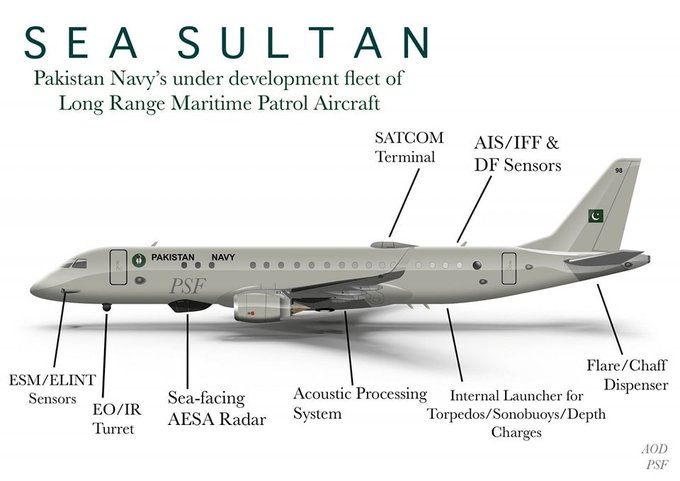
The Sea Sultan, based on the Embraer Lineage 1000E business jet, is Pakistan’s first true next-generation long-range maritime patrol and ASW aircraft.
Equipped with:
- Leonardo Seaspray AESA radar for 360° surface and air surveillance
- Electro-optical/infrared (EO/IR) sensors for night and all-weather targeting
- MAD boom and sonobuoy systems for submarine detection
- Integrated Electronic Warfare (EW) suite
- Advanced data-links enabling real-time intelligence sharing
This aircraft represents Pakistan’s entry into the era of network-centric maritime warfare.
What makes the Sea Sultan transformative is not just its sensor suite, but its integration. It forms the ISR nerve center of Pakistan’s naval operations, feeding live target data to:
- Hangor-class submarines (under construction in Pakistan and China)
- Zarb coastal missile batteries
- Type 054A/P and MILGEM-class frigates
This tight sensor-to-shooter link ensures that once a target is detected, it can be destroyed within minutes, a capability vital in the high-tempo environment of the Indian Ocean.
Operationally, the Sea Sultan will bridge the ISR gap with India’s P-8I Poseidon, offering extended endurance, modern avionics, and advanced networking, a force multiplier that guarantees Pakistan’s maritime situational awareness and deterrence.
Sea Eagle:
The RAS-72 Sea Eagle is a modern Maritime Patrol Aircraft (MPA) operated by the Pakistan Navy, developed from the ATR-72 twin-turboprop platform. It is equipped with advanced surface and sub-surface surveillance systems, including multimode maritime surveillance radar, Electro-Optical/Infrared (EO/IR) sensors, Electronic Support Measures (ESM), and Automatic Identification Systems (AIS). The aircraft is also fitted with a sonobuoy launch and processing system for anti-submarine warfare (ASW), and can carry lightweight torpedoes underwing. With long endurance, low operating costs, and real-time ISR (Intelligence, Surveillance & Reconnaissance) capabilities, the RAS-72 enhances Pakistan Navy’s coastal defense, sea lane security, and anti-submarine operations across the Arabian Sea and beyond.
Shahpar-III (Maritime Variant by GIDS/Pavnautics)
- Reconfigured MALE UCAV optimized for maritime hunter-killer operations with the following claimed/engineered fit:
- 2 × sonobuoy pods (total 8 active/passive sonobuoys) for submarine localization
- 2 × lightweight GIDS torpedoes for direct ASW engagement
- 60 km-range SAR for wide-area surface detection and imaging
- Zumr-3 HD EO/IR sensor for precision visual targeting
- Likely COMINT/ELINT payload for emitter attribution and passive detection
- SATCOM-capable datalink enabling long-range tasking and real-time handoff
- Endurance/Performance claims: ~3,000 km range, ~40-hour endurance, service ceiling ≈ 41,000 ft
- Tactical significance: Converts Shahpar-III from an ISR/strike node into an autonomous maritime hunter-killer, SAR + sonobuoys + COMINT + torpedoes = independent undersea search and prosecute capability when integrated with the fleet.
- Engineering trade-offs: Managing sensor power/cooling, EMI between sonobuoy processors & comms, weapons-release aerodynamics and weight vs endurance constraints. If validated, the platform multiplies reach and persistence at lower cost and risk than manned sorties.
Sea King & Rotary Wing Evolution
Complementing the Sea Sultan’s long-range reach, the Sea Eagle helicopters will continue to serve as the Navy’s close-in ASW and SAR (Search and Rescue) backbone.
The Navy’s fleet currently includes:
- Sea King helicopters for anti-submarine and transport roles
- Lynx helicopters aboard frigates for ASW and anti-ship operations
- Z-9EC helos, Chinese-origin platforms equipped with dipping sonar and lightweight torpedoes
Under Vision 2030, the Navy aims to phase out older Sea Kings and expand its shipborne helicopter fleet with modern multirole platforms, likely through partnerships with Türkiye or China.
Newer systems are expected to feature:
- Compact AESA radars
- Lightweight torpedoes (such as the Eghraaq or Mk46 series)
- Enhanced data-link connectivity to surface combatants and UAVs
This will allow the Pakistan Navy to execute multi-layered ASW missions, with aircraft, drones, and ships all linked into a single command grid.
How Sea Sultan & Shahpar-III operate together, the digital web
- Wide-area detection: Sea Sultan’s AESA + SAR/EO scans regions beyond surface fleets. Shahpar-III provides persistent overwatch and local SAR imaging.
- Localization: Sonobuoys launched by Shahpar-III or deployed from P-3C/Sea Eagle patterns feed underwater acoustic fixes. Hangor subs re-task to prosecute or shadow.
- Targeting & kill chain: Real-time datalinks push tracks to Zarb coastal missile batteries, Type 054A/P & MILGEM frigates, or airborne weapons (Sea Sultan or embarked helos) for precision strikes.
- EW and deception: Sea Sultan’s EW suite and Shahpar-III COMINT/ELINT provide emitter targeting and jamming options to blind adversary ASW/ISR and protect friendly assets.
- Persistent coverage: Long-endurance Shahpar-III and high-endurance Sea Sultan sorties dramatically increase time-on-station, minimizing ISR gaps against India’s P-8I patrols.
The next step is drone swarm integration, where multiple Shahpar-IIIs, Al-Buraq UCAVs, and naval UAVs operate in tandem with manned aircraft, expanding ISR coverage exponentially.
Long endurance (up to 40 hours for ISR), high payload capacity for sensors and munitions (like Barq missiles or a potential smart torpedo like the Eghraaq), and advanced satellite communication links. Its induction represents a push towards indigenous, affordable, and persistent maritime domain awareness.
Pakistan is also exploring vertical take-off and landing (VTOL) UAVs for ship-based deployment, enabling real-time surveillance from frigates and corvettes without relying solely on shore-based aviation.
Future Plan & Strategic Thrust Before 2030
The period leading up to 2030 is focused on integration, self-reliance, and doctrinal shift:
- Network-Centric Warfare (NCW): The central theme is linking all air, surface, and sub-surface assets via secure, high-speed data links (e.g., Link-17/XS-3) to ensure real-time information fusion across the entire naval battle space.
- Fleet Integration: Full operational integration of the Sea Sultan and the first batches of Hangor-class submarines is a high-priority goal, creating a seamless, long-range deterrent force.
- Indigenization: Continued investment in the domestic defense industrial base (like KSEW) and the Naval Research and Development Institute (NRDI) to ensure local maintenance, upgrades, and indigenous production of electronics and sensor suites, reducing foreign dependency.
- Technological Focus: Emphasis on Artificial Intelligence (AI) and Machine Learning (ML) for faster decision-making, better sensor data processing, and autonomous operations in both manned and unmanned platforms. This also includes an expanded focus on Electronic Warfare (EW) and Cyber capabilities to counter increasingly complex threats.
The Pakistan Navy Aviation Vision 2030 is not merely a plan to replace old aircraft; it is a strategic roadmap to transform the PN into a more technologically advanced, lethal, and self-sufficient force, capable of deterring aggression and ensuring the security of its critical Sea Lines of Communication (SLOCs) in the Indian Ocean.
Network-Centric Future: The 2030 Horizon
By 2030, Pakistan Navy Aviation aims to operate as a digitally integrated, multi-domain network, linking air, surface, and subsurface assets under a unified command architecture.
Key components of this vision include:
- Full deployment of Sea Sultan fleet (6–8 units)
- Retirement of P-3C Orion
- Expansion of shipborne ASW helicopter fleet
- Operational deployment of Shahpar-III maritime UAVs
- Integration with National Command and Control systems for joint-force operations
- Indigenous development of EW and SIGINT suites
The end goal: a self-reliant, AI-assisted maritime intelligence grid capable of continuous monitoring from the Gulf of Oman to the Horn of Africa, ensuring Pakistan’s sea lanes remain secure and its deterrence credible.
Conclusion: Guardians of the Deep Blue
Pakistan Navy Aviation Vision 2030 is more than a modernization roadmap, it’s the blueprint for strategic independence in maritime warfare.
In a region where India’s P-8Is and expanding blue-water ambitions dominate headlines, Pakistan is quietly but effectively building a smart, connected, and lethal naval air arm.
From the legacy P-3C Orion to the Sea Sultan, and from rotary-wing evolution to AI-powered UAVs, the transformation represents the Navy’s shift from reactive defense to proactive sea control.
The Arabian Sea is changing, and so is the way Pakistan commands it.