
By Zohaib Ahmed – 15th December 2025
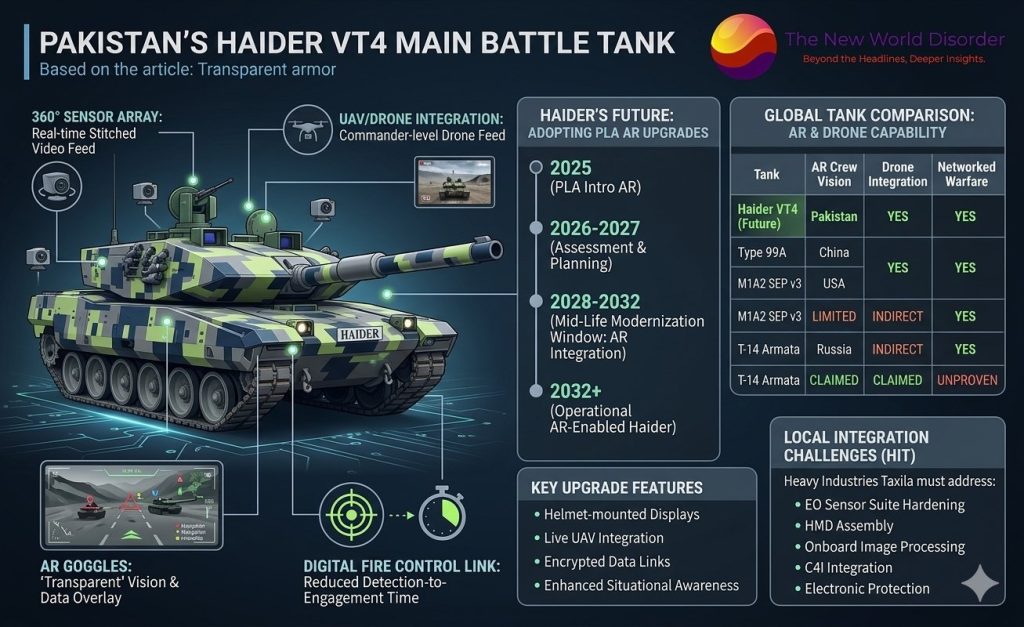
The future of armored warfare is no longer about just thicker armor, bigger guns, or faster engines, it’s about perception. The battlefield is being redefined by who sees first, who reacts fastest, and who processes the chaos most effectively. And China has just signaled the next big leap in this direction: PLA tank crews are now being equipped with Augmented Reality (AR) goggles that make armor “transparent,” projecting 360° camera feeds and even drone footage directly into the tanker’s line of sight.
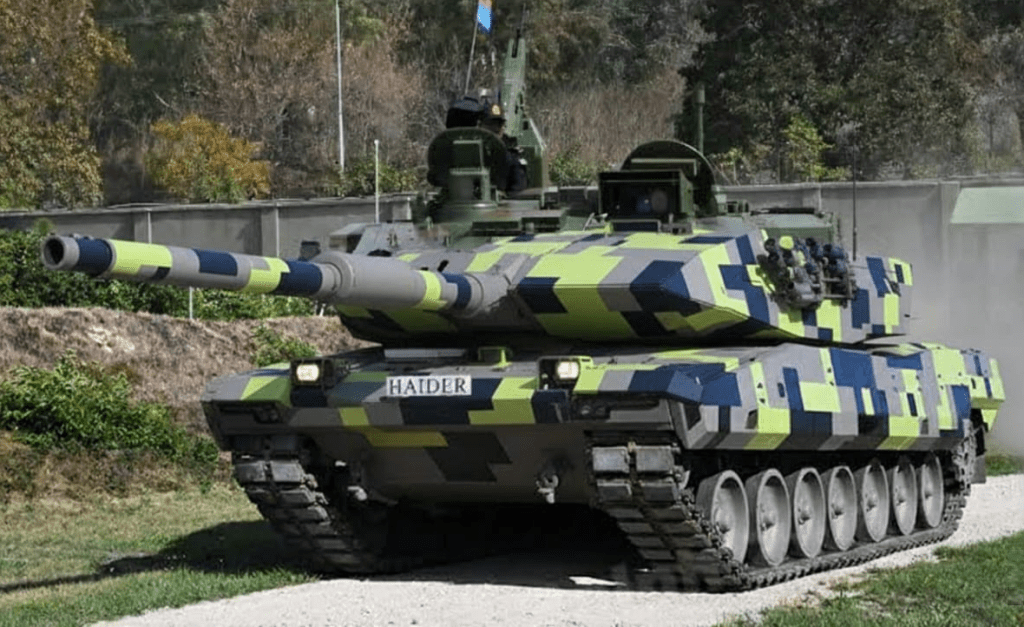
You should read this development as a signal. Pakistan already operates the same core platform. The VT4 based Haider gives Pakistan a direct and realistic pathway to adopt these upgrades before 2030.
PLA’s AR Upgrade and What It Changes
The PLA has introduced augmented reality goggles for tank commanders and drivers, integrated with distributed optical sensors and tactical UAVs. This allows crews to operate with closed hatches while maintaining full external awareness.
Key technical elements observed and assessed by defense analysts include:
360-degree camera arrays mounted around the hull and turret, providing stitched real-time video feeds.
Commander-level drone integration, allowing direct viewing of quadcopter and tethered UAV imagery.
Helmet-mounted displays that overlay navigation, threat cues, and friendly unit markers.
Digital fire control linkage that reduces reaction time between detection and engagement.
For you as an observer, the implication is clear. These tanks operate as sensor platforms rather than isolated armored vehicles.
VT4 as the Foundation Platform
The VT4 was designed from the start as a digitally integrated tank. This matters because retrofitting older designs often runs into power, cooling, and processing limits.
Baseline VT4 specifications relevant to AR integration:
Combat weight approximately 52 tons.
125mm smoothbore gun with ATGM firing capability up to 5 kilometers.
Digital fire control system with thermal sights for commander and gunner.
Modular composite armor with ERA packages.
1,300 horsepower diesel engine with power-to-weight ratio near 25 hp per ton.
The PLA upgrades do not change the gun or engine. They change how the crew perceives and reacts to the battlefield.
Why Pakistan Is Positioned to Implement These Upgrades
Pakistan already operates the VT4 derivative Haider and maintains deep integration with Chinese armored doctrine, logistics, and electronics supply chains. This reduces development risk and shortens timelines.
Historical acquisition patterns matter here. You have seen similar pathways with JF-17 avionics upgrades, HQ-9P air defense systems, and UAV cooperation.
A realistic timeline places AR-enabled Haider upgrades within the 2028 to 2032 window, aligned with mid-life modernization cycles.
Role of Heavy Industries Taxila
HIT will be central to local integration. The challenge is not mechanical. It is electronic and computational.
Areas HIT must address include:
Installation of distributed electro-optical sensor suites hardened for dust and heat.
Assembly or licensed production of helmet-mounted AR displays.
Integration of onboard image processing units capable of handling multiple high-resolution video streams with latency below 50 milliseconds.
Secure data links compatible with Pakistan Army C4I architecture.
Electronic protection against jamming and data interception.
This is comparable to the transition the PAF made from analog platforms to digitally networked fighters.
Operational Impact Against India
If you are assessing regional balance, AR-enabled Haider units would affect several operational variables.
Crew survivability improves due to reduced exposure.
Detection ranges increase through UAV integration.
Engagement timelines shorten, especially in low-visibility conditions.
Situational awareness surpasses current Indian Arjun and T-90S configurations.
India is investing in thermal sights and battlefield management systems, but there is no confirmed AR-based crew vision system in service as of now.
Expected Features in Pakistan’s AR-Enabled Haider
You can reasonably expect the following configuration by the early 2030s:
125mm gun with ATGM capability retained.
ERA and passive armor packages tuned against Indian ATGM threats.
Third-generation thermal sights for commander and gunner.
Helmet-mounted AR displays for commander and driver.
Live UAV feed integration at platoon and company level.
Encrypted data links to artillery, drones, and reconnaissance units.
Chinese-origin processing hardware with gradual localization.
Global Comparison of Leading Main Battle Tanks
| Tank | Country | AR Crew Vision | Drone Integration | Fire Control Level | Networked Warfare |
|---|---|---|---|---|---|
| Haider VT4 (Future) | Pakistan | Yes | Yes | Advanced digital | Yes |
| Type 99A | China | Yes | Yes | Advanced digital | Yes |
| M1A2 SEP v3 | USA | Limited | Indirect | Advanced digital | Yes |
| Leopard 2A7 | Germany | No | Limited | Advanced digital | Partial |
| T-14 Armata | Russia | Claimed | Claimed | Digital | Unproven |
| Arjun Mk1A | India | No | No | Modernized | Limited |
This table highlights where AR-enabled Haider would sit in relative capability rather than raw armor thickness.
What This Means for You as an Observer
You are not looking at a speculative concept. You are looking at a validated PLA capability moving down an existing export and co-production pathway. Pakistan does not need to invent this system. It needs to integrate it.
If Pakistan delays, its armored corps risks operating with lower awareness than potential adversaries. If it proceeds on schedule, Haider becomes one of the most situationally aware tanks in the region.
Outlook
Between 2028 and 2032, Pakistan is likely to field Haider variants with augmented reality crew systems derived directly from PLA upgrades. The platform already exists. The partner already exists. The operational need is clear.
The deciding factor will be execution speed and electronic integration capacity.