
By Zohaib Ahmed | 3rd December 2025
Executive Summary
Humanity stands at the intersection of three converging technological megatrends:
- Cognition-Level AI (neuromorphic, generative, sentient-like systems)
- Tokenized Economies (digital assets tied to identity and ownership)
- Totalizing Authentication Infrastructures (biometric, behavioral, and financial data fused into a unified ledger)
BlackRock CEO Larry Fink’s push for digital assets authenticated by personal data is not merely a financial innovation, it signals the birth of a new operating system for society, one where identity, assets, reputation, and behavior become inseparable.
“I do believe more transactions are going to be done digitally with authentication of ownership,” WEF co-chair and BlackRock CEO Larry Fink says.
The promise?
Efficiency, transparency, and frictionless commerce.
The danger?
Infrastructures of irreversible, programmable control.
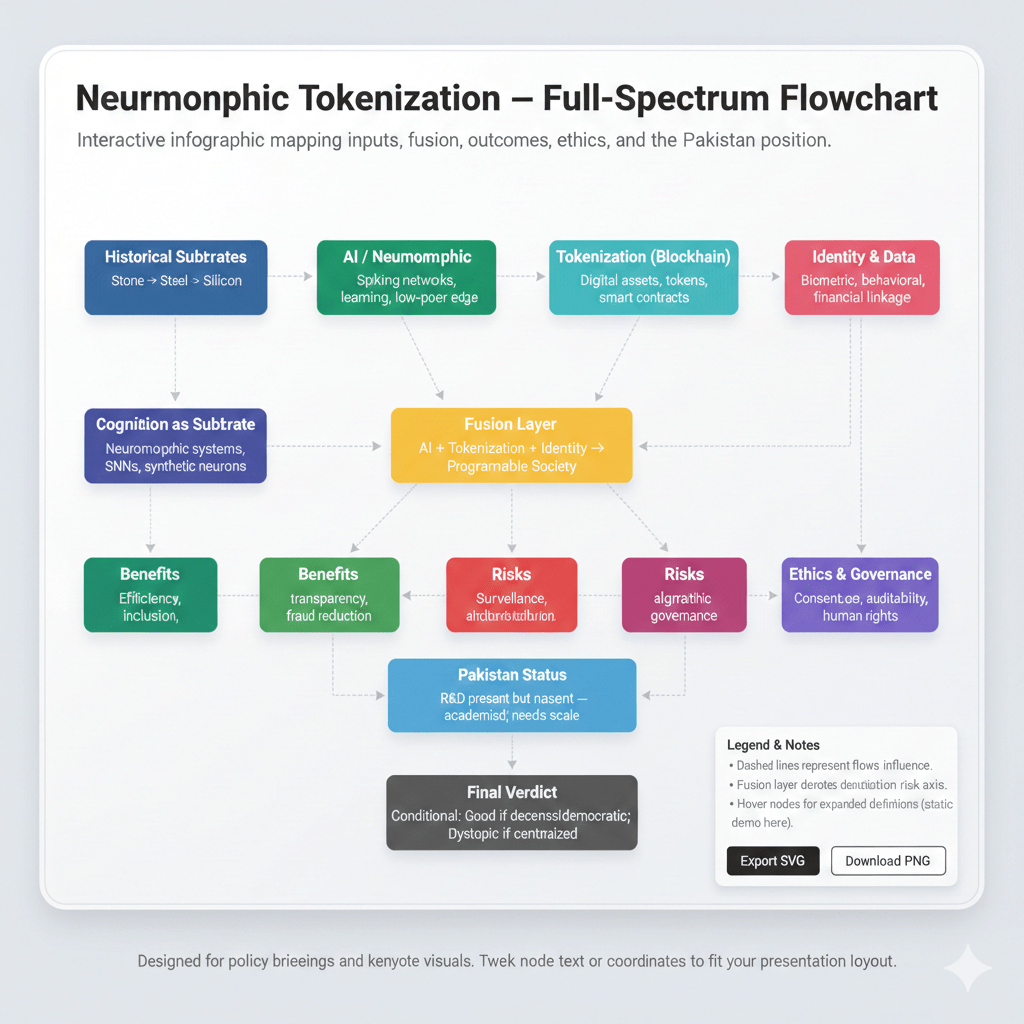
This paper explores what happens when AI cognition, blockchain tokenization, and identity surveillance converge.
What Larry Fink is actually saying (in easy words)
Larry Fink (CEO of BlackRock) is saying:
1. In the future, everything you buy or own will be digital.
Not just crypto — even your stocks, bonds, house papers, insurance, maybe even your bank account will exist as digital tokens on a blockchain.
2. Every transaction will be linked to your identity.
If you buy something, sell something, or move money, it will be tied to your verified personal data — no anonymity, no cash-like freedom.
3. Big institutions (like BlackRock) will manage these digital systems.
They’ll run the platforms, control the infrastructure, and take a cut from every transaction.
What does “tokenization” mean? (Simple example)
Think of it like:
Example 1. A house:
Today:
You have paper documents showing you own a house.
Tokenized world:
Your house becomes 1 digital token on a blockchain.
If you sell it, the token transfers to someone else.
Example 2, A stock:
Today:
You have shares in your broker’s app.
Tokenized world:
Each share is a digital token.
Buying or selling it is like passing the token to someone.
Example 3, Your identity & money:
Today:
Your ID card, bank account, passport, health record are all separate.
Tokenized world:
They become a single digital identity token, and all your money flows will be tied to it.
1. The Cognitive Substrate Behind Tokenization
1.1. Cognition as the Next Empire-Building Layer
Empires were built on materials: stone, steel, silicon.
The next will be built on cognition, synthetic or biological.
Neuromorphic systems, spiking neural networks, and self-improving models allow machines to reason, anticipate, and predict human behavior. When paired with tokenized data structures, AI becomes not just a prediction system, but an allocation system.
Imagine an economy where:
- Access to services depends on AI interpreting your reputation.
- Financial movement is controlled by algorithmic risk scoring.
- Asset ownership is contingent on compliance with digital policies.
This is not sci-fi; this is predictive governance.
1.2. Tokenization + Cognition = Algorithmic Economies
Tokenizing assets makes markets efficient.
Tokenizing identities makes people programmable.
When digital ownership requires biometric or behavioral authentication, AI systems become the arbiters of:
- Permission
- Eligibility
- Access
- Risk
- Freedom
An AI that evaluates language, sentiment, or movement becomes an AI that determines worth.
This is the cognitive substrate of future power.
2. Surveillance, Control & Ownership Disguised as Innovation
2.1. The Panopticon is Not Coming, It’s Updating Its Firmware
Digital assets tied to personal data create a perfect ledger of human life:
- What you own
- Where you travel
- What you say
- Who you interact with
- How you spend
That ledger does not forget.
It does not forgive.
And if it’s centralized, it does not need your permission.
In the wrong hands, tokenization becomes:
- Financial censorship (freeze assets algorithmically)
- Behavioral scoring (like China’s social credit, but global)
- Predictive policing (arrest before crime)
- Digital segregation (AI-determined access to services)
- Personhood-based taxation (real-time automated deductions)
This is the Black Mirror financial arc, with blockchain as the infrastructure and AI as the supervisor.
2.2. Consent Illusion & Data Enclosure
When governments and corporations merge financial and biometric identity, “consent” becomes ceremonial.
Refusing becomes impossible.
You cannot opt out of a system that replaces cash, banks, and identity.
Snowden’s warning would be clear:
If your money requires permission, it is not your money.
If your identity can be revoked, it is not your identity.2.3 Technical and Economic Perspectives on Tokenization
2.4 The Efficiency and Innovation Perspective
Advocates of tokenization argue that digital asset rails introduce:
2.4.1 Atomic Settlement and Reduced Counterparty Risk
Tokenized assets allow transfers where ownership settles instantly, eliminating reconciliation delays inherent in traditional clearing systems.
2.4.2 Fractionalization and Increased Liquidity
High-value assets can be represented as divisible digital units, broadening participation and improving liquidity in markets historically limited to institutional investors.
2.4.3 Programmable Financial Instruments
Tokenized securities can embed:
- Automated dividend distribution
- Corporate governance rights
- Compliance rules
- Escrow functions
This reduces manual processes and operational friction.
2.5 Composability and Open Financial Architecture
Tokenized assets become interoperable building blocks across applications, enabling new financial products and greater innovation.
In this vision, tokenization is a public technological upgrade, delivering long-term value to markets and end-users.
3. The Technical Reality Behind Tokenization
3.1. Tokenization Itself Is Not the Threat
Blockchain, done right, can empower:
- Self-sovereign identities
- Zero-knowledge authentication
- Decentralized asset ownership
- Uncensorable financial rails
- Transparent, auditable systems
The problem is who controls the chain.
A centralized tokenization system with “blockchain branding” is not decentralization.
It is a database with marketing.
3.2. The Real Fight: Decentralized vs. Permissioned Chains
There are two futures:
Future A, Open, Decentralized Tokenization
- Zero-knowledge proofs protect privacy
- Users own keys
- No central authority can freeze or monitor assets
- Computation and governance are distributed
This future empowers citizens.
Future B, Permissioned, Identity-Bound Tokenization
- Every transaction linked to biometric identity
- All movements monitored by AI
- Assets can be frozen by algorithm
- Smart contracts enforce behavioral compliance
This future empowers empires.
Larry Fink’s version, “digital assets tied to personal data,” leans dangerously toward the second.
3.3. Attack Surface: When Identity = Wallet
Once your wallet equals your identity:
- Data leaks become existential
- State-level hacks become life-altering
- Ransomware becomes identity-theft
- Failed authentication could erase ownership
We are building a world where losing your password means losing your personhood.
4 The Skeptic’s Perspective: Centralization and Systemic Risk
The opposing viewpoint warns that tokenization—when led by incumbent financial institutions—may reproduce existing power imbalances under new branding.
4.1 Centralized Control of Digital Rails
If a small number of platforms control tokenized asset infrastructure, they can:
- Enforce participation rules
- Censor transactions
- Extract rent through mandatory fees
- Consolidate data access
This centralizes financial sovereignty into private hands.
4.2 Smart Contract and Custody Vulnerabilities
Tokenized systems introduce new failure modes:
- Smart contract bugs
- Oracle manipulation
- Custodial hacks
- Protocol governance attacks
These can propagate faster than failures in traditional markets.
4.3 Amplified Market Contagion
24/7 frictionless markets:
- Accelerate liquidity crises
- Intensify leverage cycles
- Amplify flash crashes
Increased speed equals increased systemic sensitivity.
This view sees tokenization as less a financial revolution and more an operational restructuring that increases private control while offloading risk onto retail or unregulated markets.
5. Moral & Ethical Framework: What Should Humanity Fear?
5.1. Fear the Fusion, Not the Technology
AI alone is not dangerous.
Blockchain alone is not dangerous.
Identity verification alone is not dangerous.
But the fusion of all three creates a civilizational bottleneck:
Technology that predicts you, records you, verifies you, and controls your access to assets becomes an authority more powerful than any government in history.
5.2. Moral Red Flags
- Algorithmic discrimination baked into money
- Behavior-linked financial penalties
- Loss of anonymity in everyday life
- Permanent digital memory
- Economic exclusion for dissenters
- Machine-governed justice
It is a system where rights become permissions and permissions become fragile.
Digital Identity: Privacy vs. Compliance
The debate becomes most acute when tokenization is explicitly linked to identity verification.
6.1 Arguments for Identity-Linked Tokenization
Supporters claim:
- Regulators require identity transparency to prevent fraud, AML violations, and illicit finance.
- Verified identity improves accountability and reduces compliance overhead.
- Authenticity of ownership can be cryptographically attested.
Under this model, each transaction involving tokenized assets is tied to a verified digital ID.
6.2 Risks of Identity Consolidation
Critics warn that tying asset ownership + transaction history + personal identity yields an extremely powerful data structure prone to:
- Surveillance
- Data monetization
- Behavioral profiling
- State or corporate overreach
- Targeted discrimination in insurance, employment, lending, etc.
The absence of pseudonymity eliminates essential safeguards for political, personal, and economic autonomy.
7. Governance and Power Structures
Tokenization’s societal impact hinges entirely on system architecture.
7.1 Permissioned Ledgers Controlled by Institutions
This model:
- Limits access to approved participants
- Centralizes governance
- Reduces transparency for end-users
- Creates vendor lock-in
It effectively digitizes the existing financial system without decentralization benefits.
7.2 Open, Modular, Interoperable Infrastructure
A public-good-oriented model relies on:
- Open protocols
- Multiple custodians
- Non-custodial user options
- Decentralized verification
- Privacy-preserving proofs
This approach maximizes competition and user autonomy.
8. Systemic Risk Considerations
Tokenization reshapes risk in the following ways:
8.1 Liquidity Risks
Fractionalization can expand participation but also attract speculative behavior.
8.2 Smart Contract Risks
Code vulnerabilities become single points of failure for large pools of value.
8.3 Custody Concentration
If institutions hold most private keys on behalf of users, a handful of custodians become systemically critical.
5.4 Accelerated Contagion
Real-time, borderless asset transfer can propagate price shocks at extraordinary speed.
9. Legal and Regulatory Realities
9.1 Mapping Tokenized Assets to Existing Law
Securities, property, and insolvency frameworks were not designed for tokenized ownership. Regulators will require identity linkage and custodial oversight, potentially limiting decentralization.
9.2 Need for New Primitives
Innovations such as:
- Zero-knowledge compliance proofs
- Multi-party governance
- On-chain corporate actions
- Digital registries with legal finality
must be integrated into evolving legal standards.
10. Data Monetization and Ethical Concerns
The integration of financial data and personal identity creates opportunities and threats.
10.1 Potential Benefits
- More precise credit scoring
- Reduced fraud
- Improved compliance efficiency
10.2 Potential Harms
- Data brokerage by financial institutions
- Algorithmic discrimination based on behavioral patterns
- Social-credit–like systems
- Loss of transactional privacy
Safeguards must prevent misuse of identity-linked financial data.
11. Benefits of Tokenization (If Implemented Responsibly)
- Lower settlement costs
- Reduced operational friction
- Improved liquidity for high-value assets
- Transparent ownership trails
- Increased financial inclusion through fractionalization
- Faster cross-border settlement
12. Risks of Tokenization (If Implemented Poorly)
- Mass surveillance and erosion of pseudonymity
- Extreme centralization of financial power
- Systemic risk from smart-contract failures
- Regulatory capture by monopolistic platforms
- Data exploitation and discriminatory pricing
- Speculative bubbles around illiquid tokenized assets
13. Policy and Technical Safeguards
To ensure tokenization benefits society, the following protections are essential:
13.1 Privacy-First Architecture
- Zero-knowledge proofs for identity verification
- Minimal data exposure
- Consent-based data sharing
13.2 Open and Decentralized Infrastructure
- Avoid single-vendor platforms
- Promote interoperability via public standards
- Encourage multi-custodial ecosystems
13.3 Custodial Oversight and Resilience
- Mandatory code audits
- Insurance for custodial failures
- Clear legal recourse for asset recovery
13.4 Market Stability Mechanisms
- Circuit breakers
- Stress-testing of collateral systems
- Risk-adjusted capital requirements for tokenized markets
13.5 Regulatory Evolution
- Legal sandboxes for security tokens
- Updated frameworks for tokenized property and insolvency
- Anti-discrimination safeguards on data usage
14. Verdict: Is This Good or Bad for Humanity?
THE BENEFITS ARE REAL
- Faster, more transparent markets
- Lower corruption
- Programmable trust
- Reduced fraud
- Efficient asset management
- More inclusive financial access
THE RISKS ARE EXISTENTIAL
- Total financial surveillance
- Corporations replacing governments as identity custodians
- Loss of privacy as a human right
- Algorithmic coercion
- Societies governed by AI risk scores
- Permanent power imbalance
THE FINAL VERDICT
Tokenization is not inherently dystopian, but tokenization tied to personal data and governed by centralized institutions is the most dangerous financial architecture ever conceived.
If built openly and democratically, it can empower humanity.
If built secretly and centrally, it will cage it.
Tokenization is neither inherently liberating nor inherently dangerous. It is a powerful infrastructure upgrade whose societal impact depends entirely on design choices.
- Implemented responsibly, with privacy-preserving identity, open standards, non-custodial options, and transparent governance, it can democratize access, reduce costs, and improve market efficiency.
- Implemented irresponsibly, with centralized custody, identity consolidation, opaque governance, and aggressive data monetization, it can entrench corporate power, enable financial surveillance, and introduce new systemic risks.
The future of tokenization depends not on the technology itself, but on the governance, standards, and accountability frameworks chosen today.
The technology is not the threat.
The custodians are.