
By Zohaib Ahmed | 2nd April 2026
By any serious technical standard, the modern battle rifle market is saturated with incremental improvements built on familiar gas-operated systems. From the SIG Sauer XM7 rifle to the FN Herstal SCAR-H, most contemporary platforms rely on variations of short-stroke piston systems paired with increasingly complex engineering solutions.
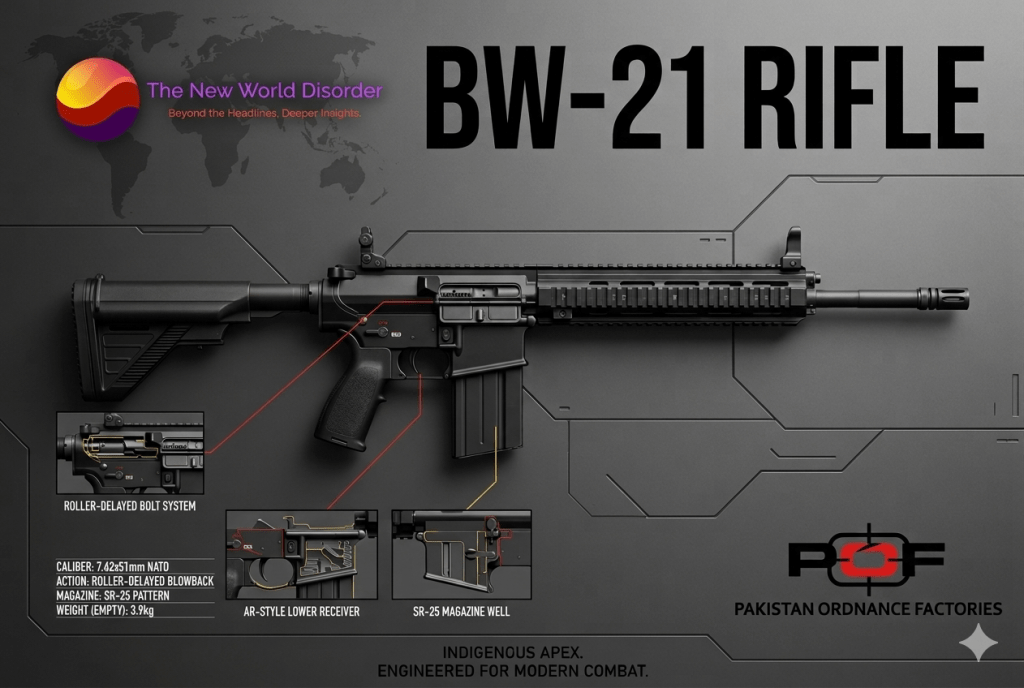
Against this backdrop, the Pakistan Ordnance Factories POF BW-21 emerges not as another iteration, but as a philosophical departure. It represents a return to mechanical fundamentals, refined through modern manufacturing and modular design principles. Together with its sibling, the BW-20, the BW-21 stands as a compelling argument that simplicity, when executed with precision, can outperform complexity in real-world combat environments.
The Renaissance of Roller-Delayed Blowback
The BW-20 and BW-21 are built upon the legendary roller-delayed blowback system, a mechanism most famously associated with the Heckler & Koch G3 rifle and MP5. For decades, this system was considered a relic of Cold War engineering. POF has fundamentally challenged that assumption.
Mechanical Philosophy
Unlike gas-operated rifles, the BW-21 eliminates:
- Gas blocks
- Pistons
- Gas tubes
Instead, it relies purely on mechanical delay through roller geometry. This results in:
- Reduced fouling inside the action
- Fewer moving parts under stress
- Greater reliability in harsh environments
Where modern rifles attempt to manage gas, pressure, and heat through layered systems, the BW-21 achieves stability through geometry and timing.
Technical Evolution: From G3 to BW-21
The BW series is not a clone. It is a full-spectrum redesign.
Core Engineering Improvements
| Feature | G3 Legacy System | BW-20 / BW-21 Evolution |
|---|---|---|
| Parts Count | ~200 parts | ~125 parts |
| Ergonomics | Limited, dated controls | Fully ambidextrous AR-style |
| Magazine System | Proprietary steel mags | SR-25 / AR-10 compatible |
| Optics Mounting | Claw mount | Monolithic rail |
| Barrel System | Non-free-floating | Free-floating barrel |
This transformation addresses every historical limitation of the G3 platform while preserving its unmatched reliability.
The BW-21: Tactical Refinement in Compact Form
While the BW-20 serves as a full-length battle rifle and designated marksman platform, the BW-21 is optimized for maneuverability and close-to-mid-range engagements.
Key Characteristics
- Barrel configurations: 12-inch and 16-inch
- Enhanced rail integration for optics and IR systems
- Compact profile for urban and mechanized operations
- Retention of full 7.62x51mm NATO lethality
This makes the BW-21 particularly suited for modern hybrid warfare environments where mobility and firepower must coexist.
Comparative Analysis: Positioning Among Global Elite Rifles
The BW-21 must be evaluated against its global peers to understand its true standing.
Core Comparison Table
| Feature | POF BW-20 / BW-21 | SIG Sauer XM7 (M7) | Kalashnikov AK-12 | FN SCAR-H (Mk17) | HK417 (G27) |
|---|---|---|---|---|---|
| Operating System | Roller-Delayed Blowback | Short-stroke Gas Piston | Long-stroke Gas Piston | Short-stroke Gas Piston | Short-stroke Gas Piston |
| Primary Caliber | 7.62x51mm NATO | 6.8x51mm (.277 Fury) | 5.45x39mm | 7.62x51mm NATO | 7.62x51mm NATO |
| Action Philosophy | Mechanical delay; no gas ports/pistons | Ultra-high pressure (80k psi); Hybrid case | Traditional high-reliability cycle | Lightweight modularity; polymer lower | AR-10 ergonomics with piston reliability |
| Weight (Unloaded) | ~4.2 kg (BW-20) | ~3.8 kg | ~3.5 kg | ~3.58 kg | ~4.0 kg |
| Accuracy (MOA) | ~1.5 – 2.0 MOA | Sub-MOA | ~2.5 – 3.0 MOA | ~1.5 MOA | ~1.0 – 1.5 MOA |
| Magazine Pattern | AR-10 / SR-25 | Proprietary / SR-25 | Proprietary | Proprietary | Proprietary |
| Parts Count | ~125 parts | High | Low | Moderate | High |
Accuracy and Barrel Dynamics
One of the defining advantages of the BW-21 is its inherent accuracy.
Why It Performs
- Fixed barrel system eliminates shifting during cycling
- Free-floating barrel prevents external pressure distortion
- Reduced mechanical disturbance compared to piston systems
Real-World Performance
- Consistent 1.5 to 2 MOA at extended ranges
- Effective engagement beyond 400 meters
- Performance comparable to designated marksman rifles
This effectively elevates the BW-21 from a standard infantry rifle to a precision-capable platform.
Recoil Behavior and Control
Recoil management is where the BW-21 quietly outperforms expectations.
Comparative Recoil Characteristics
| Rifle | Recoil Type | Shooter Experience |
|---|---|---|
| BW-21 | Linear, delayed impulse | Smooth and predictable |
| XM7 | High-pressure impulse | Sharp and forceful |
| AK-12 | Long-stroke cycle | Heavy and oscillating |
| SCAR-H | Piston-driven | Noticeable rearward snap |
| HK417 | Controlled piston | Moderate but firm |
The roller-delayed system distributes recoil over time rather than delivering a sudden impulse. This results in faster follow-up shots and improved shooter fatigue management.
Modular Versatility: A Unified Combat Ecosystem
The BW platform is designed as a multi-caliber architecture.
Supported Configurations
| Caliber | Magazine Compatibility | Role |
|---|---|---|
| 7.62x51mm NATO | SR-25 / PMAG | Battle Rifle / DMR |
| 7.62x39mm | AK-pattern mags | Hybrid infantry role |
| 5.56x45mm NATO | AR-15 mags | Standard assault role |
This level of adaptability is rare. Only systems like the CZ BREN 2 or SCAR approach similar flexibility, often at significantly higher cost and complexity.
Solving the Proprietary Constraint
A major limitation in modern rifle ecosystems is reliance on proprietary components.
Magazine Ecosystem Comparison
| Platform | Magazine Type | Logistical Impact |
|---|---|---|
| BW-21 | SR-25 standard | Global availability |
| XM7 | Hybrid proprietary | Limited supply chain |
| SCAR-H | Modified proprietary | Expensive and scarce |
| HK417 | Proprietary | Restricted sourcing |
By adopting SR-25 compatibility, the BW-21 integrates seamlessly into global supply chains. This decision alone significantly enhances its operational practicality.
Reliability in High-Friction Environments
The BW-21 excels in conditions where maintenance is limited.
Reliability Factors
- No gas system to clog
- Fewer moving components
- Proven tolerance to dirt and debris
Comparative Reliability Profile
| Platform | Reliability Condition |
|---|---|
| BW-21 | Exceptional in adverse conditions |
| AK-12 | Extremely high |
| XM7 | High but maintenance-dependent |
| SCAR-H | High but sensitive to tuning |
| HK417 | Reliable but complex |
The BW-21 achieves a balance between AK-level ruggedness and Western precision.
Market Positioning and Strategic Adoption
The BW-21 is not only a technical achievement but also a strategic product.
Target Markets
| Region | Strategic Advantage |
|---|---|
| Middle East | Cost-effective NATO-standard rifle |
| Africa | Compatibility with G3 infrastructure |
| South Asia | Non-aligned procurement flexibility |
| North America | Strong civilian battle rifle demand |
Countries with existing G3 production capabilities can transition with minimal investment, thanks to partial parts compatibility.
Infrastructure Advantage: The G3 Legacy Network
A unique advantage of the BW-21 lies in its compatibility with legacy systems.
- Approximately 30% parts compatibility with G3
- Ability to utilize existing tooling
- Reduced retraining requirements
This creates a powerful incentive for nations seeking modernization without full-scale replacement programs.
Cost Efficiency and Production Logic
Cost Comparison Overview
| Platform | Production Complexity | Cost Tier |
|---|---|---|
| BW-21 | Moderate | Competitive |
| XM7 | High | Premium |
| SCAR-H | High | Premium |
| HK417 | High | Premium |
| AK-12 | Low | Budget |
The BW-21 occupies a critical middle ground, offering near-premium performance at a significantly reduced cost.
The “Sleeper” Sales Logic: Infrastructure as a Strategic Weapon
The most significant commercial advantage of the BW-20/21 lies not in new adopters, but in legacy operators of the G3 rifle platform.
Infrastructure Revitalization Model
| Factor | Strategic Advantage |
|---|---|
| Existing G3 Factories | Immediate production capability |
| Parts Compatibility (~30%) | Reduced retooling cost |
| Skilled Workforce | No retraining requirement |
| Technical Data Packages (TDP) | Enables local manufacturing |
| Cost Avoidance | Eliminates need for new gas-system production lines |
Many nations across Africa and Southeast Asia possess dormant or underutilized G3 manufacturing infrastructure. The BW-20/21 enables these states to leapfrog into modern rifle production without incurring the capital expenditure associated with entirely new weapon ecosystems.
Civilian and Commercial Potential
The global civilian market, particularly in North America, presents strong opportunities.
Competitive Landscape
| Rifle | Market Position |
|---|---|
| Springfield M1A | Legacy battle rifle |
| PTR-91 | G3 derivative |
| AR-10 platforms | Highly modular |
| BW-21 (potential) | Modernized roller-delayed system |
A semi-automatic BW-21 variant with SR-25 compatibility would likely disrupt this segment.
The Engineering Verdict
The BW-21 represents a synthesis of three design philosophies:
- German mechanical precision
- American ergonomic standards
- Eastern durability and manufacturability
It achieves what many modern rifles attempt but rarely balance effectively:
- High accuracy
- Mechanical simplicity
- Logistical practicality
- Modular adaptability
In an era where firearm design increasingly leans toward complexity and proprietary ecosystems, the BW-21 stands apart as a system grounded in engineering clarity and operational realism.
Gaming Perspective: The BW-20/21 as the “Heavy Hitter” Platform
For audiences familiar with modern combat platforms through titles like Call of Duty, PUBG: Battlegrounds, or Battlefield, the POF BW-20 and POF BW-21 can be understood as a hybrid category weapon. It effectively bridges the operational gap between a lightweight 5.56mm assault rifle and a precision sniper system.
Platforms such as the M4 Carbine and FN SCAR-L are optimized for speed, controllability, and high-volume fire. In contrast, the BW series operates within the battle rifle category, leveraging 7.62×51mm NATO to deliver significantly higher terminal performance and extended effective range. This comes at the cost of marginally reduced handling speed, but with substantial gains in lethality and penetration.
Gaming & Reality Comparison Table
| Feature | POF BW-20 / 21 | M4 Carbine (M4A1) | FN SCAR-L | HK416 (M416) | AK-47 (Modernized) |
|---|---|---|---|---|---|
| In-Game Role | DMR / Battle Rifle | All-Rounder | Stable Beam | Professional Standard | Hard Hitter |
| Damage Class | High (7.62mm NATO) | Medium (5.56mm) | Medium (5.56mm) | Medium (5.56mm) | Medium-High (7.62×39) |
| Recoil Feel | Linear and Predictable | Snappy / Vertical | Very Low / Vertical | Smooth / High Speed | Heavy / Horizontal |
| Effective Range | 600m+ | 300m to 500m | 400m to 500m | 400m to 500m | 300m to 400m |
| Magazine Capacity | 20 Rounds (Standard) | 30 Rounds | 30 Rounds | 30 Rounds | 30 Rounds |
| Armor Penetration | High | Low to Medium | Low to Medium | Low to Medium | Medium |
| Reliability | Extreme (Mechanical) | Gas-Sensitive | High (Piston) | Very High (Piston) | High (Piston) |
Why the BW-20/21 Functions as a “Cheat Code” in Real-World Terms
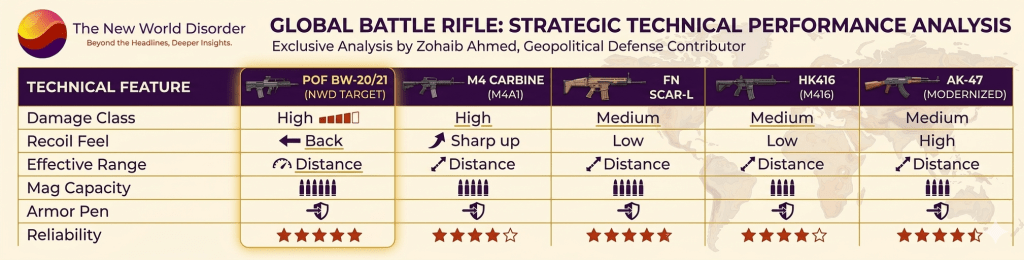
If translated into a performance model similar to gaming mechanics, the BW platform would represent a highly optimized end-tier system.
The Roller Advantage
Traditional representations of roller-delayed rifles often exaggerate recoil. The BW-20/21 corrects this through refined bolt carrier geometry and buffer systems. The result is retention of high-caliber impact with recoil characteristics closer to a 5.56mm platform.
Modular “Class Switching”
The BW architecture supports multiple calibers, allowing transition between roles such as designated marksman, standard infantry, and intermediate assault configurations. This effectively consolidates multiple weapon classes into a single operational platform.
Logistics Optimization
By utilizing SR-25 pattern magazines, the BW-20/21 integrates into a globally standardized supply chain. This eliminates dependence on rare or proprietary components and enhances operational sustainability.
System Positioning
Within a structured hierarchy, the BW-20/21 occupies the role of an advanced battle rifle platform that delivers extended range, higher impact, and cross-role adaptability beyond conventional assault rifles.
Final Assessment
The POF BW-21 earns its place among the world’s top-tier battle rifles not through marketing or novelty, but through disciplined engineering decisions.
It does not rely on experimental ammunition like the XM7, nor does it depend on expensive proprietary ecosystems like the SCAR-H or HK417. Instead, it refines a proven mechanical system and integrates it into a modern combat framework.
This is not merely an upgrade to a legacy platform. It is the logical conclusion of decades of lessons in reliability, ergonomics, and battlefield adaptability.
The result is a rifle that is not only relevant in today’s conflicts but is also positioned to define the next generation of battle rifle design.
Conclusion: POF’s Transition into a High-Tech Defense Innovator
The evolution of Pakistan Ordnance Factories reflects a broader strategic transformation from licensed production to indigenous innovation. This transition is not incremental. It is architectural.
Systems such as the POF Eye demonstrate a focus on urban warfare and operator survivability through advanced engagement solutions. The Azb DMR MK1 represents a successful conversion of legacy battle rifle platforms into precision instruments. Similarly, the HMG PK-16 showcases advancements in sustained fire capability and thermal efficiency.
Within this ecosystem, the BW-20 and BW-21 stand as flagship examples of modern combat engineering. By integrating Western ergonomic logic, legacy mechanical reliability, and scalable manufacturing strategies, POF has established itself as a credible global defense innovator.
The result is a portfolio capable of delivering NATO-standard systems designed not for controlled environments, but for the high-friction realities of modern warfare.
What’s Next? New Developments from POF (2024–2026)
POF is moving away from being just a “factory” and toward becoming a design house. Beyond the BW series, here is what is on the horizon:
1. The CW (Compact Weapon) Series
Following the success of the BW-20 prototypes, POF has been refining the CW39 (7.62x39mm) and CW56 (5.56x45mm). These are the “Assaulter” variants designed for paratroopers, special forces, and Law Enforcement Agencies (LEAs) who need the reliability of roller-delayed action in a much smaller, carbine-sized frame.
2. Modernized Heavy Firepower: HMG PK-16
While not a “gun” in the individual sense, the PK-16 is POF’s modern answer to the aging .50 cal Browning. It features a new thermal management system and a lightened chassis, making it much more portable for mountain warfare and technical-mounted roles.
3. Precision Systems: LSR (Light Sniper Rifle)
POF is doubling down on the precision market. While the Azb was a semi-auto, the new LSR projects are focused on bolt-action platforms with chassis systems that feature full-length rails and adjustable stock geometry, aiming for sub-MOA performance to compete with European sniper systems.
4. SMG-PK Evolution
The legendary MP5 clones (SMG-PK) are getting “tactical” refreshes. Expect to see integrated suppressed versions (SD variants) with M-LOK handguards and updated optics rails as standard features to keep them relevant for modern CQC (Close Quarters Combat).
Summary of Future Strategy
POF’s current roadmap is built on Modularization and Caliber Agnosticism. By creating “Weapon Families” rather than single rifles, they are ensuring that whether a soldier needs a heavy battle rifle for the mountains or a light carbine for urban centers, the “feel” and maintenance of the gun remain the same.
Read More about POF Vision at: https://zohaibauthor.com/2025/08/07/pakistan-ordnance-factories-pof-vision-2030/