
By Zohaib Ahmed
Islamabad, April 11, 2026 — The high-stakes summit underway in Pakistan’s capital is not routine diplomacy. It is a convergence shaped by constraint, urgency, and a narrowing window for de-escalation. The presence of senior political operators, financial architects, and aligned regional stakeholders signals a shift from exploratory dialogue to structured negotiation. This is a process designed to produce outcomes, not statements.
At its core, the Islamabad talks represent a recalibration of conflict mediation in the Middle East. The framework is not ideological. It is transactional, sequenced, and backed by actors with both the capacity and incentive to enforce compliance.
The Optics of Power: Delegations That Signal Intent
The composition of delegations arriving in Islamabad offers the clearest indicator of seriousness.
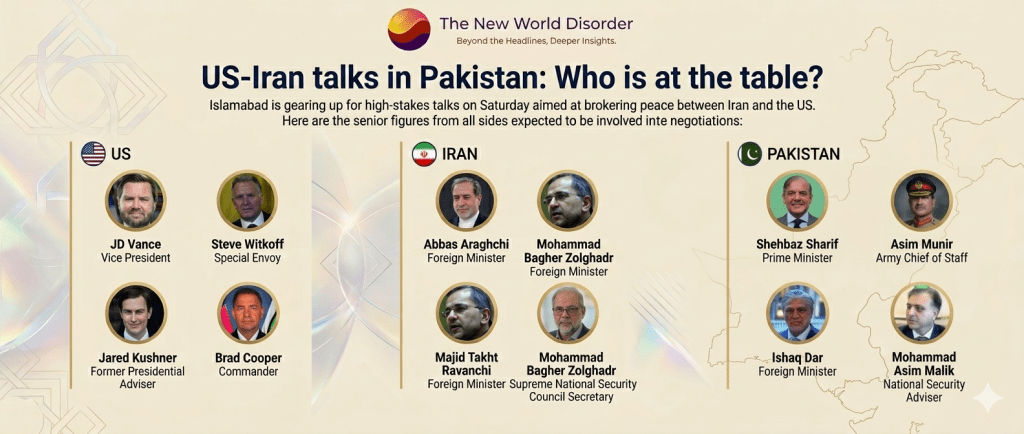
On the United States side, the presence of JD Vance, alongside Steve Witkoff and Jared Kushner, reflects a deliberate pivot away from traditional diplomatic channels. This is not a State Department-led process. It is a dealmaking team assembled to negotiate outcomes under political timelines.
Vance’s inclusion is particularly significant. As a Marine veteran with a record critical of prolonged military engagements, his role signals a mandate focused on exit strategy rather than escalation management. His presence also carries domestic political weight, indicating that any agreement emerging from Islamabad will be framed as strategic recalibration rather than concession.
Kushner and Witkoff bring a transactional layer. Their involvement suggests Washington is pursuing a broader arrangement that integrates economic incentives, investment frameworks, and geopolitical trade-offs. This is closer to a “grand bargain” model than a technical revival of previous nuclear agreements.
On the Iranian side, the delegation is led by Mohammad Bagher Ghalibaf, a figure who bridges political authority and military influence. A former Islamic Revolutionary Guard Corps commander and current parliamentary speaker, Ghalibaf provides the institutional cover required to negotiate without appearing to compromise Iran’s strategic posture.
However, the Iranian delegation operates within a more complex internal structure. Unlike the unified chain of command on the US side, Iran’s negotiating position reflects a balance between elected leadership, clerical authority, and the IRGC. The composition of the team signals intent, but authority remains the critical variable. Without alignment between these centers of power, no agreement can be sustained.
Structured Convergence: A Managed Diplomatic Environment
The choreography surrounding the summit reinforces the seriousness of the process.
The United States accepting host nation air cover indicates a high degree of trust in Pakistan’s security framework and a willingness to operate within its managed environment. This is not symbolic. It reflects operational confidence and recognition of Pakistan’s role as a neutral security guarantor during negotiations.
At the same time, the presence of delegations from Saudi Arabia, China, Russia, and Egypt creates a consolidated diplomatic setting. The visual message is alignment around a single venue rather than fragmented parallel tracks.
This convergence suggests the negotiations are structured, time bound, and backed by stakeholders with a direct interest in enforcing outcomes. The escort protocols, synchronized arrivals, and controlled staging point to a process where de-escalation is being actively managed, not passively discussed.
The Core Constraint: Control and Credibility
Despite alignment on process, the negotiations face two structural constraints.
For Iran, the central issue is internal coherence. The key question is whether political leadership and the IRGC are operating in sync. Without that alignment, even a well-negotiated agreement risks fragmentation during implementation.
For the United States, the constraint lies in external control. Representation by Vance signals seriousness, but Washington’s ability to influence Israeli decision-making remains uncertain. Previous negotiation cycles have been disrupted by unilateral actions, making Iran’s demand for credible guarantees structurally valid.
This creates a dual credibility gap. Both sides are prepared to negotiate, but each requires assurances that extend beyond the negotiating table.
The Agenda: From Hormuz to Enrichment
The negotiations are structured around interconnected issues, each carrying both strategic and economic implications.
Strait of Hormuz: Economics of Control
The Strait of Hormuz remains the most immediate pressure point. With global energy flows vulnerable, both sides have a strong incentive to stabilize transit.
A potential “transit fee” model is emerging as a workaround. This would allow Iran to capture economic value without framing it as direct reparations, while enabling the United States to maintain political distance from financial concessions. It reflects a broader pattern where economic instruments are used to resolve political constraints.
Nuclear Program: From Dismantlement to Containment
On the nuclear front, there is a clear shift in US posture. Rather than pursuing total dismantlement, the focus appears to be on containment and monitoring.
Enhanced oversight mechanisms, likely involving international agencies, could provide a framework for managing enrichment without forcing Iran into a position of strategic vulnerability. This reflects recognition that regime change is no longer an actionable objective. Stability has replaced transformation as the primary goal.
Missiles and Regional Posture
Iran’s missile program and regional network remain central to its deterrence strategy. These capabilities are unlikely to be negotiated away. Instead, the focus is expected to be on limiting deployment patterns, reducing escalation triggers, and establishing communication channels to manage incidents.
Lebanon: The Persistent Flashpoint
Lebanon remains the most difficult issue on the table. Iran’s position on Hezbollah and Israel’s operations create a dynamic that cannot easily be separated from the broader negotiation track.
Attempts to isolate Lebanon face structural limitations. Ghalibaf’s presence makes compartmentalization difficult, given his ties to the security establishment. Without progress on this front, the negotiations risk stalling.
The “No-War” Guarantee
The most critical issue is the demand for a credible no-war guarantee. Iran requires assurances that any agreement will not be undermined by subsequent military action, particularly from Israel.
Designing such a guarantee requires a broader security architecture involving multiple stakeholders. This is where mediation and enforcement mechanisms become decisive.
Pakistan’s Role: From Host to Operational Guarantor
Pakistan’s role extends well beyond hosting.
Under Shehbaz Sharif and Asim Munir, the country is functioning as an operational guarantor. This involves managing sequencing, reducing escalation pressure, and maintaining communication channels throughout the negotiation process.
Pakistan’s ability to provide a controlled and secure environment is central to the talks. The presence of coordinated military protocols suggests contingency planning is already in place. If negotiations collapse, escalation could follow quickly.
At the same time, Pakistan’s role is not to resolve every issue. It is to hold the process together long enough for both sides to move from rigid positions to workable terms.
The Financial Layer: Saudi Arabia’s Strategic Entry
The arrival of Mohammed Al-Jadaan introduces a critical financial dimension.
Received by Muhammad Aurangzeb and Nawaf Saeed Al-Malki, his presence signals a shift from negotiation to execution planning.
While foreign policy teams address sovereignty and security, Al-Jadaan represents the economic architecture required to sustain any agreement. His role points to Saudi Arabia acting as a financial facilitator, potentially enabling asset access, trade normalization, and structured investment flows.
One of Iran’s core demands is access to frozen assets. Saudi Arabia, following its recent rapprochement with Tehran, is positioned to facilitate mechanisms that bypass traditional financial bottlenecks. This could include trade clearing systems or structured investment vehicles.
A potential “Regional Stability Fund” is emerging as a logical next step. Drawing on Saudi financial capacity and investment experience, such a fund could support reconstruction, infrastructure, and economic stabilization across affected regions.
Economics Meets Strategy: Parallel Tracks
Al-Jadaan’s visit also aligns with broader Saudi-Pakistan economic engagement.
Projects such as Reko Diq remain central, reflecting the strategic importance of resource security. Discussions around energy integration, electricity interconnection, and technology collaboration indicate movement toward sector-specific execution rather than general commitments.
Short-term financial measures, including deposit rollovers and oil facilities, address immediate stability concerns. The longer-term objective is to institutionalize these commitments through structured frameworks that ensure continuity and regulatory backing.
A parallel defense agreement is also likely, reinforcing alignment between financial flows, resource strategy, and security cooperation.
The Timeline: A Narrow Window
The negotiations are operating within a defined timeframe. Regional mediators have indicated a 45-day window for establishing a framework, with immediate progress expected within the first phase of talks.
This time-bound structure reflects a shared understanding that prolonged negotiations increase the risk of disruption. Both sides are entering with mandates that prioritize speed and clarity.
There is no appetite for extended diplomatic cycles. This process is driven by deadlines, not open-ended dialogue.
Bottom Line: Closers at the Table
The presence of Vance and Ghalibaf indicates both sides have sent decision-makers, not intermediaries. These are teams authorized to close, not just discuss.
The outcome, however, will depend on factors beyond the room. Internal alignment in Tehran, external control in Washington, and the effectiveness of Pakistan’s mediation will determine whether momentum converts into agreement.
If a framework is not established quickly, the fragile ceasefire underpinning the talks is likely to collapse. The alternative is not a return to the previous status quo, but escalation into a more direct and economically disruptive phase of conflict.
For now, Islamabad represents a structured opportunity to move from confrontation to managed stability. The process is active, the stakeholders are aligned, and the costs of failure are clearly understood.
What remains uncertain is whether that alignment can be converted into a durable agreement before the window closes.