
By Zohaib Ahmed | 6th May 2026
The Type 625E: A Mobile SHORAD System Built for the Drone Age
The modern battlefield is no longer defined by traditional air superiority alone. It is increasingly shaped by low-cost drones, loitering munitions, and swarm-based aerial tactics that overwhelm conventional air defense systems. In this evolving threat environment, Pakistan’s reported acquisition of the Chinese Type 625E Short-Range Air Defense (SHORAD) system represents a calculated shift toward high-density, mobile, and layered air defense coverage.
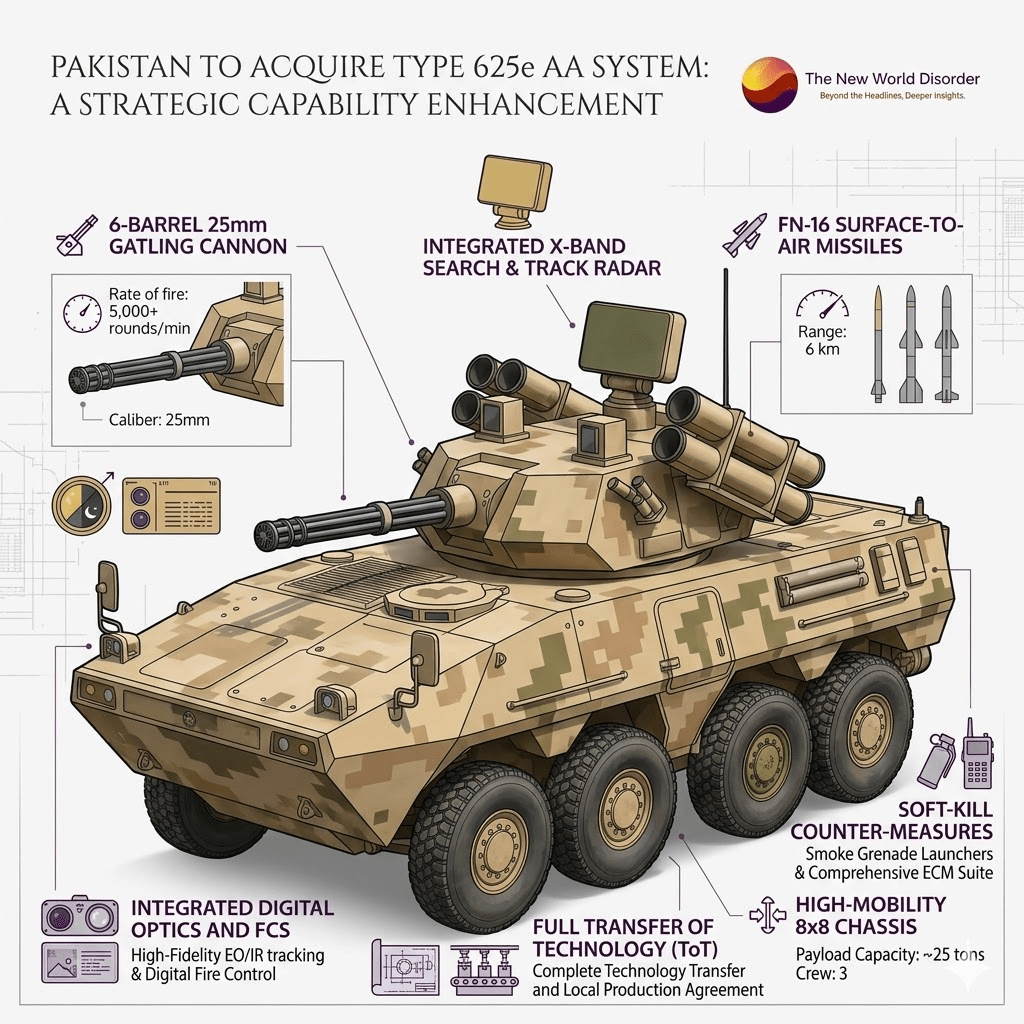
The Type 625E is a wheeled 8×8 mobile air defense platform designed to operate alongside armored and mechanized formations. Its core strength lies in its dual-weapon architecture. The system integrates a six-barrel 25mm Gatling cannon for high-volume kinetic interception with a short-range surface-to-air missile system, typically the FN-16 infrared-guided missiles. This combination allows the platform to engage both fast, low-altitude drones and slightly higher-altitude aerial threats within a practical engagement envelope of roughly 4 to 6 kilometers.
At the heart of the system is its radar and electro-optical suite. The Type 625E carries its own search-and-track radar, paired with electro-optical and infrared sensors, enabling autonomous target acquisition without dependence on external fire control units. This makes it highly effective in dispersed battlefield conditions where electronic warfare and GPS jamming are expected.
The key operational strength of the system lies in its burst fire capability. The 25mm Gatling cannon can deliver extremely high rates of fire in short bursts, creating a dense projectile cloud that is particularly effective against drones and loitering munitions. Instead of relying on single precision shots, the system uses volume-based interception, increasing hit probability against fast, erratic targets.
This design philosophy reflects a broader shift in Chinese SHORAD development, focusing less on expensive missile interception and more on layered kinetic saturation combined with missile backup for higher-value targets.
Why the Type 625E Matters for Pakistan
For Pakistan, the appeal of the Type 625E lies in three strategic advantages: mobility, volume production, and cost efficiency. The system is designed to move with armored columns, providing immediate air defense cover in fluid frontline environments. Unlike static air defense batteries, it is not tied to fixed infrastructure, making it suitable for Pakistan’s terrain and operational doctrines.
The second advantage is scalability. The system is expected to be inducted under a Transfer of Technology (ToT) framework with China, allowing domestic assembly and eventual localized manufacturing at facilities such as Heavy Industries Taxila. This reduces dependency on external supply chains and allows Pakistan to scale production rapidly in wartime scenarios.
The third advantage is doctrinal alignment. Pakistan already operates a largely China-standardized defense ecosystem, meaning integration, logistics, and training pipelines remain consistent. The Type 625E fits seamlessly into this architecture without requiring a major overhaul of existing command and control systems.
Comparison with Russia’s Pantsir System
The Russian Pantsir-S1 has long been considered one of the most widely exported short-range air defense systems. It combines missile and gun-based interception similar in concept to the Type 625E. On paper, the Pantsir offers a slightly longer engagement range and a heavier missile loadout, making it appear more capable in mixed threat environments.
However, operational experience in recent conflicts has raised questions about its real-world effectiveness, particularly under conditions of electronic warfare saturation and mass drone attacks. Reports from the Ukraine conflict have highlighted issues related to target prioritization, radar confusion under swarm pressure, and inconsistent interception rates against low-cost UAVs. While the system remains effective in controlled environments, its battlefield performance has been more variable than expected in high-density drone warfare scenarios.
The core issue is structural. Pantsir was originally designed in an era when threats were fewer, more predictable, and more expensive. Modern drone warfare, by contrast, relies on saturation attacks, decoys, and rapid multi-vector approaches that overwhelm traditional tracking and engagement logic.
The Type 625E, by comparison, is built with a more modern assumption set. It prioritizes high-volume kinetic interception and rapid sensor fusion, which makes it better suited for swarm-heavy environments even if it sacrifices some range and heavy missile capability.
Comparative Overview: Type 625E vs Pantsir-S1
| Feature | Type 625E (China) | Pantsir-S1 (Russia) |
|---|---|---|
| Primary Role | Short-range mobile SHORAD | Short to medium-range SHORAD |
| Mobility | High (8×8 wheeled platform) | Medium (tracked/wheeled variants) |
| Gun System | 25mm Gatling cannon (high burst rate) | Twin 30mm cannons |
| Missile System | FN-16 short-range IR missiles | 57E6 or variants (longer range) |
| Engagement Range | ~4–6 km | Up to ~20 km (missiles) |
| Radar System | Integrated AESA + EO/IR | Phased array radar system |
| Drone Defense Focus | Optimized for swarm interception | Designed for mixed threats |
| Combat Performance | Newer, limited combat data but promising | Mixed performance in Ukraine conflict |
| Cost Efficiency | Lower, mass-production oriented | Higher unit and maintenance cost |
| Doctrine Fit | Mobile frontline protection | Static and semi-mobile defense |
Pantsir in Ukraine: A System Under Stress
In the Ukraine conflict, the Pantsir system has faced significant operational pressure. While it has successfully intercepted cruise missiles and aircraft in several instances, it has also been challenged by the scale and complexity of drone-based attacks. The increasing use of low-cost UAV swarms, electronic countermeasures, and decoy systems has exposed limitations in target discrimination and engagement prioritization.
Reports from the battlefield suggest that in some scenarios, Pantsir units struggled to maintain consistent interception rates when faced with multiple simultaneous low-altitude targets. The issue is not simply technological failure but doctrinal mismatch. The system was optimized for high-value aerial threats, not economically scalable drone swarms operating in saturation patterns.
This does not make Pantsir obsolete, but it does highlight a transition point in air defense evolution. Systems designed for the early 2000s threat environment are now being forced to operate in a battlefield dominated by expendable aerial platforms.
Synergy with Pakistan’s Korkut System
Pakistan’s air defense modernization is not centered on a single platform but rather a layered ecosystem. In this context, the Turkish-origin Korkut self-propelled air defense system plays a complementary role to the Type 625E.
The Korkut system uses twin 35mm cannons with advanced airburst ammunition, making it highly effective against drones, cruise missiles, and low-flying aircraft. While the Type 625E emphasizes mobility and burst saturation with a Gatling configuration, Korkut focuses on precision airburst fragmentation with programmable rounds.
Together, these systems create a layered kinetic shield. The Type 625E is designed for frontline maneuver units, rapidly moving with armored formations, while Korkut provides more stabilized coverage for critical zones such as forward operating bases, logistics hubs, and semi-static defensive positions.
From a procurement standpoint, the integration strategy also reflects a dual sourcing philosophy. China provides scalable volume production and rapid deployment capability, while Turkey provides advanced fire control and ammunition technologies through a more collaborative industrial model. This combination allows Pakistan to diversify its air defense ecosystem without overdependence on a single supplier.
Drone and Drone Swarm Warfare: The Real Target
The real driver behind the induction of the Type 625E is not traditional air warfare but the rapid evolution of drone warfare. Modern conflicts have shown that even low-cost commercial drones, when used in coordinated swarms, can neutralize high-value assets, disrupt logistics, and overwhelm legacy air defense systems.
The Type 625E is specifically optimized for this environment. Its high rate of fire cannon is designed to create a physical interception cloud, while its missile system handles higher-value or more distant targets. This layered response is essential when facing swarm attacks where decision time is measured in seconds.
Unlike traditional missile-centric systems, which are economically inefficient against low-cost drones, the Type 625E enables a cost-exchange ratio that is far more sustainable. Using a missile worth tens of thousands of dollars to intercept a drone worth a few hundred dollars is strategically unsustainable. The Gatling-based kinetic layer solves this imbalance by shifting interception to cheaper ammunition-based solutions.
FK-3000 and the Future of Autonomous Air Defense
Alongside the Type 625E, Pakistan is also evaluating the Chinese FK-3000 air defense system, which represents a more futuristic approach to drone warfare. Unlike kinetic-heavy systems, the FK-3000 is built around mass missile saturation capability, carrying up to 96 micro-missiles designed specifically for drone swarm interception.
What makes the FK-3000 particularly significant is its potential for semi-autonomous deployment. The system can control unmanned auxiliary platforms, effectively multiplying its engagement capacity without increasing crew exposure. This introduces a new concept in air defense architecture where a single operator can coordinate multiple robotic interceptors across a wide battlespace.
For Pakistan, the FK-3000 is still under evaluation, but its potential role is clear. It would likely serve as a high-value asset protection system, deployed around strategic installations such as airbases, command centers, and nuclear-related infrastructure. While the Type 625E focuses on mobile battlefield protection, the FK-3000 is oriented toward static but high-density defense zones.
A final decision on procurement is expected to depend heavily on China’s own operational feedback and Pakistan’s internal trials.
Transfer of Technology: The Strategic Core of the Deal
Beyond hardware, the most significant dimension of the Type 625E acquisition is the Transfer of Technology framework. Pakistan’s defense procurement strategy has increasingly prioritized local production capability over direct imports, and this system fits squarely into that model.
Under expected arrangements, Pakistan will assemble and eventually manufacture key components domestically, likely through Heavy Industries Taxila. This ensures not only cost reduction but also supply chain independence in prolonged conflict scenarios.
The ToT component also enables doctrinal autonomy. Local production means faster upgrades, easier integration with indigenous systems, and the ability to adapt the platform based on evolving threat environments. In modern warfare, this adaptability is often more important than initial system capability.
Conclusion: A Shift Toward Layered, Mobile, and Economically Rational Air Defense
The induction of the Type 625E represents more than just a procurement decision. It signals a broader doctrinal transition in Pakistan’s air defense strategy. The focus is shifting from high-cost, long-range interception systems to layered, mobile, and economically sustainable platforms capable of handling drone-heavy threat environments.
When paired with systems like Korkut and potentially FK-3000, Pakistan is building a multi-tiered air defense network that balances mobility, precision, and saturation capability. In this structure, the Type 625E becomes the frontline kinetic shield, the Korkut provides precision mid-layer defense, and systems like FK-3000 offer high-density strategic protection.
In the era of drone warfare, survival is no longer determined by single systems but by integrated ecosystems. The Type 625E is a clear step toward that reality.