
Special Paper| New World Disorder by Zohaib Ahmed | 6th May 2026
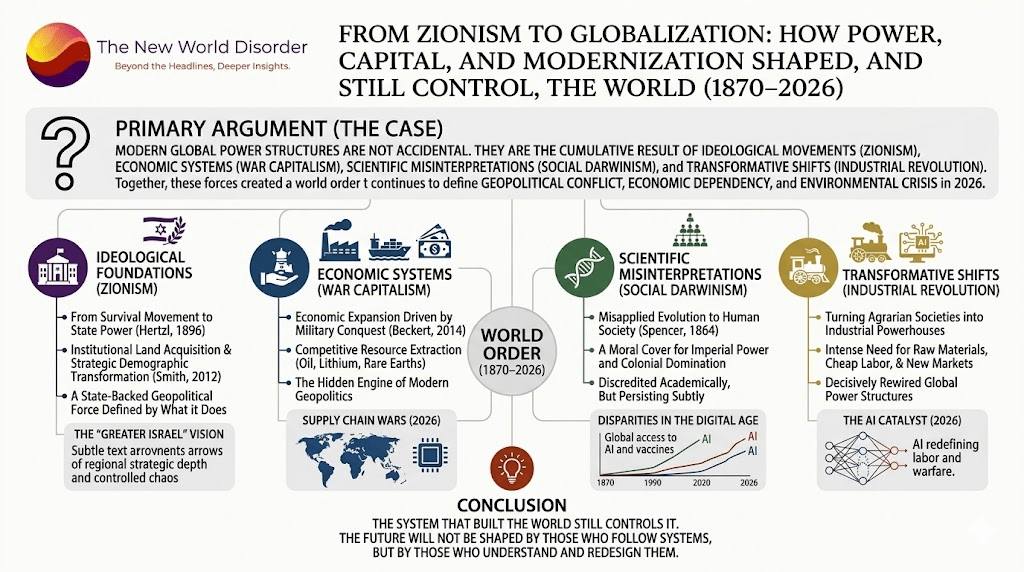
Primary Argument (The Case)
Modern global power structures are not accidental, they are the cumulative result of ideological movements like Zionism, economic systems like war capitalism, scientific misinterpretations like social Darwinism, and transformative shifts such as the Industrial Revolution. Together, these forces created a world order that continues to define geopolitical conflict, economic dependency, and environmental crisis in 2026.
Part I: The Ideological and Economic Foundations of Power
Zionism: From Movement to State Power
Zionism emerged in the late 19th century as a nationalist movement advocating for a Jewish homeland, primarily in Palestine. While its roots are often traced to ancient historical claims, modern political Zionism took shape in Europe amid rising antisemitism and nationalist movements (Herzl, 1896; Smith et al., 2012).
Between 1870 and 1897, early Jewish settlements began forming in Palestine, laying the groundwork for demographic and political transformation. This period marked not just migration, but strategic land acquisition and institutional organization (Smith et al., 2012, pp. 759–783).
The real turning point came after World War II, when global sympathy for Jewish suffering, particularly after the Holocaust, accelerated international support for a Jewish state. This culminated in the establishment of Israel in 1948.
While classical Zionism as a “movement” arguably declined after statehood, its ideological and geopolitical legacy persists. In 2026, debates around settlements, sovereignty, and identity continue to shape Middle Eastern geopolitics, especially in the context of recurring conflicts in Gaza and the West Bank (UN Reports, 2024–2026).
Key Insight:
Zionism evolved from a survival-driven movement into a state-backed geopolitical force, illustrating how ideology, once institutionalized, becomes power.
Zionism did not remain what it originally claimed to be.
What began in the late 19th century as a movement for Jewish self-determination has, in its modern execution, evolved into a state-backed system of territorial control, military dominance, and demographic engineering. The shift is not subtle, it is structural.
From the early settlements in Ottoman Palestine to the establishment of Israel, Zionism moved from ideology to enforcement. And once it became a state project, it stopped being defensive and started becoming strategic.
The “Greater Israel” Vision: Not a Myth, A Direction
The idea of “Greater Israel” is often dismissed in mainstream discourse as fringe or symbolic. That dismissal doesn’t hold up under scrutiny.
Whether framed through religious texts, political rhetoric, or strategic doctrine, the underlying principle remains consistent: expand influence, secure dominance, and eliminate long-term threats permanently.
This is no longer about drawing borders on a map, it’s about reshaping the region:
- Fragmenting neighboring states
- Weakening rival powers
- Ensuring military superiority across all fronts
And this isn’t theoretical. It shows up in policy behavior.
When Benjamin Netanyahu publicly displayed a map at the United Nations General Assembly in 2023 that excluded Palestine entirely, it wasn’t a diplomatic accident, it was a signal. A visual declaration of how power sees geography.
That moment matters because it strips away ambiguity. It shows intent, not just defense.
Palestine: Systematic Erasure, Not Collateral Damage
What is happening in Palestinian territories, particularly Gaza, is not a series of isolated military operations. It is a sustained, multi-decade process of displacement, restriction, and destruction.
Let’s be clear about the pattern:
- Land is gradually absorbed through settlements
- Movement is restricted through checkpoints and blockades
- Infrastructure is repeatedly destroyed in cycles of war
- Civilian populations are trapped within shrinking territories
This is not random. It is structural.
In recent conflicts (2023–2026), the scale of destruction in Gaza, flattened neighborhoods, destroyed hospitals, mass civilian casualties, has pushed even mainstream scholars and institutions to openly debate whether the threshold of genocide has been crossed.
Israel frames these actions as security measures against Hamas. But the scale, repetition, and targeting of civilian infrastructure raise a more uncomfortable question:
When does “self-defense” become a system of permanent domination?
That question is now central to global discourse.
Antisemitism: The Shield That Ends Debate
One of the most powerful, and controversial, tools in this entire dynamic is the framing of criticism.
There is no denying that antisemitism is real, dangerous, and historically catastrophic. But there is also a growing argument that the term is being expanded and weaponized in political discourse.
Criticism of Israeli state actions is frequently reframed as hostility toward Jewish identity itself.
The result?
- Political debate gets shut down
- Academic criticism is labeled as prejudice
- Activism is delegitimized before it begins
This creates a strategic shield, one that makes meaningful accountability extremely difficult.
And that’s the core tension:
Opposing a state’s actions is not the same as targeting a people.
But in practice, that distinction is increasingly blurred.
Middle East Wars: Security Doctrine or Controlled Chaos?
Israel’s military footprint across the Middle East is extensive:
- Repeated wars in Gaza
- Deep involvement in Lebanon conflicts
- Continuous airstrikes in Syria
- Escalating confrontation with Iran
Officially, this is all framed as preemptive defense.
Strategically, however, a different pattern emerges:
- Prevent any rival from becoming regionally dominant
- Keep neighboring states unstable or fragmented
- Maintain absolute military superiority
This isn’t just about survival, it’s about ensuring no equal ever emerges.
The Iran Confrontation: The Ultimate Barrier
In 2026, the conflict with Iran has become the defining axis of Middle Eastern geopolitics.
Iran represents something no other regional actor currently does:
- Strategic depth
- Proxy networks across the region
- Independent military capability
- Resistance to Western-aligned order
For Israel, Iran is not just a threat, it is an obstacle.
And that’s why this conflict keeps escalating.
Because if one side is aiming for dominance, and the other refuses to submit, collision becomes inevitable.
The “David Corridor” Concept: Ambition Meets Reality
Among the more controversial strategic discussions is the idea of a “David Corridor”, a proposed land linkage cutting through parts of Syria and Iraq.
The objective behind such a concept is straightforward:
- Break territorial continuity of hostile states
- Limit Iranian movement and influence
- Create strategic depth beyond current borders
But here’s where ambition meets reality.
The plan, whether formal or conceptual, has struggled to materialize because:
- Regional resistance is too strong
- Military occupation costs are unsustainable
- Global backlash would be immediate
In simple terms:
Expanding influence is one thing, holding it is another.
And that’s where even aggressive strategic visions hit limits.
Final Strategic Take
Zionism today cannot be understood through its origin story alone.
It must be evaluated based on its current execution:
- A state with unmatched military dominance in its region
- A long-term pattern of territorial consolidation
- A security doctrine that justifies continuous expansion of control
- A narrative shield that limits criticism
Supporters call it survival.
Critics call it occupation.
But one thing is undeniable:
This is no longer just a movement, it is a power system.
And like all power systems, it is defined not by what it claims,
but by what it does.
War Capitalism: The Hidden Engine Behind Conflict
Capitalism, at its core, promotes private ownership and free markets. However, history reveals a more aggressive variant, what scholars call war capitalism (Beckert, 2014).
During the rise of the British Empire, economic expansion was inseparable from military conquest. Colonization of regions like India and Africa was not merely political, it was economic extraction designed to fuel industrial growth.
Similarly, emerging powers like Germany and Japan adopted aggressive expansionist strategies to secure resources.
This pattern persists today. Modern wars are rarely declared over ideology alone, they are deeply tied to:
- Energy resources (oil, gas)
- Rare earth minerals
- Strategic trade routes
- Defense industry profits
In 2026, global tensions over lithium, semiconductors, and AI infrastructure echo the same logic. The competition between United States and China is not purely ideological, it is fundamentally economic.
Key Insight:
War capitalism did not disappear, it evolved. Today’s “cold wars” are supply chain wars.
Social Darwinism: Justifying Inequality
The concept of Social Darwinism emerged from the misapplication of Theory of Evolution to human society. Popularized in the 19th century, it argued that societies, like species, evolve through “survival of the fittest” (Spencer, 1864).
This idea became a powerful justification for:
- Colonial domination
- Racial hierarchies
- Economic inequality
It provided moral cover for imperial powers to exploit weaker nations, framing domination as “natural.”
Although widely discredited today, its influence lingers subtly in global systems. In 2026, disparities between the Global North and Global South, particularly in access to AI, vaccines, and financial systems, reflect structural inequalities rooted in this ideology.
Key Insight:
Social Darwinism may be academically rejected, but its logic still operates in global power distribution.
Industrial Revolution: The Catalyst of Everything
The Industrial Revolution marked a turning point in human history. Beginning in the late 18th century, it transformed agrarian societies into industrial powerhouses.
Key outcomes included:
- Mass production
- Urbanization
- Technological innovation
- Global trade expansion
Industrialization created unprecedented wealth, but also unprecedented inequality. It intensified the need for:
- Raw materials (driving colonization)
- Cheap labor (often exploited populations)
- New markets (fueling globalization)
By the early 20th century, industrial capacity became directly linked to military strength, setting the stage for global conflicts.
Modern Parallel (2026):
The AI revolution mirrors the Industrial Revolution. Just as steam power redefined economies, artificial intelligence is redefining labor, warfare, and global dominance.
Key Insight:
Industrialization didn’t just change economies, it rewired global power structures.
Part II: Modernization, Progress or Dependency?
The Rise of Technological Superpowers
The late 19th and early 20th centuries marked a rapid shift toward modernization. Nations that embraced science and education, such as France, United Kingdom, and the United States, gained significant advantages.
Technological advancements included:
- Airplanes
- Advanced weaponry
- Industrial machinery
- Early computing systems
By the mid-20th century, modernization had become synonymous with power.
Japan’s rise is particularly notable. Once isolated, it rapidly industrialized and became a technological leader, demonstrating that modernization was not exclusive to the West.
The Dark Side of Modernization
Despite its benefits, modernization created a deeply unequal world.
North vs. South Divide
Most industrialized nations were located in the Northern Hemisphere, while resource-rich but underdeveloped nations remained in the Global South.
These countries became:
- Suppliers of raw materials
- Sources of cheap labor
- Markets for finished goods
This created a cycle of dependency that persists today.
In 2026, developing nations, including Pakistan, continue to navigate this imbalance, often relying on foreign investment, technology imports, and international financial institutions.
Environmental Collapse: The Cost of Progress
One of modernization’s most devastating consequences has been environmental degradation.
Key issues include:
- Climate change
- Ozone depletion
- Deforestation
- Water scarcity
According to the IPCC (2023–2025), global temperatures are approaching critical thresholds. Glaciers are melting at unprecedented rates, and biodiversity loss is accelerating.
In 2026, climate crises, from floods in South Asia to wildfires in North America, demonstrate that the environmental cost of industrialization is no longer theoretical, it is immediate.
Key Insight:
Modernization improved human life, but at the expense of planetary survival.
Part III: Globalization, From Trade Routes to Digital Empires
The Birth of Globalization (19th Century)
Globalization did not begin with the internet, it began with ships.
In the 19th century, expanding trade networks connected distant regions. Maritime exploration led to the discovery of new lands, resources, and cultures.
The construction of the Suez Canal in 1869 revolutionized global trade, significantly reducing travel time between Europe and Asia.
Trade goods included:
- Spices
- Textiles
- Precious metals
- Knowledge and ideas
Companies like the East India Company became powerful enough to control entire regions, including India.
Globalization and Conflict
As trade expanded, so did competition.
Key developments included:
- Tariff systems
- Trade monopolies
- Colonial expansion
Control over trade routes became a primary cause of conflict. Ports, canals, and shipping lanes were strategic assets worth fighting for.
Cheap labor also became globalized. Workers from underdeveloped regions were employed in harsh conditions, forming the backbone of global trade systems.
The Financial Architecture: From Petro-Dollar to Data Sovereignty
While capitalism and war economics form the visible layer of power, the real control mechanism lies beneath, in the architecture of global finance. The modern system is not sustained by markets alone, but by institutional gatekeeping of transactions. The global financial messaging network, SWIFT, has become a geopolitical weapon; nations can be effectively paralyzed by exclusion from it, as seen in sanctions regimes over the past decade. This marks a shift from territorial warfare to financial asphyxiation.
By 2026, this control is evolving further with the rise of Central Bank Digital Currencies (CBDCs). Unlike traditional fiat systems dominated by the US Dollar, CBDCs introduce programmable money, where transactions can be monitored, restricted, or even denied in real time. Sovereignty is no longer just about borders or resources; it is about who controls the ledger. In this new paradigm, economic independence is not measured by GDP alone, but by control over digital financial infrastructure.
Demographic Inversion and Migration as Strategic Pressure
Territorial control is no longer exercised solely through military occupation, it is increasingly shaped through population dynamics. Across the developed world, declining birth rates have created structural vulnerabilities, particularly in Europe and parts of North America. This demographic inversion is not just a social issue; it is a strategic one.
Migration, in this context, becomes more than a humanitarian phenomenon, it becomes leverage. At the borders of the European Union and along the frontier between the United States and Mexico, population flows have increasingly been framed as instruments of pressure. Whether driven by conflict, climate, or economic collapse, these movements reshape political landscapes, strain institutions, and alter cultural balances.
This reflects a broader pattern of demographic engineering, where population movement, intentional or not, becomes a tool of influence. In this sense, territorial strategy is no longer just about land, it is about who occupies it, and under what conditions.
The Cognitive Layer: The Battle for Perception and Reality
If the 20th century was defined by control over land and resources, the defining battlefield of 2026 is the human mind. Power now operates at the level of perception, what people believe, how they interpret events, and whether they can agree on reality itself.
Digital platforms such as Meta, Google, and TikTok have created algorithm-driven environments where information is filtered, amplified, or suppressed. This has led to the fragmentation of shared reality into isolated echo chambers.
The result is a form of neuro-cognitive warfare, where influence is not exerted through censorship alone, but through narrative architecture, the deliberate shaping of perception. In such an environment, truth becomes relative, consensus collapses, and coordinated resistance becomes nearly impossible.
Power, therefore, is no longer just about controlling what is said, it is about controlling how reality itself is constructed and perceived.
Non-State Sovereignty: The Rise of the Corporate Power Layer
The traditional model of geopolitics assumes that states are the primary actors. In 2026, that assumption is increasingly outdated.
A parallel layer of power exists above nation-states, dominated by financial giants like BlackRock and Vanguard. These institutions control trillions in assets and hold significant stakes across industries, from energy and infrastructure to technology and defense.
This creates a system where ownership transcends borders. The same entities financing reconstruction in conflict zones may also hold stakes in the industries that benefit from those conflicts. Power becomes circular, self-reinforcing, and detached from national accountability.
Simultaneously, the rise of private military contractors, such as Wagner Group and Blackwater, further blurs the line between public and private force. Warfare is no longer monopolized by states; it is outsourced, privatized, and globalized.
In this emerging order, sovereignty is fragmented. States remain visible, but the true centers of influence are increasingly institutional and transnational.
The Final Frontier: Orbital and Sub-Surface Dominance
To fully understand modern power, one must look beyond land and sea, to the domains above and below.
In orbit, satellite constellations such as SpaceX’s Starlink network are redefining control over communication, navigation, and surveillance. Dominance in Low Earth Orbit (LEO) means control over internet access, military coordination, and real-time intelligence. The battlefield has expanded into space, where infrastructure, not territory, defines supremacy.
Beneath the oceans lies another critical layer: undersea cables. These cables carry nearly all global internet traffic, forming the backbone of digital globalization. Despite their importance, they remain highly vulnerable, susceptible to sabotage, espionage, and geopolitical manipulation.
This dual frontier, orbital and sub-surface, reveals a fundamental shift:
Power in 2026 is no longer just about controlling land corridors like the “David Corridor.”
It is about controlling the invisible arteries of global connectivity.
Strategic Integration: The Invisible System Behind Power
These layers, financial systems, demographic flows, cognitive control, corporate sovereignty, and physical infrastructure, form what can be called the Invisible Architecture of Power.
They ensure that the global system remains stable, not through peace, but through self-correction. Even when governments change, conflicts erupt, or alliances shift, the underlying structure continues to operate.
This is the missing dimension that transforms the framework:
From a historical analysis of power…
to a real-time operating manual of how power sustains itself in 2026.
Globalization in 2026: The Digital Evolution
Today, globalization operates on a different scale.
Key drivers include:
- The internet
- Artificial intelligence
- Global supply chains
- Digital finance
The world is now a “hyper-connected” system where:
- A product designed in California is manufactured in Asia and sold globally
- Financial markets react in real time
- Information spreads instantly
However, the same inequalities persist:
- Wealth concentration in developed nations
- Labor exploitation in developing regions
- Digital divides in access to technology
Key Insight:
Globalization evolved, but its power dynamics remained consistent.
The Architecture of Total Integration
The transition from the late nineteenth century to the current year of 2026 represents the most successful consolidation of structural influence in human history. We are no longer observing a series of disparate geopolitical events but rather the final assembly of a integrated global stack. At the foundation of this stack is the transition of ideology into institutional reality. Zionism serves as the primary case study for how a movement can move from a state of existential vulnerability to one of regional hegemony by successfully aligning its interests with the evolving needs of global capital. The expansion of influence from the Levant into the broader Middle East is not merely about geography. It is about the creation of a technological and military fortress that serves as a permanent anchor for Western aligned power in an increasingly multipolar world.
The Evolution of War Capitalism
War capitalism has moved beyond the crude extraction of minerals and labor that defined the British or French imperial projects. Today, dominance is exercised through the ownership of the operating systems of modern life. In 2026, a nation is truly sovereign only if it owns its digital architecture and its financial plumbing. The modernization described in the text was essentially a strategic onboarding process. By integrating the Global South into international banking standards and digital infrastructure, we ensured that their survival was tethered to a system they do not control. The competition between major powers now centers on the supply chains of high end semiconductors and the computational power required for artificial intelligence. If a state lacks the capacity to participate in the silicon based economy, it is effectively relegated to the status of a data colony.
The Algorithmic Social Darwinism
The nineteenth century misapplication of Darwinian theory provided the moral justification for colonialism. In our contemporary era, this has been replaced by a data driven hierarchy that is much more efficient because it is largely invisible. We have moved from racial hierarchies to a binary of the augmented versus the unaugmented. The international order now uses climate volatility and environmental collapse as levers for crisis management. This allows for the suspension of traditional sovereignty under the guise of global security or ecological preservation. Those who control the narrative and the sensors control the resources. Power in 2026 is the ability to define what constitutes a crisis and who is authorized to solve it.
The Strategic Closure of Reality
The most significant development in this hundred and fifty year arc is the shift from controlling what people do to controlling what they are able to perceive. The concept of the narrative shield is not just a defensive posture. It is a proactive tool used to fragment the collective reality of any potential opposition. By controlling the information flows, the system can delegitimize criticism before it ever gains institutional traction. Whether it is through the framing of antisemitism to protect state actions or the use of algorithmic echo chambers to stabilize domestic populations, the goal is the same: the total management of the cognitive layer.
Bottomline: Redesigning the Future
The world in 2026 is at a critical juncture where the old Westphalian models of statehood have been superseded by a corporate and technological layer that sits above the map. The forces of Zionism, war capitalism, and industrialization have converged into a singular mechanism of global governance. For any actor operating outside of the primary power centers, the strategy of following existing systems is a path to obsolescence. The future belongs exclusively to those who possess the foresight to recognize that the system is not a set of rules to be followed but a structure to be bypassed or redesigned. True autonomy in this century requires a departure from the established global ledgers and the creation of independent architectures of power and perception.
Conclusion: The System That Built the World, and Still Controls It
From Zionism to globalization, from industrialization to modernization, the forces that shaped the modern world are deeply interconnected.
They reveal a consistent pattern:
- Ideology creates direction (Zionism, Social Darwinism)
- Economics drives expansion (War capitalism)
- Technology accelerates dominance (Industrial Revolution, AI)
- Global systems reinforce inequality (Globalization)
In 2026, the world stands at a critical juncture:
- AI threatens to redefine labor
- Climate change threatens survival
- Geopolitical tensions threaten stability
Yet, the underlying structure remains the same, a system built on power, competition, and control.
Final Thought (Strategic Lens):
If history teaches anything, it is this:
The future will not be shaped by those who follow systems, but by those who understand and redesign them.
Expanded References
- Smith, B. G., Lane, K., Mieroop, M. V., & Glahn, R. v. (2012). Crossroads and Cultures: A History of the World’s Peoples.
- Beckert, S. (2014). Empire of Cotton: A Global History.
- Herzl, T. (1896). The Jewish State.
- Spencer, H. (1864). Principles of Biology.
- IPCC Reports (2023–2025).
- United Nations Reports on Middle East (2024–2026).
- Fordham University Sourcebooks: Industrial Revolution