
By Zohaib Ahmed| 19 August 2025
Executive Summary
Graphene, a one-atom-thick carbon sheet—combines extreme strength (~130 GPa tensile), ~1 TPa stiffness, record thermal conductivity (up to ~5,300 W/m·K) and carrier mobility (approaching ~200,000 cm²/V·s in suspended form). These properties enable category-shifting advances in water treatment, energy storage, lightweight composites, EMI shielding, sensors, and flexible electronics. ScienceDirectWiley Online LibraryACS Publications
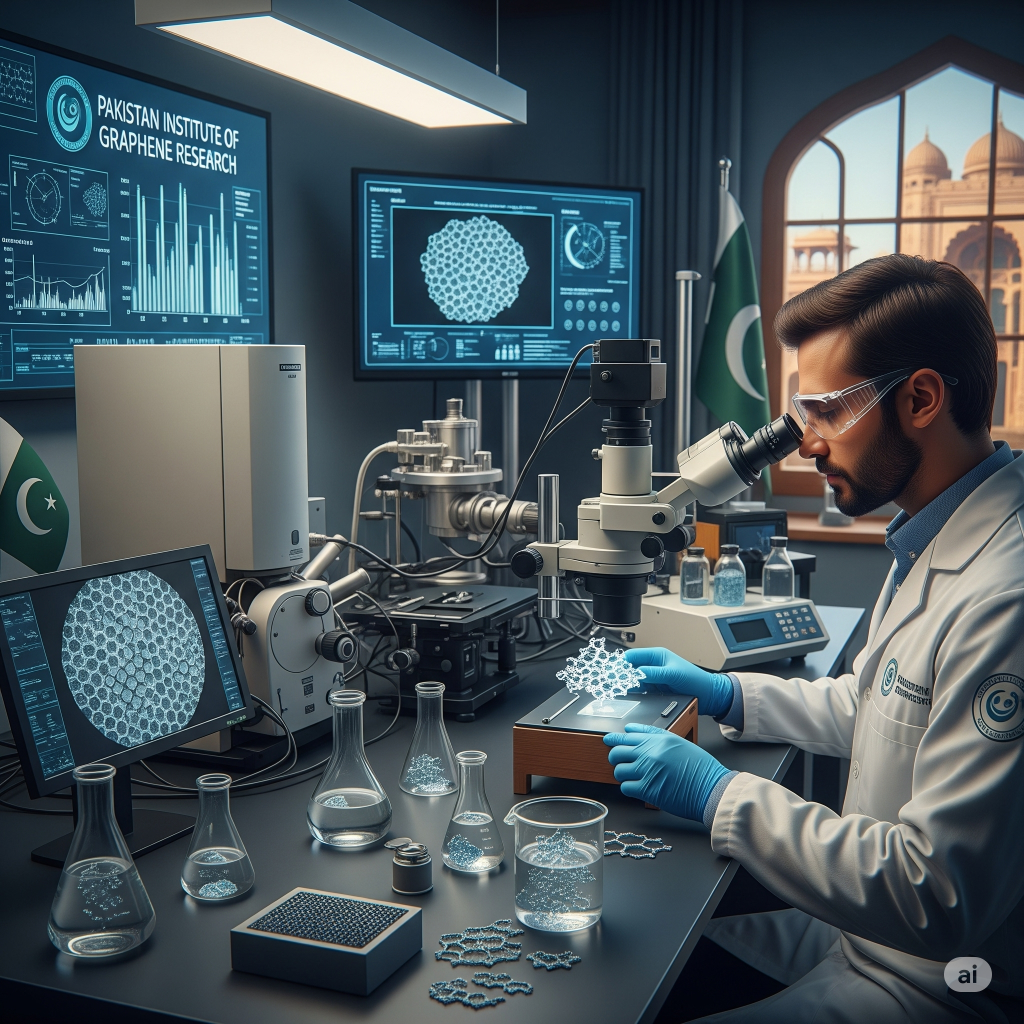
Global graphene revenues are still early but scaling fast: estimates put the market near USD 0.2 B (2023) with forecasts around USD 1.6 B by 2030 (CAGR ~35%). Pakistan can leverage its massive waste streams (plastic, biomass, coal), R&D base, and demand in water, construction, textiles, defense, and energy to build a strategic graphene value chain—even with limited domestic natural graphite. SCIRPPakistan Super Fund
1) What is Graphene—Properties & Production
1.1 Properties (why it matters)
- Mechanical: ~1 TPa Young’s modulus; ~130 GPa tensile strength (≈200× steel by strength-to-weight).
- Thermal: up to ~5,000–5,300 W/m·K.
- Electrical: electron mobility up to ~200,000 cm²/V·s (suspended), enabling high-frequency electronics and ultra-sensitive sensors. ScienceDirect+1ACS Publications
1.2 How graphene is made (industrial routes)
- Top-down from graphite: mechanical or liquid-phase exfoliation to graphene/graphene-oxide (GO) flakes for inks, coatings, cement, polymers. Open Knowledge Repository
- Chemical Vapor Deposition (CVD): methane → monolayer graphene on Cu/Ni foils (then transferred) for transparent conductors, RF, sensors. globalplasticaction.org
- Flash Joule Heating (FJH): milliseconds-long electrical pulses convert plastics, food waste, petroleum coke, coal to “flash graphene” at low cost/ton—ideal for circular economy feeds. BCC ResearchGrand View Research
2) Global Supply: Where Graphene/Graphite Comes From
Graphene itself is manufactured; the “extracted” feedstock is typically natural graphite (also synthetic graphite or waste hydrocarbons). Natural graphite resources & production are concentrated in China, Mozambique, Madagascar, Tanzania, Brazil & Turkey; this concentration creates a supply-security issue. 4SPe PublicationsQueen’s University Belfast
Implication for Pakistan: With limited domestic graphite, Pakistan should diversify feedstocks (waste → FJH graphene; methane → CVD) and secure offtake from friendly graphite producers under long-term contracts. BCC Research
3) Pakistan’s Current Footprint in Graphene
3.1 R&D & Academia (selected signals)
- PCSIR (Ministry of Science & Technology) conducts applied materials research; public docs and publications show GO synthesis and characterization work in local labs. jcsp.org.pk
- Universities (e.g., NUST and collaborators) publish on graphene derivatives (e.g., graphene quantum dots; nano-material labs under national centers). PubMed
- National innovation platforms—HEC’s RIC portal and NUST’s NSTP—link researchers, startups and industry, providing a landing zone for graphene pilots. RFI HECnstp.pk
3.2 Early Commercial & Startup Activity
- Zoxcell: graphene-enhanced supercapacitors with operations in Pakistan/Dubai; has supported local deployments. graphene-info.com
- ENA x Jolta Battery: collaboration on graphene supercapacitors (ENARGEZE) for Pakistani market; Jolta highlights local supercapacitor module manufacturing. graphene-info.comFacebook
- MatEnTx (NUST startup) and other NSTP residents indicate a maturing deep-tech pipeline to translate lab results. matentx.com
Bottom line: Pakistan’s ecosystem is nascent but active in supercapacitors, GO synthesis, and nano-coatings—ripe for scale-up via targeted procurement and pilot financing.
4) Pakistan’s Feedstock Reality: “Where can it be extracted?”
Pakistan does not (yet) host large, high-grade natural graphite mines. Documented occurrences exist in Gilgit-Baltistan (Astore/Shounter Valley) and Azad Kashmir, but are low-grade and need beneficiation; one study upgraded ~8.9% C ore via flotation to an industrial concentrate—proof of potential but not immediate large-scale supply. Nature
Abundant alternative feedstocks inside Pakistan:
- Thar coal (Sindh): ~175 billion tonnes lignite—viable for FJH conversion to graphene for cement/composites if environmental controls are met. ScienceDirectBCC Research
- Plastic & municipal waste: Pakistan generates ~3.9 Mt plastic waste/year with high mismanagement rates—an opportunity to up-cycle to graphene via FJH. SpringerLink
- Natural gas (methane): domestic methane streams can feed CVD graphene lines for electronics and sensors. globalplasticaction.org
5) Why Pakistan Should Prioritize Graphene—High-Impact Use-Cases
5.1 Water Security (national priority)
Pakistan is water-scarce with per-capita availability ~900–1,000 m³/year and trending lower; PCRWR and policy documents warn of crossing “absolute scarcity” without reforms. Graphene-oxide (GO) membranes offer fast water flux with ion/salt rejection, enabling low-energy desalination, pathogen removal, and point-of-use purification. Pilot deployments can target brackish groundwater and industrial wastewater. Indus PublishersIrrigation KPKSpringerLink
What the tech does: GO laminates can allow ultrafast water permeation while rejecting hydrated ions; nanoporous and stacked GO membranes continue to improve flux/selectivity—an R&D area ready for field pilots in Pakistan’s cities and coastal belts. ScienceDirect+1
5.2 Energy Storage & Grid Stability
- Supercapacitors & hybrid systems: pairing graphene-based supercaps with Li-ion/LFP in microgrids can smooth load-shedding and support UPS/telecom towers (where Pakistan has heavy backup demand). Local players (Zoxcell, ENA/Jolta) provide a starting base. graphene-info.com+1
- Battery anodes/cathodes: graphene improves conductivity and cycle-life in Li-S, Si-anode Li-ion, and Na-ion—routes compatible with local assembly ambitions. ScienceDirect+1
5.3 Construction & Low-Carbon Cement
Adding small fractions of GO/graphene can raise concrete compressive strength and reduce permeability, enabling cement reduction for the same performance—directly cutting embodied CO₂ in Pakistan’s large cement sector. (Cement accounts for ~8% global CO₂; improving strength by even 20–50% at low loadings is repeatedly reported in literature.) ScienceDirect
5.4 Textiles & Technical Fabrics
Graphene coatings yield conductive, anti-microbial, and thermal-management textiles for high-value exports (wearables, ESD garments, PPE). Pakistan’s textile base can capture value-added niches by integrating graphene inks/finishes. PubMed
5.5 Defense, Space & Telecom
Graphene-polymer composites provide lightweight EMI shielding and potential radar-absorbing performance (30–60 dB reported in thin sections), alongside high-T sensors and durable coatings—aligned with Pakistan’s defense electronics and aerospace goals. ncp.edu.pknsf.ac.lk
6) Market & Industrial Context
- Market trajectory: ~USD 195–200 M (2023) → ~USD 1.6 B (2030), CAGR ~35%. Packaged value comes largely from applications (cement admixtures, coatings, energy storage, membranes), not raw powder. SCIRP
- Manufacturing playbooks: Global firms demonstrate scalable powder production from low-cost feedstock and downstream integration into coatings, batteries, thermal products—models Pakistan can localize. Graphene Manufacturing Group
7) A National Roadmap for Pakistan (2025–2030)
7.1 Mission & Governance
Launch “Graphene Pakistan Mission 2030” under MoST with HEC/PCSIR/PAEC/NTC + private sector (textiles, cement, utilities, defense). Establish a Graphene Program Office to coordinate standards, pilots, and procurement.
7.2 Feedstock & Production
- Waste-to-Graphene Pilots (FJH): 3 city pilots (Karachi, Lahore, Islamabad) converting mixed plastic/biomass and Thar lignite residues into graphene for cement and road composites. Target: >500 t/year aggregate graphene feed by 2028. BCC Research
- CVD Line (Methane → Monolayer): a 300–600 mm foil line for sensor films/transparent conductors at NSTP; joint lab with PAC/telecoms for RF devices. globalplasticaction.org
- Beneficiation of Local Graphite Occurrences: field sampling in Astore/Shounter & AJK; flotation & purification to assess cost curves versus imports.
7.3 Application Pilots (procurement-led)
- Water: 10 municipal/industrial GO-membrane pilots (0.5–2 MLD each) for brackish & reuse; KPI: ≥30% energy reduction vs. incumbent membranes; >90% salt rejection targets where applicable. SpringerLink
- Cement/Construction: graphene admixture trials with top producers; KPI: ≥20% compressive strength gain at ≤0.1 wt% additive; ≥8% cement savings at equivalent strength. ScienceDirect
- Energy: deploy 1,000+ graphene supercap modules in BTS/UPS and 10 microgrids; KPI: >10% lifetime TCO reduction vs. battery-only. graphene-info.com
- Textiles: create a Graphene Finishing Hub in Faisalabad for ESD/PPE fabrics; KPI: USD 50–100 M in value-added exports by 2030. PubMed
- Defense/Telecom: EMI/RAM panels for shelters & vehicles; KPI: >40 dB shielding with <1.5 kg/m² areal density. ncp.edu.pk
7.4 Standards, Metrology & Talent
- Set national specs (flake size, defects, oxygen %, conductivity) aligned with international norms; equip PCSIR/PAEC labs with Raman, AFM, TEM, 4-pt probe.
- Fund 50 applied PhD/industry fellowships annually in membranes, cement, composites, and power electronics.
7.5 Finance & Incentives (illustrative)
- Pilot Matching Grants: 50% capex for first-of-kind pilots (water, cement, energy), capped at USD 2 M per site.
- Green Procurement: mandate graphene-enhanced concrete in federal projects where it cuts cement use with validated LCA. ScienceDirect
- Waste-to-Value Credit: per-ton incentive for plastic/biowaste up-cycled to graphene, tied to verified product outputs. SpringerLink
8) Risks & Mitigations
- Hype vs. spec control: Many “graphene” powders are low-grade. ⇒ Adopt national specs + third-party testing to ensure performance.
- Supply risk (natural graphite): ⇒ Diversify to waste-based graphene + import offtakes with friendly countries. Queen’s University Belfast
- Scale economics: Unit economics improve with application integration (cement, coatings). ⇒ Demand-pull via procurement and cluster manufacturing.
9) KPIs (2025–2030)
- Local graphene output: ≥1,000 t/year (all grades) by 2030; ≥40% from waste/FJH. BCC Research
- Water: ≥15 MLD treated via GO systems; ≥25% energy savings vs. baseline RO/NF. SpringerLink
- Construction: ≥1 Mt concrete poured using graphene admixtures with certified cement intensity reduction. ScienceDirect
- Exports: ≥USD 100 M graphene-enabled textiles & components. PubMed
- Defense/Telecom: EMI/RAM panels installed across ≥200 strategic assets (shelters, vehicles, radomes). ncp.edu.pk
Annex A: Pakistan’s Water & Waste Context (why graphene fits)
- Per-capita water availability has fallen from ~5,260 m³ (1951) to around 900–1,000 m³—water-scarce—with official strategies warning of potential absolute scarcity without action. Indus PublishersIrrigation KPK
- Plastic waste ~3.9 Mt/year; low recycling and mismanagement create an environmental burden that FJH can up-cycle to graphene. SpringerLink
Annex B: Pakistan’s Known Graphite Occurrences
- Shounter Valley (Astore, GB) and AJK show low-grade graphite; flotation studies demonstrate upgrade feasibility but not yet commercial scale.
References (selected)
Properties & methods: ScienceDirectWiley Online LibraryACS Publicationsglobalplasticaction.org
Flash graphene: BCC ResearchGrand View Research
Market sizing: SCIRP
USGS graphite supply: 4SPe PublicationsQueen’s University Belfast
Pakistan R&D & ecosystem: jcsp.org.pkPubMednstp.pk
Startups/industry: graphene-info.com+1Facebook
Water scarcity: Indus PublishersIrrigation KPK
Cement/construction studies: ScienceDirect
Textiles review: PubMed
EMI/RAM reviews: ncp.edu.pknsf.ac.lk