
By Zohaib Ahmed | 11th September 2025
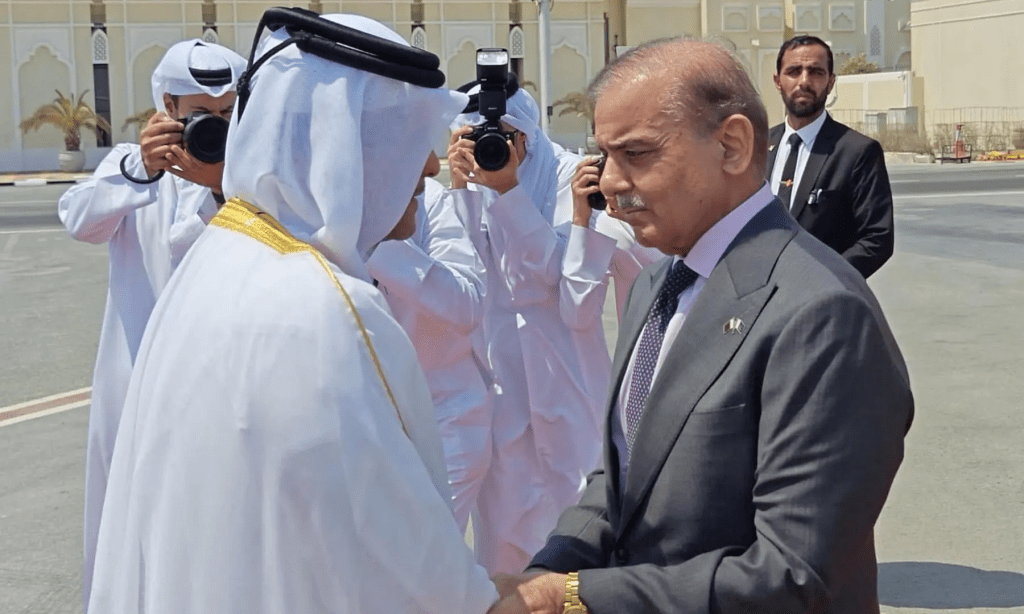
The optics in Doha are historic: Prime Minister Shahbaz Sharif and Crown Prince MBS sitting in Qatar at a time when Arab capitals are no longer hypothetical targets, but proven ones. Damascus has already been hit, Doha followed, and no analyst can rule out Dammam or Jeddah being next. For the Gulf, the illusion of safety is shattered.
This urgency has revived an old idea—the Pan-Islamic defense pact, rebranded by Pakistani diplomats as the “Crescent Security Initiative.” Its promise: Rawalpindi as the SHAPE of the Muslim world, rotating command across member states, limiting itself initially to defensive and counter-terror operations. With Pakistan’s nuclear deterrence, Türkiye’s defense industry, and Gulf money, it reads like a recipe for Muslim world autonomy.
Historical Roots: Where We Are Coming From
The idea of Muslim solidarity in defense—Pan-Islamic defence pacts, collective security, protection of Muslim lands—has long lingered in speeches and manifestos, but always fragmented by suspicion, sectarian divides, and the geopolitical weight of external powers. During the Arab Spring, calls for unity rose, but regimes retreated back into their spheres of influence. Oman kept to itself. Saudi Arabia leaned on the U.S.; Iran played the revolutionary outsider. Pakistan, despite its nuclear arsenal and decades of military experience, has often been seen not as an equal player but as a buffer, a mercenary, or a collaborator, depending on who is speaking.
Fast forward through years of joint exercises, military sales, defense cooperation, and political rhetoric—Al-Samsam, Affaa Al Sahel, Al-Battaar with Gulf states—these weren’t just token displays. They built operational familiarity, trust at command levels, intelligence sharing and capacity for joint readiness. Pakistan’s military has been battle-tested—against insurgency, in conventional skirmishes, in nuclear deterrence—and has maintained relations across Arab states that go beyond cultural affinity into working defense coordination. The groundwork exists. What has been missing is urgency, conviction, and strategic leverage.
The Current Picture (2025): The Region Burns, Alliances Struggle
Recent events have sharply shifted the Middle East’s security calculus. Israel striking Doha during ceasefire mediation, Hamas leaders hunted in Qatari territory, and a perception dawning across Gulf capitals that Israel is no longer just a threat to Palestinian camps or Iranian proxies—but to the capitals themselves. The Guardian recently ran commentary arguing that Israel has replaced Iran as the biggest security threat to the Gulf states, following the strike in Doha. Gulf states once secure under U.S. guarantees are now asking: “Does this umbrella still cover us?” The Guardian
There’s also the fallout from the 2025 Iran-Israel war. Infrastructure shells, intelligence disruptions, missile strikes on bases like Al Udeid, and the realization that nuclear postures alone do not provide protection from kinetic strikes, airspace incursions, or strategic deception. Iranian defenses have been tested—and in many respects found wanting. Even with nuclear rhetoric, Tehran was pushed back, suffered losses, and its command and logistic nodes exposed. Gulf viewers saw this closely. The lesson: having weapons is one thing; maintaining deterrence credibility and protective sovereignty is another.
At the same time, U.S. defense capabilities are being questioned—not for lack of hardware, but for lack of trust. Former allies in the Gulf are uneasy: advanced air defense systems, fighter fleets, radar installations—yet strikes, drone pathways, and operations continue to bypass or penetrate these defenses. Shared intelligence doesn’t always become shared warning. Commitments seem contingent. Friendships have fine print.
This is the first time a GCC capital has been directly struck, and on paper that should trigger a reassessment. But if history is any guide, Arab rulers don’t transform under pressure, they double down on outsourcing. Whether it was Saddam rolling into Kuwait in ’90, the Houthis raining missiles on Riyadh, or Iran striking Aramco in Abqaiq, the instinct wasn’t to build indigenous alliances but to lean harder on Washington and buy more Western toys. Yes, Islamabad and Ankara can technically step in, but the question is, will Arab leadership ever accept them as equals, or just as contractors? Until they shed this client-state mentality and actually put sovereignty above palace survival, a Pakistani or Turkish “role” won’t be strategic partnership, it’ll be business as usual.
Pakistan’s Moment: Bigger Role, Big Stakes
This is no longer a moment for Pakistan to stay on the sidelines. Islamabad has enough credibility and capability to offer real deterrence, not just rhetoric.
What Pakistan brings to the table:
- Nuclear deterrence credibility: In the Muslim world, Pakistan stands out as the only widely recognized nuclear power with a standing doctrine. That matters when Gulf states wonder whether strategic escalation protections exist.
- Combat experience & battle-hardened force structure: Decades of asymmetric warfare, conventional border defense, electronic warfare (EW) trials, joint military exercises with Gulf states show Pakistan is not just talk. The Karbala EW trial, for example, demonstrates practical field-success under leadership observation.
- Defense exports & industrial capacity: With China as partner, Pakistan can scale production of EW systems, drones, small arms, air defense augmentation, and training programs. While the U.S. is stretched thin and facing trust deficits, Pakistan can pitch itself as reliable, cheaper, culturally aligned, and willing to share control—not just sell hardware.
- Strategic geography: Proximity to the Gulf, and historical ties with GCC nations, give Pakistan short logistical lines, shared understanding of threat perceptions, and ability to respond quickly.
- Peer relationships: Pakistan has already invested in Gulf relations beyond oil and remittances. Trade, economic MoUs, military cooperation remain strong. Export doubling ambitions in Pakistani government circles aim to tap GCC markets not just for textiles and labor, but for defense, training, technical support.
Why Pakistan Will Not Risk Missing This
Pakistan will not let this moment slip for several reasons:
- Credibility & Sovereignty: To lead—or even to be taken seriously as a partner—Pakistan must show that it protects jurists, ambassadors, politicians, territories. If it waits, Pakistan risks being a back-bench mercenary, not a strategic pillar.
- Economic Opportunity: Defense export markets are booming. Gulf states will need additive systems, EW, counter-drone tech, radar integration, secure communication, air control; many of these spaces have supply gaps and trust deficits with existing Western suppliers.
- Diplomatic Bargaining Power: If Pakistan positions itself as an indispensable defense partner, it gains leverage not just with GCC states but in global diplomacy: in trade, in Kashmir, in regional influence. A reliable partner is a valued partner.
- Geopolitical Momentum: China’s growing influence, Gulf states’ recalibration, and waning certainty in U.S. guarantees mean that the tectonic plates are shifting. Pakistan can ride this wave rather than be left behind.
Risks & What Must Be Done
Having said all that, the path is fraught. Pakistan cannot treat this as a purely transactional moment. The Gulf’s leadership, while shaken, remains deeply conservative when it comes to sovereignty risk. Arab regimes love stability more than justice; self-preservation more than strategic clarity. There remains the risk of being taken for granted, misused, or isolated if Pakistan demands too much without delivering immediately.
Pakistan must therefore:
- Establish transparent deterrence doctrines with GCC partners: clearly define what it will commit to, under what circumstances, and ensure allied ship-shape command, rules of engagement, and reciprocal guarantees.
- Manufacture visible success stories: small joint deployments, training programs, EW field support, rapid response logistic hubs.
- Be humble in overtures: Islam and shared culture help, but practical trust must come from proven reliability, not rhetoric.
- Expand defense production in partnership with China to include quality assurance, spare parts, repair and heavy industrial capacity to avoid the “vendor dependency” trap.
- Secure diplomatic backing for any “Crescent Security Initiative” by starting small (counter-terror, shared airspace surveillance) before scaling to broader defense or nuclear issues.
- Manage U.S. and China relationships carefully: Pakistan must avoid alienating either, leveraging both for technology, arms, and legitimacy.
The Bigger Picture: What This Could Look Like
Imagine a future where:
- A rotating command center in Rawalpindi supervises radar and air defense coordination with Saudi Arabia, UAE, Qatar, and Türkiye.
- Pakistan provides EW detachments to Gulf states, jointly patrols air corridors, and backs this with its nuclear umbrella as political deterrence.
- Gulf purchase cycles tilt toward Pakistani systems (drones, radar, EW), and Pakistan begins co-manufacturing war assets inside GCC states.
- Strategic military education and intelligence training exchanges become standardized: Pakistani officers rotate through Gulf commands and vice versa.
- The U.S., witnessing shifting loyalties, offers Pakistan more favorable trade and defense terms—both to keep influence and to stay relevant.
But here’s the paradox: such grand visions don’t emerge from strength, but from fragility. Every major Arab crisis—Baghdad in 2003, Tripoli in 2011, Sana’a in 2014—exposed the hollowness of Arab security promises. When the shells start falling, Arab regimes turn not to each other, but to Washington, London, and Paris.
And here lies the bigger question: is Islamabad ready to lean into that mercenary role? Because make no mistake, this isn’t about Muslim unity. It’s about Arab survival instincts wrapped in Islamic rhetoric. The Gulf monarchies don’t bleed for each other; they won’t bleed for Pakistan or Türkiye either.
The Pakistani government’s pitch is clear—expand defense exports, monetize military expertise, gain leverage in GCC corridors, and perhaps secure political bargaining chips for Kashmir. But this isn’t a shield for Pakistan, it’s a business opportunity. Unless Islamabad ties any Crescent Pact to hard guarantees—be it nuclear umbrella commitments, permanent basing rights, or mutual defense clauses—Pakistan risks being sucked into Arab insecurities with little to gain.
The bottom line? Arabs may be under attack, but unless they shed their client-state mentality, even the strike on Doha won’t change their reflex: outsourcing sovereignty to outsiders. For Pakistan, the Crescent Security Initiative is less a path to Muslim unity and more a test—whether we define ourselves as a mercenary state for hire or demand a deeper, strategic bargain.
Conclusion:
Arab regimes are risk-averse, transactional, and survivalist. They won’t bleed for Pakistan, Turkey, or even for each other. Pakistan risks being sucked into their insecurities without any reciprocal guarantees. A Crescent Security Initiative, if ever realized, would be less about Muslim world unity and more about monetizing Pakistan’s military edge. The Pakistani government is less interested in Islamic solidarity and more in expanding its defense export market, selling arms, training, and security packages. In that sense, a “Crescent Security Initiative” is marketing, not strategy. It gives Pakistan leverage in GCC corridors and bargaining chips with Washington and Beijing, but offers no real collective shield.