
By Zohaib Ahmed | 17th September 2025
1) Executive snapshot, what Shahpar-III is (and why it matters)
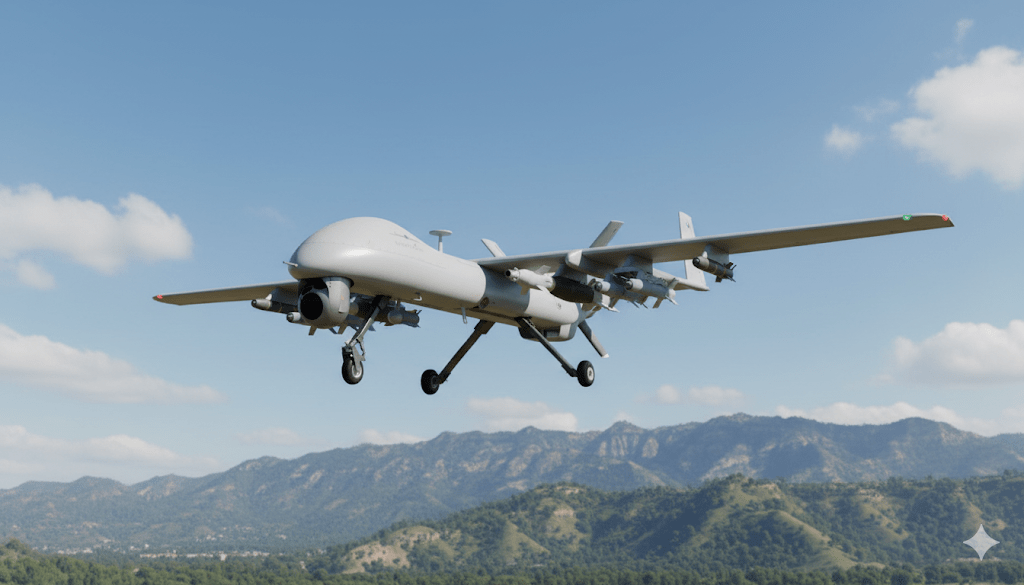
Shahpar-III is GIDS/NESCOM’s Group-4+ Medium-Altitude Long-Endurance (MALE) unmanned combat aerial vehicle (UCAV) program unveiled publicly at IDEAS 2024. It’s presented as Pakistan’s largest indigenous UCAV to date, sized and spec’d to sit in the same mission envelope as internationally-fielded MALE systems rather than the small tactical UAVs Pakistan already fields. Key published design figures: MTOW ≈ 1,650 kg, payload 400–570 kg (varies by engine variant), endurance ~30 hours (claims vary 30–40 hrs), service ceiling ~35,000 ft, and SATCOM-extended range in the low thousands of kilometers. Quwa+2
2) Platform architecture — airframe, propulsion, and open-systems design
Airframe & aerodynamics: Reports and displays show a high-aspect-ratio wing and cruciform empennage optimized for MALE endurance and payload carriage across six underwing hardpoints. Public imagery and exhibitor specs point toward a wingspan and structural layout consistent with 1.5–2-ton MTOW MALE designs. Defence News India+1
Propulsion: GIDS/NESCOM advertise two engine options — a ~140 hp and a ~170 hp powerplant — implying modular powerplant integration to trade payload/endurance vs. dash/climb performance. Variantized engines allow mission tailoring: heavier payloads or weapons (170 hp) vs longer endurance (140 hp). Quwa
Systems engineering note (Engr. Hamza Qureshi): modular engine fits, twin-redundant flight computers (1534/1553 architecture reported in some briefings), and common-bus avionics are the expected baseline for survivability and maintainability in this class. Native integration of flight control, mission computer, and open-bus payload interfaces is the critical enabler for a domestic sensor/weapon ecosystem. Wikipedia
3) Avionics, datalinks & SATCOM — the nervous system
Shahpar-III is claimed to include domestically designed flight control systems and avionics, with SATCOM-backed beyond-line-of-sight (BLOS) links enabling ranges in the thousands of km (vendor claims ~2,500–3,000 km). Dual-redundant buses and MIL-STD-1553 style communication lines (or local equivalents) are cited — consistent with MALE UAV design for mission assurance. This enables persistent ISTAR and weapons employment from safer standoff ranges.
4) Payload & mission modularity — six hardpoints and an ecosystem strategy
Payload architecture: Sources report up to six hardpoints with a usable weapons/sensor payload band of ~400–570 kg depending on powerplant and mission profile. That payload is ambitious for the 1,650 kg MTOW class and signals GIDS is designing for multiple mission sets — precision strike, anti-surface/maritime, ELINT/COMINT pods, and maritime sensors. Quwa+1
Ecosystem approach (central thesis): Shahpar-III is not just “a bigger drone”; it’s a platform for a domestically built suite: smart munitions (air-to-surface missiles, stand-off cruise variants, precision glide bombs), multi-sensor surveillance pods (EO/IR, SAR/GMTI), and EW/ELINT packages. Building the factory around the platform — weapons, sensors, ground control, training, maintenance — is what gives the program strategic value beyond unit sales. Quwa
5) Weapons integration & plausible load-outs
Public briefings and show displays imply Shahpar-III could be cleared for integration of Pakistan-made precision munitions (examples reported in press: Barq, Rasoob family, and local LGBs). With six hardpoints and a 400–570 kg payload band, expected loadouts (illustrative, not confirmed) include:
- Two medium-range air-to-surface missiles + EO/IR pod;
- Two pairs of guided bombs (laser/GPS) + fuel tanks;
- Single torpedo or maritime sensor pod for PN-oriented missions (reported in exhibitions). Army Recognition+1
Integration is the hard part, safe weapons separation, fuzing logic, and mission planning need hardware-in-the-loop testing before operational use.
6) Survivability & EW/defense considerations
Shahpar-III’s survivability posture will depend on passive (low RCS shaping, signature management) and active (EW suites, expendable countermeasures, datalink resiliency) measures. GIDS public material claims EW packages and ELINT capability as part of the ecosystem — implying a platform role not only in strike/ISR, but in electromagnetic spectrum control. For contested airspaces, counter-datalink and anti-jam features plus mission autonomy (safe-return/LOST link modes) are mission-critical. Quwa
From an engineering lens, the priorities are redundancy and graceful degradation, redundant avionics, hardened datalinks, and the ability to complete critical mission legs even after component failure.”
7) Endurance, ceiling & operational envelope — what the numbers imply
Published numbers vary (30–40 hrs endurance; 30,000–35,000 ft ceiling; 2,500–3,000 km SATCOM range). If realized, 30+ hour endurance plus SATCOM reach places Shahpar-III in the strategic ISR/stand-off strike category — capable of persistent maritime patrol, long-dwell border ISTAR, and theatre-level strike coordination. However: public claims must be validated in flight tests and IOC phases. Army Recognition+1
Numbers are useful, but the operational concept of employment — who flies it, how many, and what logistics is put behind it, is what determines strategic impact.
8) Industrial & economic implications — why Pakistan is betting on Shahpar-III
Domestic development signals an industrial strategy: create indigenous avionics, weapons, and payload manufacturing lines; reduce dependency on foreign suppliers for critical kill-chains; and develop an exportable product with competitive pricing. Program cost estimates (by analogy to peers) place R&D in the low-hundreds of millions USD — a significant bet but one that can be amortized by large domestic orders and export potential. Quwa+1
9) Limitations, risks & open questions
- Flight-test validation: many capabilities cited are vendor claims; sustained flight test data, weapons release trials, and operational deployments are the real validators. Wikipedia
- Supply chain & quality control: indigenous production of complex subsystems (high-reliability avionics, SATCOM modems, IR/EO gimbals) is non-trivial. Scaling such production reliably is a multi-year challenge. Army Recognition
- Export politics: export success depends on geopolitical buyers, certification, and performance parity vs. Chinese/Turkish competitors. Army Recognition
10) The strategic question — platform vs. ecosystem
A core trade: perfect the airframe, or master the integration ecosystem (weapons, sensors, datalinks, GCS, logistics)? My judgment: ecosystem mastery yields larger strategic returns. A capable airframe without indigenous munitions, SATCOM resilience, and mission systems is merely an expensive sensor. Shahpar-III’s public posture — six hardpoints, domestic avionics, and a clear push to develop weapons/pods — suggests Pakistan is aiming for the full factory, not a standalone product. Quwa
11) What to watch next (short list)
- Flight test reports and weapons separation trials (first proof of lethality). Wikipedia
- SATCOM/datalink resilience tests and BLOS demonstrations. Medium
- Domestic sensors/weapons IOC announcements (Barq, Rasoob, local LGB integration). Army Recognition
- Export/marketing activity and foreign delegations during future exhibitions (IDEX/IDEAS follow-ups). Army Technology
12) Comparison Table: Shahpar-III vs. MQ-1C Gray Eagle vs. Bayraktar Akıncı
| Specification | Shahpar-III (Pakistan, expected / claimed) | MQ-1C Gray Eagle (USA) | Bayraktar Akıncı (Turkey) |
|---|---|---|---|
| MTOW (Max Take-Off Weight) | ~1,650 kg | ~1,633-1,900 kg (3,600-4,200 lb depending on variant) Warrior Lodge+3Valiant Air Command, Inc.+3Army Recognition+3 | ~5,500-6,000 kg baykartech.pk+3militarynow.live+3Army Recognition+3 |
| Payload Capacity (weapons + sensors) | ~400-570 kg (reported) | ~360-400 kg sensor + weapons payload (≈800 lb) Warrior Lodge+3designation-systems.net+3Valiant Air Command, Inc.+3 | ~1,350-1,500 kg payload (internal + external) Mezha Media+4militarynow.live+4Army Recognition+4 |
| Endurance / Flight Time | Claimed ~30-40 hours | ~24-30 hours depending on configuration Warrior Lodge+2Army+2 | ~24-26 hours typical for long missions; some claims up to ~25 hrs depending on variant Mezha Media+2militarynow.live+2 |
| Service / Operating Ceiling | ~30,000-35,000 ft (public claims) | ~25,000-29,000 ft designation-systems.net+2Valiant Air Command, Inc.+2 | Up to ~40,000 ft (12,000-12,500 m) ceiling in many sources Wikipedia+3baykartech.pk+3militarynow.live+3 |
| Range / BLOS / SATCOM / Link Range | Claims ~2,500-3,000 km SATCOM range, BLOS link possible via ecosystem integration (vendor claims) | Extended range via SATCOM; range varies—but Gray Eagle is designed for wide-area, long-reach missions. Army+2Warrior Lodge+2 | Claims of long range, BLOS/SATCOM links; some reports ~7,500 km ferry or mission-range in certain configurations. baykartech.com+3militarynow.live+3Mezha Media+3 |
| Hardpoints / Weapons Integration | Six hardpoints (claimed) with ability for smart munitions, precision bombs, maritime strike etc. (domestic weapons) | Up to 4 Hellfire missiles plus various sensors (MTS, SAR/GMTI, EO/IR) Army+2Valiant Air Command, Inc.+2 | Multiple external suspension points (≈8), wide munitions variety; internal payload/sensor bays also. Army Recognition+2militarynow.live+2 |
| Avionics / Radar / Sensor Suite | Domestic avionics claimed, with mission computing, EO/IR, anticipated SAR/GMTI/ELINT/EW pods in ecosystem | Gray Eagle has SAR/GMTI, EO/IR, targeting pods (AN/AAS-52 etc.) Army+2designation-systems.net+2 | Akıncı features AESA radar (MURAD), SAR/GMTI, EW/ELINT suites, EO/IR sensors; advanced avionics. Wikipedia+2militarynow.live+2 |
| Powerplant / Engines | Two engine options (≈140/170 hp in reports); modular powerplant strategy (still to be confirmed in flight testing) | Single heavy-fuel (diesel/jet fuel) engine (HFE), ~165 hp in baseline; improved variants somewhat more powerful. designation-systems.net+2Warrior Lodge+2 | Two turboprops; variants with ~450 hp or ~750 hp per engine depending on configuration. Army Recognition+3militarynow.live+3baykartech.pk+3 |
Analysts’ Take: What This Comparison Means
Strategic Warfare Lens:
- Shahpar-III slots in more modestly in MTOW and payload compared to Akıncı, which gives Akıncı a strategic advantage in global reach and heavier strike packages. But Shahpar-III is still a leap forward for Pakistan.
- For strategic autonomy and deterrence, even a medium payload with precision weapons + reach confers value. If Shahpar-III can reliably deliver those capability pillars, its value will outstrip raw spec numbers.
Operational / UCAV Specialist Lens:
- Endurance and ceiling are crucial — a drone that can stay on station long enough and high enough to avoid many ground threats while keeping sensor footprints large. On these metrics, Shahpar-III claimed numbers are competitive with Gray Eagle, though slightly behind Akıncı in ceiling and payload.
- Hardpoints and weapons integration will be a heavy test. Shahpar-III’s six hardpoints are good, but performance depends on how well weapons are separated, how standard the weapons are, and operational reliability under mission stress.
Systems Engineering Lens:
- The trade-offs in engine choice, weight vs. payload vs. endurance will define real operational capability. Having two engine options is smart for modularity, but adds complexity (maintenance, supply).
- Avionics, sensor integration, SATCOM and EW resilience are likely to be differentiators: Akıncı already features AESA-type radar, heavy sensors, strong BLOS/SATCOM and advanced avionics. Shahpar-III must match in data link robustness, sensor fusion, avionics redundancy if it is to compete.
Implications & Gaps Once Compared
- Payload gap: Shahpar-III carries less than Akıncı; this limits how much weaponry or sensors it can carry without compromising endurance or ceiling.
- Ceiling / altitude: Slightly lower ceiling may expose Shahpar-III to more threat types (e.g., ground SAM, better radar visibility) unless mitigated by stealth/signature management or ECM/EW packages.
- Engine & power margin: Lower horsepower engines (if the claimed 140-170 hp options are accurate) may limit performance under heavy load or in less favorable atmospheric conditions.
- Ecosystem maturity matters: Even if Shahpar-III’s own numbers are somewhat behind, having domestic production of weapons, sensors, SATCOM/datalinks, ground stations, training, maintenance infrastructure closes the gap.
- The Shahpar-III Maritime Variant by GIDS/Pavnautics
- The Shahpar-III Maritime Variant for the Pakistan Navy by Gids/Pavnautics is a redesigned MALE UCAV configuration optimized for anti-surface and anti-subsurface warfare: it features 2 × sonobuoy pods carrying a total of 8 active/passive sonobuoys, 2 × lightweight GIDS torpedoes, a 60 km-range Synthetic Aperture Radar (SAR), and a likely COMINT/ELINT payload in addition to the Zumr-3 HD EO/IR sensor, all integrated into a SATCOM-capable airframe claiming ~3,000 km range, ~40 hr endurance, and a 41,000 ft ceiling. Technically, this loadout converts Shahpar-III from a pure ISR/strike node into a networked maritime hunter-killer platform: SAR + EO/IR for wide-area and precision surface detection, sonobuoys + ELINT/COMINT for undersea localization and emitter attribution, and torpedoes for direct ASW engagement; SATCOM and datalink resilience enable fleet-level tasking and real-time target handoff. The engineering trade-offs are clear, managing power, cooling, and electromagnetic interference for sensors and sonobuoy processing, plus weapons-release aerodynamics and weight vs. endurance balance, yet if validated in flight trials this variant substantially increases Pakistan’s autonomous maritime reach and layered sea-denial capability.
Closing
Shahpar-III is Pakistan’s attempt to move from buying capability to making capability: an airframe wrapped in an ecosystem. The airframe and numbers are eye-catching — but the program’s strategic value will be determined by flight validation, weapons integration, datalink robustness, and scale of domestic procurement. If GIDS and Pakistan’s tri-services deliver the full ecosystem they’ve pitched, Shahpar-III won’t just be a bigger drone; it will be the backbone of a homegrown MALE UCAV enterprise.
— Zohaib Ahmed
Sources and reading (selected)
Core reporting and vendor/analysis pages used: GIDS/Shahpar-III briefings and exhibitor material, press reports from IDEAS 2024, Quwa analysis, Army Recognition, Army-Technology and Janes coverage.
Really it is very nice