
By Zohaib Ahmed | 18th September 2025
The End of the American Century
Empires rarely collapse with a single shock; they unravel through exhaustion, overstretch, and internal fracture. The “American Century,” declared in 1941 by Henry Luce, has run its course. The United States remains a formidable military machine and an economic titan, but the world has shifted beneath its feet. Multipolarity has taken hold — China in Asia, Europe in climate and trade, Russia in security disruption, and non-state actors across the Middle East. America no longer dictates outcomes in the way it did in Vietnam, Iraq, or Afghanistan.
General Omar Bradley warned during the Korean War: “In war, there is no victory at bargain prices.” America has learned this lesson repeatedly — and painfully. But decline is not only measured in failed wars abroad; it now manifests in political fractures at home.
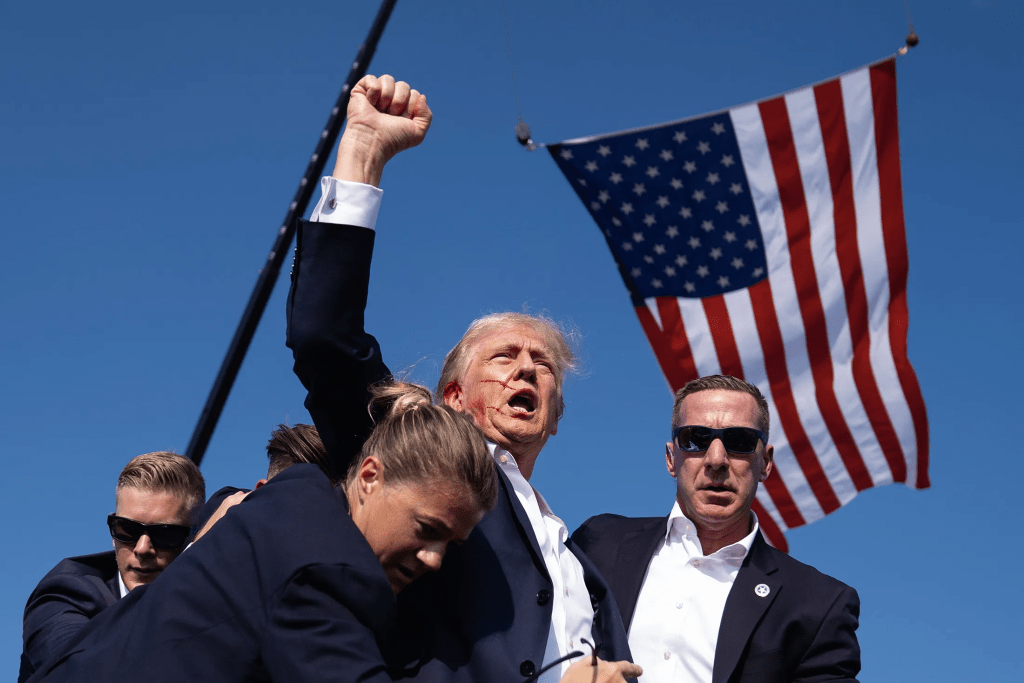
Assassinations as Signals of Structural Decay
Donald Trump’s brush with death in 2024 and Charlie Kirk’s killing in 2025 are not isolated events. They are stress fractures in the armor of a republic that once exported order but now struggles to contain chaos within its borders. Political violence has crossed the threshold from metaphor to material — America’s “culture war” has become kinetic.
History tells us assassinations are rarely about individuals. Caesar’s death was about the future of Rome, not the man himself. Franz Ferdinand’s murder set off a global war because of what he represented, not who he was. Similarly, these American attacks are not about Trump or Kirk alone — they symbolize a deeper reality: an empire turning inward, paranoid of itself, and increasingly unfit to carry allies’ burdens.
Exceptionalism: From Civic Religion to Dangerous Myth
For centuries, American foreign policy was justified by exceptionalism, a belief in divine mission. From John Winthrop’s “city on a hill” to Reagan’s shining vision of redemption, it framed the U.S. as the indispensable nation. Historian Harry Stout summarized it bluntly: “The norm of American national life is war.”
But what once inspired confidence now fuels arrogance. Exceptionalism justified 280+ interventions, from Latin America to the Middle East, but in today’s interconnected age it has become self-destructive. Trump’s “America First” was not a break with exceptionalism but a distortion of it — inward populism weaponized against outsiders. James Mattis warned: “Nations with allies thrive, nations without allies wither.” Under Trump, America chose the latter, and adversaries like China filled the void.
The Deep State’s Rightward Drift
Here, structural decline and political violence intersect. As wars abroad drained treasure and patience, U.S. institutions recalibrated. The intelligence bureaucracy, the judiciary, and the military have begun drifting rightward, less from ideology than necessity.
- Domestic crises — opioid epidemics, migration surges, urban unrest — force resources inward.
- Nativism hardwires itself into policy.
- Foreign adventurism becomes a liability.
This is not isolationism; it is fortress mentality. America will intervene, but selectively — sharper, narrower, more brutal. It will guard borders, surveil citizens, and project power surgically, not universally.
The Middle East: Gaza’s Isolation and Israel’s Ascendancy
The blog of structural decline highlights America’s endless wars of choice — Vietnam, Iraq, Libya — as disasters that eroded its legitimacy. The symptomatic view explains why Muslim states hesitate to break with Washington over Gaza.
- Economic entanglement: Arab regimes are tied to U.S. defense industries, IMF bailouts, and dollarized oil flows.
- Domestic fragility: Youth bulges and economic crises leave rulers unwilling to risk rupture.
- Strategic expendability: Gaza is seen as tragedy, not an asset.
Thus, the Palestinian cause is reduced to speeches and aid, not strategy. Israel, by contrast, has played its cards with ruthless rationality. It has embedded itself as America’s irreplaceable outpost, turning every crisis — Hamas, Hezbollah, Iran — into an opportunity to deepen U.S. reliance. Where Europe drained U.S. patience in Ukraine, Israel entrenched itself in Washington’s bloodstream.
Europe’s Strategic Folly
If Israel has been strategic, Europe has been naïve. NATO overestimated America’s stamina. The Ukraine war became a bottomless pit, eroding U.S. bandwidth and credibility. The czar’s forecast is blunt: U.S. protection of Europe will contract. NATO will hollow out, and Brussels will face exposure it is not prepared to confront.
Global Threats, Local Blindness
While America tightens its fortress walls, existential threats march on: climate change, pandemics, and resource depletion. António Guterres, UN Secretary-General, warned: “Humanity is waging war on nature. This is suicidal.” These crises demand multilateral cooperation, yet U.S. paranoia blinds it to the need for collaboration.
The principle of subsidiarity — solving problems at the lowest effective level — is ignored in favor of militarized nationalism. Where regional blocs like the EU or AU innovate, Washington regresses.
Two Futures: Cooperation or Conflict
Both the structural and symptomatic analyses converge on a single truth: America stands at a crossroads.
- One path is Sachs’ vision: embrace multipolar cooperation, lead on climate, sustainability, and technology, and turn exceptionalism into humility.
- The other is the czar’s warning: paranoid violence, fortress mentality, abandoned allies, and selective favoritism — Israel shielded, Europe abandoned, Arab states cautious, non-state actors rising.
Albert Einstein warned: “I do not know with what weapons World War III will be fought, but World War IV will be fought with sticks and stones.” That warning is no longer theoretical. It is urgent.
Final Analysis by Zohaib Ahmed
The attempted assassination of Trump and the killing of Charlie Kirk are not the causes of America’s strategic drift — they are symptoms of it. They dramatize what the czars of history already see: the exhaustion of empire, the fraying of exceptionalism, and the turn inward of a once-global hegemon.
The future of American power will not be decided in Baghdad or Kyiv, but in how it reconciles its domestic fractures with its global obligations. If America clings to paranoia, it will mutate into a fortress, abandoning Europe, pacifying Arabs, and entrenching Israel. If it embraces cooperation, it can lead through technology, climate diplomacy, and sustainable development.
The choice is stark: America as paranoid empire in retreat, or America as humbled leader in a multipolar order. The assassins’ shadows show us how fragile the first path is. The structural czars remind us how vital the second could be. The time to choose is now.