
By Zohaib Ahmed, Strategic Foresight Analyst | 18th September 2025
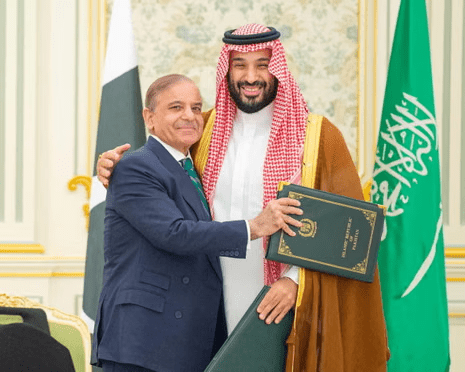
When Crown Princes roll out the purple carpet and headlines scream “historic friendship,” Pakistanis should pause, cheer cautiously, and remember one truth: in geopolitics, every embrace carries the weight of leverage, and every pact can double as a trap. The latest Pakistan–Saudi Arabia Strategic Mutual Defense Agreement—promising that any aggression against one will be considered an aggression against both—is a milestone in optics, but not yet in operational terms.
✦ The Hype vs. the Hard Truth
Yes, this agreement signals trust and elevates Pakistan into the big leagues of Muslim security architecture. Yes, the purple carpet reception in Riyadh was a powerful signal that Pakistan is no longer seen as a client but a partner. Yet behind the pomp lies a delicate balance: Riyadh has money and diplomatic corridors; Pakistan has manpower, combat experience, and an expanding defense industry. Neither can substitute the other.
But history reminds us that Saudi gestures are never free. When Pakistan tested its nuclear weapons in 1998, our economy was crumbling—reserves at just $600 million and sanctions looming. Saudi Arabia stepped in, offering a three-year deferred oil payment plan worth billions. According to diplomats, those payments were quietly written off. Even at $10 oil and record deficits, Riyadh extended a lifeline. That wasn’t charity—it was strategic investment. Prince Turki bin Faisal once described Pak–Saudi ties as “probably one of the closest relationships in the world between any two countries.” But closeness comes with expectations.
✦ The Nuclear Question
Western analysts have long whispered about the Saudi nuclear “insurance policy” with Pakistan. From visits by Saudi defense chiefs to Pakistani nuclear labs in 1999 and 2002, to reports by NATO and Israeli officials suggesting “ready-to-deliver” warheads, the narrative persists: Riyadh bankrolled Pakistan’s program, and in return, Pakistan would provide nuclear guarantees “in extremis.”
A former senior U.S. official once called it the “NATO model”—Pakistani nukes, under Pakistani control, potentially deployed on Saudi soil. Others allege it could be a cash-and-carry arrangement, warheads for Riyadh if Iran crosses the threshold. Whether myth, signal, or reality, the nuclear shadow is real, and Pakistan cannot pretend it does not hang over this friendship.
Saudi Arabia’s Nuclear Hedge with Pakistan
For decades, Riyadh has quietly bankrolled Pakistan’s nuclear and missile programs, and multiple intelligence assessments suggest that this “investment” was never charity. A senior NATO decision maker admitted to BBC Newsnight that “nuclear weapons made in Pakistan on behalf of Saudi Arabia are now sitting ready for delivery.” The implication is clear: the Kingdom has long prepared an insurance policy against Iran.
Israeli intelligence concurs. Amos Yadlin, former chief of Israel’s military intelligence, declared bluntly: “If Iran got the bomb, the Saudis will not wait one month. They already paid for the bomb, they will go to Pakistan and bring what they need to bring.” Such statements echo the warning King Abdullah gave to a U.S. envoy in 2009: “If Iran crossed the threshold, we will get nuclear weapons.”
Western officials, too, see credibility in this understanding. Gary Samore, who served as Barack Obama’s WMD czar, explained that “the Saudis believe they have some understanding with Pakistan that, in extremis, they would have claim to acquire nuclear weapons.” Pakistani insiders have been even more candid. One senior figure reportedly asked, “What did we think the Saudis were giving us all that money for? It wasn’t charity.” Another, a former intelligence officer, suggested that warheads were indeed being maintained with the assumption they could be transferred to Saudi Arabia at short notice.
The mechanics of such a deal remain debated. Some argue for a “cash-and-carry” option, where Riyadh simply lifts ready-made devices from Pakistan. Others, like Samore, view a NATO-style model as more plausible — “for Pakistan to send its own forces, its own troops armed with nuclear weapons and with delivery systems to be deployed in Saudi Arabia.” This arrangement would give Islamabad deniability, while providing Riyadh the deterrence it craves.
The circumstantial evidence runs deep. In the late 1980s, Saudi Arabia purchased CSS-2 ballistic missiles from China — systems experts deemed unsuitable for conventional warheads but perfect for nuclear payloads. By 2013, defense analysts reported new Saudi missile bases with launch rails aligned toward Israel and Iran. Overlaying this with Pakistan’s Shaheen missile developments and A.Q. Khan’s well-documented proliferation network, the architecture of a Saudi-Pakistani nuclear understanding becomes hard to dismiss.
Even if Saudi warheads remain stored in Pakistan, the political signaling is powerful. Simon Henderson of the Washington Institute observed that “the Saudis speak about Iran and nuclear matters very seriously. They don’t bluff on this issue.” Israeli intelligence has gone further, briefing allies that Saudi Arabia may already be ready to “take delivery of finished warheads.” Whether or not this has occurred, the very ambiguity gives Riyadh leverage — against Tehran, against Washington, and within the Sunni Arab order.
Both Riyadh and Islamabad officially deny such an arrangement. Pakistan’s Foreign Ministry calls the allegations “speculative, mischievous and baseless”, while Saudi officials point to their status as NPT signatories and their public advocacy for a nuclear-free Middle East. Yet as one Pakistani insider summarized, “Saudi Arabia provided generous financial support to Pakistan that enabled the nuclear program to continue.” That strategic patronage remains an open secret in global security circles.
✦ The Cautionary Angle
Here lies the trap. If Pakistan slides too deep into Riyadh’s embrace:
- It risks becoming a nuclear subcontractor. The very credibility of Pakistan’s command-and-control could be questioned globally if even the perception of “outsourcing” nukes gains traction.
- It risks repeating history. Arab regimes have proven transactional, survivalist, and unwilling to bleed for others. Saudi Arabia struggled against Houthis with all its wealth. Would it truly risk escalation for Pakistan against India? Unlikely.
- It risks entanglement. Israel, Washington, and Tehran would all recalibrate against Islamabad if a nuclear-Saudi axis appears credible.
✦ Strategic Value for Pakistan
And yet, the business dimension is undeniable. Pakistan doesn’t need a collective Islamic shield—because such a shield will never exist. What Pakistan gains here is far more pragmatic and useful:
- Defense market access. Selling JF-17s, drones, GBAD systems, and training to Riyadh could unlock billions in defense contracts.
- Industrial leverage. PAF–SAF collaboration (Patriot with HQ-9, J-10C with F-15) positions Pakistan as a bridge between Chinese and Western systems, a rare role that boosts Islamabad’s bargaining power globally.
- Symbolic deterrence. Even the possible deployment of Pakistani troops in Tabuk—if confirmed—adds psychological weight to the pact.
✦ What Pakistan Must Do
As a foresight analyst, here’s the way forward for Pakistan:
- Guard the nuclear card fiercely. Pakistan must keep its deterrent national and untouchable. Any perception of nuclear outsourcing would invite sanctions, isolation, and strategic suffocation. Riyadh may want ambiguity; Islamabad must maintain deniability.
- Monetize without militarizing. Sell defense systems, training, cyber, EW, and GBAD—not troops for foreign wars. Pakistan should stand in the line of defense exporters, not rented armies.
- Balance Riyadh with other poles. Turkey, China, and even Indonesia must remain in Pakistan’s security calculus. Overdependence on Arab regimes risks trapping Pakistan in their insecurities.
- Leverage optics smartly. The purple carpet is leverage—use it in Washington and Beijing to bargain better. Show that Pakistan is indispensable to GCC security, but avoid being shackled by it.
✦ Final Word
The Pak–KSA defense pact is both opportunity and trap. The opportunity lies in business, defense exports, and elevated status. The trap lies in becoming Riyadh’s nuclear insurance policy and being entangled in Arab insecurities. If Pakistan can walk this tightrope—monetizing ties while safeguarding its sovereignty—it will emerge as a co-architect of Muslim defense discourse, not just a mercenary in gilded robes.
This friendship is worth celebrating—but only with eyes wide open.