
By Zohaib Ahmed | Strategic Foresight Analysis | 22nd September 2025
Part 1: The Return of Bagram – More Than Nostalgia
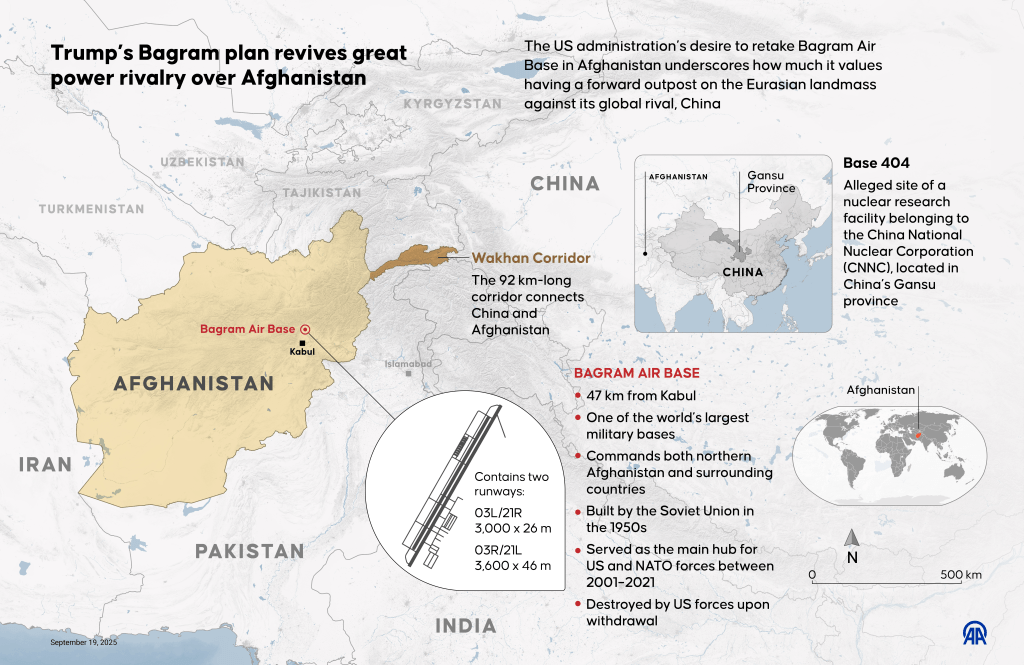
When Donald Trump said he wanted the U.S. back at Bagram, it wasn’t because he missed America’s longest war. It was pure strategy. Bagram is not just an abandoned Afghan airfield—it is one of the most strategically located bases in the world.
From Bagram, the U.S. can:
- Monitor China’s Xinjiang province (only 600 km away).
- Keep an eye on Iran’s eastern flank.
- Watch over Russia’s Central Asian backyard.
The U.S. already has bases in the Gulf and naval dominance around Taiwan. But there is a missing link in America’s force posture: China’s western underbelly. Bagram fills that gap.
Part 2: The Israel Diversion – A Convenient Argument
Some analysts argue that Israel is behind Trump’s call for Bagram, especially after Pakistan and Saudi Arabia signed their defense agreement. The logic goes: Israel fears Pakistan’s growing Gulf role, so it wants a U.S. footprint nearby.
But this doesn’t hold up. Israel cannot openly operate in Afghanistan—it would trigger an enormous backlash in the Muslim world. The U.S. military does not design its global posture around Israel’s preferences. Yes, Israel may indirectly benefit from stronger U.S. positioning, but Bagram’s primary purpose is not Tel Aviv.
The U.S. wants Bagram because it is fighting a global contest with China, Russia, and Iran—not because of Pakistan or Israel.
Part 3: Why Gulf Bases Aren’t Enough
Some say: “The U.S. has Al-Udeid in Qatar, Al-Dhafra in UAE, Bahrain’s Fifth Fleet, and Diego Garcia. Why does it need Bagram?”
The answer is geography.
- Gulf bases project power southward—Hormuz, Arabian Peninsula, and the Indian Ocean.
- They are 2,000+ km away from western China. Long flights, refueling requirements, and drone endurance limits make them ineffective for Xinjiang surveillance.
- Diego Garcia is even farther—3,000 km from inland Asia. Excellent for maritime dominance, but weak for watching land corridors.
Bagram, by contrast, is a front-row seat. It puts U.S. ISR drones, spy planes, and strike aircraft within one hour of China’s western front.
Part 4: Pakistan and Saudi Arabia – A Different Equation
Some suggest Bagram is meant to “counter” Pakistan’s role in the new Saudi deal. Again, this is miscalculated.
Pakistan’s nuclear doctrine remains India-specific, not Middle East-focused. The Pak–Saudi agreement does not transfer nukes or “umbrellas.” It is about:
- Troop deployments in Tabuk.
- Defense of Makkah and Madinah.
- Joint air defense, missiles, and ISR systems.
Washington knows this. The U.S. intelligence community does not see Pakistani missiles pointed at Israel or the West. Linking Bagram to “catching” Pakistani nukes is flawed.
Bagram’s purpose is China, Russia, Iran—not Pakistan.
Part 5: India’s Silent Fear
For India, the idea of the U.S. returning to Bagram is deeply unsettling. New Delhi has tried to make itself Washington’s key South Asian partner against China. But if the U.S. returns to Afghanistan:
- It sidelines India’s influence in Kabul, where Delhi spent billions after 2001.
- It shows Washington wants direct leverage on China, not just through India.
- It reduces India’s monopoly as America’s “regional partner.”
For Delhi, Bagram is a reminder: the U.S. doesn’t outsource its China strategy. It builds its own options.
Part 6: Trump’s Timing – Why Now?
Why raise Bagram now? Three reasons:
- China’s Belt & Road is advancing, with routes through Pakistan (CPEC) and Central Asia. The U.S. wants eyes on those arteries.
- Russia, after Ukraine, is pushing harder into Asia.
- Iran and China are cementing security and trade links.
Trump’s call for Bagram signals:
- To China: America can put ISR on your western doorstep.
- To Russia: Central Asia won’t be uncontested.
- To Iran: Your eastern borders are not safe havens.
Rebuttals – Answering the Hard Questions
Q1: Other than prestige, how does this serve U.S. interests?
It gives the Pentagon a land-based ISR hub into China’s west and Central Asia—something naval fleets and Gulf bases cannot deliver.
Q2: Is this about Pakistan’s nuclear weapons?
No. Pakistan’s deterrence is India-focused. The U.S. does not need Bagram to monitor Pakistan; satellites and SIGINT already cover that. Bagram is about China, Russia, Iran.
Q3: If not Israel, who benefits?
The claim that Bagram is “for Israel” falls apart once you map U.S. basing geography. Yes, Washington has naval dominance around Taiwan and deep-water strike capability from Diego Garcia, but those assets are optimized for the Pacific and Indian Ocean theaters—far too distant for persistent ISR over Xinjiang, Iran, or Central Asia. Gulf bases like Al Udeid and Al Dhafra are closer but still over 2,000 km from western China, forcing reliance on tankers and limiting drone endurance. Bagram, by contrast, sits less than 600 km from Kashgar and Hotan, giving the Pentagon the rare ability to run MQ-9s, RQ-170s, and Rivet Joint sorties directly into China’s most sensitive corridors with minimal logistical strain.
Linking this to Israel or Pakistan-Saudi nuclear speculation ignores doctrine and intent: Pakistan’s deterrent remains India-centric, Riyadh has no operational nuclear umbrella, and Israel’s intelligence-sharing pipeline runs through U.S. and NATO networks in the Med and Gulf—not Afghanistan. What Trump is signaling with Bagram is not a proxy play for Tel Aviv, but a forward lily-pad in the Eurasian heartland, meant to deny China uncontested access to Afghan rare earths, energy routes, and the surveillance blind spots along its western flank.
Q4: Trump’s demand to take back Bagram is likely CT, wanting to be better positioned to monitor IS-K, the Afghanistan-based faction of Islamic State that projects a global threat?
Trump’s push for Bagram cannot be divorced from layered strategic calculus: while counterterrorism against IS-K offers a publicly palatable rationale, the reality is that Washington does not need a sprawling Afghan airfield to track militants—it already leverages satellites, drones from Diego Garcia, and Gulf bases for CT missions. The real value of Bagram lies in its geography: less than 600 km from Kashgar and Hotan, giving the U.S. ISR reach into western China, northern Iran, and Central Asia’s mineral corridors, far beyond what embassies or limited diplomatic presence can provide. The irony is correct—Afghanistan is not yet a frontline of U.S.–China competition, but Trump’s rhetoric signals intent to make it one, turning the “roof of Eurasia” into a new surveillance and pressure node. In this framing, Bagram is less about IS-K or Pakistan and more about preempting China’s long-term integration of Afghanistan into BRI and rare-earth supply chains.
Q5: What will be the role of Pakistan? “Watching China” from Bagram still lands on Pakistan’s ledger. ISR and strike enablers are dual-use; electromagnetic signatures, cueing chains, and recovery routes rarely stop at a border on a map. That invites counter-moves, cyber, economic, or proxy, priced into Pakistan’s stability, not Washington’s.
Total autonomy in Afghanistan is a myth, but it is also true that Washington would prefer minimal reliance on Pakistani corridors precisely because it knows the political costs. That is why the US has been cultivating Central Asian overflight, long-haul ISR from the Gulf, and even Diego Garcia backups. Pakistan’s airspace is not an inevitability—it’s one option among several, and one we can pre-emptively wall off with a bright-line policy.
As for leverage: nuclear deterrence doesn’t stop IMF or FATF pressure, agreed. But it changes the ceiling of coercion. Post-2011 Pakistan is not the pliant 1960s Pakistan—you now have structural hedges (CPEC, multipolar alignments, Chinese equity in stability) that raise the cost of Western overreach. That doesn’t grant “immunity,” but it does give Islamabad room to negotiate limits—to say “no corridors, yes humanitarian” without collapsing under pressure.
Finally, ISR signatures spill across borders, and that blowback risks are real. But that is exactly why the conversation should focus less on “Pakistan will inevitably be dragged in” and more on “how Pakistan can proactively insulate itself.” Vigilance should translate into assertive boundary-setting, not a fatalistic expectation that Bagram = Badaber 2.0.
Final Word – The Real Shadow of Bagram
Bagram’s shadow isn’t over Pakistan, or even Israel. It falls squarely over China’s Belt and Road, Russia’s Central Asia, and Iran’s eastern flank.
The U.S. interest in Bagram Air Base is far less about intercepting hypothetical Pakistani missiles and far more about strategic geography. Bagram sits less than 600 km from both western China (Xinjiang) and Central Asia, making it an ideal surveillance, drone, and rapid-deployment hub to project pressure on Beijing, Moscow, and Tehran simultaneously. The Pentagon’s renewed focus on “lily-pad bases”—forward operating hubs that allow ISR, cyber, and special ops reach—fits Bagram perfectly. From a czar’s lens, Trump’s framing of “an hour away from China’s missile factories” was clumsy but pointed at the real calculus: countering China’s military-industrial buildup, not Pakistani nuclear forces.
The Pakistan link is overblown. The Saudi-Pakistan defense pact, despite speculation, contains no operationalized nuclear guarantees—and Washington’s intelligence community knows this. Pakistan’s nuclear doctrine remains strictly India-centric, with no credible pathway or posture for missiles flying west toward Israel. For Washington, the real contest is not to “catch” Pakistani missiles, but to deny China uncontested access to Afghanistan’s rare earths, energy corridors, and surveillance blind spots along its western periphery. Bagram is a chessboard square in the U.S.–China game, not an anti-Pakistan play.
Key Takeaway:
- Not for Israel.
- Not against Pakistan.
- Directly against China, Russia, and Iran.