
By Zohaib Ahmed, Strategic Foresight Analyst | 22nd September 2025
When the purple carpets roll out and official communiqués stop short of details, that’s when the real foresight analysis begins. Based on calculations, trend-mapping, and the trajectory of current Pakistan–Saudi defense diplomacy, here is what the expected formation of the Pak–KSA defense agreement may realistically look like in operational terms.
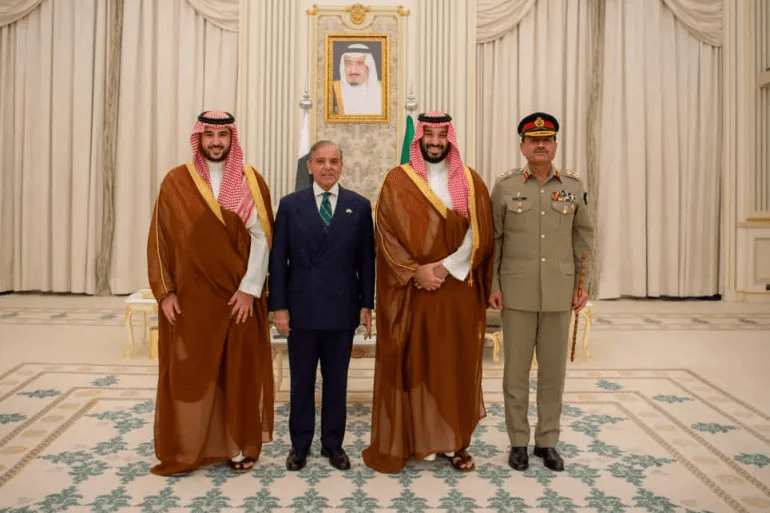
1. Troop Deployment and Ground Presence
At the core of this pact will be boots on the ground. My analysis suggests Pakistan will deploy up to 50,000 troops in Saudi Arabia, most likely concentrated in Tabuk—a geostrategic chokepoint for both land and air defense operations. Beyond Tabuk, the defense of Makkah Mukarramah and Madinah Munawwarah will be handed entirely to the Pakistan Army, institutionalizing what has long been an informal understanding: that Pakistan is the guarantor of the sanctity of the holy cities.
2. Missile and Air Defense Architecture
Saudi vulnerabilities in recent years—Aramco’s drone strikes, Houthi missile barrages—underscore that air and missile defense is the single most critical gap. Pakistan’s expected contribution here will be transformative:
- Deployment of Ababeel missile regiments capable of MIRV strikes on 13 targets simultaneously, alongside ballistic and cruise missile batteries.
- Establishment of a modern air defense shield integrated with both Pakistani and Chinese systems.
- Joint rocket force formations that extend deterrence beyond symbolic presence.
For Riyadh, this offers not just insurance but a credible deterrent grid. For Islamabad, it positions its indigenous missile ecosystem on one of the world’s most lucrative stages.
3. Air Power Integration
A likely but underplayed element is the induction of Pakistani JF-17 Thunder squadrons and J-10C aircraft into the Royal Saudi Air Force. This does two things:
- It plugs gaps in the RSAF’s current structure dominated by U.S. F-15s and Eurofighter Typhoons.
- It establishes Pakistan as a bridge between Western and Eastern air platforms, creating an interoperability edge few countries can offer.
A new joint air base remains a possibility—but only if China directly enters the operational equation. That would mark a true tri-polar partnership: Pakistan manpower, Saudi financing, and Chinese tech-systems.
4. Satellite & Communication Dominance
A linchpin of the expected pact will be command, control, and communication (C3) supremacy. Pakistan is already finalizing a deal with China for 20 satellites worth $406 million. Once operational, this network will feed into a Link-17 air communication system designed to blanket the Gulf with ISR (Intelligence, Surveillance, Reconnaissance).
The practical effect? The entire region’s air and missile space will be monitored in real time, giving both countries a shared early-warning and rapid response system.
5. Oil Route Security and Maritime Layer
Pakistan’s Navy is expected to play a more pronounced role in securing Saudi oil supply routes, particularly against asymmetric threats in the Red Sea and Gulf of Aden. Think joint patrols, PAF maritime ISR, and perhaps even deployment of Pakistan’s long-range drones for route security. This isn’t charity—it’s survival: 90% of Saudi exports depend on sea lanes, and Pakistan’s geostrategic naval reach adds redundancy to Riyadh’s reliance on U.S. 5th Fleet.
6. Joint Command and Control System
Perhaps the most critical clause: any attack on one will trigger automatic retaliation by both. This won’t be left to political phone calls—it will be baked into a joint command-and-control (C2) system.
- Shared early-warning.
- Coordinated rules of engagement.
- Automatic mobilization protocols.
For the first time, Islamabad and Riyadh would have a fusion center ensuring their militaries act in sync rather than sequentially.
7. Timeline and Operationalization
Sources indicate a Pakistani defense delegation will land in Riyadh in the coming days to begin groundwork. Based on my foresight calculations, the full architecture—troops, C2, ISR, missile deployments—could be operational within one year, Insha’Allah.
Final Word
At its core, this agreement is not about a protective shield for Pakistan—it is about business, leverage, and positioning. Both the United States and China are on board, but the driver here is Pakistan itself. The recent attack on Qatar exposed a harsh truth: American defense systems, despite their branding, failed to provide reliable protection. Riyadh and others now seek what Pakistan uniquely offers, indigenous, battle-tested, and reliable systems that do not bend to foreign control. This is not China’s achievement; it is Pakistan’s effort, earned through decades of combat experience and steady defense industrial growth. With this pact, Islamabad signals it is no longer a hired gun but a competitor in the global defense marketplace, standing in line with top-tier defense exporters. Washington’s failure to restrain Israel will echo for years, and in that space of strategic disillusionment, Pakistan has found its opening. The key will be to keep it strictly business. That is what this deal represents, and more like it will follow.