
Special Think Tank Research Paper by Zohaib Ahmed | 14th November 2025
Executive summary
Under a renewed Trump administration the dominant threat vectors for Pakistan are geopolitical marginalization (a durable U.S. tilt toward India as a China-counterweight), tightened economic leverage (sanctions, export controls, conditional trade/aid), and the diplomatic pressure that comes from intensifying U.S.–China strategic competition. Combined with Trump’s demonstrated appetite for transactional deals and unpredictable decision-making, Pakistan faces a difficult balancing act: preserve its deep economic and strategic ties with China (CPEC), avoid severe diplomatic isolation vis-à-vis the United States, and manage regional flashpoints (Afghanistan, India, Iran) that could be exploited by external pressure.
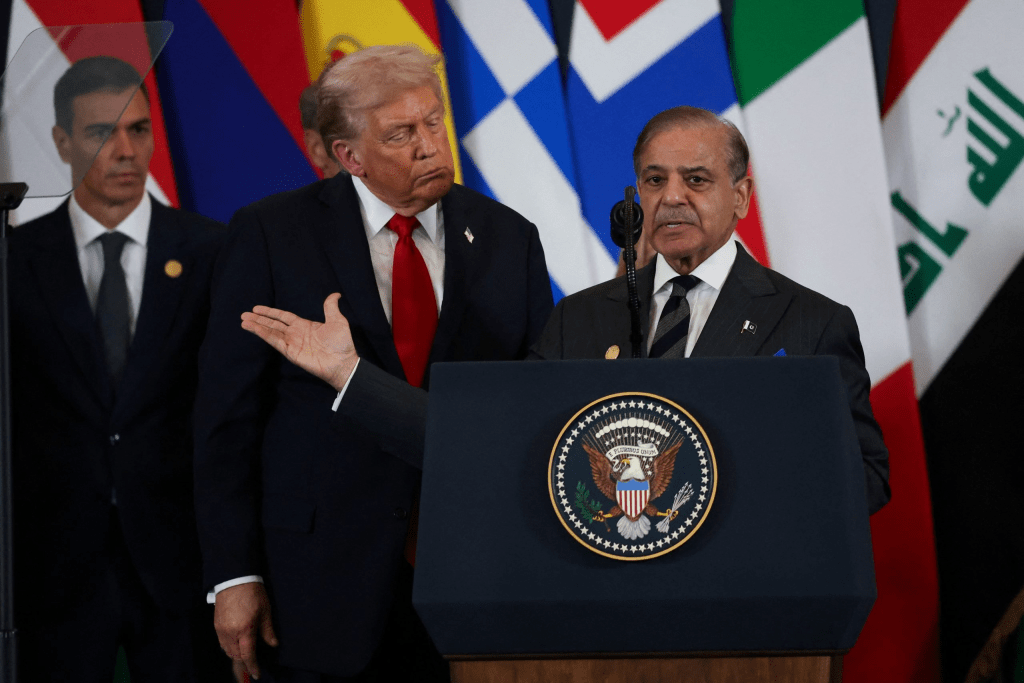
What’s provably happening in 2025 (evidence, brief)
- High-level U.S.–Pakistan engagement and public praise: Multiple mainstream pieces report warm encounters and praise from President Trump toward Pakistani leadership and the military in 2025. Pakistan’s leaders have responded publicly and ceremonially (including reported nominations of Trump for the Nobel Peace Prize). These interactions are unusually positive compared with past cycles. Межа. Новини України.+1
- Trade talks & mineral/oil investment discussions: Reuters and other outlets reported that Pakistan and the U.S. were concluding trade negotiations in mid-2025 and exploring U.S. investor involvement in major mineral projects (Reko Diq) and energy deals; U.S. agencies (EXIM) were reported to be evaluating financing. Those are concrete, documentable commercial tracks. Reuters+1
- Port/minerals pitch near Gwadar (Pasni): Multiple outlets, including the Financial Times and Reuters, published reporting that Pakistani advisers floated a proposal for a Pasni deep-sea terminal aimed at U.S. commercial (and strategic) involvement, explicitly framed as a way to diversify away from singular Chinese dependence and open U.S. access to minerals. This is a major geopolitical signal. Financial Times+1
- US–India frictions (tariffs): International reporting documents a sharp U.S. tariff squeeze on India in 2025 (25–50% measures reported and widely covered) tied to trade and geopolitical complaints, a dynamic that arguably gives Islamabad strategic breathing room as Washington publicly turns on New Delhi’s economic posture.
- Praveen Swami and regional read: Swami and other regional commentators highlight that Pakistan’s military/intelligence circles are actively involved in recalibrating options, offering new port pitches and courting non-Chinese investment, and that public elite signaling matters domestically and in Delhi.
History
“Being an ally of the United States is like living on the banks of an enormous river… every four or eight years the river changes course, and you may find yourself alone in a desert.”
, General Zia-ul-Haq to CIA Director William Casey, 1980s
Pakistan’s history with the United States provides a clear template for caution. During the 1980s, Pakistan was central to the U.S. strategy in Afghanistan, receiving billions in military aid and intelligence support. The Afghan jihad against the Soviet Union made Islamabad Washington’s frontline partner. Yet when the Cold War ended, U.S. priorities shifted, and Pakistan faced sanctions, isolation, and diplomatic marginalization. The pattern repeated in the 2000s. Pakistan became indispensable in the global war on terror after 2001, hosting bases and providing operational support, only to face persistent mistrust, aid freezes, and reputational costs when bilateral disagreements arose.
These historical lessons have reshaped Pakistan’s foreign policy approach. Policymakers now recognize that reliance on the United States carries structural risk. Unlike its deep, long-term partnership with China, which encompasses infrastructure, defense production, and multilateral agreements, Pakistan treats its engagement with the U.S. as strictly transactional and interest-based. Current goodwill, trade agreements, and joint initiatives are approached as temporary, contingent opportunities rather than enduring strategic bonds. Defense cooperation, once a key pillar of U.S.–Pakistan relations, is now largely off the table; Islamabad has signaled a clear preference to source military capabilities from China and domestic production channels.
Think-tank analyses from RAND, CSIS, and Brookings emphasize that Pakistan is actively institutionalizing this cautious posture. Intelligence-sharing, counterterrorism coordination, and economic projects with the U.S. are pursued selectively, with clearly defined objectives, exit clauses, and limited exposure to long-term dependency. Islamabad’s approach reflects a deliberate calculus: maximize benefit from the current U.S. engagement while insulating itself against the historical volatility of American policy.
You can interpret this as a shift from historical over-reliance to strategic pragmatism. Pakistan will maintain working relations with the United States where mutually beneficial, but it will avoid deep commitments in defense or critical infrastructure. The relationship is now structured to deliver transactional gains, not strategic security guarantees. This cautious, interest-based approach ensures Pakistan can engage with Washington without repeating the vulnerabilities of the past, while continuing to prioritize partnerships, such as with China, that provide durable, long-term strategic stability.
Introduction to the Geopolitical Paradox
The South Asian strategic environment in 2025 is defined by a significant strategic shock: the rapid and unexpected resurgence of US-Pakistan bilateral engagement, occurring concurrently with punitive economic and diplomatic measures directed at India. This reversal of the decades-long strategic trajectory marks the return of the traditional India-Pakistan “hyphenation” to US strategic thinking, a linkage that New Delhi believed had been largely neutralized in bilateral discourse over the past half-decade.
Under previous administrations, US policy had increasingly moved away from viewing South Asia through the India-Pakistan lens, focusing instead on building a diversified strategic partnership with India encompassing technology, defense procurement, and counterterrorism cooperation. However, the onset of the second Trump administration has rapidly recalibrated this policy. The pivot has seen U.S. President Donald Trump taking credit for mediating the May 2025 India-Pakistan conflict, Pakistan endorsing his Nobel Peace Prize nomination, and high-level military-centric engagement replacing years of diplomatic drift.
Strategic Assessment: Tactical Utility vs. True Alliance
The foundational assessment of the current US-Pakistan reset defines the relationship not as a return to long-term alliance, but as tactical statecraft driven by specific, narrow objectives. The core US motivation centers on resource security (specifically critical minerals) and immediate geopolitical leverage against China. This convergence is utilitarian and politically contingent, avoiding the institutional commitments that characterize enduring alliances.
For Islamabad, this opening is recognized as a critical, albeit temporary, window to secure immediate economic benefits (trade agreements, critical mineral investment) and regain diplomatic relevance. Pakistan is fully cognizant of the historical risk of abandonment by the United States. The engagement is therefore categorized by analysts as “hard-edged tactical statecraft” with clear, limited objectives, confirming that this is explicitly not a move toward a lasting, structural strategic partnership.
Structural Implications of Policy Volatility
The rapid shift in US policy, moving swiftly from treating Pakistan as a security liability to offering it the lowest tariff rate it enjoys in any major market , while simultaneously imposing secondary tariffs on India , demonstrates the complete primacy of unconventional and unpredictable presidential decision-making over institutional policy frameworks. This volatility undermines the credibility of long-term alliance structures like the Quad and foundational defense agreements (GSOMIA, BECA) built with partners such as India.
This erosion of strategic predictability means that allied states must now include the risk of economic coercion (such as punitive tariffs) as a primary feature of US foreign policy engagement. This behavior accelerates the tendency of partners, including those in the Asia-Pacific, to develop and execute multilateral hedging strategies, seeking resilience outside of exclusive reliance on Washington’s security guarantees or economic stability.
The Strategic Shock: Unpacking the Trump 2.0 Policy Reversal
The principal strategic drivers behind U.S. interest
Why would the U.S. court Pakistan in 2025?
Three motives emerge from think-tank policy literature and public reporting:
- Access to minerals and energy. The world’s race for copper, rare earths and hydrocarbons has made projects like Reko Diq geopolitically salient. U.S. firms and agencies (including export-credit and development institutions) are actively exploring Pakistan’s mineral potential. If the U.S. can secure a commercial foothold, it reduces Chinese monopolies in critical supply chains. Reuters+1
- Geopolitical hedging against China. By courting Pakistan, Washington can complicate Beijing’s untroubled access to Gwadar and CPEC corridors, either by offering alternatives or by simply introducing competition. Think-tank analyses of U.S.–China competition emphasize precisely this: deny Beijing unchallenged strategic depth. Council on Foreign Relations+1
- Personality diplomacy and rapid wins. A motif of Trump’s foreign policy is the search for headline deals and high-impact gestures. If Pakistani concessions can be traded for visible gains (trade agreements, investment announcements), the administration perceives value in fast rapprochement. But this baked-in transactional logic increases the reversibility of those gains. Reuters
China’s likely reaction, nuanced, not apoplectic
China will not treat Islamabad’s outreach to Washington as a simple betrayal. Beijing’s strategic options and likely reactions are predictable:
• Diplomatic recalibration, not rupture. China will publicly reaffirm the China-Pakistan relationship while privately seeking contractual reassurance: more favorable credit terms, renegotiated timelines, and political guarantees. Beijing’s objective is to preserve its strategic access while signaling the cost of pivoting too far toward the U.S. CPEC
• Economic leverage as the blunt instrument. If Beijing perceives tangible encroachment near Gwadar (e.g., a U.S. terminal at Pasni with military dual-use concerns), it can slow disbursements, condition future loans, and push Pakistani partners to prioritize Chinese projects. But those moves are costly for Beijing too: CPEC is pitched as China’s flagship connectivity play in the region. Reuters+1
In short: expect calibration and pressure, not immediate decoupling. Beijing values Pakistan’s strategic geography and will act to limit but not catastrophically punish Islamabad.
India’s reaction: escalation, hedging, and economic countermeasures
A visible U.S.–Pakistan warming undercuts New Delhi’s strategic narrative of exclusive U.S. alignment. Delhi has options:
• Diplomatic pushback and re-alignment with other partners (BRICS cadence, deeper ties with Russia/China), plus intensified lobbying in Washington to restore preferential treatment. Already, in 2025 U.S.–India trade tensions (including punitive tariff moves) have dramatically strained ties, leading India to seek alternative markets and partnerships. Financial Times
• Military and intelligence hedging. India may accelerate defense acquisitions and regional initiatives intended to shore up deterrence, particularly if it sees Washington tilting or brokering deals that undercut Indian security calculations.
A key risk for Pakistan: New Delhi’s countermeasures could produce regional polarization that complicates Islamabad’s ability to manage both Beijing and Washington simultaneously.
The U.S. Rationale: From Counterterrorism to Critical Commerce
The underlying transactional logic driving the renewed US interest in Pakistan is primarily economic and resource-oriented. After years of focusing almost exclusively on counterterrorism and security matters, Washington’s priority has pivoted to securing global supply chains.
The primary transactional driver is the imperative to gain access to Pakistan’s critical minerals, which include copper, gold, rare earth elements, antimony, and tungsten. This strategy is an integral part of a broader global effort by the US to decouple critical supply chains from Chinese mineral dominance. US policy analysts recognize that China dominates key mineral supply chains and has previously restricted rare earth exports, compelling the United States to seek diversified access that avoids Chinese chokepoints. The US delegation, led by the State Department, has explicitly stated that Pakistan’s mineral sector constitutes a “Core Interest” for American technology, energy, and defense sectors.
To capitalize on this interest, Pakistan has quietly pitched a bold idea to Washington: the development of a new deep-sea port at Pasni, situated strategically near the Arabian Sea coastline. This location is just over 100 kilometers from the China-funded Gwadar port and borders the Balochistan mineral belt. If backed by the US, this venture would provide Washington with a commercial foothold to counter the significant expansion of China’s influence in the region via CPEC. Furthermore, the Pasni location’s proximity to the Strait of Hormuz and the border with Iran significantly elevates its value for US geopolitical calculus, particularly in relation to energy, trade, and regional data routes.
Washington’s engagement with Islamabad, which includes securing the lowest tariff rate in any major market for Pakistan , also functions as geopolitical leverage. This tactical move serves to “remind India that Washington retains options” in the region, providing the US with bargaining power against both Delhi and Beijing.
Geopolitical imbalance: the India-first tilt and strategic sidelining
The defining U.S. posture toward South Asia under a Trump 2.0 is likely to prioritize India as Washington’s principal regional partner to counterbalance China’s rise. Think-tank analysis over 2024–2025 documents a pattern of increasingly reciprocal U.S.–India security and economic alignment (deeper defense cooperation, trade leverage, reciprocal strategic outreach), while Pakistan is treated instrumentally, judged on immediate utility to U.S. counterterrorism or transactional economic deals rather than as a strategic partner. This creates two structural problems for Pakistan:
• Diplomatic asymmetry, India receives preferential access to military technology, high-level political buy-in, and economic carrots that Pakistan does not. That reduces Islamabad’s leverage and bargaining room. CSIS+1
• Security framing as “negative”, U.S. policy toward Pakistan is increasingly described in Washington circles as primarily about limiting threats (terrorist safe havens, proliferation risks) rather than investing in a broad partnership, a political environment where Pakistan’s actions are viewed through a risk lens rather than an opportunity lens. That makes every Pakistani misstep more likely to provoke punitive measures. Brookings
Implication: Pakistan’s diplomatic latitude shrinks, incentives for strategic hedging with China rise while options for balanced relations with both great powers narrow.
Diplomatic and Institutional Manifestations of the Reset
The shift in US-Pakistan relations became diplomatically apparent in May 2025, following a four-day conflict between India and Pakistan. President Trump publicly claimed credit for brokering a ceasefire. Although India publicly refuted Trump’s role, Pakistan emphasized his mediation efforts and endorsed his nomination for the Nobel Peace Prize. This diplomatic gesture successfully opened new avenues for high-level US-Pakistan interaction.
A distinctive feature of the current engagement is Washington’s clear preference for dealing with Pakistan’s military establishment over its democratically elected leadership. The Chief of Army Staff, Field Marshal Asim Munir, received an unprecedented invitation to the White House in June 2025, marking the first time a US president hosted a Pakistani military chief unaccompanied by civilian leaders. Munir followed this with another visible attendance at the US Central Command (CENTCOM) change-of-command ceremony in Florida. The strategic symbolism of these interactions culminated in September 2025 with the conferment of Pakistan’s prestigious Nishan-e-Imtiaz (Military) honour upon CENTCOM chief General Michael Kurilla, underscoring the deep military-to-military engagement.
Concrete policy moves have accompanied this surge of protocol. Washington has revived the long-dormant US-Pakistan Counterterrorism Dialogue and elevated the Balochistan Liberation Army (BLA) to full Foreign Terrorist Organization (FTO) status. The elevation of BLA status is directly connected to the US need for mineral resource stability. The American focus on securing critical minerals in Balochistan requires stabilizing the region. Consequently, granting BLA FTO status legitimizes Islamabad’s internal security operations against groups perceived as threatening those resource sites and infrastructure, thus transforming Balochistan from a peripheral concern into a core component of US supply chain strategy.
Economic conditionalities, sanctions and export controls, leverage in peacetime
Think tanks and policy analysts track several concrete levers the U.S. can, and has, used to pressure Pakistan:
• Sanctions and targeted designations, In recent years Washington has levied sanctions on entities connected with missile programs or proliferation links and on suppliers abroad. Tightened secondary sanctions or further designations are credible tools if Pakistan’s behavior (military programs, perceived support for extremist groups) crosses U.S. red lines.
• Export controls & technology denial, The U.S. controls access to dual-use technologies, semiconductors, aerospace components, and financial clearing. Incremental tightening can stall Pakistan’s defense modernization and civilian tech transfers without requiring overt large-scale sanctions. Analysts argue export controls are a preferred, deniable pressure mechanism. CSIS
• Aid, trade and investment conditionality, While overt large-scale U.S. aid is smaller than during the Afghanistan war years, conditional trade incentives, investment agreements, or withholding of bilateral initiatives can be used as bargaining chips. Brookings/CSIS commentary warns that a transactional approach means these levers will be applied when Washington wants behavioral change.
Implication: Economic pressure will look surgical, calibrated to signal costs and change behavior while leaving room for restoration if Islamabad complies.
The Straining of U.S.-India Strategic Ties
While the US-Pakistan relationship has warmed, the US-India partnership has simultaneously come under severe stress. The most visible manifestation of this tension is the imposition of secondary tariffs of 50 percent on Indian exports by the Trump administration. Ostensibly, these tariffs were imposed due to India’s continued high-volume import of Russian oil, which Washington views as undermining efforts to contain Russia. However, the punitive action followed closely after India publicly refuted President Trump’s claims of mediating the May 2025 India-Pakistan conflict, suggesting that trade coercion may be used to express diplomatic frustrations.
US policy analysis attributes the tariffs partly to underlying grievances regarding India’s determined pursuit of strategic autonomy, often described as “overhedging”. India’s continued engagement in non-Western forums like BRICS and the Shanghai Cooperation Organisation (SCO), alongside its participation in the Quad, has been interpreted in Washington as a challenge to US hegemony and strategic objectives. The tariffs compel a reconsideration of global governance structures and the legitimacy of unilateral measures, accelerating India’s shift toward multilateral trade and payment systems.
Although the structural framework of the US-India partnership, codified through foundational agreements like GSOMIA (2002), LEMOA (2016), COMCASA (2018), and BECA (2020), remains intact and supports comprehensive military cooperation , the sudden reappearance of the Pakistan factor and the use of economic coercion risk undermining the strategic trust cultivated over two decades.
The convergence of U.S. commercial interest in Pakistan’s mineral belt and the simultaneous elevation of the BLA to FTO status represents a unified policy mechanism. The rationale behind these actions is securing access to strategic resources while simultaneously stabilizing the operating environment by legitimizing Islamabad’s counter-insurgency efforts in the resource-rich Balochistan province. This direct linkage between U.S. commercial supply chain requirements and Pakistan’s internal security policies fundamentally transforms Balochistan’s strategic status in Washington’s eyes.
Table 1: The India-U.S. Strategic Stressors (2025)
| Stress Factor | U.S. Perception/Action | India’s Response/Action | Implication |
| Trade Policy/Tariffs | Imposition of 50% secondary tariffs on exports | Defense of global governance structures | Economic Weaponization of Policy |
| Energy Sourcing | Annoyance over continued Russian oil purchases | Defense of strategic autonomy and energy security | Undermining of US-Russia containment goals |
| Geopolitical Alignment | Perception of “overhedging” (BRICS, SCO, Quad) | Determined pursuit of agency and strategic autonomy | Acceleration of Indian multilateralism |
| Pakistan Conflict (May 2025) | Trump taking credit for brokering ceasefire | Public refutation of Trump’s role | Trigger for diplomatic cooling and subsequent tariffs |
The observable reluctance by Washington to commit to international multilateral forums further reinforces this shift to transactional bilateralism. President Trump’s second administration has displayed an “antipathy toward international collaboration,” evidenced by the administration’s decision to skip high-level forums such as APEC, the U.N. Climate Change Conference (COP), and the G20 leaders’ meeting. This institutional tendency confirms that the preference is for bilateral, mercantilist-inspired “deals” (such as those pursued with Pakistan for critical minerals) rather than the complex, institutional multilateralism that defined the US-India partnership through the Quad framework.
CPEC, China ties, and the “precarious balancing act”
China–Pakistan Economic Corridor (CPEC) is the structural glue of Beijing–Islamabad ties; Washington’s intensifying strategic competition with China elevates Pakistan into the theatre of great-power rivalry:
• CPEC as a liability under competition, CFR and RAND analysis highlight that CPEC’s strategic value to China makes Pakistan a focal point of U.S. concern; the U.S. may push to counter Chinese infrastructure influence economically and politically. At minimum, U.S. strategy will aim to curb China’s unchallenged influence, and Pakistan, deeply invested in CPEC, may be squeezed to pick sides. Council on Foreign Relations
• Security vulnerability for Chinese projects, RAND has noted frictions: Chinese workers and projects in Pakistan have been targeted by insurgent attacks, creating friction inside the China–Pakistan relationship that Washington can exploit diplomatically. RAND Corporation
• Economic decoupling pressures, The U.S. may intensify restrictions on Chinese investment flows, or offer alternative financing packages to Pakistani projects (or to rivals), to erode Chinese dependence, putting Islamabad in a difficult position when project financing and strategic alignment are at stake. Council on Foreign Relations
Implication: The more Washington views China as the primary strategic competitor, the more Pakistan will find itself pressured to reduce opaque elements of its China ties, a politically and economically painful proposition.
The Enduring Calculus: Pakistan’s Strategic Hedging and Lessons Learned
The Historical Betrayal: General Zia-ul-Haq’s Prophecy
Pakistan’s current approach to the renewed relationship with the US is conditioned by deep institutional memory of previous betrayals. General Zia-ul-Haq’s warning to CIA Director William Casey in the 1980s encapsulates this enduring strategic caution: “Being an ally of the United States is like living on the banks of an enormous river… every four or eight years the river changes course, and you may find yourself alone in a desert”
This quote is recognized as the fundamental historical truth guiding Islamabad’s calculus. Pakistan was indeed Washington’s primary proxy during the Afghan war in the 1980s, only to be abandoned and left “stranded in the sanctions desert” when the Soviet threat evaporate. A similar pattern of deep distrust and disengagement occurred following the post-9/11 partnership, particularly after the abrupt US withdrawal from Afghanistan in 2021.
The result of these hard-learned lessons is a policy of non-reliance on the US for long-term security. Islamabad’s state policy dictates that the current bond with the USA will be maintained strictly on an interest-based, transactional foundation. Crucially, the institutional decision has been made that “by no means there will be any further defense deal with USA,” signaling an end to defense sector dependency on Washington.
Institutional Reliance on China: The True Strategic Anchor
The shift away from US defense products is not merely a diplomatic threat but an institutional reality, reflecting Pakistan’s long-term reliance on China. Beijing is recognized as Pakistan’s most important defense partner since the Cold War, and the volume of Chinese arms transferred has consistently outweighed US transfers. Since 2015, China has supplied nearly 75% of all of Pakistan’s imported arms, making the defense supply chain convergence largely irreversible.
China’s role extends beyond conventional arms supply. It is the dominant provider of higher-end offensive strike capabilities, including frontline combat platforms such as the J-10 fighter, the Type 039A submarine, and advanced VT-4 tanks. Furthermore, Pakistan was the first country to gain access to China’s restrictive BeiDou navigation satellite system for positioning, navigation, and timing, linking Pakistan’s military hardware to China’s command and control infrastructure. This integration suggests a developing commonality of doctrines and operational plans.
Most significantly, China’s foundational support for Pakistan’s nuclear program, including assistance with enrichment, weaponization, and missile delivery platforms, establishes a degree of strategic trust and commitment that the episodic US alliance has never approached. This depth of military and strategic cooperation, alongside the existential commitment of the China-Pakistan Economic Corridor (CPEC) (with an estimated original cost of $62 billion), positions Beijing as the unshakeable strategic anchor. China views Pakistan as vital for mitigating the “Malacca Dilemma” and securing trade access to the Persian Gulf, reinforcing the “all-weather strategic cooperative partnership” as an enduring geopolitical pillar.
Leveraging the US Window for Structural Gains
Recognizing the temporary nature of the US alliance, Pakistan has adopted a sophisticated diplomatic and economic strategy to maximize enduring benefit. The core objective is to ensure that the engagement yields long-term, non-defense benefits with dual applications, securing gains that persist even after Washington inevitably shifts its focus.
The recent deal signed between the Frontier Works Organisation (FWO) of Pakistan and Missouri-based US Strategic Metals, valued at $500 million, exemplifies this approach. This memorandum of understanding aims to develop and process critical minerals such as copper, gold, and rare earth elements. By focusing on exploring, extracting, refining, and processing valuable products domestically rather than merely exporting raw ores, Pakistan is leveraging the US need for supply chain decoupling to build domestic industrial capacity. This policy ensures that the economic benefit and skilled infrastructure remain in place, securing a structural advantage regardless of future political volatility in Washington.
Furthermore, Pakistan has strategically utilized the renewed diplomatic window to enhance its strategic deterrence posture against India. Following the May 2025 conflict, Field Marshal Asim Munir used American soil to engage in implicit nuclear saber-rattling against India. This tactic was not incidental; it was a deliberate strategy to implicitly bring the US in as a structural factor in the India-Pakistan nuclear dyad, thereby enhancing Pakistan’s strategic deterrence by inserting external great power risk into the regional equation.
Risk of unpredictability: transactional moves and destabilizing gambits
Analysts at U.S. policy centers increasingly flag the political style component: a transactional, deal-first White House that prizes high-visibility bilateral wins, quick concessions, and unconventional diplomacy. The practical effects for Pakistan include:
• Rapid normalization or sudden punitive acts, Islamabad might be courted or chastised quickly based on tactical gains (e.g., short-term agreements, counterterror wins), but the same administration may reverse course or weaponize revelations for domestic politics. That makes long-term policy planning riskier. CSIS
• Reliance on persona-driven diplomacy, High-profile meetings (e.g., leaders’ summits) could shift bilateral dynamics overnight, positive or negative, meaning Pakistan must maintain flexible but resilient diplomacy. Analysts caution that transactional optics can substitute for sustainable institutional ties. Wilson Center
Implication: Pakistan needs contingency planning for diplomatic whiplash, because the U.S. tools will be applied in nimble, sometimes unpredictable ways.
The Regional Quadruple Nexus: Impact of the Pivot
The strategic pivot profoundly impacts the complex nexus of regional powers, placing Pakistan in a highly precarious balancing act.
China (The Primary Ally)
The growing alignment between Pakistan and the US, evidenced by critical minerals deals and military protocol, is viewed by the US with suspicion due to the backdrop of CPEC and Pakistan’s strategic agreements with Beijing. The US push for a commercial foothold at Pasni, near Gwadar, is a clear attempt to counter China’s influence. Pakistan is thus forced to manage the demands of both great powers simultaneously: ensuring the safety and successful operation of CPEC projects for its vital Chinese ally while offering commercially sensitive access to the US for economic survival and diplomatic relevance. The outcome of this balancing act determines whether Pakistan successfully leverages its position or risks increased exposure to external shocks and geopolitical rivalry.
India (The Estranged Strategic Partner)
The current US policy constitutes a “reverse betrayal” of India. Historically, Washington consistently prioritized its long-term strategic relationship with India while maintaining a transactional, often strained, security relationship with Pakistan. Now, India, the partner that never faced the sanctions and abandonment Pakistan endured, faces punitive tariffs and watches Washington empower its primary regional rival. India remains highly wary of any US assistance or economic rehabilitation directed toward Pakistan that is not conditioned on strict counterterrorism compliance. Should the United States further deepen its embrace of Pakistan without such caution, it risks enabling Islamabad to act as a destabilizing swing state between Washington and Beijing, ultimately undermining the stability of South Asia and the broader Indo-Pacific architecture built around Delhi.
US President Donald Trump says in trade deal with #India, “We’re making a deal with India, a much different deal than we had in the past. So right now, they don’t love me, but they’ll love us again. We’re getting a fair deal, just a fair trade deal. We had pretty unfair trade deals. But we’re getting close.”
The U.S. uses “trade fairness” as the moral pretext for restructuring economic hierarchies in its favor, forcing partners to open markets under the illusion of equality. Trump’s tone signals a transactional recalibration, India is being reminded of its place in the American financial order after overplaying its autonomy through BRICS and protectionist tariffs. The phrase “they’ll love us again” is not diplomacy; it’s leverage, an implicit threat that affection will be conditional on compliance. Behind this, Washington’s machinery of trade negotiators, finance agencies, and corporate lobbyists moves quietly to extract concessions in data access, defense offsets, and resource flows. The “deal” is not just about trade, it’s a soft colonization of economic sovereignty through engineered affection.
Afghanistan (The Nexus of Instability)
The US-Pakistan rapprochement in 2025 occurs amid Washington’s renewed strategic focus on South Asia, following shifts in Afghanistan and regional militancy. The Taliban’s continued harboring of TTP fighters and cross-border operations has intensified pressure on Islamabad, while U.S. policy expects Pakistan to act as a stabilizing force despite Kabul’s refusal to control proxies. Recent talks in Istanbul and Qatar underscored Pakistan’s demands for verifiable mechanisms to restrain Afghan-based militants. At the same time, U.S. leverage—through conditional aid, visa restrictions, and refugee policy shifts—continues to impose immediate operational and economic costs on Pakistan, reinforcing Afghanistan as the central proximate challenge in bilateral relations and the key variable shaping Pakistan’s broader security calculus.
Iran (The Persian Gulf Dimension)
Pakistan’s geographical location, which includes bordering Iran and proximity to the Strait of Hormuz, enhances its strategic utility to the US Central Command (CENTCOM). Policy analysts, such as Praveen Sawhney, have suggested that Pakistan is one of a handful of regional powers, alongside Turkey and Egypt, possessing the human resources and infrastructure to help secure the Persian Gulf. This assessment is particularly relevant given the anticipated policies of Trump 2.0, which may involve drawing down the overt US military presence in the Middle East. Washington can potentially leverage Pakistani security cooperation for regional projection or containment strategies directed at Iran, further solidifying CENTCOM’s role as the primary channel of engagement.
Policy Longevity and Strategic Foresight (POV Pakistan)
The Facade: Authenticity Assessment and Policy Trajectory
The current US-Pakistan relationship is fundamentally a facade because it lacks the necessary institutional convergence, shared ideological vision, or deep mutual trust required for a true alliance. It is driven purely by immediate and highly transactional requirements: U.S. scarcity (critical minerals and counter-China leverage) and Pakistan’s diplomatic necessity (economic lifeline and regional relevance).
This policy change will reverse the moment the Trump administration’s tactical objectives are met, or when a new geopolitical crisis dictates a renewed focus on India as the indispensable power capable of truly balancing China in the broader Indo-Pacific theater. Given the history of the Trump administration, the policy change will likely be swift, unconventional, and dictated by “mercantilist-inspired ‘deals'” with high unpredictability.
The administration’s hollowing out of traditional diplomatic bureaucracies and replacement of career experts with loyalists means that even if a future, more conventional US administration takes office, the institutional capacity to execute sophisticated diplomatic strategies in Asia will be diminished. This systemic erosion of the US state apparatus demonstrates that the US may be “unable, not just unwilling, to lead” in the Asia Pacific , compelling Pakistan, India, and other partners to build durable security architectures that assume long-term American unreliability.
Safeguarding the Enhanced Relationship Beyond Political Leadership
For Pakistan, the only reliable defense against the “river changing course” is the deliberate institutionalization of military-to-military (M2M) ties through CENTCOM. This channel is recognized as the most stable long-term foundation for convergence of interests, as “agency-level cooperation on intelligence and counterterrorism” is less susceptible to presidential volatility than political-level diplomacy. The high-profile engagement with CENTCOM, including the invitation of the Army Chief to the change-of-command ceremony and the conferment of the Nishan-e-Imtiaz on General Kurilla, serves to cement this structural hedge.
Furthermore, Pakistan is actively working to recast its narrative in the international arena. Its measured conduct during the May 2025 conflict and cooperation in counterterrorism offer a chance to shift previous narratives and position Islamabad as a resilient, reform-driven, and globally engaged actor. Institutionalizing this strategic partnership through long-term foreign policy planning is essential for Pakistan to maintain its diplomatic standing and secure reputational dividends.
Pakistan’s role in CENTCOM
From a strategic foresight perspective, Pakistan’s role in the coming years will be defined by its ability to convert tactical cooperation into durable, state-to-state alignment. Its growing relationship with CENTCOM offers a platform to build political engagement, intelligence-sharing, and regional operational coordination. Analysts at RAND and CSIS emphasize that such engagements gradually build trust, but this trust must extend beyond individual political leaders to avoid volatility from domestic or U.S. electoral cycles. To safeguard the enhanced relationship, Pakistan should focus on embedding institutional mechanisms, formal agreements, and joint operational frameworks that align national security and economic interests with U.S. strategic priorities where possible. You can see this as a pathway to long-term convergence: military collaboration, coordinated counterterrorism efforts, and logistics integration become not temporary expedients but structural ties. By emphasizing institutionalized cooperation rather than leader-driven goodwill, Pakistan positions itself as a reliable strategic partner, ensuring that engagement with CENTCOM contributes to enduring influence, regional stability, and diversified foreign policy options in a rapidly shifting geopolitical environment.
Pakistan’s Strategic Role in the Coming Years
From a strategic foresight perspective, Pakistan is successfully diversifying its foreign economic partnerships, utilizing China and Gulf economies to build resilience that is more sustainable than the aid-driven relationships of the past.
Pakistan’s geopolitical position, controlling the critical coastline and standing at the nexus of Central Asia, the Middle East, and the Balochistan mineral belt , ensures its continued strategic importance, regardless of the momentary favor of Washington.
The strategic conclusion for Islamabad is clear: Pakistan has learned its lesson and will maintain its core strategic focus toward China, using the current US diplomatic window to secure non-defense, long-term economic gains. The current friendship is a valuable, interest-based tactical asset, but the relationship is recognized internally as purely transactional, reflecting the institutional knowledge that abandonment is not a possibility, but an anticipated feature of the US alliance model.
Table 2: The Transactional Basis of the US-Pakistan Reset (2025)
| U.S. Strategic Interest/Gain | Pakistan Strategic Interest/Gain | Status/Data Source | Strategic Function |
| Access to Critical Minerals (Antimony, Rare Earths) | Economic relief, tariff advantages (lowest rate in major market) | MOU signed with US Strategic Metals | Supply Chain Resilience |
| Commercial Foothold in Arabian Sea (Counter-CPEC) | Attracting high-profile foreign investment, infrastructure development | Pasni Port pitch to US officials | Geopolitical Leverage |
| Counterterrorism and Regional Stability Leverage | Enhanced military-to-military dialogue (CENTCOM), diplomatic re-engagement | Revival of CT Dialogue, Munir visits, Kurilla award | M2M Institutionalization |
| Regaining leverage over India/China in South Asia | Global re-recognition as a ‘credible regional player’ (Nobel nominations) | Shift in Washington’s focus, diplomatic praise | Diplomatic Relevance |
Trump’s Caspian Trade Route: Opportunity or Trap for Pakistan?
“Empires no longer march with legions, they march with lenders.”
, Anonymous IMF official, 2023
The New Great Game: From Cold War to Gold War
Central Asia is once again at the heart of a global power competition, but unlike the 20th-century Great Game of espionage and proxy wars, this 21st-century confrontation is economic. Under the Trump 2.0 administration, Washington has launched an aggressive new push: the C5+1 Initiative, designed to bring all five Central Asian republics, Kazakhstan, Kyrgyzstan, Tajikistan, Turkmenistan, and Uzbekistan, under a U.S.-led economic and logistical orbit.
This is not diplomacy in the traditional sense; it’s a geo-economic encirclement strategy. As policy analysts from the Atlantic Council (2024) and Brookings Institution (2025) note, Washington’s latest “Central Asia reset” aims to decouple Eurasian mineral routes from Chinese and Russian control, carving out a U.S.-aligned bloc capable of feeding American industries dependent on lithium, rare earths, uranium, and copper.
Billions are flowing into new Caspian trade corridors, designed to bypass both the Belt and Road Initiative (BRI) and Russia’s Eurasian Economic Union (EAEU). The underlying motive: create a U.S.-funded mineral and logistics ecosystem independent of Beijing and Moscow.
The Economic Hitman Model, Reborn
To experts like John Perkins, author of Confessions of an Economic Hitman, this American playbook looks familiar: debt diplomacy cloaked as development. In his framework, nations are enticed into “soft colonization”, massive loans, advisory programs, and NGO-led institutional restructuring that quietly transfer sovereignty from local governments to Western financial systems.
The IMF-World Bank reform cycle, often triggered by currency pressures or budget shortfalls, is already visible in Central Asia. Uzbekistan’s recent decision to sell off gold reserves to cover its deficit mirrors Perkins’ pattern of “economic dependency via liquidity crises.” Similarly, Kyrgyzstan and Tajikistan have entered “public sector modernization” programs funded by USAID and Western consultancies, bureaucratic soft power that aligns local decision-making with U.S. commercial interests.
The Council on Foreign Relations (CFR) calls this approach “economic forward basing”: embedding U.S. influence not through troops, but through financial management, digital infrastructure, and corporate presence.
Pakistan’s Dilemma: Opportunity in the Crossfire
For Pakistan, this Central Asian realignment is both an opportunity and a geopolitical trap. Islamabad’s location makes it a gateway between the Arabian Sea and the Central Asian steppes. Projects like CPEC (China-Pakistan Economic Corridor) were built precisely to serve that purpose, connecting Western China to Gwadar through Pakistan.
However, Washington’s emerging Caspian logistics network seeks to bypass Pakistan entirely, routing goods from Kazakhstan through the Caspian to Azerbaijan, Georgia, and Turkey, into Europe. The U.S. is not simply competing with China; it’s undercutting Pakistan’s entire transit leverage.
RAND and CSIS 2025 briefs warn that this could marginalize Pakistan economically if it remains tied exclusively to the Sino-centric corridors. In effect, while U.S. praise and trade deals flow toward Pakistan in 2025, the strategic economic architecture of the future is being built around it, not through it.
Short-Term Gains, Long-Term Risks
Trump’s transactional diplomacy has given Islamabad some short-term benefits, oil import deals, mineral contracts in Gwadar, and increased trade access. But the U.S. Central Asia project changes the equation. As the U.S. locks in resource rights and builds its own Eurasian supply network, Pakistan risks being relegated to observer status in the very region where it should be a connector.
Think tanks like Carnegie and Hudson Institute point out that Pakistan’s heavy reliance on Chinese infrastructure and capital limits its ability to participate fully in this U.S.-led regional expansion. Furthermore, Washington’s economic corridors are explicitly designed to counter Chinese influence, meaning they inherently sideline CPEC and its dependent economies.
This is why analysts from Stimson Center (2024) describe Pakistan’s current U.S. engagement as “a tactical détente, not a strategic re-entry.” Islamabad is using its improved ties with Washington to extract projects with dual-use, self-sustaining benefits, while staying alert to the possibility of a future policy reversal, when U.S.-India relations improve or when China becomes the sole strategic target again.
Institutional Capture and Sovereignty Erosion
Pakistan’s policymakers are keenly aware of the “institutional capture” strategy the U.S. deploys in regions it seeks to integrate. Brookings reports highlight how the U.S. uses educational partnerships, development grants, and management committees to anchor influence deep within local bureaucracies. Once such institutional scaffolding is in place, national decision-making subtly aligns with Washington’s preferences, from resource extraction terms to digital governance.
For a country like Pakistan, which has fought to preserve economic sovereignty after multiple IMF entanglements, this serves as a stark warning. Analysts in Islamabad see the C5+1 initiative as a model of how Washington might eventually seek to restructure Pakistan’s economic governance, under the pretext of “regional integration” or “fiscal modernization.”
China’s Countermove and the Eurasian Chessboard
Beijing views the U.S. Central Asia offensive as a direct strategic intrusion into its Belt and Road heartland. China’s response, according to MERICS and SIPRI papers, has been to accelerate resource linkages through CPEC Phase II and new multilateral financing channels via the AIIB (Asian Infrastructure Investment Bank).
Pakistan stands to gain from this Sino-American competition, if it plays its cards correctly. Islamabad could position itself as a neutral logistics broker, linking both corridors through Gwadar and trans-Karakoram connectivity. But this demands delicate balancing: too much tilt toward Beijing invites U.S. sanctions; too much accommodation to Washington risks alienating China.
A Fragile Equilibrium
Pakistan’s foreign policy establishment recognizes the fluidity of U.S. commitments. Trump’s embrace of Pakistan in 2025, including public praise, trade deals, and symbolic gestures like the Nobel Prize nomination, is unlikely to last beyond its tactical shelf life. As CSIS and RAND repeatedly caution, U.S.–Pakistan relations are leader-contingent, not institutionally embedded.
When the river shifts again, as General Zia once warned, Pakistan could find itself stranded once more. Yet this time, Islamabad seems determined to avoid being caught off guard. Its hedging through China, Turkey, and regional blocs like the SCO (Shanghai Cooperation Organization) reflects an evolved realism: engage the U.S., but never depend on it.
Reality:
Trump’s plan to create a U.S.-backed rival to CPEC faces a practical reality on the ground that strengthens Pakistan’s position. In 2023, the National Logistics Corporation successfully transported export cargo to Kyrgyzstan via China, bypassing Afghanistan, under the UN-mandated TIR system. NLC trucks delivered medicines to Bishkek and are scheduled to return with consignments including mango juice, household appliances, and other goods. This operation demonstrates that Pakistan already has functional, secure, and scalable land-based trade routes connecting it to Central Asia, Russia, and Eastern Europe. Analysts argue that Washington’s push to establish an alternative corridor under Trump may encounter logistical and political limitations. Pakistan’s existing infrastructure, operational experience, and established bilateral agreements with China give it a first-mover advantage. You can view this as Pakistan maintaining regional connectivity while positioning itself as an indispensable hub for Central Asian trade, reducing the likelihood that a U.S.-led corridor will bypass it entirely.
Conclusion: A Tightrope Walk Between Empires
From John Perkins’ “debt diplomacy” to RAND’s “economic warfare” doctrine, the American Central Asia push encapsulates modern empire-building without conquest. For Pakistan, this is both a cautionary tale and a policy challenge.
If Islamabad can extract short-term capital and technology gains without succumbing to institutional dependence, it stands to benefit. But if it allows itself to be pulled too deeply into Washington’s resource and debt ecosystem, it risks losing the strategic autonomy that its China partnership painstakingly secured.
The Trump administration’s Central Asia coup is a reminder: the battlefield of the 21st century is not ideological, it’s infrastructural. And in this new economic Cold War, Pakistan’s best defense lies in balance, not allegiance.
Conclusion and Strategic Recommendations
It is unlikely the U.S. will formally “ditch” Pakistan in the sense of abandoning all engagement or treating Islamabad as an irrelevance. But it is likely that the U.S. will increasingly prioritise India as its principal strategic partner in South Asia, using deeper institutional ties with New Delhi while keeping U.S.–Pakistan relations transactional, conditional, and subordinate to the China competition. In practical terms that will feel like a de-prioritisation (equivalent to being “sidelined”), not a complete diplomatic rupture.
How this constellation will play out, scenarios and timeline (POV: Pakistan)
I. Short term (next 3–12 months): concrete gains, rapid but transactional wins
- What Pakistan experiences: fast-track trade deals, targeted U.S. investment interest in mining/energy, high-visibility visits, possible U.S. financing windows (EXIM, private institutional interest), public diplomatic cover (praise, nominations). These deliver immediate fiscal and political dividends, headline wins for a government that needs investment and legitimacy. Reuters+1
- Why it happens now: U.S. administration priorities: quick diplomatic wins, access to minerals/energy, recalibrating China strategy with economic carrots, and transactional diplomacy with pliable partners. Pakistan’s offer of a port/mineral access is exactly the kind of deal the administration rewards. Financial Times+1
II. Medium term (12–30 months): strategic balancing, rising tensions with China and India
- Two simultaneous dynamics:
a) Deeper economic ties with the U.S. (if deals are concluded and financing flows). This reduces Pakistan’s near-term fiscal dependence on Chinese projects. CPIC Global
b) Chinese unease, Beijing will react (publicly measured, privately firm). Expect diplomatic reminders, renegotiation pressure on CPEC terms, and possible leverage (slower disbursements, political pressure via projects). Chinese responses will be calibrated: Beijing needs to avoid losing face yet deter abrupt realignment. Analytical pieces warn that China will treat any near-Gwadar U.S. presence as strategically sensitive. Lowy Institute+1 - India’s reaction: India will interpret U.S.–Pakistan rapprochement as a strategic inversion; New Delhi may harden its posture regionally, deepen counter-alignments (defense, intelligence, diplomatic) and seek alternative trade routes and partners to offset U.S. pressure. Tariff retaliations and diplomatic escalation already reported in 2025 suggest New Delhi may pivot more toward BRICS/Global South economic options. Financial Times+1
III. Long term (2–5 years): structural questions, real alignment or transactional truce?
- Three possible end-states:
- Genuine re-anchoring: Pakistan successfully diversifies economic partners (U.S. + broader investors), CPEC continues but on renegotiated commercial terms, and Pakistan institutionalizes a multi-vector foreign policy that keeps Chinese and U.S. ties manageable. Achieving this requires deep reforms, transparency, and durable legal/investment changes to convince both capitals. Brookings
- Facade/episodic honeymoon: The U.S.–Pakistan warming remains tactical and presidential-persona-driven; deals are symbolic, and the U.S. reverts to India-first posture once a better strategic settlement with India/China emerges, leaving Pakistan exposed. Think-tank history shows U.S.–Pakistan swings are cyclical and often short-lived unless institutional ties deepen. Congress.gov
- Realignment with major cost: Pakistan tilts toward the U.S. more visibly (economic agreements, partial port access) provoking a durable deterioration with China and domestic backlash; this could yield immediate gains but long-term strategic isolation from Beijing and internal political costs.
Final Assessment: A Highly Calculated, Mutual Facade
The U.S.-Pakistan rapprochement of 2025 is a masterful execution of transactional diplomacy by both nations. For Washington, the engagement serves the narrow, immediate commercial imperative of critical mineral access and the geopolitical maneuvering inherent in the strategic competition with China. For Islamabad, it is a necessary, short-term diplomatic opportunity to secure tangible economic resources and bolster its standing against India. It is a facade of friendship wherein both sides are extracting maximum short-term value while actively preparing for the inevitable strategic realignment, the moment when General Zia-ul-Haq’s river changes course once more.
The tangible elements are real, trade talks, investment interest, Gwadar pitches, and public praise, but the political logic on both sides is transactional and reversible.
- Evidence of reality: Reuters, FT, Dawn/Time reporting show concrete offers, talks, and high-level meetings. Governments don’t nominate a sitting U.S. president for a Nobel Peace Prize unless there’s a public diplomatic payoff; and parties are actively discussing concrete commercial projects. ReutersFinancial Times
- Evidence of transactional fragility: U.S. incentives (tariffs, EXIM financing windows, rapid bilateral deals) fit a short-term, persona-driven policy toolkit. Think-tank literature emphasizes that such ties often lack the institutional depth that survives changes in priorities or incidents. Historical cycles of U.S.–Pakistan relations (back and forth since 1947) make it unlikely to be a permanent strategic realignment without deeper, structural changes (legal transparency, defense procurement adjustments, economic reforms). Brookings
Practical reading: treat the current warming as an opportunity window, real money and access may be available now, but prepare for rapid reversals if: (a) Pakistan’s internal behavior (e.g., intelligence or militant-related incidents) triggers U.S. sanctions/pressure, (b) U.S.–India relations re-stabilize under a new bargain, or (c) Washington’s domestic politics change.
When will the policy change (triggers / timing)
U.S. posture toward Pakistan (and India) will shift when one or more of these occur:
- A U.S.–India settlement (trade/strategic) that satisfies Washington’s India objectives, once the U.S. gets a durable India bargain, it will likely re-reorient toward Delhi and deprioritize Pakistan. (Timing: months–2 years, depending on U.S.–India negotiations and India’s domestic adjustments.) Financial Times
- A major negative incident emanating from Pakistan (a demonstrated support link to outlawed groups, nuclear/security concern, or high-profile attack traced to Pakistani territory), this would rapidly reverse goodwill and invite sanctions. (Timing: instant reaction window.) Congress.gov
- China–U.S. détente or a major deal that reshapes the bilateral competition calculus, if Washington and Beijing reach a durable understanding (trade/tech/security), U.S. strategic incentives to woo Pakistan may diminish. (Timing: unpredictable; depends on great-power summitry.) The Times of India
- U.S. domestic politics or legal constraints, if the U.S. administration’s domestic position weakens or Congress asserts tougher conditions, the personality-driven warmth could be constrained. (Timing: electoral cycles, congressional actions, 1–4 years.) Brookings
Strategic Recommendations for Islamabad
- Prioritize Irreversible Economic Gains: Islamabad must aggressively accelerate the development and processing of critical mineral assets with US investment to secure long-term industrial capacity. This economic foundation, once built, is independent of political volatility.
- Cement the CENTCOM Channel: Continued engagement with the U.S. military command structure is vital. The M2M dialogue must be leveraged to institutionalize agency-level cooperation on counterterrorism and regional stability, providing a structural hedge against presidential upheaval and ensuring continuity of security coordination.
- Maintain CPEC Priority: Given the deep, foundational support and economic certainty provided by Beijing, resources must continue to be channeled toward ensuring the physical security and operational stability of CPEC projects. This strategic focus ensures that Pakistan’s core partnership remains secure.
Analytical posture, a composite “intelligence + narrative” lens
Viewed through a hybrid analytic frame that blends operational intelligence pragmatism, tradecraft suspicion, novelist-style moral ambiguity, and high-level policy realism, the picture is clear:
• Pragmatism: Washington will use surgical levers (sanctions, export controls, targeted aid) more than wholesale isolation, these are effective, deniable, and reversible.
• Narrative: The U.S. will continue to tell a story of India as a stabilizer and Pakistan as a risk-management case, that narrative influences elite and public pressures inside Pakistan.
• Tradecraft: Asymmetric information, rapid designation authorities, and secondary sanctions are tools Washington prefers because they preserve flexibility while imposing cost.
This composite read suggests Pakistan must operate with both the cold pragmatism of daily statecraft (financial hedging, supply-chain redundancy) and the narrative acumen to manage international perceptions (public diplomacy, human-rights framing, trade reforms).
Framework for analysis, how to think about state choices
Use four analytical lenses (drawn from standard policy / academic frameworks used at think tanks) to structure reasoning:
- Interests & utility, What does each great power need from the partner? (Access to bases/ports, minerals/energy, geopolitical leverage against rivals.) When utility is high, engagement increases. When utility falls, so does priority. CFR and RAND studies emphasise resource and geostrategic utility as primary drivers. Council on Foreign Relations+1
- Capabilities & constraints, What can the partner actually provide? (Influence over militants; port access; secure zones for Chinese workers; ability to host investment.) Pakistan’s capabilities are asymmetric: high geostrategic value, limited institutional capacity and governance constraints. Think tanks stress that capability gaps reduce the attractiveness of long-term, high-risk partnerships. rand.org
- Domestic politics & transactionality, U.S. foreign policy under a transactional, personality-driven administration tends to reward short-term, headline deals and is sensitive to domestic politics (Congress, industry lobbyists). Brookings/CSIS work on U.S.–India relations shows the U.S. mixes institutional ties (defense sales, CEO forums) with persona-driven actions; the same mechanics explain why Pakistan can win quick gains but struggle to build durable institutional ties. Brookings+1
- Great-power competition dynamic (China factor), If Pakistan’s utility to Washington is primarily measured by its leverage over China (or as an access point to Chinese supply chains/minerals), Pakistan’s strategic weight rises or falls with U.S.–China tensions. When U.S.–China competition intensifies, Washington is more likely to invest in alternatives (India, coastal partnerships) and to use economic levers to pry open Chinese influence. CFR and RAND highlight this causal pathway. Council on Foreign Relations+1
These four lenses let us map likely U.S. choices and Pakistan’s policy space.
2) What the U.S. wants now (2024–25 snapshot), and why Pakistan matters
From policy papers and task-force reports the U.S. objective set looks like this:
• Deny China uncontested strategic depth and critical-minerals monopoly. Task-force and CFR work explicitly sees BRI/CPEC as creating systemic dependencies the U.S. wants to mitigate; Pakistan’s mineraĺ corridor and ports are therefore of interest. Council on Foreign Relations
• Create a capable regional balancer, India. The U.S. is building deeper institutional security and technology links with India to balance China in the Indo-Pacific. CSIS and Brookings analyses document increasing defense and economic interlockages with India. CSIS+1
• Keep tactical lines to Pakistan open (counterterrorism, regional influence). Pakistan remains useful on Afghanistan, counterterror cooperation, and as a geopolitical lever vis-à-vis China. RAND and other papers note Pakistan’s continued operational utility, but also its governance and risk profile. rand.org
Net effect: Pakistan is valuable but ambivalently valuable, worth engagement when it serves U.S. strategic aims (access, minerals, influence) but not necessarily worth major institutional sacrifices when the U.S. can secure similar benefits through India or other partners. Council on Foreign Relations+1
3) What “being ditched” would actually look like (operational indicators)
If the U.S. decided to downgrade Pakistan decisively, think-tank analysis suggests we’d see a sequence of measurable policies:
- Institutional reallocation, more defense sales, technology transfer, multilateral integration for India (CEPA-type deals, joint technology pacts), and fewer institutional pathways for Pakistan (limited defense cooperation, curtailed high-end technology transfers). CSIS/Brookings documents track these institutional deepening with India. CSIS+1
- Economic leverage used selectively, export controls, denial of EXIM/DFC support for sensitive projects, and targeted sanctions or conditionality on finance. CFR task force and RAND analyses emphasise these as preferred levers. Council on Foreign Relations+1
- Diplomatic signalling, public support for India in major fora, softer public language for Pakistan, fewer high-level state visits and less public praise beyond tactical statements. (Reporting in 2025 shows both warming gestures and, simultaneously, durable policy differences.) Reuters+1
- Alternative access provision, instead of basing or port access in Pakistan, U.S. helps expand Indian/other partner presence or invests in alternative routes to minerals (e.g., Central Asia, African suppliers). CFR and RAND point to supply-chain diversification as a key strategy. Council on Foreign Relations+1
Those indicators are how analysts would judge a functional sidelining.
4) Probability assessment and timelines (reasoned forecast)
Using the four-lens framework and current policy signals, here’s a probabilistic forecast framed in near-, medium-, and long-term horizons:
Near term (0–12 months): Probability of Pakistan being actively sidelined, LOW to MODERATE.
Why: The U.S. values the short-term benefits Pakistan can provide (mineral access interest, headline wins). Transactional deals, trade MoUs, investment talks, make Washington loath to burn a new opening. Expect continued transactional engagement. Council on Foreign Relations+1
Medium term (12–36 months): Probability, MODERATE to HIGH that India becomes the dominant U.S. partner and Pakistan is de-prioritised.
Why: If U.S.–India institutional ties deepen (defense, tech, trade) and if the U.S. secures acceptable strategic returns from India, the relative marginal utility of Pakistan declines. A sustained U.S.–China escalation increases pressure to consolidate with India. CSIS/Brookings analyses of U.S.–India institutional deepening signal this vector. CSIS+1
Long term (3–7 years): Probability, HIGH that policy settles into an India-first regional architecture with limited, transactional ties to Pakistan unless Pakistan institutionalizes a new value proposition.
Why: Great-power competition, supply-chain reshaping, and alliance logic favour a long-term consolidation around India if New Delhi demonstrates reliability, democratic-market compatibility, and military modernization. Pakistan can avoid deep sidelining only by delivering institutionalized, transparent capabilities (e.g., secure ports with clear civil control, investment-friendly reforms) that materially serve U.S. strategic or commercial aims. RAND and CFR work outline this structural pathway. rand.org+1
5) Triggers that would accelerate “sidelining” (what to watch)
Think-tank policy papers point to several triggers that would cause the U.S. to materially downgrade Pakistan more rapidly:
• A durable U.S.–India grand bargain, a package of security, trade, and tech arrangements that meets Washington’s strategic objectives vis-à-vis China. (Watch for a defense-industrial or tech accord.) CSIS
• A major security incident traced to Pakistani territory or actors, e.g., cross-border terrorist strikes with traceable links or proliferation concerns. (Historical pattern: U.S. penalties in response to perceived security failures.) rand.org
• Pakistan fails to institutionalize investment/legal protections, if U.S. investors see too much political risk, Washington’s commercial agencies will defer, and the U.S. will invest elsewhere. CFR/RAND emphasize institutional credibility as critical. Council on Foreign Relations+1
• U.S.–China détente or deal, if Washington and Beijing reach a working accommodation, the strategic impetus to woo Pakistan as a counter-China lever wanes. Council on Foreign Relations
6) Is the U.S. “fooling” Pakistan (persona vs institutions)?, analytic verdict
Think-tank systems analysis shows two simultaneous facts:
- Persona-driven reversibility. High-profile praise and headline deals under a transactional administration deliver quick wins but not durable policy change. The U.S. can and does deploy applause and MoUs as leverage; these can be rescinded or hollowed out politically. Brookings/CSIS analyses of recent U.S. interactions in the region show this pattern. Brookings+1
- Institutional logic is glacial. Only when deals are locked into formal institutions, defense cooperation agreements, long-term investment treaties, IMF/EXIM/DFC commitments, do they survive political whiplash. CFR and RAND explicitly recommend institutionalizing gains to prevent reversals. Council on Foreign Relations
Therefore: The U.S. is not necessarily “fooling” Pakistan in an intentional duplicitous sense; rather, U.S. behaviour follows its internal strategic calculus: seize tactical openings while reserving the option to prioritise India if that better meets long-term objectives. For Pakistan, the danger is treating persona-driven warmth as a seal of long-term protection. Brookings+1
Concrete indicators Pakistan should monitor (early warning & opportunity signs)
- New U.S.–India institutional accords (defense industrial cooperation, technology transfer acts). Presence → increased sidelining risk. CSIS
- EXIM/DFC funding commitments to Pakistan vs. India, shifts here show where capital flows. Council on Foreign Relations
- Chinese project financing tempo, slowdowns or harder terms suggest Beijing displeasure; accelerated Chinese support suggests Beijing is trying to re-lock Pakistan. rand.org
- Public human-rights/security incidents with U.S. attribution, could trigger sanctions. Reuters/CFR reporting show such reports have heavy policy impact.
The Inevitability of Re-Hyphenation and Betrayal
While India is currently subject to punitive measures, the foundational strategic logic of the United States dictates that it must ultimately align with the largest regional power capable of balancing China in the broader Indo-Pacific theater. Therefore, Pakistan should assume that it will be strategically sidelined again for India at some future point, a reversion to the historical norm once the Trump administration’s tactical needs have been satisfied. Pakistan’s institutional defense against this strategic inevitability is the realization that this subsequent sidelining is not a shock, but an anticipated and planned-for feature of its alliance management with Washington.
Final assessment, strategic verdict (from Pakistani POV)
- Realism: This is a real and useful opening. Pakistan should extract financing, diversify investment, and win market access while the window remains. The Gwadar maneuver demonstrates Islamabad is actively trying to convert geopolitics into balance-of-payments relief and industrial investment.
- Caution: It is not a permanent, defence-pact style re-anchoring. The warming is transactional and persona-sensitive; institutional guarantees, legal contracts, and diversified partners are essential to make gains durable. Don’t trade away strategic leverage with China lightly, short-term financial wins can become long-term strategic costs if not managed. Middle East Institute
- What to expect next: More headline deals (trade agreements, mining MoUs, targeted U.S. investments) in the short term; more behind-the-scenes Chinese recalibration; likely Indian diplomatic retaliation and greater regional friction; and persistent uncertainty because U.S. policy remains transactional and volatile. Plan for reversals, build institutional locks for deals, and keep diplomatic channels open to both Washington and Beijing. CPIC Global
Sources:
India-US Relations: Pakistan Re-emerges in Trump 2.0 – The …
Renewed US–Pakistan relations stand on shaky ground | East Asia Forum
Explaining Trump’s Surprising Turn to Pakistan – War on the Rocks
Pakistan’s Strategic Importance: US-China Rivalry and CPEC Role
A United States that is disintegrating and no longer a leader in Asia
Trump’s Attacks on Multilateralism Make America Weaker, Not Stronger
Pakistan’s Strategic Partnership Or Sell-Out To US? – OpEd – Eurasia Review
Stronger SCO Can Counter U.S. hegemony – Zhang Wenzong – CHINA US Focus
US tariffs push India towards SCO-led trade realignment – Policy Circle
A Threshold Alliance: The China-Pakistan Military Relationship
Mapping a U.S. Strategy To Counter China’s CPEC Clout – New Lines Institute
Conflict between the US and China: Challenges for Pakistan – National School of Public Policy