
Pakistan and Turkey have two maturing BVRAAM programs that sit on strong but different technical foundations. FAAZ focuses on extended reach with high end kinematics. Gökdoğan focuses on seeker accuracy and counter countermeasures. If both design lines are combined, you get a missile that fills current gaps in South Asian air combat and creates a new class of long range precision weapons with high energy, high resistance to jamming, and reliable terminal behaviour.
1. Current Design Lines
1.1 FAAZ Design Characteristics
FAAZ is built to produce energy at range. Engineers focus on range persistence, terminal manoeuvrability, and consistent midcourse updates.
Key features:
- Estimated reach: 180 to 200 km class
- Propulsion: Dual pulse solid rocket motor for long energy sustain
- Guidance: Midcourse datalink with high integrity update rate
- Terminal phase: Active seeker with high g-control authority
- ECCM logic: Frequency agility and lock recovery algorithms
- Platform readiness: JF-17 Block III and J-10C without major OFP revision
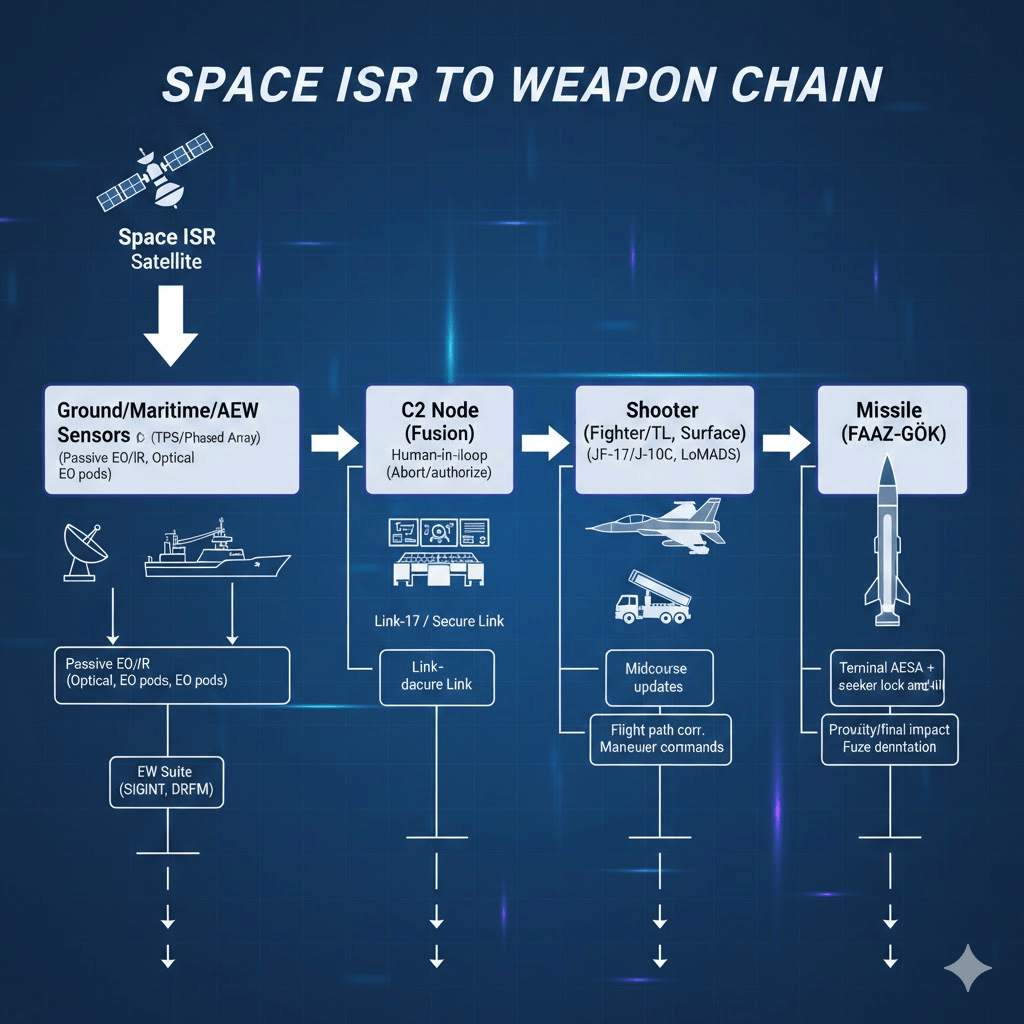
FAAZ fits the needs of a force that wants reach during long range cueing from Erieye, ZDK03, or ground-based sensors. Its kinematic envelope remains strong near the target. This matters most at high altitudes where closure rates exceed 1,200 meters per second.
1.2 Gökdoğan Design Characteristics
Gökdoğan is the precision seeker and ECCM specialist. It is designed to survive heavy electronic attack and extract clean track data in dense clutter.
Key features:
- Seeker: AESA transceiver with fast refresh cycles
- ECCM: High resistance to DRFM repeaters and barrage jamming
- Terminal logic: High resolution processing for small RCS targets
- Accuracy: Narrow beam shaping, low sidelobe energy
- Update logic: Stable midcourse correction for long track fidelity
This gives pilots confidence during long range shots where the target uses escort jammers or onboard EW. With Gökdoğan, the missile keeps guidance quality until the last few kilometres instead of losing accuracy due to false target generation.
2. Fusion Concept: FAAZ-GÖK Integrated Architecture
A merged program can take FAAZ kinematics and combine them with the electromagnetic and terminal strength of Gökdoğan. You get a missile designed around long reach, high energy at endgame, and strong seeker intelligence.
Key Fusion Elements
Propulsion architecture
Dual pulse motor from FAAZ extended with optimized burn scheduling to sustain energy above 30 km altitude.
Seeker system
AESA seeker from Gökdoğan integrated with improved cooling flow and expanded frequency hopping patterns.
Datalink
Secure midcourse link with 20 Hz message update and reduced latency to support long range cueing from Erieye ER.
Terminal flight control
FAAZ high g actuator package with larger control fin surface for high altitude agility.
ECCM
Gökdoğan advanced DRFM counter logic with angle-gate pull protection and reliable burn-through threshold.
Kill Chain Strength
A pilot gets:
- Long reach from 120 to 160 km effective shot envelope
- High probability of hit when the target uses jamming
- Good track continuity from long range radar cues
- High energy in terminal phase for manoeuvring targets at 40,000 to 55,000 feet
This is an advantage that India cannot currently match with R-77 variants or Astra Mk-2 test units.
3. Comparative Technical Table
Hypothetical fused missile compared with five closest rivals.
| System | Effective Range (km) | Seeker Type | Propulsion | ECCM Strength | Terminal Energy | Integration Status |
|---|---|---|---|---|---|---|
| FAAZ-GÖK Fusion Concept | 160 to 200 | AESA active | Dual pulse | High | High at 40k ft | JF-17 Block III, J-10C (projected) |
| Astra Mk-2 | 120 to 140 | Active RF | Dual pulse | Medium | Medium | Limited testing |
| R-77-1 | 90 to 110 | Active RF | Single pulse | Low | Low to medium | Su-30MKI |
| Meteor | 150 to 180 | Active RF | Ramjet | Very high | Very high | Blocked for India |
| PL-15 | 150 to 200 | AESA active | Dual pulse | High | High | J-10C |
| MICA RF | 70 to 80 | Active RF | Single pulse | Medium | Medium | Rafale |
The fused concept sits close to Meteor and PL-15 in terminal energy and seeker resilience. It holds an advantage over Astra Mk-2 in midcourse reliability and datalink frequency integrity. It outperforms R-77-1 in every parameter.
4. Analyst View
A combined FAAZ-Gökdoğan line reduces foreign restrictions and gives Pakistan a controlled BVRAAM with reach, accuracy, and resilience under electronic attack. Engineers solve two problems in one cycle. Pilots get a weapon that fits long range kill chains. Commanders gain a missile that can work inside Erieye supported networks. You also match the growth in Indian airborne sensing and reduce surprises during the first volleys of any engagement.
India still relies on mixed fleets with incomplete fusion between Su-30, Rafale, Phalcon, and Netra. Long range cueing with R-77 or MICA limits engagement windows. The fused concept fills this gap with a consistent long range envelope and better terminal behaviour under jamming.
Conclusion:
Technically, the synergy is explosive: FAAZ-2 brings long-reach kinematics (180+ km class, dual-pulse motor concepts, high terminal energy similar to R-27ER/MICA hybrids), while Gökdoğan contributes a combat-proven active AESA seeker, ECCM logic hardened for NATO jamming environments, and high-agility TVC controls.
The merged missile family will essentially combine Pakistan’s long-range propulsion philosophy with Turkey’s seeker-dominant fire-control architecture, creating a BVRAAM capable of outranging AMRAAM variants while resisting modern DRFM jammers and off-axis engagements.
For Pakistan, this is lethal because it closes the loop: FAAZ-2 becomes not just a missile fitted on JF-17 Block III and J-10C, but a modular ecosystem adaptable for air-launched, surface-launched, and naval LoMADS integration. And strategically, it means Pakistan finally joins the league of nations that produce their own air-dominance missiles end-to-end, building an indigenous, export-viable BVRAAM that India simply cannot counter with its fractured Astra–Meteor–R-77 mix or its outdated sensor fusion limitations.
Read More About Faaz: Faaz and the Strategic Pivot: A Post-May 2025 Technical and Strategic Assessment