
By Zohaib Ahmed| 8th February 2026
Baykar is now in advanced exploratory talks to establish a dedicated drone manufacturing and integration facility inside Pakistan, a move driven by the rapid progress Pakistan has made through GIDS in UCAVs, EW pods, AI-enabled mission systems, and swarm-capable munitions. For Baykar, Pakistan offers something no other partner does: a mature drone ecosystem with indigenous flight-control computers, data links, SATCOM modules, and loitering-munitions already in serial production, meaning Kızılelma-class and TB3-class platforms can be locally adapted with Pakistani sensors, weapons, and autonomy stacks rather than remaining off-the-shelf imports.
For Pakistan, the entry of Baykar would deepen co-development in jet-powered UCAVs, composite airframes, and stealth shaping, while giving the country access to Turkish AI-based swarm control architectures and naval UAV integration for future PN carriers. If finalized, this would mark Pakistan’s shift from a drone importer to a regional manufacturing hub, fusing Turkish flight platforms with Pakistani electronic brains, a combination that will outpace anything India or the GCC fields before 2030.
Baykar is coming to Pakistan: Read: https://zohaibauthor.com/2025/12/19/baykar-is-looking-for-drone-manufacturing-hub-in-pakistan/
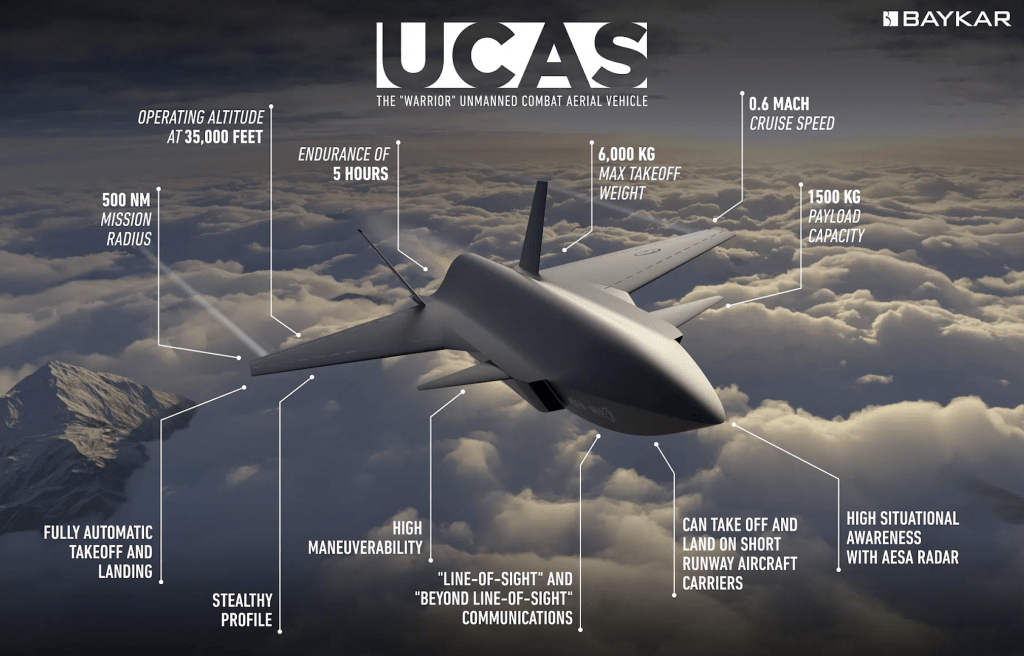
Bayraktar Kızılelma , literally “Red Apple” , is Turkey’s first jet‑powered, unmanned combat aircraft (UCAV/UCAS) designed for true air‑combat and multi‑role operations rather than simple reconnaissance or strike missions typical of earlier drones. It is developed by Baykar Technologies as a fully autonomous fighter‑class drone with stealth‑oriented features and advanced sensor and weapons integrations.
Core Technical Capabilities
Airframe & Aerodynamics
- Twin‑engine/afterburner options with Ukrainian AI‑322F turbofan (and future Turkish engines) enabling high‑performance flight and approach to supersonic envelope (Mach‑0.8‑0.9).
- Low‑observable design with internal weapons bays and angular planform for reduced radar cross‑section (RCS), a true stealth profile among UAVs.
- Carrier/short‑deck operations capability can autonomously take off and land on short runways or amphibious assault ships like TCG Anadolu.
Performance
| Attribute | Kızılelma Capability |
| Maximum Speed | Up to ~Mach 0.9 (≈900–1,100 km/h) |
| Cruise Speed | ~Mach 0.6 (~735 km/h) |
| Combat Radius | ≈500 nautical miles (~930 km) |
| Endurance | ~3–5+ hours |
| Payload | up to ~1,500 kg internal and external |
| Altitude | Operates up to ~35,000–45,000 ft |
Sensor & Combat System
- MURAD Active Electronically Scanned Array (AESA) radar, multi‑mode fire‑control radar capable of tracking and engaging multiple targets.
- Embedded Electro‑Optical Targeting System (EOTS) integrated into low‑observable fuselage, protecting both stealth and targeting accuracy.
- Autonomy & AI for autonomous take‑off/landing, mission execution, and potential Manned‑Unmanned Teaming (MUM‑T).
- Advanced weapons suite including indigenous air‑to‑air and air‑to‑surface missiles (e.g., Gökdoğan for BVR engagements) and precision guided munitions.
- Historic BVR capability, in late 2025, Kızılelma proved its first beyond‑visual‑range air‑to‑air kill in tests, the first time any unmanned combat platform achieved such capability.
Role & Integration
Unlike earlier UCAVs focused on ISR and ground strikes, Kızılelma is designed for full multi‑domain combat operations:
✅ Air superiority & intercept tasks
✅ SEAD (Suppression of Enemy Air Defenses)
✅ BVR engagements
✅ Naval strike and carrier operations
✅ MUM‑T “loyal wingman” missions alongside manned fighters.
Why Kızılelma Is Different: A New Category of Warrior Plane
1. True Fighter‑Class UAV
Where most UCAVs (like Bayraktar TB2, Anka, or Pakistan’s Shahpar/ Burraq) are propeller/turboprop attack or ISR platforms, Kızılelma is jet powered with stealth characteristics and full air‑combat capability.
2. Internal Sensors & Low Observability
Unlike earlier drones with bulky external pods, its internal AESA radar and embedded EOTS reduce drag and RCS while giving sensor fusion comparable to crewed fighters.
3. Autonomous Combat Readiness
Kızılelma’s autonomy is designed for mission planning, execution, and even autonomous engagements within predefined rules of engagement, pushing beyond remote piloted UCAVs.
4. Multirole Payload Flexibility
Its payload is not just bombs or rockets, it carries BVR air‑to‑air missiles, cruise missiles, precision guided munitions, and even air‑to‑surface ordnance inside stealth bays.
Comparing Kızılelma to Global and Regional Competitors
| Platform | Class | Key Strength | Limitation |
| Bayraktar Kızılelma | Advanced UCAV / UAV Fighter | Full air‑combat, BVR missile, AESA radar, stealth design | Still early in serial production/testing |
| Kratos XQ‑58 Valkyrie (USA) | Loyal Wingman | Autonomy, low cost | Lower payload/sensor capability than Kızılelma |
| Boeing MQ‑28 Ghost Bat | Wingman UAV | Networked teaming, flexible EW roles | Not proven BVR kill, smaller air‑combat profile |
| Sukhoi S‑70 Okhotnik (Russia) | Loyal Wingman / Strike | Large payload | Less mature, limited combat integration $ |
| Pakistan Shahpar‑III | MALE UCAV | Local UCAV design, ~500 kg payload | Not air‑combat focused, ISR/strike only |
| NESCOM Burraq | UCAV | Proven strike utility | Limited altitude/speed, no air‑to‑air role |
Pakistan’s Strategic Interest & Domestic Production Vision
Bayraktar Teknoloji Pakistan & NASTP Synergy
Pakistan and Baykar have reportedly moved beyond mere procurement, with Bayraktar Teknoloji Pakistan and a strategic link to the National Aerospace Science and Technology Park (NASTP) aimed at technology transfer and co‑development of Kızılelma variants.
The goal is not just assembly, but:
➡ Local production of low‑observable airframes tuned to Pakistani needs,
➡ Integration with indigenous sensors and software, including future AI‑driven MUM‑T systems,
➡ Co‑development of complementary systems like domestic AESA radar modules, avionics and future engines,
➡ Production of “B” and “C” supersonic / high‑energy variants rather than one‑off imports.
Why This Matters for the Pakistan Air Force (PAF)
Force Multiplication & Air Superiority
- Pakistan currently operates modern but mostly MALE drones (like GIDS Shahpar‑III) with reconnaissance/strike roles. These lack pure air‑to‑air capability and high‑altitude performance , gaps that Kızılelma would fill.
Complement to Manned Fighters
- When integrated into PAF’s JF‑17 / F‑16 fleets, Kızılelma adds a loyal wingman and autonomous layer that can suppress air defenses, screen ahead, or execute high‑risk missions without risking pilots.
Emerging Doctrine: MUM‑T & Distributed Air Combat
- The combination of human pilots with autonomous fighters like Kızılelma ushers in a distributed air combat paradigm that enhances survivability, situational awareness, and lethality.
Indigenous Capability & Export Potential
- Localizing production through Bayraktar Teknoloji Pakistan and NASTP accelerates Pakistan’s sovereign aerospace capability, building a defense ecosystem capable of exporting advanced UCAV platforms to aligned nations.
Conclusion: A Paradigm Shift in Aerial Combat
Bayraktar Kızılelma is not just a drone; it is the first real unmanned fighter jet blending stealth, air‑to‑air combat capability, and autonomy, a breakthrough that places Turkey at the forefront of next‑generation air warfare.
For Pakistan, embracing and localizing this technology signals a strategic elevation:
🔹 From tactical reconnaissance/strike drones to high‑end networked fighters
🔹 From dependence on foreign UAV imports to sovereign aerospace production
🔹 From standalone UCAVs to integrated MUM‑T force multipliers.
In essence, Kızılelma produced in Pakistan could serve as a cornerstone of future PAF air power, bridging the gap between conventional combat aircraft and autonomous systems , and positioning Pakistan as a regional leader in evolved air warfare.