
By Zohaib Ahmed | 9th February 2026
The fifth-generation fighter arena has been defined for decades by the United States’ F-35 Lightning II and Russia’s Su-57 Felon. However, China’s J-35 is emerging as a serious contender that challenges both legacy Western and Russian concepts of fifth-generation air superiority. These three aircraft represent distinct philosophies in aircraft design, stealth, sensor integration, and operational deployment. An in-depth technical comparison reveals not only differences in performance but also how design choices affect survivability, lethality, and operational practicality in modern combat.
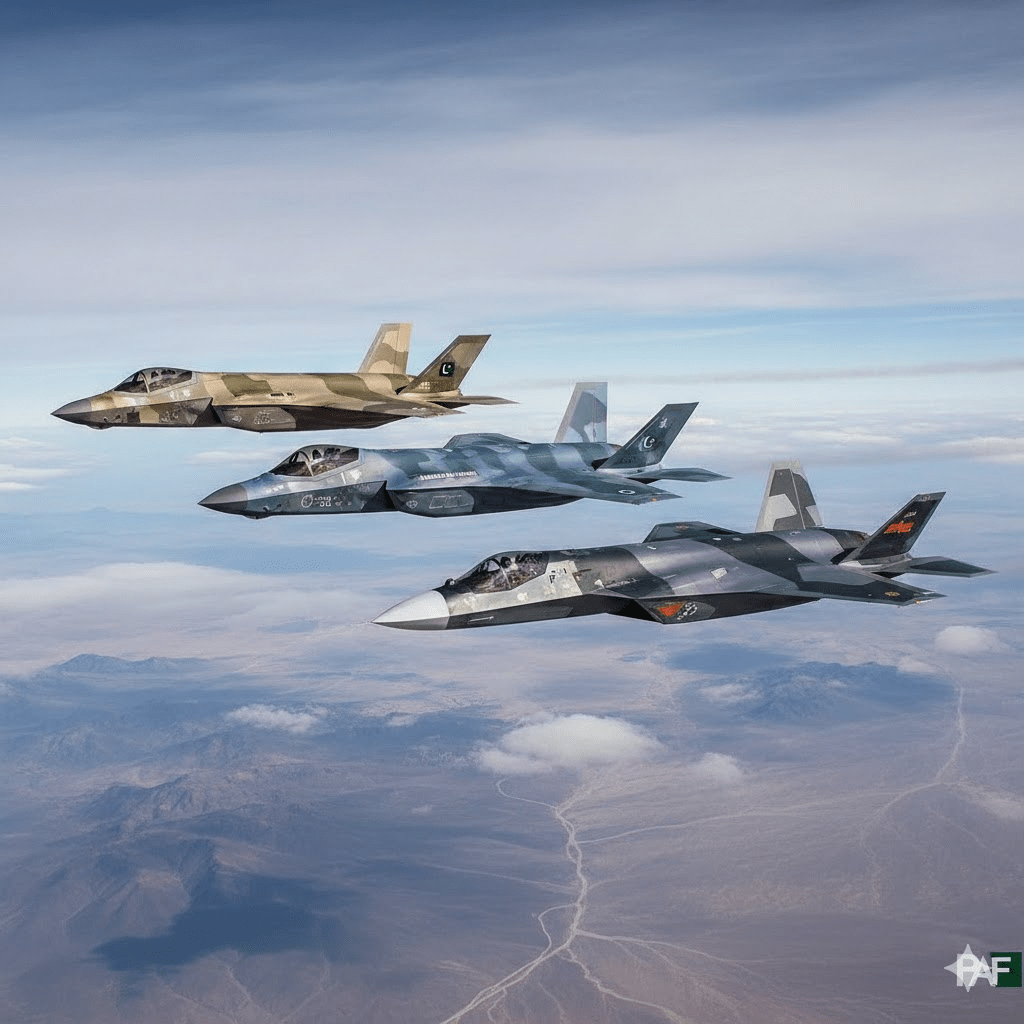
The F-35 Lightning II: A Multi-Role Project with Persistent Technical Hurdles
Designed as a multi-service platform, the F-35 was intended to serve the Air Force, Navy, and Marine Corps with one airframe. This design ambition has created fundamental compromises that impact speed, maneuverability, and mission readiness.
Aerodynamic and Flight Limitations
The F-35 is often criticized for its “brick-like” fuselage. The STOVL lift fan for the Marine variant required a wide fuselage, resulting in high transonic drag across all versions.
- Speed Constraints: Although advertised at Mach 1.6, the F-35 cannot sustain supersonic flight for extended periods. Operational limits are in place because sustained high-speed flight causes stealth coatings to blister and rear antenna arrays to overheat, prompting the Pentagon to restrict supersonic use to short bursts.
- Dogfighting Deficiency: Its thrust-to-weight ratio is lower than many 4th-generation fighters. Simulations show that even F-16s, designed in the 1970s, can outmaneuver the F-35 in high-G sustained turns.
- Energy Management: The wide fuselage and internal lift systems reduce energy retention during combat maneuvers, meaning the aircraft loses kinetic advantage faster than legacy platforms.
Software, Mission Readiness, and ODIN
The F-35’s operational model relies heavily on software integration, a domain where it has experienced persistent challenges. The transition from the failed ALIS system to ODIN (Operational Data Integrated Network) was meant to streamline logistics and maintenance but has created its own bottlenecks.
- ODIN Limitations: ODIN was designed as a cloud-native platform to coordinate spare parts, maintenance schedules, and mission data. Early 2026 reports indicate uneven adoption and inaccurate data reporting, leaving aircraft grounded for weeks waiting for components.
- Mission-Capable Rates: As of late 2025 and early 2026, fleet-wide mission capability hovers near 51 percent. This stagnation is directly linked to software inefficiencies, parts coordination failures, and the complex architecture of the aircraft itself.
- Software Delays: The TR-3/Block 4 upgrade, which is critical for running modern mission packages, is years behind schedule. Over 100 jets have been placed in storage because their hardware cannot support the software intended for operational deployment.
Crash Record
The F-35’s safety record has been another source of concern. As of February 2026, 13 major Class A mishaps have been recorded.
- Recent Incidents: Crashes in New Mexico (May 2024) and Alaska (January 2025) were tied to hydraulic failures in extreme temperatures. A US Navy F-35C crashed near NAS Lemoore in July 2025, continuing a worrying pattern of complex systems failures.
- System Complexity: These incidents are often linked to engine fires, landing gear failures, and software-induced control anomalies rather than pilot error. At nearly $100 million per aircraft, each loss is both a financial and public relations blow.
Internal Payload and the Sidekick Upgrade
Initially, the F-35 faced limitations in internal payload, with standard bays accommodating only four air-to-air missiles.
- Sidekick Rack: This upgrade allows six AIM-120 AMRAAMs in F-35A and F-35C variants. The F-35B remains constrained due to smaller bays required for its lift fan.
- Integration Issues: Sidekick is contingent on Block 4/TR-3 software updates, which are delayed. This has kept the internal payload enhancement from being widely operational.
The J-35: China’s Dedicated Medium-Weight Stealth Fighter
The J-35 embodies a design philosophy focused on air superiority and interception. It sacrifices the F-35’s multi-role ambitions in favor of speed, maneuverability, and stealth-optimized internal payload.
Airframe and Aerodynamics
- Continuous Curvature and DSI: The J-35 uses a smooth, continuous fuselage with edge alignment and diverterless supersonic inlets. This reduces radar reflections and hides engine blades from incoming detection.
- Twin-Engine Design: WS-19 engines provide redundancy, increased thrust, and allow for supercruise, the ability to sustain supersonic flight without afterburners. This contrasts sharply with the single-engine F-35, which lacks sustained supersonic capability.
Stealth Capabilities
China claims the J-35 has an RCS smaller than a human palm (<0.01 m²). Features include:
- Edge-aligned surfaces and canted vertical stabilizers
- Diverterless supersonic inlets (DSI)
- Advanced Radar Absorbent Materials (RAM)
- Internal weapons bays optimized for high-density missile carriage
These design choices emphasize first-day access operations, allowing the J-35 to penetrate defended airspace undetected and strike high-value assets.
Sensors and Networking
| Sensor System | F-35 Lightning II | J-35 Stealth Fighter |
|---|---|---|
| Radar | AN/APG-81 AESA: High resolution, advanced electronic warfare | Type 1475/KLJ-7A AESA: Long-range detection, stealth target optimized |
| Optics | EOTS & DAS: 360° IR coverage | EORD/EOTS: Frontal IRST, heat-signature detection |
| Sensor Fusion | Advanced, multi-source integration | Focused on fire control, less mature than F-35 software |
| Networking | MADL: Secure, LPI link between allies | High-speed datalink with KJ-500 AWACS and ground radars |
The J-35 focuses on “kinetic interception,” prioritizing missile engagement over the F-35’s networked intelligence emphasis. While less mature in sensor fusion, it is optimized for coordinated air-to-air standoff operations.
Weapons and Payload
- Internal Bay Capacity: Designed from the outset to carry six PL-15E missiles internally, maximizing stealth while providing significant firepower.
- PL-17/PL-21: Extremely long-range missiles must be carried externally, sacrificing stealth. This reflects a trade-off between range and low-observable characteristics.
- Strategic Advantage: Even with six PL-15Es internally, the J-35 can strike from beyond the reach of most Western short-to-medium-range interceptors, giving it a first-strike edge.
Operational Limitations
Despite its technical promise, the J-35 faces challenges:
- Engine Reliability: WS-19 engines are in early operational life, with TBO significantly lower than Western equivalents, requiring more frequent maintenance.
- Combat Proven Status: Unlike the F-35, the J-35 has no real-world combat record, and stealth claims remain untested in complex EW environments.
- Carrier Integration: Tailhook and airframe reinforcements are still being perfected for deployment on China’s Fujian carrier.
- Software Maturity: Mission Data Files (MDFs) and threat libraries remain less comprehensive than the F-35’s, limiting situational awareness and sensor fusion effectiveness.
The Su-57 Felon: Russia’s Boutique Fighter
The Su-57 embodies a Russian approach emphasizing agility and maneuverability but has struggled in production, deployment, and combat relevance.
Combat and Deployment
- Ukraine Conflict: Su-57s have remained deep inside Russian airspace, relying on standoff missiles to avoid exposure. This limited engagement raises doubts about their operational readiness.
- Ground Vulnerability: Ukrainian drone strikes in 2024 destroyed parked Su-57s, illustrating the fragility of a low-volume fleet.
- Air Superiority Impact: Despite its maneuverability, the Su-57 has failed to alter air dominance in the operational theater.
Production Challenges
- Hand-Built Approach: Small-batch production at Komsomolsk-on-Amur restricts output to 6–10 jets per year.
- Stealth Quality: Photos of prototypes reveal exposed screws and uneven panels, reducing stealth effectiveness.
- Sanctions Impact: Russia cannot reliably produce high-end microelectronics or engines, leading to cannibalization from other programs. Most jets still fly with AL-41F1 engines, while the Izdeliye 30 5th-generation engine remains in development.
Stealth and Philosophy
| Feature | F-35 (USA) | J-35 (China) | Su-57 (Russia) |
|---|---|---|---|
| Stealth Focus | High | High | Low |
| Production | Mass-produced | Scaling rapidly | Boutique |
| Combat Philosophy | Networked multi-role | Interceptor / Air superiority | Super-maneuverable flanker |
| Radar Cross Section | ~0.001 m² | <0.01 m² | 0.1–1 m² |
| Operational Reality | Active / tested | Entering service | Limited deployment |
The Su-57 prioritizes agility over survivability. In modern long-range missile warfare, being highly maneuverable is less valuable if radar visibility is high.
Internal Payload and Missile Strategy: F-35 vs J-35
The internal bay “war” favors the J-35 in first-day stealth missions.
- F-35: With Sidekick, F-35A/C can carry six AIM-120s internally, but integration delays and the B variant’s small bay constrain capacity.
- J-35: Six PL-15Es fit natively inside bays. Long-range PL-17 and PL-21 missiles must be carried externally, sacrificing stealth.
| Missile | Range | Notes |
|---|---|---|
| AIM-120D | 160–180 km | Internal only |
| AIM-260 JATM | >300 km | Planned internal carriage |
| PL-15E | 200–300 km | Internal, folding fins |
| PL-17 | 400+ km | External only, stealth compromised |
| PL-21 | 400+ km | External only, high-speed ramjet |
This highlights a critical trade-off: J-35’s first-day stealth with six PL-15Es offers superior engagement range over the F-35, but its ability to field extreme long-range missiles comes at the cost of radar visibility.
Conclusion: Divergent Philosophies and Operational Realities
The comparison between the F-35, J-35, and Su-57 illustrates three distinct philosophies in fifth-generation fighter design:
- F-35: A technologically ambitious multi-role platform hampered by software delays, complex logistics, limited internal payload, and structural compromises. Its fleet remains partially grounded and maintenance-intensive.
- J-35: A focused interceptor and air superiority fighter that emphasizes speed, stealth, and internal missile capacity. Its operational maturity and engine reliability remain developing issues.
- Su-57: Russia’s boutique fighter prioritizing maneuverability over stealth, hindered by low production, sanctions, and a lack of combat deployment.
The J-35’s combination of twin-engine reliability, internal payload density, and stealth-optimized design positions it as a genuine threat in the next decade. The F-35 continues to struggle with ODIN, Block 4 upgrades, and fleet readiness. The Su-57 remains largely untested in combat, with stealth claims compromised by production realities.
In modern aerial warfare, the ability to strike first, remain undetected, and sustain operations across multiple theaters defines fifth-generation relevance. In this context, the J-35 represents the first serious challenger to Western air dominance since the inception of the F-22 and F-35 programs.