
By Zohaib Ahmed | 12th February 2026
In the rapidly shifting sands of 21st-century asymmetric warfare, the “suicide drone” has evolved from a DIY battlefield modification into a sophisticated, AI-driven strategic asset. At the World Defense Show (WDS) 2026, the spotlight has firmly landed on Pakistan’s Global Industrial & Defence Solutions (GIDS) and their latest masterwork: the Yalghar.
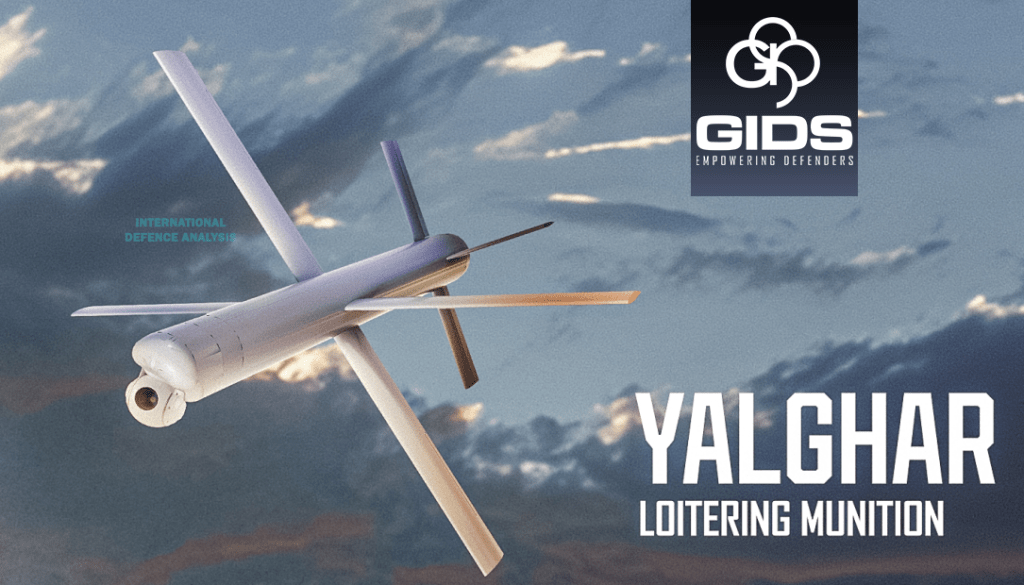
Marketed as the “Switchblade of the East,” the Yalghar is not merely a regional alternative to Western tech; it is a declaration of strategic independence. For the Middle East, and specifically Saudi Arabia, it represents a fusion of high-end autonomous lethality and the “sovereign” freedom to operate without the oversight of foreign powers.
Technical Anatomy: What Makes Yalghar Tick?
The Yalghar is a tube-launched, high-precision loitering munition designed for the modern, high-threat battlefield. It represents a significant leap in miniaturization and cognitive electronic warfare.
- Autonomous Search & Strike: Unlike older drones that require a continuous “man-in-the-loop,” the Yalghar features an onboard Automatic Target Recognition (ATR) system. It can be programmed with specific “target profiles” (such as a T-72 tank or a specific radar signature) and will hunt independently.
- The “Stealth” Sprint: While it loiters at an efficient cruise speed to conserve energy, its terminal phase is a high-speed “dash.” Once a target is confirmed, it enters a dive exceeding 180 km/h, leaving the target with virtually zero reaction time.
- Payload: It carries a 7–10 kg multi-purpose warhead. This is specifically engineered with a tandem-charge configuration, allowing it to penetrate the reactive armor of Main Battle Tanks (MBTs) by attacking the thinner top-armor.
- Navigation: It employs a dual-mode navigation system. While it uses Multi-GNSS (GPS, BeiDou, Galileo), it is primarily designed for GPS-denied environments. It uses “Visual Odometry” and “Terrain Matching” to find its way if the satellites are jammed.
The Global Comparison: Yalghar vs. Switchblade 600
The inevitable comparison at WDS 2026 is with the American Switchblade 600 (manufactured by AeroVironment). While they share a similar mission profile, the Yalghar is designed with different battlefield priorities.
Comparison Table: Yalghar vs. Switchblade 600
| Feature | Yalghar (GIDS) | Switchblade 600 |
| Origin | Pakistan | USA |
| Loiter Time | 60+ Minutes | 40+ Minutes |
| Operational Range | 60–90 km | 40 km (Standard) |
| Warhead Weight | ~10 kg (Anti-Armor) | ~15 kg (Javelin-class) |
| Navigation | AI Visual / Multi-GNSS | GPS / Data-Link |
| Launch Mode | Tube / Canister | Tube / Canister |
| Export Policy | Sovereign / Open | Highly Restricted (ITAR) |
Why Yalghar is the Better Choice for the Middle East
While the Switchblade 600 has a slightly larger warhead, the Yalghar wins on Endurance and Autonomy.
- The “Wait Time”: An extra 20 minutes of loitering time is an eternity on the battlefield. It allows the Yalghar to wait for a target to emerge from a tunnel or for a sandstorm to clear.
- Sovereign AI: The Yalghar’s AI “brain” is not tied to U.S. proprietary data links. This means KSA can integrate their own intelligence data into the drone without needing Washington’s permission.
The GIDS Hierarchy: Yalghar vs. Al Murtajiz vs. MP300
To understand Yalghar, one must see where it fits in the GIDS family. It is the “heavyweight” evolution of a proven lineage.
GIDS Loitering Munition Comparison
| System | Role | Launch Mode | Payload |
| Al Murtajiz | Squad Support | Man-Portable Tube | < 2 kg (Anti-Personnel) |
| MP300 | Tactical Strike | Catapult | ~30 kg (Static Targets) |
| Yalghar | Strategic Hunter | Canister / Multi-Tube | ~10 kg (Anti-Armor) |
| Yiha-3 (Turkish-Pak) | Swarm Attack | Rail / Air | Variable (Networked) |
| Baykar Kemankes | Mini Cruise Missile | Air-Launched | 6 kg (High Speed) |
Analysis: Compared to the Baykar Kemankes (which is essentially a tiny, fast cruise missile), the Yalghar is a truer “loiterer.” It is built to hang in the air, whereas the Kemankes is built to strike quickly. Against the Yiha-3, the Yalghar offers a more robust, “tank-killing” capability for individual operators.
The Ghost in the Machine: Why it’s Hard to Detect and Jam
The Yalghar is a nightmare for modern Electronic Warfare (EW) suites for two primary reasons:
- Passive “Silence”: Most drones are detected because they “talk” to their pilot via radio waves. The Yalghar can be set to Radio Silence Mode. Once launched, it doesn’t emit signals; it simply “looks” at the world through its AI eyes, making it invisible to signal-detection equipment.
- Low-RCS Design: Its airframe is constructed from carbon-fiber and specialized composites that absorb rather than reflect radar waves. At its small size, it often appears on radar as nothing more than a large bird.
- Anti-Jamming AI: Even if an enemy jams the GPS in a 50km radius, the Yalghar doesn’t fall out of the sky. Its Dead Reckoning and AI Scene Matching allow it to compare what it sees on the ground to a pre-loaded map, navigating with surgical precision without a single satellite bar.
FAQs: Clearing the Air
Q: Is it “fully” autonomous?
A: It has the capability, but it typically operates with a “Human-in-the-Loop” for ethical and safety reasons. However, if the signal is lost, the pilot can pre-set the AI to complete the mission independently.
Q: Can it be launched from a ship?
A: Yes. Its canister-launch system is “platform agnostic,” meaning it can be mounted on the deck of a Saudi Corvette or a Pakistani Frigate to strike coastal targets or small boats.
Q: How does it compare to the Shahed?
A: The Shahed is a “long-range kamikaze” meant for static buildings. The Yalghar is a “precision hunter” meant for moving tanks and mobile radars.
The Final Word
The Yalghar is the perfect weapon for the Saudi Vision 2030 era because it bridges the gap between hardware and software. As an analyst, my take is that Pakistan has successfully “democratized” high-end loitering technology.
By offering a system that matches the Switchblade’s performance but exceeds it in endurance and sovereign control, GIDS has positioned the Yalghar as the primary “Tank-Killer” of the Islamic world. In the Red Sea or on the Yemeni border, the Yalghar provides a low-cost, high-reward way to hold a technologically advanced enemy at bay. It is, quite simply, the smartest bird in the sky.