
By Zohaib Ahmed
April 13, 2026
The Big Picture
The Middle East conflict in 2026 has entered a phase where narrative strength and strategic outcome are no longer aligned. Iran’s doctrine of “Victory through Resistance” continues to function as a powerful internal and regional message, yet the operational record of the war reveals a widening gap between ideological framing and measurable strategic gain.
Iran must move beyond the perception of being in a “we are winning” narrative in order to meaningfully engage in fair and structured negotiations. What Pakistan has consistently tried to convey is that the majority of Iran’s actions, over 80%, have been directed toward Muslim-majority countries rather than its primary adversaries. As a result, the strategic and material damage has largely not been inflicted upon the intended opposing side. While US bases in these regions have been impacted, the losses do not constitute a significant strategic setback for the United States. Similarly, although Iranian missiles have reached Israeli territory, the scale of damage in Israel appears limited when compared to the extensive impact across Muslim countries, to the extent that at times it raises questions about whether Israel was a primary intended target in practice.
Moving forward, Iran cannot claim a meaningful victory without demonstrable and consequential damage to its adversaries that contributes to deterrence. In strategic terms, parties are more likely to engage seriously when tangible costs are imposed. From this perspective, a negotiated agreement may currently represent the most viable option for Iran, particularly because the optics of such a settlement could still be framed domestically as a form of victory. The absence of broad retaliation from Muslim countries despite significant damage has also created a narrative space that could be leveraged diplomatically.
Saudi Arabia, as a key Islamic state and custodian of sacred sites, has already been directly affected, yet broader escalation thresholds have not been crossed by regional actors. However, this restraint cannot be assumed to continue indefinitely. If a settlement is not reached, the likelihood of reduced restraint among Islamic countries may increase, further escalating instability. Ultimately, continued escalation risks leaving Iran with diminishing strategic returns and little to present as a political or symbolic victory. In such a trajectory, the broader Middle East bears the cost of instability, while Israel will emerge as the primary strategic beneficiary of prolonged fragmentation.
The Calculus of Misdirected Force
A defining feature of the current conflict is not simply the scale of Iranian action, but its geographic distribution.
Across 2026, regional assessments indicate that a substantial majority of kinetic activity attributed to Iran and its network of aligned actors has impacted Muslim-majority countries. These include Iraq, Syria, Lebanon, Yemen, and several Gulf environments affected indirectly through maritime and security spillover.
The consequence is structural rather than incidental. Instead of consolidating pressure on core adversaries, operational energy is absorbed within the regional system itself. Infrastructure damage, political fragmentation, and economic strain accumulate primarily in neighboring Islamic states.
This creates a strategic contradiction. A doctrine framed around resistance against external powers increasingly produces internal regional exhaustion. The result is not strategic consolidation but regional cannibalization.
83% Against the Ummah
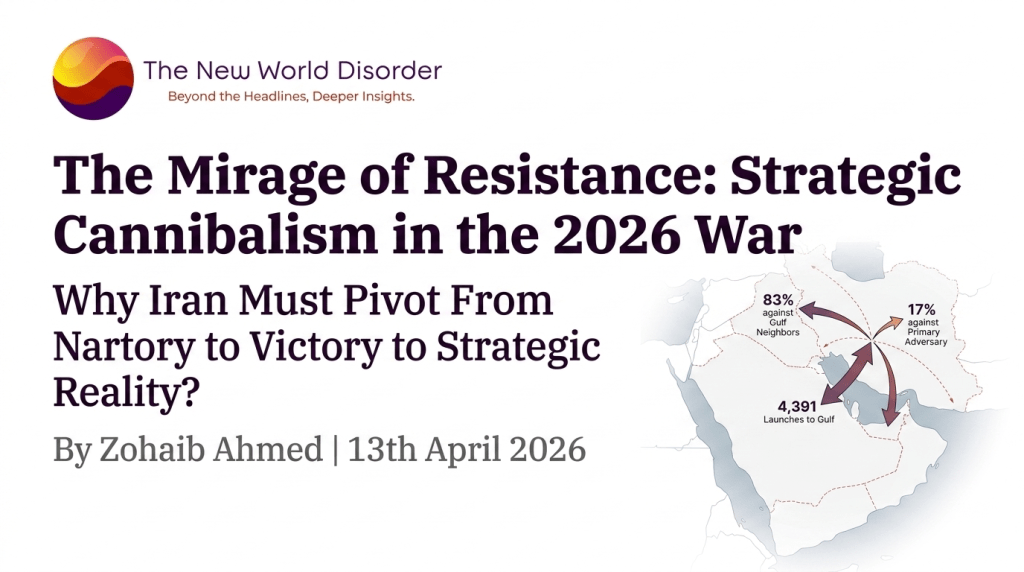
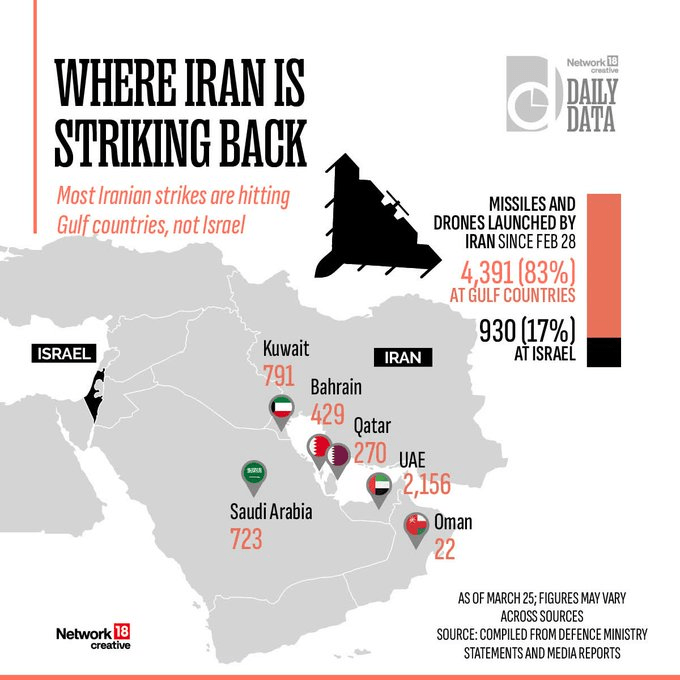
A defining contradiction of the current conflict lies in the geographic distribution of Iranian kinetic activity. Regional tracking by security analysts and institutions such as the International Institute for Strategic Studies (IISS) indicates that approximately 83 percent of Iranian-linked missile and drone activity has impacted Gulf and broader Muslim-majority states, totaling roughly 4,391 out of 5,321 recorded launches.
The implication is not statistical alone. It is strategic.
Rather than concentrating pressure on declared adversaries, operational energy is absorbed within the regional system itself. The result is sustained disruption across Iraq, Syria, Yemen, Lebanon, and Gulf states, where infrastructure and economic systems carry the primary burden of damage.
Regional Infrastructure Shock
- Energy System Strain: Repeated strikes on LNG and refining infrastructure, including Ras Laffan in Qatar, have reduced export capacity by approximately 17 percent. Broader supply disruption across the Gulf region has contributed to a multi-million barrel per day contraction in regional output.
- Economic Targeting: Commercial and financial nodes, including parts of Dubai’s financial infrastructure and industrial zones in the UAE, have experienced repeated disruption.
- Maritime Pressure: Sustained instability in the Strait of Hormuz has introduced severe volatility in global shipping routes, increasing insurance costs and reducing predictable throughput across one of the world’s most critical energy corridors.
The strategic contradiction is clear. A resistance framework intended to counter external dominance increasingly manifests as internal regional destabilization.
The CENTCOM Factor: From Friction to Fragility
The paradigm of limited harassment that once defined Iranian engagement with United States military infrastructure has been decisively overtaken by the scale of 2026 operations.
In the aftermath of Operation Epic Fury in February 2026, Iranian actions against United States Central Command transitioned from intermittent disruption to sustained offensive pressure. The operational environment has shifted from localized risk management to continuous structural strain.
Bases across Iraq, Syria, and the Gulf region have faced repeated ballistic and cruise missile strikes. Multiple installations have been degraded or rendered temporarily inoperative. Critical radar systems and missile defense assets, including AN/TPY-2 and THAAD batteries, have sustained documented damage. Reports indicate at least 17 affected U.S. facilities across the theater.
The significance of this shift lies in its scale. The issue is no longer force protection cost or operational inconvenience. It is sustained degradation of theater-wide infrastructure.
Deterrence theory is now under direct stress testing. Iran has demonstrated an ability to impose operational cost at a level that forces recalibration within CENTCOM planning structures. This is reflected in the largest regional force buildup since 2003 and the allocation of emergency funding to sustain operational continuity.
American force projection remains active, but it is no longer operating in a stable environment. It is functioning under persistent attritional pressure that requires constant adaptation.
The system has not collapsed. It has entered transition.
Deterrence Under Mutual Pressure
The traditional framing of deterrence as unilateral restraint is no longer sufficient to describe the current environment.
Iranian actions have not eliminated American presence in the region. However, they have increased the cost, complexity, and vulnerability of maintaining that presence. At the same time, U.S. and allied operations have significantly degraded Iranian command structures and missile production capacity.
The result is a reciprocal pressure environment in which both sides impose costs without achieving decisive strategic closure.
A two-week operational pause in April 2026, initiated to facilitate negotiations, reflected not symbolic diplomacy but recognition of operational saturation on both sides of the conflict spectrum.
Deterrence is not absent. It is contested and distributed.
The False Narrative of Hosting and Strategic Substitution
A recurring justification for Iranian strikes on Gulf states rests on the argument that these countries function as logistical extensions of U.S. military presence.
This framing is strategically incomplete.
Sovereign states do not lose political agency through alliance structures. The presence of foreign military assets does not convert national infrastructure into legitimate proxy targets. More importantly, attacking these states does not translate into proportional pressure on the United States.
The strategic effect is misaligned. Regional systems absorb the physical and economic cost, while adversary decision-making structures remain largely insulated from direct consequence.
The deeper flaw in this narrative lies in substitution logic. It assumes that proximity can replace direct strategic engagement. In practice, it produces fragmentation rather than leverage.
The outcome is predictable. Regional instability increases while core adversary posture remains largely unchanged.
The False Narrative of Proxy Geography
A recurring justification for Iranian strikes against Gulf states rests on the argument that these countries host foreign military assets and therefore function as extensions of external adversary power.
This interpretation collapses under strategic scrutiny.
Sovereign states cannot be reduced to logistical extensions of foreign militaries. The presence of external forces does not negate political autonomy or justify equivalence in targeting logic.
More importantly, the strategic impact of such strikes does not translate into meaningful pressure on the United States. Instead, it produces localized economic and infrastructural damage within the Islamic world while leaving core adversary decision structures largely unaffected.
The assumption that proximity equates to leverage misreads the architecture of modern power projection. It replaces strategic targeting with geographic convenience.
The outcome is predictable. Regional instability increases. Adversary strategy remains largely intact.
Israel and the Asymmetry of Impact
The imbalance raises a deeper structural question about whether current conflict dynamics produce calibrated pressure on adversaries or primarily function as narrative reinforcement mechanisms within Iran’s domestic political ecosystem.
A striking feature of the 2026 conflict is the imbalance between symbolic reach and strategic effect.
Iranian capability to reach Israeli territory is not in question. The constraint lies in the scale and concentration of impact. Compared to the intensity of disruption across Gulf and Levantine theaters, the systemic effect on Israel remains comparatively contained.
This creates a structural asymmetry between visibility and consequence.
Operational reach generates political signaling. However, signaling without sustained systemic disruption does not translate into strategic repositioning. The result is a conflict environment where different theaters absorb vastly different levels of pressure without a unified strategic outcome.
This divergence raises a fundamental question about whether current operational patterns are aligned with stated strategic objectives.
The Strait of Hormuz: Strategic Leverage or Strategic Liability
The closure of the Strait of Hormuz represents one of Iran’s most consequential escalation tools, given its central role in global energy transit.
However, its strategic utility is constrained by structural second-order effects that limit its long-term advantage.
First, it internationalizes the conflict beyond regional parameters. Energy disruption immediately draws global maritime powers into active operational response, expanding the coalition structure against escalation.
Second, it triggers sustained naval enforcement operations in adjacent waters. This results in prolonged external military presence in sensitive maritime zones, increasing pressure rather than reducing it.
Third, it intensifies Iran’s own economic constraints by limiting export routes, insurance viability, and financial access linked to maritime trade.
The strategic outcome is expansion of confrontation rather than consolidation of leverage.
It creates global exposure without delivering proportional strategic advantage.
Saudi Arabia and the Architecture of Restraint
Saudi Arabia occupies a central stabilizing role in the regional system. Its response to sustained escalation has been defined by strategic restraint rather than proportional retaliation.
This restraint reflects deliberate policy calculation rather than incapacity. It is shaped by an interest in preventing systemic regional breakdown while preserving long-term strategic stability.
However, restraint is not structurally infinite. It is conditional on the perceived trajectory of threat accumulation and regional risk exposure.
If escalation continues without diplomatic containment, internal and regional pressures will progressively alter the calculus of restraint. The implication is not immediate escalation but the gradual erosion of current equilibrium conditions.
The Role of Pakistan
Pakistan’s role in the evolving regional crisis has been defined less by public positioning and more by sustained, behind the scenes diplomatic engagement aimed at preventing systemic escalation. The Islamabad talks have emerged as a discreet but significant channel where multiple stakeholders, directly and indirectly linked to the conflict, have explored off-ramp scenarios focused on de-escalation, maritime stability, and containment of spillover effects into Muslim-majority states. Pakistan’s approach reflects a calibrated strategic posture rooted in proximity, vulnerability, and historical regional connectivity. As a nuclear-armed state with deep economic and security exposure to Gulf stability, Islamabad has consistently pushed for structured dialogue rather than open-ended confrontation. Behind closed doors, its diplomatic machinery has worked to maintain communication continuity between competing regional blocs, while publicly advocating restraint and negotiated settlement. The underlying objective has been to prevent the conflict from crossing thresholds that would destabilize South and West Asia simultaneously, turning a Middle Eastern war into a broader continental security shock.
The Gulf Misinterpretation and Strategic Fallacy
The argument that Gulf states function merely as staging grounds for external adversaries misrepresents the structure of regional sovereignty.
Targeting infrastructure in these states does not produce equivalent strategic pressure on external powers. Instead, it shifts the burden of conflict onto regional economies and civilian systems.
This creates a strategic misalignment between intended coercion and actual impact.
The result is not leverage over adversaries but fragmentation within the regional system that ultimately reduces collective strategic capacity.
The Strategic Beneficiary of Fragmentation
A fragmented regional environment produces uneven strategic outcomes.
As Iranian operations intensify across multiple theaters, regional cohesion weakens. Economic systems experience sustained strain. Political coordination becomes more difficult. Security alignment becomes increasingly externally dependent.
In such conditions, actors with higher internal cohesion and lower exposure to fragmentation pressures gain relative advantage.
Israel benefits from this structural asymmetry not through direct expansion alone, but through the absence of a unified regional counterweight capable of sustained strategic coordination.
Iran’s current trajectory, while tactically active, contributes to this fragmentation cycle.
The Necessity of a Negotiated Exit Ramp
Iran has demonstrated operational capability across multiple domains. It has not demonstrated the ability to convert that capability into decisive strategic outcomes against primary adversaries.
Deterrence is not measured by activity levels. It is measured by the ability to impose stable constraints on adversary decision-making while maintaining internal and regional sustainability.
At present, the cost distribution of the conflict is uneven. Regional states absorb significant structural damage. Global systems experience volatility. Adversary core structures remain operationally intact under adaptation pressure.
A negotiated framework represents the only viable mechanism to stabilize this imbalance without further escalation.
Such a framework does not require narrative surrender. It requires strategic recalibration.
The Bottom Line
The 2026 conflict environment is defined by escalation without resolution and pressure without closure.
Iran has moved from symbolic resistance to sustained operational engagement. The United States has moved from uncontested projection to adaptive regional posture under attritional strain. Regional actors continue to absorb disproportionate systemic disruption.
Yet none of these shifts have produced decisive strategic convergence.
CENTCOM is under unprecedented operational pressure but remains structurally intact in transition. Gulf states maintain restraint under increasing strain. Israel faces expanded reach without proportional systemic degradation. The Strait of Hormuz has elevated global stakes while simultaneously expanding the scope of confrontation.
The core issue is no longer whether Iran can act. It is whether action produces advantage.
Without strategic conversion, the gap between narrative victory and strategic reality will continue to define the conflict’s trajectory.