
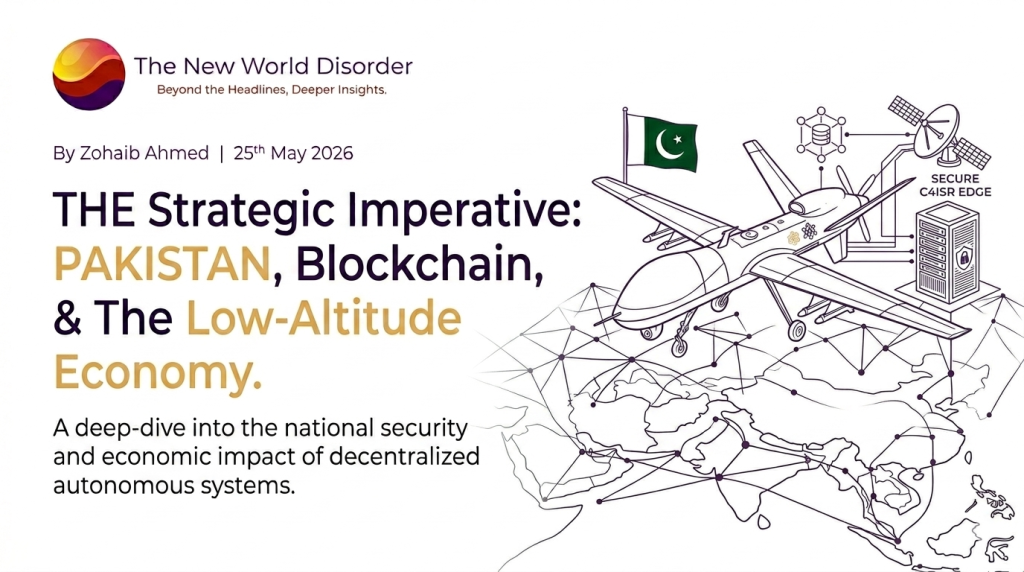
By Zohaib Ahmed | 25th May 2026
The Geopolitical and Strategic Imperative
Pakistan’s designation as the “Country of Honour” at the 10th World Drone Congress in Shenzhen reflects more than symbolic diplomatic recognition. It signals a deliberate strategic repositioning within the rapidly evolving technological landscape of autonomous systems and the emerging low-altitude economy. Traditionally, Pakistan’s aerospace capabilities have been viewed primarily through the prism of conventional defense and military modernization. However, this development indicates a broader institutional shift toward integrating unmanned aerial systems into civil logistics, precision agriculture, infrastructure monitoring, and sovereign digital ecosystems.
At the core of this transition lies the concept of interoperability. Modern drone ecosystems are fundamentally data-intensive and increasingly vulnerable to electronic warfare, spoofing, cyber intrusion, and centralized command failures. By exploring the integration of UAV infrastructure with decentralized Web3 architecture, Pakistan is attempting to address one of the defining vulnerabilities of next-generation automation: secure, resilient, and tamper-resistant command and control networks.
This approach represents an effort to bypass traditional infrastructural limitations by building digital systems optimized for autonomous coordination rather than legacy centralized oversight. In strategic terms, Pakistan is not merely pursuing drone deployment; it is attempting to establish the foundational architecture for sovereign autonomous operations in contested digital environments.
The Convergence of UAVs and Blockchain Infrastructure
Pakistan’s emerging initiatives in this sector indicate an emphasis on constructing the institutional and technological framework required to scale autonomous aerial operations. The participation of leadership from the Pakistan Virtual Assets Regulatory Authority (PVARA) demonstrates that Islamabad’s interest in blockchain technology extends beyond speculative finance into broader domains of institutional governance, machine-to-machine communication, and secure data management.
1. Decentralized Identity for Autonomous Systems
As low-altitude airspace becomes increasingly congested, authentication and airspace accountability will become critical national security and commercial concerns. Pakistan is exploring the use of blockchain-based decentralized identity systems to assign immutable cryptographic identities to UAV platforms.
Such a framework would ensure that flight records, telemetry data, payload information, and operational histories remain verifiable and resistant to manipulation. In practice, this could create a transparent and secure registry for civil, commercial, and strategic drone operations while significantly reducing the risks associated with unauthorized system interference.
2. Machine-to-Machine Transactions and Autonomous Logistics
In a mature autonomous ecosystem, drones will need to interact independently with charging infrastructure, logistics depots, supply hubs, and maintenance facilities. Pakistan’s broader vision appears to involve the integration of smart contracts and tokenized digital systems to facilitate these interactions without constant human oversight.
Under such a framework, a UAV could autonomously verify delivery completion, trigger payment execution through a smart contract, secure authorization for its next operational cycle, and coordinate maintenance or charging procedures in real time. The strategic value of this model lies in reducing operational latency while enabling scalable automated logistics networks.
3. Secure Telemetry and Data Integrity
The integration of blockchain architecture with drone telemetry systems also carries significant implications for data security and strategic intelligence collection. Data captured through UAV operations, whether related to agriculture, border surveillance, disaster response, or infrastructure mapping, can be cryptographically hashed onto distributed ledgers at the point of capture.
This creates a verifiable chain of custody for operational intelligence and minimizes the possibility of data tampering at vulnerable edge nodes. In strategic environments where information integrity is increasingly contested, such systems could provide substantial advantages in maintaining trusted situational awareness.
Macro-Economic and Geopolitical Implications
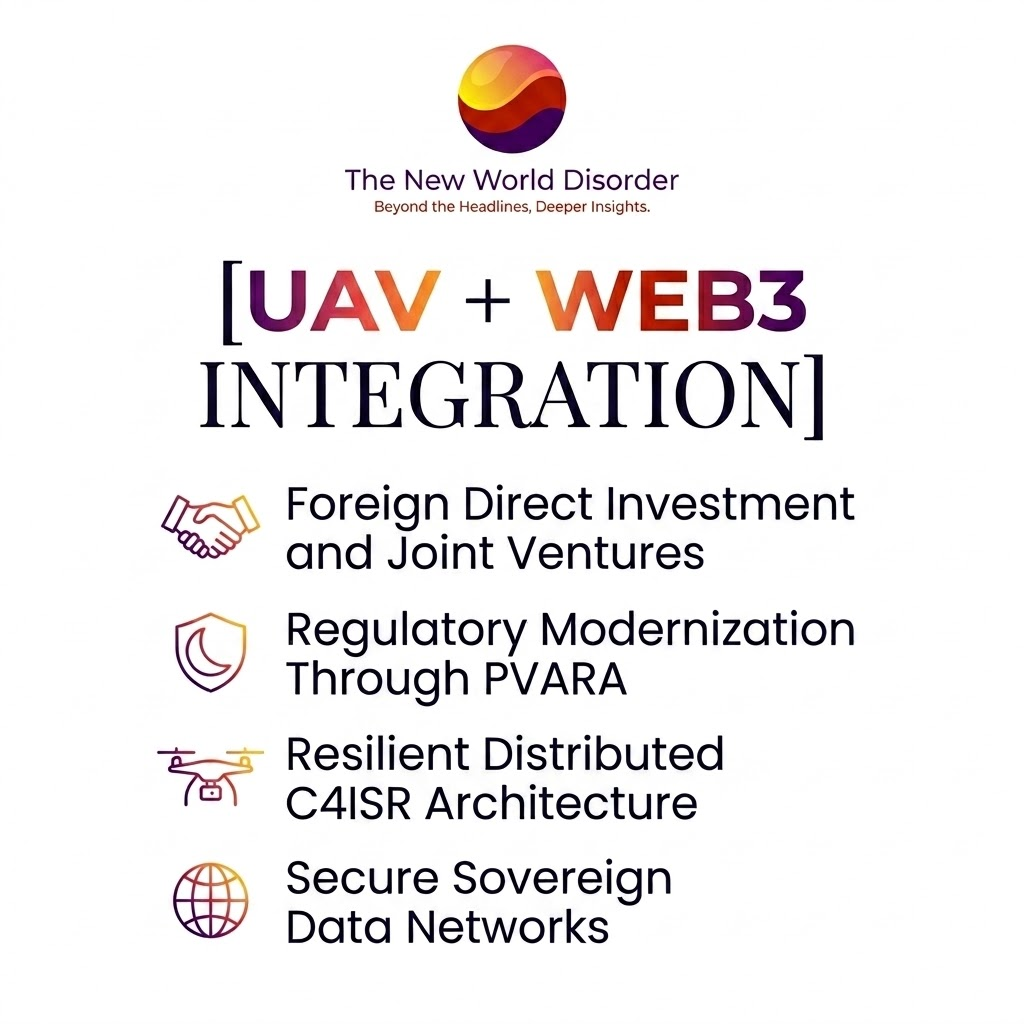
High-Tech Capital Inflow
By aligning its regulatory trajectory with China’s dominant UAV manufacturing ecosystem, Pakistan positions itself as a potential hub for joint ventures involving autonomous systems, secure software development, and decentralized operational protocols. This creates an opportunity to move beyond the role of a hardware importer and toward participation in higher-value segments of the autonomous technology chain.
Such positioning may attract foreign direct investment focused on advanced software infrastructure, AI-enabled logistics, and distributed data systems rather than traditional industrial manufacturing alone.
Regulatory Sandbox Advantage
The use of PVARA as a governing institution for the intersection of virtual assets and autonomous systems provides Pakistan with a potentially agile regulatory framework. By establishing legal clarity around tokenized logistics, machine-to-machine transactions, and decentralized validation systems, the country could emerge as a live testing environment for Web3-enabled automation technologies.
In contrast to heavily layered Western regulatory structures, this model offers international firms a more flexible environment for experimentation and deployment.
Strategic Resilience and Asymmetric Security
From a defense and surveillance perspective, decentralized drone architectures offer important asymmetric advantages. Conventional centralized command systems remain vulnerable to targeted disruption, cyber attacks, and electronic warfare operations.
A distributed UAV ecosystem supported by blockchain-backed verification mechanisms can maintain partial operational continuity even if specific nodes are compromised or jammed. In contested environments, this resilience enhances survivability, preserves network awareness, and reduces dependence on single points of failure.
Special Report: Architecting the Low-Altitude Economy
Beyond the Horizon: Pakistan’s Autonomous Transition
The global transition toward autonomous systems is increasingly being defined not by advances in hardware alone, but by the data architectures governing those systems. At the 10th World Drone Congress, Pakistan’s designation as the “Country of Honour” represented more than ceremonial recognition. It marked the formal emergence of a non-traditional actor within the evolving competition for low-altitude economic sovereignty.
For decades, Pakistan’s technological narrative remained closely tied to industrial localization and conventional defense procurement. However, the delegation led by Bilal Bin Saqib presented a markedly different strategic vision centered on the convergence of UAV ecosystems, blockchain infrastructure, and decentralized digital governance.
The significance of this shift lies in addressing a defining challenge of the automation era: trust at the edge. As urban density increases and global logistics networks demand greater speed and efficiency, autonomous systems will require infrastructure capable of managing vast quantities of real-time data securely and reliably. Traditional centralized cloud architectures face growing limitations related to cybersecurity vulnerabilities, latency, and operational fragility.
By integrating blockchain frameworks into its national drone strategy, Pakistan is attempting to proactively address these structural weaknesses. Decentralized ledger systems provide a mechanism for secure machine-to-machine communication, autonomous authentication, and trusted operational coordination without excessive reliance on centralized oversight.
The geopolitical implications are substantial. Through alignment with Shenzhen’s industrial and technological ecosystem, Pakistan is positioning itself as a potential hub for secure autonomous software development and decentralized operational frameworks. This strategy reflects an attempt to bypass traditional industrial bottlenecks by focusing on the architecture of secure digital coordination rather than solely on manufacturing scale.
However, the long-term success of this vision will depend on institutional continuity and domestic execution. International signaling alone will not translate into strategic leverage unless accompanied by sustained investment in research, regulatory development, academic collaboration, and public-private integration.
If implemented effectively, Pakistan’s participation in Shenzhen may ultimately be viewed not as a symbolic diplomatic milestone, but as an early blueprint for the country’s entry into the emerging autonomous and decentralized technological order.