

Special Paper by Zohaib Ahmed | 25th May 2026
The sky is no longer governed by fiscal extravagance; it belongs to the architect of asymmetric denial. The JF-17 Thunder stands not merely as a combat aircraft, but as a profound geopolitical statement wrapped in machined aluminum and carbon fiber, a living masterclass in industrial defiance. Born out of the crucible of severe resource constraints and relentless regional tension, this platform has shattered the Western monopoly on elite airspace by proving that 4.5-generation lethality can be democratized. With the arrival of the digitized Block III, the Thunder has completed its evolution from a pragmatic, no-frills legacy replacement into a predatory, network-centric apex node. Wielding an ironclad sensor-to-missile symmetry that aggressively pushes the engagement envelope past the horizon, it has transformed from a shield of conventional deterrence into a lethal instrument of sovereign power projection, signaling to the global defense market that true airpower is measured by strategic autonomy, not price tags.
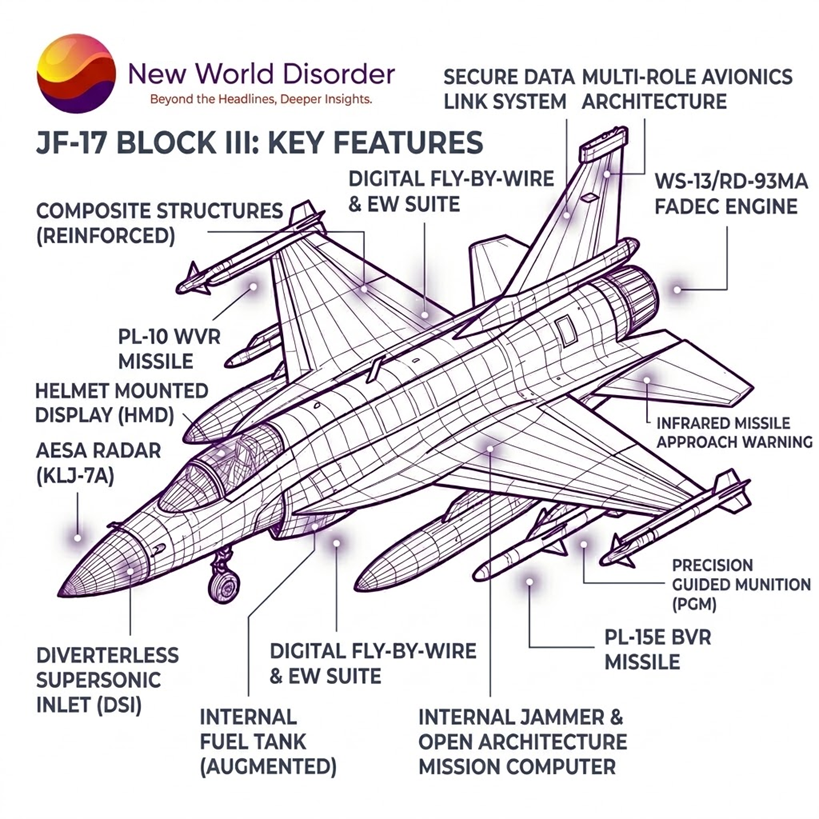
The Evolution of the Thunder: From Budget Interceptor to Sovereign 4.5+ Gen Reality
The story of the CAC/PAC JF-17 Thunder is an industrial masterclass in iterative engineering. Born out of an urgent, asymmetric necessity to replace an aging fleet of third-generation platforms (F-7P/PGs, Mirage IIIs, and A-5Cs) under strict fiscal constraints and geopolitical sanctions, the project has evolved over two decades from a simple, no-frills airframe into a globally sought-after, combat-validated strike platform. By separating the mechanical lifecycle of the jet from its rapid avionics evolution, the Pakistan Air Force (PAF) has avoided the paralysis that often plagues multi-decade, “clean-sheet” fighter programs, forging a reliable path toward full industrial sovereignty.
The breakdown of production responsibilities reveals a highly structured co-production dynamic. Currently, 58% of the airframe is manufactured entirely in Pakistan at the Pakistan Aeronautical Complex (PAC) in Kamra, while the remaining 42% of sub-assemblies are supplied by the Chengdu Aircraft Industry Group. What makes this aircraft truly special, however, is not just the percentage of sheet metal stamped domestically, but how Pakistan transformed itself from a consumer into a system designer.
Sovereign engineering efforts allowed the Pakistan Air Force (PAF) to take absolute control over the aircraft’s Weapon Management System and Open-Architecture Mission Computer. This means the country can integrate domestic weapons, like the 600 km low-observable Taimoor cruise missile and the new FAAZ BVR missile, entirely in-house without needing foreign source code clearance. By engineering its own national tactical data-link (Link-17) and developing localized Electronic Countermeasure (ECM) algorithms, PAC Kamra has insulated the platform from external software locks or geopolitical kill-switches, creating a rare level of defensive self-reliance.
Strict Aerodynamic and Operational Flight Validation
Every structural boundary, aerodynamic contour, and flight envelope restriction governing the platform was subjected to a rigorous and completely localized verification regime, cementing full testing sovereignty within Pakistan. Utilizing the highly advanced aerodynamic laboratories and high-speed wind tunnel testing complexes established across the country, including the supersonic wind tunnel facilities at the Institute of Space Technologies (IST) capable of generating controlled airflows ranging from Mach 1.6 to Mach 3.75, scale models of the fighter underwent exhaustive aerodynamic verification. These critical computational and physical fluid dynamic tests evaluated lift-to-drag ratios, high-angle-of-attack airflow behaviors, and the stress parameters of the Diverterless Supersonic Inlet (DSI) design.
Beyond the initial wind tunnel regimes, the platform successfully triumphed over extreme operational stress testing under the direct command of the Pakistan Air Force’s Test and Evaluation Flight (TEF). This included structural flutter evaluations, high-G stress analysis on domestic composite bulkheads, dynamic weapon-separation trials for specialized munitions like the Taimoor ALCM, and relentless electronic resilience testing in simulated high-clutter jamming environments. Passing every single phase of these demanding domestic validation criteria with zero structural compromises, the fighter proved its absolute flight worthiness and engineering maturity before entering frontline mass serialization.
1. The Block-by-Block Journey to Lethality
Block I: The Structural Foundation
The initial variant was strictly about achieving industrial baseline capability and mass deployment. It was designed around a clean cockpit featuring an early generation Electronic Flight Instrument System (EFIS) and three Multifunction Color Displays (MFDs). Powered by the standard Russian Klimov RD-93 turbofan engine, it relied on the KLJ-7 mechanically-scanned pulse-Doppler radar. While its Beyond-Visual-Range (BVR) capabilities were modest, anchored by early Chinese SD-10 integrations, Block I proved that the Pakistan Aeronautical Complex (PAC) at Kamra could successfully manage a high-speed assembly line, manufacturing 58% of the airframe domestically while establishing complete maintenance, repair, and overhaul (MRO) autonomy.
Block II: The Multirole Maturity
Block II transitioned the Thunder from a pure defensive interceptor into a true multirole workhorse. The most visible upgrade was the inclusion of an aerodynamically refined, star-side In-Flight Refueling (IFR) probe, which dramatically expanded its operational radius and endurance. The avionics spine was upgraded to support a more robust MIL-STD-1760 weapons databus, enabling the integration of heavy stand-off precision weapons and electro-optical targeting pods like the Turkish Aselsan ASELPOD. This era also marked the platform’s first operational validation during counter-terrorism deployments, establishing a baseline of high readiness and low lifecycle costs.
Block III: The Generational Leap
As detailed previously, Block III represents a total digitization of the platform. Integrating the active electronically scanned array (KLJ-7A AESA) radar, a 3-axis quadruplex digital fly-by-wire flight control system, internal DRFM electronic protection, and an imaging infrared missile approach warning system (IIR-MAWS) closed the situational awareness gap with Western architectures. Paired with the long-range PL-15E and the sovereign FAAZ BVR missiles, alongside the 600-kilometer terrain-hugging Taimoor ALCM, the Block III has become a premier system of conventional area denial and deep-strike power projection.
A Complete Technical Assessment of the JF-17 Block III
The maturation of the CAC/PAC JF-17 Thunder program has culminated in the Block III, a variant that marks a definitive shift from a budget-conscious legacy replacement to a highly lethal, data-centric 4.5-generation multirole fighter. While earlier iterations focused heavily on establishing structural reliability and basic multirole functions, the Block III completely re-architects the aircraft’s sensory, electronic warfare, aerodynamic, and offensive capabilities.
By decoupling the airframe design from its internal computing limits, aerospace engineers have created a platform tailored specifically for complex, contested electromagnetic environments. This complete technical breakdown details every integrated system, structural modification, and aerodynamic refinement that defines the definitive iteration of the Thunder.
1. Sensor Architecture and Electronic Warfare (EW) Suite
The true lethality of the Block III lies in its dense, highly integrated sensor web, converting the platform into a network-centric node capable of tracking and engaging multiple threats without exposing its own position.
NRIET/CETC KLJ-7A AESA Radar
The core sensor is the X-band air-cooled Active Electronically Scanned Array (AESA) radar, featuring a massive array of transmit-receive (TR) modules. Unlike the legacy mechanical slotted-array radars, the KLJ-7A scans electronically across multiple frequencies simultaneously, lowering its probability of intercept (LPI).
- Detection Range: Exceeds 150 kilometers for a standard 5 m² Radar Cross Section (RCS) target, with enhanced detection thresholds for smaller, low-RCS targets.
- Target Tracking & Engagement: Tracks up to 15 aerial targets simultaneously and possesses the processing bandwidth to guide active radar homing munitions against 4 targets concurrently.
- Operational Modes: Includes robust Synthetic Aperture Radar (SAR) for high-resolution ground mapping, Doppler Beam Sharpening (DBS), and advanced Ground/Sea Moving Target Indication (GMTI/GMTT).
Multi-Spectral Defensive Web
The defensive capabilities are built into the skin of the airframe, moving away from drag-inducing external pods toward a deeply internalized Electronic Support Measures (ESM) and Electronic Countermeasures (ECM) suite.
- Imaging Infrared Missile Approach Warning System (IIR-MAWS): Utilizing multi-spectral optical sensors derived from higher-tier 5th-generation programs, the MAWS provides full 360-degree spherical coverage. It tracks the thermal signature of incoming passive or radar-guided missiles against high-clutter backgrounds, enabling timely, automated countermeasure deployment.
- Digital Radio Frequency Memory (DRFM) Jamming Suite: The internal EW suite contains an upgraded digital jammer. By capturing incoming enemy radar signals, digitizing them, modifying the signature, and retransmitting them, the DRFM system spoofs enemy tracking radars and air-to-air active seekers, creating false targets and breaking locks.
- Radar Warning Receiver (RWR): A wide-band digital RWR system that detects, classifies, and prioritizes enemy emissions, instantly feeding threat coordinates into the main mission computer for dynamic jamming or evasive routing.
- Chaff and Flare Dispenser (CFD): High-capacity smart dispensers integrated aerodynamically into the fuselage, linked directly to the automated MAWS/RWR threat management matrix.
2. Cockpit Architecture and Human-Machine Interface (HMI)
To manage the massive influx of data from the AESA radar, internal jammers, and external networks, the cockpit has been fully redesigned to lower pilot cognitive workload and speed up decision-making.
Wide-Angle Holographic Head-Up Display (HUD)
The legacy HUD is replaced with a wide-angle holographic HUD featuring a total field of view of at least 25 degrees. This smart system features built-in symbol generation, allowing the pilot to read weapon state, navigation corridors, and high-priority threat indicators clearly even in high-glare or low-visibility conditions.
Smart Multifunction Color Displays (SMFCD)
The instrument panel is dominated by three large 8×12-inch high-resolution Smart Multifunction Color Displays arranged side by side in portrait orientation. They provide a completely configurable, unified digital flight instrument system (EFIS) that allows pilots to instantly toggle between tactical situational awareness maps, engine diagnostics, sensor fusion matrices, and weapon management pages.
Helmet-Mounted Display and Sight (HMDS)
The integration of a lightweight, advanced HMDS turns the pilot’s line of sight into a primary targeting tool. Crucial flight telemetry, targeting cues, and threat data are projected directly onto the helmet visor, giving the pilot spatial awareness without needing to look down at cockpit instruments.
Core Systems Engineering
- Dual Mission Computers: Driven by an open-architecture 32-bit Weapon and Mission Management Computer (WMMC) utilizing a high-speed MIL-STD-1553B Multi-Bus system. The open architecture ensures new algorithms, threat libraries, and weapons can be integrated without a complete rewrite of the operational software.
- Full HOTAS Controls: Hands-On-Throttle-and-Stick architecture allows the pilot to execute radar adjustments, target selection, defensive jamming, and weapon selection without taking their hands off the physical flight controls.
- Martin-Baker Mk-16LE Ejection Seat: A zero-zero ejection seat optimized for lightweight cockpits, ensuring high-reliability escape profiles across the entire flight envelope.
3. Flight Control, Propulsion, and Structural Aerodynamics
To support the increased power consumption and thermal load of the 4.5-generation electronics, the physical platform underwent significant internal and aerodynamic modifications.
Quadruplex Digital Fly-By-Wire (FBW)
The Block III transitions from the previous hybrid flight control system to a full three-axis, quadruplex digital fly-by-wire system. This provides automatic envelope protection, completely neutralizing the risk of pilot-induced overstressing during extreme maneuvers, while drastically improving longitudinal stability, pitch rate responsiveness, and overall handling during heavy armament configurations.
Klimov RD-93MA Turbofan Engine
Propulsion is supplied by the upgraded Russian Klimov RD-93MA turbofan engine (with a structural transition pathway designed for advanced Chinese WS-13 series variants).
- Thrust Performance: Delivers an increased maximum afterburning thrust of approximately 91.2 kN (9.3 tons), pushing the thrust-to-weight ratio of the platform up to 1.07 in clean configurations.
- FADEC Integration: Features a modern Full Authority Digital Engine Control system, optimizing fuel flow, accelerating throttle response times, and ensuring stable thermodynamic parameters under extreme high-G and high-altitude flight regimes.
Airframe and Range Enhancements
- Material Science: Increased use of carbon-fiber composites in key structural bulkheads and control surfaces, dropping dead weight while maintaining structural strength for +8/-3 G maneuvers.
- In-Flight Refueling (IFR) Probe: A fixed, removable star-side IFR probe that expands the operational radius and transit range of the fighter, enabling long-range deployments without requiring intermediate staging bases.
4. The Offensive Matrix: Integrated Armaments
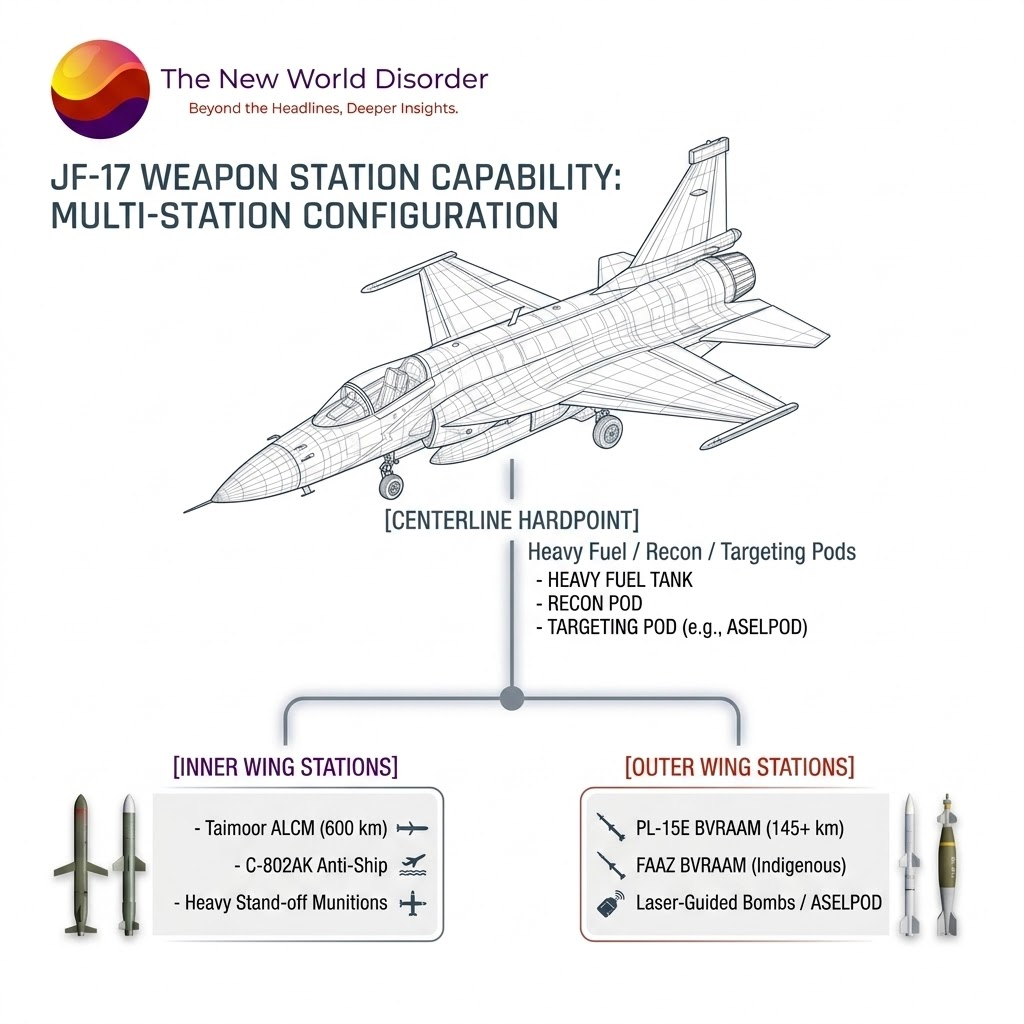
The weapon management system utilizes a MIL-STD-1760 weapon databus linked to 8 external hardpoints (including a dedicated centerline, twin wet wing stations, and wingtip rails), capable of carrying 3,600 kilograms of ordnance.
Beyond-Visual-Range (BVR) Air-to-Air Prowess
- PL-15E BVRAAM: The primary long-range air-to-air asset. Utilizing a dual-pulse solid rocket motor and an active radar seeker, it boasts an operational range exceeding 145 kilometers, providing a clear first-look, first-kill capability over regional legacy fighters.
- FAAZ BVRAAM: The domestically designed and produced active radar-homing BVR missile. Integrating the FAAZ provides the fleet with a sanction-proof, high-volume domestic supply of long-range interceptors, removing reliance on foreign supply chains during active warfare.
Within-Visual-Range (WVR) Air Combat
- PL-10E High-Off-Boresight (HOBS) Missile: A 5th-generation infrared-guided missile featuring an imaging infrared seeker and thrust-vectoring control. When slaved directly to the pilot’s Helmet-Mounted Display (HMD), it allows the aircraft to engage targets at extreme off-boresight angles, meaning if the pilot can see the enemy target by turning their head, the missile can track and destroy it.
- GSh-23-2 Twin-Barrel Autocannon: An internal 23mm kinetic cannon providing a high-rate-of-fire backup for close-range engagements and strafing maneuvers.
Stand-Off Air-to-Surface & Maritime Interdiction
- Taimoor Air-Launched Cruise Missile (ALCM): A low-observable, terrain-hugging, turbofan-powered strategic cruise missile with an operational range of 600 kilometers. This weapon allows the Block III to conduct precise, deep-penetration strikes against critical land installations and hardened command infrastructure from deep within protected airspace.
- C-802AK Anti-Ship Cruise Missile: A dedicated, sea-skimming, active-radar homing missile designed to saturate and defeat modern naval air defense grids, turning the Block III into a potent maritime denial asset.
- Laser-Guided and Satellite-Guided Munitions: Full compatibility with tactical precision weapon families (including the LS and GB series glide bombs), supported by external electro-optical targeting systems such as the Turkish-produced Aselsan ASELPOD or equivalent Chinese targeting systems for all-weather, day-and-night precision strikes.
Summary Technical Specifications
| Parameter | Performance Matrix |
| Generation | 4.5 Generation Multi-Role |
| Powerplant | 1 × Klimov RD-93MA (FADEC equipped) |
| Maximum Thrust | 91.2 kN (20,500 lbf) with Afterburner |
| Maximum Speed | Mach 1.6 to 1.8 at altitude |
| Thrust-to-Weight Ratio | 1.07 (Clean configuration) |
| External Hardpoints | 8 total stations |
| Maximum Payload | 3,600 kg (7,936 lbs) |
| Flight Control System | Quadruplex Digital Fly-By-Wire (3-Axis) |
Through this comprehensive integration of high-end AESA tracking, internal DRFM electronic protection, sovereign long-range strike capabilities via the Taimoor ALCM, and domestic air-to-air independence via the FAAZ missile, the JF-17 Block III establishes itself as a complete, self-sustaining system of conventional air defense and asymmetric power projection.
To watch an analytical overview of the aircraft’s presentation on the global defense stage, view the World Defense Show Official Presentation, which highlights the modern 4.5-generation avionics suite, AESA system orientation, and multirole capability profiles showcased by the Pakistan Air Force during international military exhibitions.
2. Navigating the Hurdles: From Skepticism to Combat Validation
The journey was not without steep structural and geopolitical hurdles. Early in the program, Western defense analysts dismissed the JF-17 as a “budget jet” or a cobbled-together hybrid of legacy platforms, questioning its survivability in contested environments. Finding a balance between the high electrical and cooling demands of modern 4.5-generation electronics and a lightweight, single-engine airframe required complex engineering changes, a hurdle finally solved in Block III through advanced air-cooled radar designs and the upgraded RD-93MA FADEC powerplant.
The turning point for global credibility came down to real-world performance. During high-density aerial clashes under Operation Sindoor, the Thunder demonstrated its operational readiness, network integration, and ability to handle large-scale BVR environments. Shifting from an “affordable alternative” to a combat-validated platform, it proved that smart network-centric architecture could effectively neutralize heavier, numbers-based platform advantages.
To measure the JF-17 Block III against platforms that carry deep, operational flight hours and frontline combat relevance, it must be benchmarked against the gold standards of the single-engine and lightweight multirole export market.
The matrix below removes developmental projects and places the Block III directly alongside the premier operational workhorses of contemporary airspace: the Lockheed Martin F-16 Block 70/72 Viper, the Saab JAS-39E/F Gripen (the heavily redesigned, next-generation iteration of the Swedish jet), and the combat-hardened Dassault Mirage 2000-5 Mk2:
| Operational Parameter | JF-17 Block III (Pakistan / China) | F-16 Block 70/72 Viper (USA) | JAS-39E/F Gripen (Sweden) | Mirage 2000-5 Mk2 (France) |
| Radar & Sensor Class | KLJ-7A (AESA, Air-Cooled) + IIR-MAWS | AN/APG-83 SABR (AESA) + Legion-ES IRST | Leonardo ES-05 Raven (AESA, Swashplate) | Thales RDY-2 (Mechanical Pulse-Doppler) |
| Max Thrust (Afterburning) | ~91.2 kN (RD-93MA / WS-13) | ~130 kN (GE-F110-129) | ~98 kN (GE-F414-GE-39E) | ~98 kN (SNECMA M53-P2) |
| Thrust-to-Weight Ratio | 1.07 (Clean configuration) | 1.11 (Clean configuration) | 1.10 (Clean configuration) | 0.98 (Clean configuration) |
| BVR Engagement Envelope | PL-15E / FAAZ (145+ km) | AIM-120D AMRAAM (160+ km) | MBDA Meteor (150+ km) | MICA EM / IR (80 km) |
| Sovereign Stand-Off Strike | Taimoor ALCM (600 km Low-Observable) | AGM-158 JASSM (370+ km) | KEPD 350 Taurus (500 km) | SCALP-EG / Black Shaheen (250–400 km) |
| WVR High-Off-Boresight | HMD + PL-10E (Thrust Vectoring) | JHMCS II + AIM-9X Sidewinder | Cobra HMD + IRIS-T | Modernized Glass + MICA IR |
| Fleet Flight Status | Active mass service; combat-validated lineage. | Over 4,500 legacy hours; global production surge. | Highly active NATO policing & Baltic deployment footprint. | Heavy frontline combat deployment history (Europe/Asia). |
| Geopolitical Freedom | Complete. Non-Western supply lines & source code control. | Highly Restrictive. Subject to End-User Monitoring. | Moderate. Requires US export clearance for the F414 engine. | Moderate. Subject to French ITAR and defense policy shifts. |
| Estimated Unit Price | $35M – $40M | $75M – $85M | $85M – $95M | Out of production (Upgrades variable) |
Strategic Takeaway
When juxtaposed with these elite global platforms, the JF-17 Block III exposes a fascinating asymmetric reality. While the F-16 Viper and Gripen-E command higher raw thrust and payload capabilities, the Block III effectively neutralizes this gap in the opening salvos of an engagement through its sensor-to-missile symmetry. By paring the KLJ-7A AESA with the PL-15E and the long-range, terrain-hugging Taimoor ALCM, the Thunder out-ranges the kinetic reach of the legendary Mirage 2000-5 and aggressively matches the BVR envelopes of the newest Western fighters, doing so at a fraction of the cost, completely independent of foreign sanctions or end-user surveillance.
3. The Global Footprint: Export Dynamics
The combination of combat validation, sanction-proof supply chains, and an attractive price-to-performance ratio (with unit costs estimated at USD 30–40 million) has turned the JF-17 into a major market disruptor. The platform has broken out of its regional box to secure confirmed orders and active operator status across three continents:
- Myanmar: The first international customer, inducting Block II variants to modernize its close air support and air defense capabilities.
- Nigeria: Acquired Block II platforms integrated with localized logistics packages, deploying them successfully in high-tempo internal security operations.
- Azerbaijan: Marked a massive breakthrough with a landmark USD 1.6 billion contract for modern Block III variants. The Azerbaijani Air Force formally unveiled its first batch of operational Thunders during its late-2025 Victory Day parade, establishing itself as the premier European-fringe operator of the jet.
This momentum has triggered an un-precedent level of interest. At least 13 nations are now engaged in varying stages of defense diplomacy and acquisition talks with Islamabad and Beijing. Advanced negotiations are underway with Iraq and Bangladesh for light tactical modernization, while exploratory discussions exist with resource-heavy states like Indonesia and Saudi Arabia—the latter considering the platform as part of a broader, multi-billion-dollar defense diversification strategy following recent mutual defense pacts.
4. Digital Culture: The DCS World Phenomenon
Beyond the physical theater of war, the JF-17 achieved a unique cultural status when it was meticulously recreated for DCS World (Digital Combat Simulator) by third-party developer Deka Ironwork Simulations. Within the hyper-realistic simulation community, known for its demanding standards of technical fidelity, the “Jeff” instantly became a community favorite. Sim pilots around the world were exposed to the sheer efficiency of its modern Chinese-origin Human-Machine Interface, the power of its SPJ jamming pods, and the lethal accuracy of its completely automated data-link and sensor fusion capabilities. By letting aviation enthusiasts personally manage its radar modes and deploy its unique stand-off weapon matrix in complex digital environments, the simulation demystified the fighter, building an unprecedented level of global popularity and respect for the platform’s engineering logic.
5. The Horizon: The PFX (Pakistan Fighter Experimental) Program
The strategic roadmap does not stop at Block III. Publicly showcased at the IDEAS defense exhibition, the PAF has launched the PFX (Pakistan Fighter Experimental) program, often referred to internally as the next-generation evolution of the Thunder lineage.
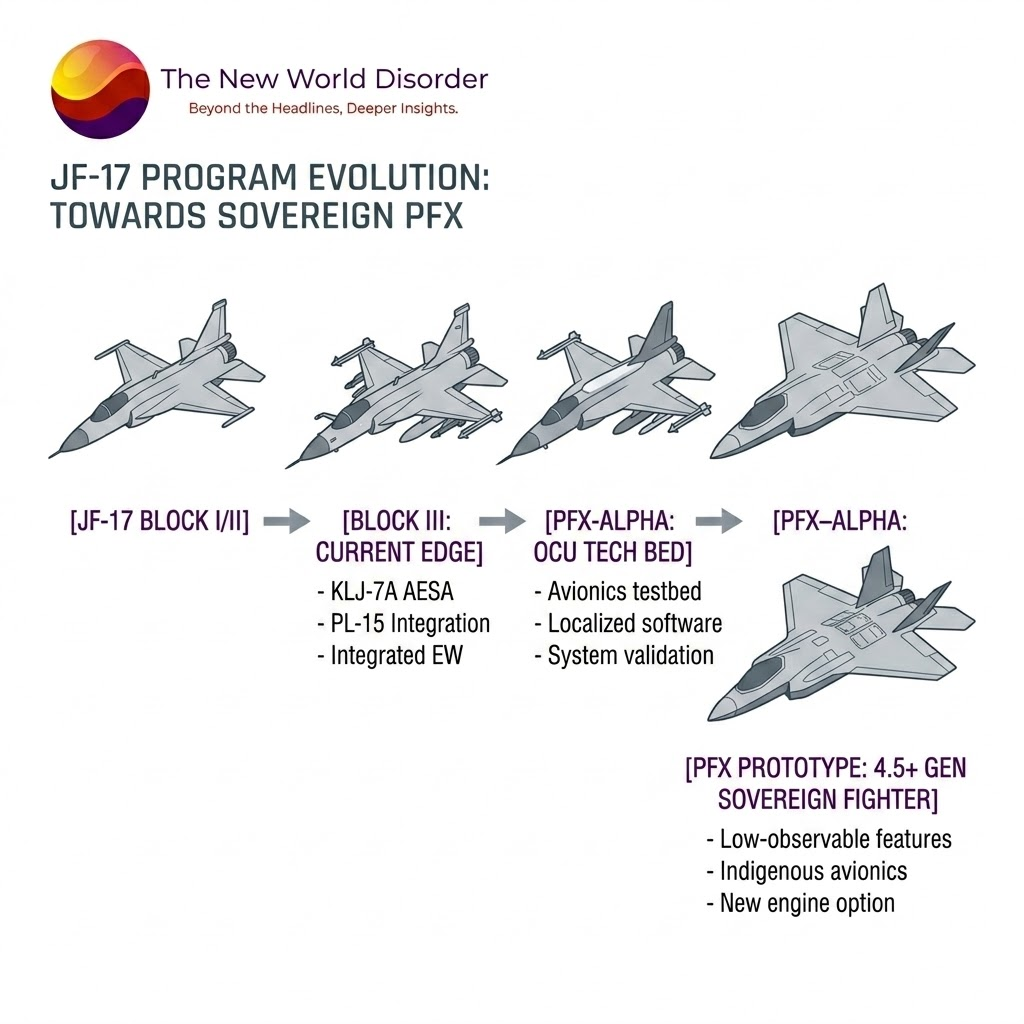
Managed under a systems-first doctrine through the National Aerospace Science and Technology Park (NASTP), the PFX shifts focus completely toward brains and network sovereignty.
- PFX-Alpha Pipeline: Serves as a near-term Operational Capability Upgrade (OCU) track for late-build airframes, functioning as a flying testbed for an entirely indigenous mission computer, secure national data-links, and localized electronic warfare suites.
- Advanced Sensor Integration: The program aims to integrate localized sensor variations, potentially testing the domestic Murad AESA radar alongside advanced Turkish sub-systems like the Aselsan Tulgar Helmet-Mounted Sight, Gokhan ramjet missiles, and the indigenous FAAZ-II BVRAAM.
- Structural Evolution: Early industrial designs and mockups indicate that the final PFX prototype will feature a reworked, noticeably larger aerostructure. It incorporates a modified wing geometry (resembling low-observable Lambda wing concepts), increased internal fuel storage, an optimized thermal management system to sustain next-generation radar loads, and an adaptable engine bay designed to transition into higher-thrust powerplants like the WS-21.
By using the existing, highly efficient PAC Kamra industrial line as its launchpad, the PFX project ensures that Pakistan’s airpower evolution remains fiscally sustainable, modularly upgradeable, and entirely free from external geopolitical influence.
Top 15 Most Searched Questions About the JF-17 Answered
1. Is the platform a 4th or 5th generation fighter?
The aircraft is classified as a 4.5-generation multirole fighter in its latest Block III configuration. While the early Block I and II variants fit firmly within the 4th-generation category, the Block III incorporates advanced 5th-generation technologies—specifically an AESA radar, an imaging infrared missile approach warning system, and high-off-boresight weapon integration.
2. Can the aircraft beat an F-16 in a dogfight?
In a classic within-visual-range (WVR) dogfight, older iterations would face a distinct kinetic disadvantage against the high thrust-to-weight ratio and superb energy retention of an F-16. However, the Block III completely alters this dynamic. By pairing a Helmet-Mounted Display (HMD) with the thrust-vectored PL-10E High-Off-Boresight missile, the pilot can lock and fire at targets at extreme off-boresight angles simply by looking at them, neutralizing the F-16’s traditional airframe maneuvering edge.
3. Which countries currently operate the fighter?
The jet is actively operated by the air forces of Pakistan, Myanmar, and Nigeria. Additionally, Azerbaijan has finalized a massive $4.6 billion agreement for 40 Block III aircraft, with operational deliveries already visibly advancing.
4. What is the actual unit cost of a Block III?
The estimated flyaway unit cost sits between $35 million and $40 million. This makes it one of the most cost-effective 4.5-generation platforms on the global arms market, offering modern sensor suites at a fraction of the price of Western or heavy twin-engine alternatives.
5. What engine powers the fighter?
The current operational fleet is predominantly powered by the Klimov RD-93 turbofan engine (and the upgraded RD-93MA variant featuring FADEC for the Block III). Structural provision and transition pathways are also established to seamlessly house advanced variants of the WS-13 engine series.
6. Can it carry Western weapons and targeting pods?
Yes. Thanks to the open-architecture design of its weapon management system and standard MIL-STD-1760 databus routing, the fighter has been successfully integrated with non-origin subsystems. A prime operational example is its active deployment of the Turkish-made Aselsan ASELPOD for precision-guided day/night bombing missions.
7. What is its maximum operational range?
The clean internal fuel range allows for an operational combat radius of around 1,350 kilometers. However, with the integration of the star-side In-Flight Refueling (IFR) probe introduced in Block II and the utilization of three external drop tanks, its ferry range expands significantly to over 3,500 kilometers.
8. Has the platform ever seen real-world combat?
Yes, the platform is combat-validated. It has been used extensively in high-tempo domestic counter-terrorism operations to deliver precision-guided munitions, and it was heavily deployed during active regional border skirmishes in early 2019 and mid-2025, proving its network-centric warfare and beyond-visual-range tracking reliability.
9. What is the primary long-range weapon of the Block III?
The definitive long-range weapon system is the PL-15E Beyond-Visual-Range Air-to-Air Missile (BVRAAM), which utilizes a dual-pulse solid rocket motor to achieve ranges exceeding 145 kilometers. This is supplemented by the indigenous active radar-homing FAAZ missile.
10. How many hardpoints does it have?
The aircraft features 8 external hardpoints: one centerline station (typically reserved for heavy fuel tanks or pods), four under-wing wet stations, two wingtip launch rails for short-range air-to-air missiles, and a dedicated under-fuselage sensor pod chin mount.
11. What is the PFX program related to this jet?
The PFX (Pakistan Fighter Experimental) is the next-generation evolution of the lineage. Rather than a simple upgrade block, it is a complete structural and system redesign managed under the National Aerospace Science and Technology Park (NASTP) to test a larger airframe, modified low-observable wing geometries, and a fully indigenous national avionics and computing suite.
12. Is the aircraft capable of carrier operations?
No, the aircraft is strictly a land-based, conventional take-off and landing fighter. Its landing gear structure, airframe stress tolerances, and absence of a tailhook assembly mean it cannot be operated from naval aircraft carriers.
13. How does its AESA radar compare to mechanical radars?
The Block III’s KLJ-7A AESA radar scans electronically using hundreds of individual transmit-receive modules rather than physically moving a radar dish. This allows it to track multiple targets faster, vastly improves resistance to electronic jamming, and utilizes Low Probability of Intercept (LPI) waveforms so it can search for targets without giving away the fighter’s location.
14. What are its primary maritime strike capabilities?
The platform is a potent sea-denial asset, integrated natively with the C-802AK anti-ship cruise missile. This allows the lightweight fighter to skim low over the water to target and saturate the air defense grids of hostile surface vessels from stand-off distances.
15. Who handles the maintenance and software updates?
Complete Maintenance, Repair, and Overhaul (MRO) sovereignty is held by PAC Kamra. Because Pakistan owns the software code rights to the mission computer, all electronic warfare threat libraries, radar software updates, and weapon integration cycles are done locally without needing foreign authorization.
To watch a detailed overview of the aircraft’s physical assemblies and the structural milestones realized at the manufacturing facility, you can view the JF-17 Thunder Assembly Facility Overview, which highlights the industrial layout, quality control protocols, and rollout schedules achieved at the Pakistan Aeronautical Complex.