
An Interdisciplinary White Paper on Qur’anic Eschatology, Prophetic Narrations and Theoretical Astrophysics
Author: Zohaib Ahmed
Date: 5th November 2026
Publication: New World Disorder
Research domains: Cosmology, Astrophysics, General Relativity, Planetary Geophysics, Rotational Mechanics and Islamic Eschatology
Research framework: Primordial Black Hole Encounter Hypothesis
ABSTRACT
The Qur’an describes the destruction of the existing cosmic order through a sequence of extraordinary physical events. Surah Al-Qari’ah describes humanity scattered like moths and mountains reduced to the appearance of carded wool. Other Qur’anic passages describe the transformation of the heavens, the scattering of celestial bodies and the disruption of the Earth. Authentic Prophetic narrations further identify the rising of the Sun from the West as one of the major signs preceding the Hour.
This white paper advances a theoretical framework connecting these descriptions with the gravitational mechanics of a primordial black hole passing close to Earth.
The central proposition is that a planetary-mass primordial black hole, originating in the early universe and travelling through interstellar space, could approach the Solar System and generate an extraordinary gravitational disturbance. Its tidal field could affect Earth’s geological structure, oceans, atmosphere and rotational dynamics. The proposed encounter provides a physical framework for examining the destruction described in Surah Al-Qari’ah and the extraordinary solar reversal described in Islamic eschatology.
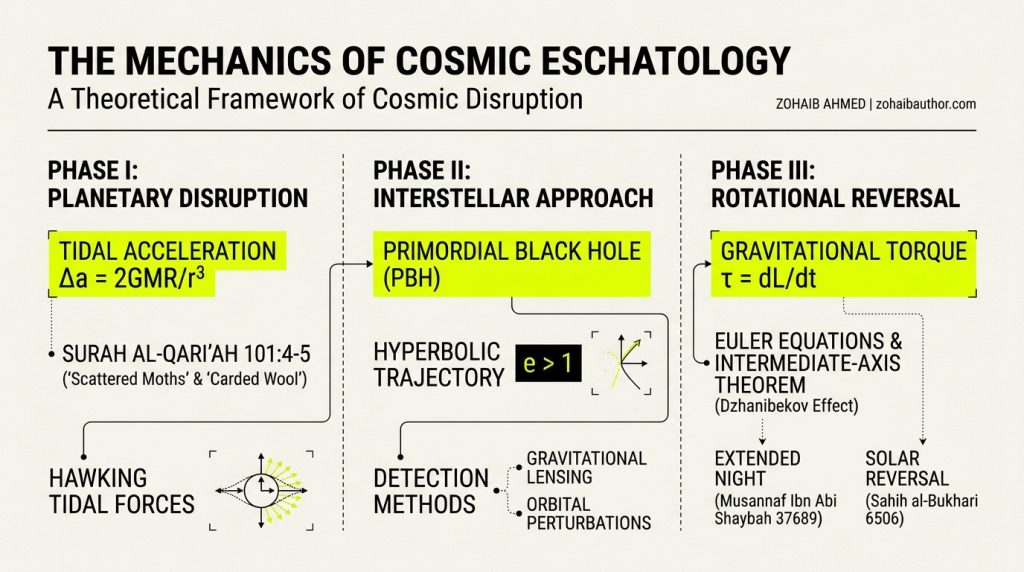
The research is divided into three phases.
Phase I: Planetary destruction. The paper examines how a black hole could disrupt Earth’s geological structure through differential gravitational acceleration, relating these mechanisms to the descriptions in Surah Al-Qari’ah.
Phase II: The arrival of the black hole. It examines the origins of primordial black holes, their possible interstellar trajectories, gravitational lensing, orbital perturbations and the mechanics of a close encounter with Earth.
Phase III: Solar reversal. It investigates gravitational torque, angular momentum, the intermediate-axis theorem and the Dzhanibekov effect as possible components of a rotational model connecting a close black-hole encounter with the extraordinary solar movement described in Prophetic narrations.
The paper brings together gravitational physics and Islamic eschatological descriptions to develop a unified theoretical model of cosmic disruption.
Methodology
This paper adopts an interdisciplinary, interpretive and scenario-based research methodology to examine the possibility that a close encounter between a black hole and Earth could provide a physical mechanism for the cosmic destruction and major eschatological events described in Islamic scripture. The research brings together four principal areas of inquiry: Qur’anic interpretation, Hadith literature, theoretical astrophysics and gravitational mechanics.
The methodology is designed to establish a structured relationship between scriptural descriptions and scientifically recognised physical processes. Rather than examining these subjects independently, the paper develops a connected sequence of events through which the proposed cosmic scenario can be investigated.
1. Qur’anic and Hadith Analysis
The first stage examines relevant Qur’anic passages and authenticated Hadith narrations concerning the destruction of the existing cosmic order and the major signs preceding the Day of Judgment.
Particular attention is given to:
- Surah Al-Qari’ah (101:1–5): The description of humanity scattered like moths and mountains becoming like carded wool.
- Surah At-Takwir (81:1–6): The transformation of the Sun, stars, mountains and other elements of the cosmic order.
- Surah Al-Infitar (82:1–3): The splitting of the heavens and the disruption of the established cosmic arrangement.
- Surah Al-Inshiqaq (84:1–5): The transformation of the heavens and Earth.
- Surah Al-An’am (6:158): The reference associated with the appearance of certain major signs.
- Sahih al-Bukhari 6506: The authentic narration concerning the Sun rising from the West.
Qur’anic passages are examined alongside classical Tafsir, particularly the explanations of Ibn Kathir and Al-Tabari. Hadith references are assessed according to their source and authentication status, with Sahih collections distinguished from narrations requiring separate evaluation.
The objective is to identify the physical phenomena described in these sources and investigate how they may correspond to processes involving extreme gravitational disruption and changes in Earth’s rotational dynamics.
2. Astrophysical Literature Review
The second stage examines established scientific literature concerning black holes, their formation, gravitational influence and interaction with surrounding celestial bodies.
The research focuses on five areas:
- Black-hole formation: The astrophysical processes through which black holes originate, including stellar collapse and the proposed formation of primordial black holes in the early universe.
- Gravitational influence: The effect of concentrated mass on the motion and orbital stability of surrounding celestial objects.
- Tidal forces: The difference in gravitational acceleration across an object, particularly the stretching and deformation that occur during a sufficiently close encounter with a black hole.
- Black-hole radiation: Stephen Hawking’s work on quantum radiation from black holes, including his 1974 paper, Black Hole Explosions?
- Observational signatures: Gravitational lensing, orbital disturbances, accretion activity and gravitational waves as scientific methods for identifying or studying black holes.
Primary scientific publications, NASA research and educational material, and peer-reviewed astrophysical literature form the basis of this review. Particular attention is given to the relationship between black-hole mass, distance, velocity and the gravitational effects produced during a close encounter.
3. Gravitational and Physical Scenario Analysis
The third stage develops the proposed black-hole encounter as a sequence of physical events. The scenario is examined through the principles of Newtonian gravitation, tidal mechanics, angular momentum and rotational dynamics.
The analysis follows three principal phases:
Phase I: Gravitational Disruption and Planetary Destruction
This phase examines how an approaching black hole could progressively influence the Solar System and Earth. The analysis considers orbital disturbances, tidal acceleration, deformation of Earth’s oceans and crust, and the possibility of planetary disintegration under sufficiently extreme gravitational conditions.
Phase II: Black-Hole Arrival and Trajectory
This phase investigates the origin, movement and possible trajectory of the black hole. It considers how a black hole could enter the Solar System, how its gravitational influence would change with distance, and what physical signatures might accompany its approach.
Phase III: Earth’s Rotational Disruption and the Sun Rising from the West
This phase examines the proposed relationship between an external gravitational encounter and changes in Earth’s rotational dynamics. The analysis considers gravitational torque, Earth’s angular momentum, its moment of inertia and the principles governing the rotation of physical bodies.
The purpose is to investigate a possible mechanical sequence through which an extraordinary gravitational interaction could alter Earth’s rotational behaviour and produce an apparent reversal of the Sun’s daily direction of movement across the sky.
4. Quantitative Analysis and Physical Modelling
Where applicable, the paper uses mathematical relationships to examine the magnitude of gravitational effects and their dependence on physical variables.
The principal relationships include:
Newton’s law of universal gravitation:
[
F=\frac{GMm}{r^2}
]
This establishes the gravitational force between two masses and provides the foundation for examining the influence of an approaching black hole.
Gravitational acceleration:
[
g=\frac{GM}{r^2}
]
This relationship is used to estimate gravitational acceleration at different distances from the black hole.
Tidal acceleration across Earth:
[
a_{\text{tidal}}\approx\frac{2GM_{\text{BH}}R_E}{r^3}
]
This approximation examines the difference in gravitational acceleration across Earth’s radius, where (M_{\text{BH}}) represents black-hole mass, (R_E) represents Earth’s radius and (r) represents the distance from the black hole.
Gravitational torque:
[
\tau=\mathbf{r}\times\mathbf{F}
]
This relationship provides the basis for examining how an external gravitational force could exert torque on a rotating planetary body.
The calculations use illustrative mass and distance values to explore the physical scale of the proposed encounter. These values are treated as scenario parameters rather than observations of an identified black hole.
5. Comparative Interpretation
The fifth stage brings the scriptural and scientific findings together.
Each major phenomenon is examined through three connected questions:
- What does the relevant Qur’anic passage or Hadith describe?
- What established physical process could produce a comparable phenomenon?
- How does that process fit within the proposed sequence of a black-hole encounter with Earth?
This comparative approach is applied particularly to the imagery of Al-Qari’ah, the transformation of celestial bodies described in other Qur’anic passages, and the Hadith concerning the Sun rising from the West.
The purpose is to construct a coherent explanatory framework in which scriptural descriptions and astrophysical mechanisms can be examined in relation to one another.
6. Research Scope and Assumptions
The paper develops a theoretical scenario using established gravitational principles and proposed astrophysical conditions. Its quantitative analysis depends on selected assumptions concerning black-hole mass, approach distance, trajectory, velocity and gravitational interaction with Earth.
The study distinguishes between established scientific principles, illustrative calculations and the proposed interpretation connecting those principles to Islamic eschatology. Scientific findings are cited according to their original publications, while Islamic references are identified by their primary source and authentication status.
The research is therefore structured as a theoretical investigation rather than an observational report. Its central objective is to develop and examine a possible physical explanation for the sequence of cosmic events described in Islamic eschatological sources, with particular emphasis on gravitational disruption, planetary destruction and the reversal of the Sun’s apparent direction of movement.
1. PHASE I: HOW WOULD THE WORLD END IF A BLACK HOLE APPROACHED EARTH?
1.1 Understanding the black hole
A black hole is an extremely compact gravitational object whose gravitational field creates a region of spacetime from which light cannot escape. The boundary of this region is called the event horizon.
Black holes are among the most extreme objects predicted by Einstein’s general theory of relativity.
Their gravitational behaviour is governed primarily by mass, angular momentum and electric charge. For a non-rotating black hole, the Schwarzschild radius determines the size of its event horizon:
[
r_s=\frac{2GM}{c^2}
]
Where:
- (r_s) represents the Schwarzschild radius.
- (G) represents the gravitational constant.
- (M) represents the mass of the black hole.
- (c) represents the speed of light.
The extraordinary feature of a black hole is the relationship between its mass and physical size.
For example, if Earth itself were compressed into a black hole without changing its mass, its Schwarzschild radius would be approximately 8.9 millimetres.
Its gravitational influence, however, would remain associated with Earth’s entire mass.
This distinction is important when considering the destruction of a planet.
A black hole does not need to physically collide with Earth to produce catastrophic consequences. Its gravitational field extends far beyond its event horizon.
NASA explains that black holes affect their surroundings through gravity, and that their gravitational effects at sufficient distances are comparable to those of other objects possessing the same mass [1].
The destructive potential of an approaching black hole therefore depends on its mass, velocity and closest-approach distance.
1.2 Gravitational tides: The mechanism of planetary destruction
The primary mechanism through which a close black-hole encounter could destroy Earth is tidal acceleration.
Gravity does not act equally across the entire diameter of a planet when an external massive object approaches it.
The side facing the black hole experiences a stronger gravitational attraction than the opposite side.
This difference produces tidal forces.
The same fundamental principle explains the tides generated in Earth’s oceans by the Moon. However, the gravitational gradient of a sufficiently massive black hole passing close to Earth would operate at an entirely different magnitude.
The approximate tidal acceleration across a planet can be calculated using:
[
\Delta a=\frac{2GM R_E}{r^3}
]
Where:
- (M) is the mass of the black hole.
- (R_E) is Earth’s radius.
- (r) is the distance between the black hole and Earth’s centre.
- (G) is the gravitational constant.
The equation demonstrates three important relationships.
- Greater black-hole mass produces stronger tidal acceleration.
- Greater planetary diameter produces a larger differential force.
- Tidal acceleration increases dramatically as the distance decreases.
The inverse-cube relationship is particularly significant.
If the distance is reduced by half, tidal acceleration increases eightfold. If the distance is reduced to one-tenth, the tidal acceleration becomes one thousand times greater.
A close gravitational encounter can therefore transform an otherwise survivable astronomical interaction into a planetary catastrophe.
What happens to Earth during such an encounter?
Earth is a layered planetary system consisting of:
- A solid crust.
- A largely solid but deformable mantle.
- A liquid outer core.
- A solid inner core.
- Oceans and atmosphere.
An external gravitational field acts upon all these components.
During a close encounter, the near side of Earth experiences a stronger attraction towards the black hole. The far side experiences a comparatively weaker attraction.
This creates differential stresses throughout the planet.
The expected physical consequences include:
Geological deformation: The tidal field generates stress across the crust and mantle, producing large-scale deformation and fracturing.
Seismic instability: Changes in gravitational loading could generate severe geological disturbances and widespread seismic activity.
Ocean displacement: The gravitational gradient affects the distribution of ocean water, producing extraordinary tidal movement.
Atmospheric disruption: Atmospheric gases and suspended material respond to the changing gravitational field and planetary deformation.
Structural fragmentation: When gravitational stress exceeds the resistance of planetary materials, geological formations can fracture and disperse.
At sufficiently close distances, the planet enters the regime of tidal disruption.
The same fundamental process is responsible for the stretching of matter near a black hole, commonly described as spaghettification.
NASA’s Goddard Space Flight Center explains that the differential gravitational pull on an object becomes increasingly destructive as it approaches a black hole [2].
The result is a gravitational mechanism capable of disrupting planetary structure without requiring the black hole to absorb the entire planet.
1.3 Surah Al-Qari’ah: Humanity scattered like moths
The Qur’an describes the event of Al-Qari’ah in Surah 101:
The Striking Calamity!
What is the Striking Calamity?
And what will make you realize what the Striking Calamity is?
It is the Day when people will be like scattered moths,
and the mountains will be like carded wool.
Qur’an 101:1–5
The Arabic expression al-farash al-mabthuth describes people dispersed and scattered like moths.
The image conveys disorder, movement, confusion and the loss of the stability associated with ordinary human existence.
The scientific model of a catastrophic gravitational encounter provides a physical setting in which this description can be examined.
Human life depends upon a stable planetary environment.
Earth’s gravity maintains the relationship between the surface, atmosphere, oceans and living organisms. Its rotational dynamics influence the distribution of energy and the cycles governing life.
An extraordinary gravitational disturbance would affect these systems simultaneously.
If a planetary-mass black hole passed sufficiently close to Earth, the differential gravitational field could displace matter, disrupt the oceans, deform the crust and create violent atmospheric conditions.
Human populations would experience a planetary environment undergoing rapid physical disintegration.
The scattering imagery of Al-Qari’ah can therefore be studied alongside the consequences of extreme gravitational instability.
Ibn Kathir, in his Tafsir of Surah Al-Qari’ah, explains the expression concerning scattered moths through their dispersal, movement and bewilderment. He also explains the description of mountains as carded wool as the loss of their familiar solid form [3].
The physical relationship explored here is between the stability of the planetary environment and the consequences of its gravitational disruption.
1.4 Mountains becoming like carded wool
The second major description in Surah Al-Qari’ah is:
[
وَتَكُونُ الْجِبَالُ كَالْعِهْنِ الْمَنْفُوشِ
]
Wa takunul-jibalu kal-‘ihnil-manfush.
“And the mountains will be like carded wool.”
(Qur’an 101:5)
The Arabic word al-‘ihn refers to wool, while al-manfush describes wool that has been loosened or fluffed.
The comparison is significant because mountains are among the most massive and apparently permanent structures on Earth.
Their stability depends on geological structure, material strength, gravitational equilibrium and the physical behaviour of the lithosphere.
A sufficiently strong tidal field could generate extraordinary differential stresses within these structures.
The resulting process would involve:
- Gravitational deformation of the Earth’s crust.
- Increasing stress across geological formations.
- Fracturing of rock masses.
- Displacement and fragmentation of mountain structures.
- Dispersion of geological material.
The mountains would lose the stable form through which humanity recognises them.
In planetary physics, this is a discussion of the transition from geological stability to gravitationally induced structural disruption.
The comparison with carded wool provides a striking textual description of the resulting loss of solidity.
Classical Tafsir literature, including Ibn Kathir and Al-Tabari, explains the expression through the image of wool becoming loose and dispersed [3, 4].
1.5 Stephen Hawking and the destructive potential of black holes
Stephen Hawking transformed the scientific understanding of black holes through his work on quantum mechanics and general relativity.
His landmark 1974 paper, published in Nature, was titled:
Black Hole Explosions?
In this research, Hawking demonstrated that quantum effects cause black holes to emit thermal radiation.
This phenomenon became known as Hawking radiation [5].
The temperature of a non-rotating black hole is expressed as:
[
T_H=\frac{\hbar c^3}{8\pi G M k_B}
]
Where:
- (\hbar) is the reduced Planck constant.
- (c) is the speed of light.
- (G) is the gravitational constant.
- (M) is the black-hole mass.
- (k_B) is the Boltzmann constant.
The equation demonstrates an inverse relationship between black-hole mass and temperature.
Smaller black holes have higher Hawking temperatures and lose mass more rapidly. Larger black holes have lower temperatures and much longer evaporation times.
Hawking’s work also established the theoretical importance of primordial black holes and their possible final stages of evaporation.
For the present research, another aspect of black-hole physics is particularly relevant: tidal destruction.
When an object approaches a sufficiently compact gravitational body, the difference between the gravitational pull on its near and far sides creates stretching forces.
Hawking discussed this process in A Brief History of Time, using the example of an astronaut approaching a black hole.
The phenomenon is now commonly known as spaghettification.
When applied to a planet, the same physical principle operates across an enormous mass distribution.
The black hole’s gravitational field can disrupt the planet’s structure through tidal forces.
The important scientific connection is therefore the relationship between extreme gravitational gradients and the physical disintegration of matter.
Hawking radiation explains the quantum behaviour of black holes, while general relativity explains the gravitational interaction responsible for tidal disruption.
Together, these fields provide the theoretical foundation for examining the effects of a black hole approaching Earth.
1.6 What Happens When a Black Hole Comes Near Earth?
Imagine a black hole entering our Solar System and moving towards Earth. It would not need to collide with the planet to cause destruction. Its gravitational field alone could begin changing the physical conditions around it. The closer it came, the stronger its influence would become. Earth, the Moon, the oceans, the atmosphere and even the planet’s internal structure would be exposed to increasingly powerful gravitational forces.
A black hole is not a cosmic vacuum cleaner that simply sucks everything into itself. Its danger comes from its extremely concentrated mass and the gravitational forces it produces. At a sufficient distance, its gravity could disturb the orbits of planets and moons. As it approached Earth, the difference between the gravitational pull on the near side of the planet and the far side would become increasingly severe. This difference is known as a tidal force.
The consequences would unfold in stages.
First, the Solar System would become gravitationally disturbed. The black hole’s mass would influence the paths of nearby objects. Planetary orbits could shift, the Moon’s orbit could be disturbed, and the gravitational balance that maintains the existing arrangement of the Solar System could begin to change. If the black hole passed through the inner Solar System, the effects could become catastrophic.
Second, Earth’s oceans and crust would experience extreme tidal stress. The side of Earth facing the black hole would experience a stronger gravitational pull than the opposite side. This difference could generate enormous deformation. Ocean levels would be violently displaced, the crust could fracture, and powerful seismic and volcanic activity could follow. The familiar pattern of tides, which is produced by the gravitational interaction between Earth, the Moon and the Sun, would be overwhelmed by a much stronger external influence.
Third, the planet itself could begin to lose its structural integrity. If the black hole approached closely enough, the gravitational difference across Earth’s diameter could exceed the forces holding the planet together. Earth could be stretched, fractured and eventually broken into fragments. Material drawn sufficiently close could be pulled into elongated streams, a process commonly described as spaghettification. The closer the approach, the more extreme the deformation.
At this stage, the destruction would extend beyond the surface. The atmosphere would no longer remain stable, oceans could be displaced or dispersed, and the planet’s solid structure could be torn apart. Depending on the black hole’s mass, speed and closest distance, the result could range from severe planetary disruption to complete tidal disintegration.
This physical sequence provides a striking scientific framework for understanding the imagery of Surah Al-Qari’ah.
Allah describes the Day of Judgment:
“The Day when people will be like scattered moths, and the mountains will be like carded wool.”
Surah Al-Qari’ah, 101:4–5
The two images describe destruction at two different scales. Human beings are compared to scattered moths, while mountains are compared to carded wool. The first image conveys the scattering and disorder of humanity. The second presents the collapse of structures that appear immovable and permanent.
A close black-hole encounter offers a physical mechanism through which such scenes can be understood. When gravitational forces become sufficiently extreme, objects that appear stable can lose their structure. Mountains, which represent permanence and strength in the human experience, would no longer retain their familiar form. Earth’s surface could be fractured and displaced, while human populations would face a world in which the natural systems supporting life had collapsed.
The comparison becomes especially significant when we consider the scale of gravitational forces involved. A mountain is held together by its own gravity and the strength of its rock. A planet is held together by its gravitational structure. An approaching black hole can impose tidal forces that act across these structures, progressively overcoming the forces that maintain their integrity. The transformation described in Al-Qari’ah can therefore be examined through the physics of gravitational disruption.
Stephen Hawking’s work provides another important scientific foundation for this explanation.
In his 1974 paper, Black Hole Explosions?, published in the journal Nature, Hawking demonstrated that black holes are not entirely black in the classical sense. Quantum effects near the event horizon allow them to emit radiation, now known as Hawking radiation. His work transformed the scientific understanding of black holes by connecting gravity, quantum mechanics and thermodynamics.
Hawking’s broader explanations of black-hole physics also made the consequences of extreme gravitational differences accessible to the public. An object approaching a black hole can experience a much stronger gravitational pull on one part of its body than another. This difference stretches the object along the direction of the black hole and compresses it from the sides. The phenomenon is known as tidal stretching.
This is central to the theory being developed here. Hawking’s work establishes the physical reality of black-hole radiation and the extreme gravitational environment around black holes. The established physics of tidal forces explains how a sufficiently close encounter could stretch, deform and destroy a planetary body. Together, these scientific foundations provide a mechanism through which the cosmic destruction described in Al-Qari’ah can be examined.
The theory can therefore be understood through one connected sequence:
- A black hole enters the Solar System.
- Its gravity begins disturbing planetary motion and the gravitational balance of the system.
- As it approaches Earth, tidal forces intensify.
- Earth’s oceans, atmosphere and crust experience increasingly severe disruption.
- At an extreme distance of approach, the planet can lose its structural integrity and be torn apart.
- Humanity experiences the collapse of its familiar physical environment, while the mountains and other massive structures lose their stability.
The central idea is that the destruction of the world need not be imagined only as a sudden event without a physical sequence. It can also be examined as a process in which an extraordinary cosmic force progressively dismantles the structures that sustain life on Earth. Surah Al-Qari’ah provides the scriptural imagery of that destruction, while black-hole physics provides a scientific framework for understanding how gravitational forces could produce such effects.
2. PHASE II: THE ARRIVAL OF A BLACK HOLE
2.1 A black hole has an origin and a trajectory
A black hole approaching Earth would not simply materialise in the Solar System.
Like other astronomical objects, it would possess an origin, a velocity and a trajectory through space.
Its gravitational field would interact with surrounding matter and celestial bodies throughout its journey.
There are several established theoretical pathways through which black holes can form.
Stellar collapse: A sufficiently massive star can collapse under its own gravity at the end of its evolutionary life.
Compact-object mergers: Two black holes can merge, producing a larger black hole and releasing gravitational waves.
Primordial formation: A black hole could have formed during the early universe through the gravitational collapse of an exceptionally dense region.
The third possibility is particularly relevant to this research.
2.2 Primordial black holes: Relics of the early universe
Primordial black holes, commonly abbreviated as PBHs, are hypothetical objects that may have formed during the early stages of cosmic evolution.
Unlike stellar black holes, they would not have originated from the collapse of stars.
The early universe was an extremely hot and dense environment. Under certain cosmological conditions, density fluctuations could have produced regions sufficiently concentrated to collapse gravitationally.
Such collapse could have created black holes with masses substantially different from those of ordinary stellar black holes.
Research into primordial black holes has examined their possible contribution to dark matter, their formation mechanisms and their observational signatures [6].
A primordial black hole could theoretically possess planetary mass while having an event horizon smaller than a conventional particle.
For a non-rotating black hole:
| Mass | Schwarzschild radius |
|---|---|
| Earth’s mass | 8.9 mm |
| (10^{23}) kg | 0.15 mm |
| (10^{24}) kg | 1.5 mm |
| Jupiter’s mass | 2.8 m |
| Sun’s mass | 2.95 km |
This creates a remarkable physical contrast.
An object with a mass comparable to a fraction of Earth’s mass could have an event horizon measuring only millimetres.
Its gravitational influence, however, would be determined by its total mass rather than the visible dimensions of its event horizon.
For this research, a planetary-mass primordial black hole provides the central astronomical candidate.
2.3 How would it enter the Solar System?
A primordial black hole could travel through the Milky Way under the influence of the Galaxy’s gravitational field.
The Solar System also moves through the Milky Way.
An object following a different trajectory could eventually enter the region occupied by the Sun and its planets.
The encounter could follow an unbound hyperbolic trajectory.
In classical orbital mechanics, an unbound trajectory has an eccentricity greater than one:
[
e>1
]
The black hole would approach the Solar System, reach its point of closest approach and continue into interstellar space.
Its trajectory would depend on:
- Initial velocity.
- Direction of approach.
- Gravitational interactions.
- Impact parameter.
- Mass of the object.
A sufficiently massive object could perturb the gravitational environment of the Solar System long before reaching Earth.
The approach would therefore be an astronomical process governed by orbital dynamics.
2.4 How would scientists detect an approaching black hole?
Black holes are difficult to observe directly because they do not emit or reflect ordinary light from within their event horizons.
However, their gravitational influence produces observable effects.
There are four particularly relevant detection mechanisms.
A. Gravitational lensing
Einstein’s general theory of relativity establishes that mass curves spacetime.
Light passing near a massive object follows the curved geometry of that spacetime.
A black hole moving in front of a distant star could bend and magnify its light.
This phenomenon is known as gravitational microlensing.
Astronomers can detect such an object by observing the temporary brightening or apparent displacement of background stars.
NASA identifies gravitational lensing as an important method for detecting isolated black holes that would otherwise remain invisible [1].
B. Orbital perturbation
A massive object approaching the Solar System would influence the gravitational motion of other celestial bodies.
Depending on its trajectory, it could alter the orbital parameters of planets, asteroids, comets and smaller objects.
The changes would include alterations in orbital eccentricity, inclination and semi-major axis.
Precision astronomical observations could identify deviations from expected orbital motion.
C. Accretion radiation
If the black hole encountered sufficient surrounding matter, some material could become gravitationally captured.
As this material spirals towards the event horizon, it can heat up and produce electromagnetic radiation, including X-rays.
The radiation would depend on the amount and distribution of surrounding matter.
D. Gravitational waves
Accelerating massive objects can generate gravitational waves.
Black-hole mergers are among the strongest known sources.
An ordinary isolated flyby would not necessarily generate a detectable gravitational-wave signal, but gravitational-wave astronomy provides another method for studying compact-object populations.
These detection mechanisms demonstrate that a black hole has a measurable gravitational presence even when the object itself is invisible.
2.5 Why the closest-approach distance determines the outcome
The physical dimensions of a black hole can be misleading.
A planetary-mass black hole might have an event horizon smaller than a coin, yet its mass could be sufficient to generate an enormous gravitational field.
Consider a hypothetical primordial black hole with a mass of:
[
M_{BH}=10^{24}\ kg
]
This is approximately 0.17 times Earth’s mass.
Assume its distance from Earth’s centre reaches:
[
r=10^7\ metres
]
Using Earth’s radius:
[
R_E=6.371\times10^6\ metres
]
The approximate tidal acceleration becomes:
[
\Delta a=
\frac{2G(10^{24})(6.371\times10^6)}
{(10^7)^3}
]
Therefore:
[
\Delta a\approx0.085\ m/s^2
]
This is approximately 0.87 percent of Earth’s normal surface gravity.
The figure represents the differential acceleration across Earth’s diameter, not the total gravitational acceleration.
The black hole would also exert a substantial overall gravitational attraction.
Reducing the closest-approach distance would increase the tidal effect according to the inverse-cube relationship.
This makes the encounter geometry central to the entire proposed model.
The black hole’s mass determines the strength of its gravitational field, while the closest-approach distance determines how sharply that field changes across Earth.
3. PHASE III: THE SUN RISING FROM THE WEST
3.1 The Prophetic foundation
The rising of the Sun from the West is one of the major signs of the Hour explicitly identified in authentic Hadith.
Abu Hurairah (RA) narrated that the Messenger of Allah ﷺ said:
The Hour will not be established until the Sun rises from the West. When it rises and the people see it, they will all believe.
The narration continues by connecting this event with Qur’an 6:158.
Source: Sahih al-Bukhari 6506, Book 81, Chapter 40.
The relevant Qur’anic passage states:
On the Day when some of the signs of your Lord will come, no soul will benefit from its faith if it had not believed before or had not earned good through its faith.
(Qur’an 6:158)
This establishes the theological significance of the solar reversal.
The event is associated with the closure of the opportunity for previously unestablished faith to benefit a person.
The subject is therefore not simply an unusual astronomical occurrence. It is a major event within Islamic eschatology [7].
3.2 The extended night before the solar reversal
An additional report preserved in Musannaf Ibn Abi Shaybah describes the night preceding the rising of the Sun from the West.
In Musannaf Ibn Abi Shaybah, report 37689, attributed to Abu Salamah, the night is described as lasting as long as three ordinary nights.
The report describes people waking for prayer, sleeping again and finding that the night has still not ended. When they eventually wait for the Sun to rise from its normal eastern direction, it appears from the West [8].
This account provides an important temporal dimension to the proposed theory.
The event is described through three interconnected observations:
- An unusually prolonged night.
- The Sun appearing from the opposite direction.
- The return of daylight following the extraordinary night.
The extended-night report is an additional narration preserved in the Musannaf. The principal textual foundation for the solar reversal itself remains the authentic narration in Sahih al-Bukhari and Sahih Muslim.
3.3 Why does the Sun normally rise in the East?
The apparent movement of the Sun is determined primarily by Earth’s rotation.
Earth rotates eastward around its axis.
Its angular velocity is:
[
\omega=7.292115\times10^{-5}\ rad/s
]
Earth completes one rotation relative to distant stars in approximately 23 hours, 56 minutes and 4 seconds.
The solar day is approximately 24 hours because Earth also moves along its orbit around the Sun.
Since Earth rotates eastward, the Sun appears to move across the sky in the opposite direction.
Consequently:
- The Sun appears in the East.
- It moves across the sky towards the West.
- It sets in the West.
The relationship is direct.
Changing the direction of Earth’s rotation changes the apparent direction of the Sun’s daily movement.
If Earth were to rotate in the opposite direction, the apparent solar trajectory would also reverse.
The astronomical basis of the proposed solar-reversal mechanism therefore begins with Earth’s rotational dynamics.
3.4 Gravitational torque and Earth’s angular momentum
Earth possesses enormous rotational angular momentum.
Angular momentum is the physical quantity associated with the rotational motion of a body.
It is expressed as:
[
L=I\omega
]
Where:
- (L) represents angular momentum.
- (I) represents the moment of inertia.
- (\omega) represents angular velocity.
Earth’s approximate moment of inertia is:
[
I\approx8.0\times10^{37}\ kg,m^2
]
Its rotational angular momentum is approximately:
[
L\approx5.8\times10^{33}\ kg,m^2/s
]
A change in Earth’s rotation requires a change in its angular momentum.
An approaching black hole produces a gravitational force that acts upon Earth’s mass distribution.
When this force acts unevenly across an extended rotating body, it can generate torque.
Torque is expressed as:
[
\boldsymbol{\tau}=\mathbf{r}\times\mathbf{F}
]
The relationship between torque and angular momentum is:
[
\frac{d\mathbf{L}}{dt}=\boldsymbol{\tau}
]
This is the fundamental equation connecting an external gravitational interaction with rotational change.
A sufficiently strong gravitational torque can alter both the magnitude and direction of a planet’s angular momentum vector.
The proposed model applies this principle to a close primordial black-hole encounter.
As the black hole approaches Earth, its gravitational field produces differential forces across the planetary mass distribution.
These forces generate a time-dependent gravitational torque.
The resulting disturbance affects the orientation and rotational state of the planet.
3.5 The gravitational torque model
Earth is not a perfectly spherical object.
Its equatorial bulge creates a difference between its principal moments of inertia.
An external gravitational body can therefore exert a torque upon Earth’s non-spherical mass distribution.
An approximate tidal torque relationship is:
[
\tau=
\frac{3GM_{BH}}{r^3}
(I_z-I_x)\sin(2\theta)
]
Where:
- (M_{BH}) is the mass of the black hole.
- (r) is its distance from Earth.
- (I_z) and (I_x) are principal moments of inertia.
- (\theta) represents the relevant angular orientation of the encounter.
The equation demonstrates why the trajectory matters.
A black hole approaching along a different inclination would produce a different torque profile.
The gravitational interaction would therefore depend on the angle of approach as well as mass and distance.
For Earth, the difference between the polar and equatorial moments of inertia is approximately:
[
I_z-I_x\approx2.6\times10^{35}\ kg,m^2
]
Using the illustrative black-hole mass of (10^{24}) kg and a distance of (10^7) metres:
[
\tau\approx
\frac{3G(10^{24})}{(10^7)^3}
(2.6\times10^{35})\sin(2\theta)
]
This produces a characteristic torque scale of approximately:
[
\tau\approx5.2\times10^{28}\sin(2\theta)\ Nm
]
The result demonstrates the extraordinary magnitude of the torque available from a close gravitational interaction.
The actual rotational response depends on the trajectory and the time-dependent integration of the torque.
The central mechanism is the transfer of angular momentum through gravitational interaction.
3.6 The Dzhanibekov effect and rotational-axis instability
The next component of the theory concerns the Dzhanibekov effect.
This phenomenon is associated with the intermediate-axis theorem of classical mechanics.
It describes the rotational instability of a rigid body rotating around its intermediate principal axis of inertia.
When a freely rotating object has three different principal moments of inertia, rotation around the intermediate axis is unstable.
A small disturbance can produce a dramatic reorientation of the object during its rotational motion.
The phenomenon has been demonstrated through rotating objects in microgravity.
Its mathematical foundation is found in Euler’s equations of rigid-body dynamics.
For a body with three principal moments of inertia:
[
I_1,\ I_2,\ I_3
]
The torque-free Euler equations are:
[
I_1\dot{\omega}_1=(I_2-I_3)\omega_2\omega_3
]
[
I_2\dot{\omega}_2=(I_3-I_1)\omega_3\omega_1
]
[
I_3\dot{\omega}_3=(I_1-I_2)\omega_1\omega_2
]
These equations describe the evolution of rotational velocity around the principal axes.
The intermediate-axis theorem establishes the instability of rotation around the middle principal moment of inertia [9].
Applying the concept to Earth
Earth is an oblate rotating planet with a non-uniform internal mass distribution.
Its rotational behaviour involves:
- The solid crust.
- The mantle.
- The liquid outer core.
- The solid inner core.
- The planetary equatorial bulge.
A strong external gravitational torque can disturb the rotational state of this complex system.
The proposed theory examines whether an extreme tidal encounter could drive the rotational system into an unstable configuration.
The Dzhanibekov effect provides a mechanical framework for understanding how a rotating body’s orientation can change dramatically when its angular-momentum state is disturbed.
In the proposed black-hole scenario, the gravitational encounter acts as the external disturbance that initiates the rotational transition.
The resulting axial reorientation and change in the rotational vector form the basis of the solar-reversal mechanism.
4. THE THREE-STAGE SOLAR REVERSAL MODEL
The relationship between the extended night, the rising of the Sun from the West and the return to ordinary solar movement can be examined through three stages.
4.1 Stage One: Rotational deceleration
As the black hole approaches Earth, its gravitational field generates an increasingly strong tidal interaction.
The torque acts upon Earth’s non-spherical mass distribution.
The rotational angular momentum begins changing under the external gravitational influence.
The proposed model associates this stage with a significant reduction in Earth’s effective eastward rotational motion.
The relationship between rotational acceleration and time is:
[
\alpha=\frac{\Delta\omega}{\Delta t}
]
If the rotational change occurs across an extended interval, the corresponding average torque is:
[
\tau=I\alpha
]
The extended-night report in Musannaf Ibn Abi Shaybah describes a night lasting approximately three ordinary nights.
Within the proposed model, this period corresponds to an extraordinary rotational disturbance affecting the normal day-night cycle.
The relevant physical process is the change in Earth’s rotational state under an external gravitational torque.
4.2 Stage Two: Axial reorientation and the Western sunrise
The second stage concerns the apparent direction of the Sun.
The direction of sunrise is determined by the relationship between Earth’s rotational vector and its geographical orientation.
A major change in the rotational vector changes the apparent movement of celestial objects across the sky.
The proposed mechanism involves a gravitationally induced reorientation of Earth’s rotational configuration.
The Dzhanibekov effect provides the rotational-mechanics analogy for a sudden change in orientation during an unstable rotational state.
Within this theoretical framework, the change in Earth’s rotational configuration produces the extraordinary solar trajectory described in the Hadith.
The Sun appears from the West, travels across the sky and reaches the observed setting direction.
The relationship is based on the fundamental principle that apparent solar movement depends upon planetary rotation.
4.3 Stage Three: Restoration of the rotational configuration
The third stage concerns the return to the ordinary solar trajectory.
As the primordial black hole moves beyond the point of closest approach, the external gravitational torque changes.
The Earth’s rotational system continues evolving under its internal dynamics and the altered angular-momentum distribution.
The proposed model associates this stage with the restoration of the normal rotational configuration.
The resulting solar movement returns to its ordinary eastern rising direction.
This completes the proposed sequence:
- Gravitational approach and rotational disturbance.
- Extended night and axial transition.
- Solar reversal.
- Restoration of ordinary solar movement.
The three-stage model connects the reported astronomical sequence with the gravitational interaction of a passing compact object.
5. THE FINAL COSMIC TRANSFORMATION
5.1 The Qur’anic descriptions of cosmic destruction
Surah Al-Qari’ah is one part of a wider Qur’anic description of the Day of Judgement.
Other chapters describe the transformation of the heavens and the Earth.
Surah At-Takwir (81:1–6) describes the loss of the Sun’s light, the scattering of stars, the movement of mountains and the overflowing of seas.
Surah Al-Infitar (82:1–4) describes the splitting of the sky, the scattering of stars, the bursting of seas and the disruption of graves.
Surah Al-Inshiqaq (84:1–5) describes the splitting of the heavens and the extension of the Earth.
Surah Al-Haqqah (69:13–16) describes the blowing of the Trumpet, the lifting and crushing of the Earth and mountains, and the splitting of the heavens.
These descriptions form a wider picture of the transformation of the existing cosmic order.
The black-hole hypothesis examines the gravitational mechanisms through which an astronomical encounter could produce catastrophic changes in planetary and celestial systems.
The proposed sequence begins with a close gravitational encounter and extends towards the destabilisation of Earth’s geological and rotational systems.
5.2 From planetary destruction to cosmic instability
A close black-hole encounter would affect more than Earth’s surface.
Its gravitational influence would extend throughout the surrounding region.
Depending on its mass and trajectory, it could alter:
- Earth’s orbital motion.
- The distribution of planetary angular momentum.
- The orbital behaviour of other Solar System bodies.
- The stability of the Earth-Sun relationship.
- The distribution of matter within the planetary system.
The gravitational interaction would therefore operate at both planetary and orbital scales.
The destruction of the Earth would represent the most immediate consequence of a sufficiently close encounter.
The broader transformation of the cosmic order described in the Qur’an belongs to the wider sequence of the Hour.
The theoretical model places the black-hole encounter within this wider framework of cosmic disruption.
6. SCIENTIFIC SYNTHESIS OF THE PROPOSED THEORY
The complete theoretical framework can be represented through the following sequence.
| Phase | Physical mechanism | Qur’anic or Hadith connection |
|---|---|---|
| 1 | Primordial black hole enters the Solar System | Arrival of an external gravitational object |
| 2 | Gravitational lensing and orbital perturbation | Detection of an approaching celestial body |
| 3 | Increasing tidal acceleration | Disruption of Earth’s gravitational environment |
| 4 | Geological deformation and fragmentation | Mountains like carded wool, Surah 101:5 |
| 5 | Surface and atmospheric disruption | People scattered like moths, Surah 101:4 |
| 6 | Gravitational torque on Earth’s mass distribution | Disturbance of rotational dynamics |
| 7 | Rotational deceleration and axial transition | Extended night report in Musannaf Ibn Abi Shaybah |
| 8 | Change in apparent solar trajectory | Sun rising from the West, Sahih al-Bukhari 6506 |
| 9 | Evolution of Earth’s rotational configuration | Return of ordinary solar movement in the extended report |
| 10 | Wider planetary and cosmic disruption | Qur’anic descriptions of the transformation of the heavens and Earth |
The scientific foundation of this model rests upon several established physical relationships.
First, black holes generate gravitational fields determined by their mass.
Second, the tidal gradient of an external gravitational field can deform and disrupt planetary bodies.
Third, a non-spherical rotating planet can experience gravitational torque.
Fourth, torque changes angular momentum.
Fifth, rotational dynamics determine the apparent daily movement of the Sun.
The research connects these physical relationships into a single proposed sequence of cosmic events.
7. CONCLUSION
The universe operates through physical laws governing gravity, matter, energy and motion.
Black holes represent some of the most extreme manifestations of these laws.
Their gravitational influence extends far beyond their event horizons. A sufficiently massive black hole passing close to Earth could generate tidal forces capable of disrupting geological structures, oceans and the atmosphere.
The imagery of Surah Al-Qari’ah describes a world in which humanity becomes scattered like moths and mountains lose their solid form, resembling carded wool.
Modern gravitational physics provides a framework for examining the destruction of planetary structures under extreme tidal forces.
The proposed theory takes this relationship further.
A primordial black hole originating in the early universe could travel through interstellar space and enter the Solar System on a hyperbolic trajectory.
Its approach would produce gravitational interactions that intensify as the distance decreases.
During a sufficiently close encounter, the gravitational field would act upon Earth’s mass distribution and rotational system.
The resulting torque could alter angular momentum and produce a significant rotational disturbance.
The Dzhanibekov effect and the intermediate-axis theorem provide the rotational-mechanics framework for examining the proposed axial transition.
This brings the discussion to one of the most extraordinary descriptions in Islamic eschatology: the rising of the Sun from the West.
Sahih al-Bukhari 6506 identifies this event as a major sign preceding the Hour. The additional report preserved in Musannaf Ibn Abi Shaybah describes an extended night preceding the event.
The proposed black-hole model connects these descriptions with the gravitational disturbance of Earth’s rotational dynamics.
The research therefore brings together three major areas:
- The destruction of planetary structure through gravitational tidal forces.
- The arrival and trajectory of a primordial black hole.
- The disturbance and reorientation of Earth’s rotational system.
The central proposition is that a close encounter with a planetary-mass primordial black hole provides a theoretical physical mechanism through which the extraordinary planetary and astronomical phenomena described in Islamic eschatology can be investigated.
The Qur’an describes the transformation of the heavens and the Earth. The Hadith identifies the extraordinary signs preceding the Hour. Modern astrophysics provides mathematical tools for studying gravitational disruption, planetary instability and rotational dynamics.
The objective of this research is to bring these fields into a single explanatory framework.
REFERENCES AND BIBLIOGRAPHY
A. Qur’an and Islamic sources
[1] The Holy Qur’an. Surah Al-Qari’ah, 101:1–11. The description of humanity scattered like moths and mountains resembling carded wool.
[2] The Holy Qur’an. Surah Al-An’am, 6:158. The sign after which faith will not benefit a soul that had not previously believed.
[3] Ibn Kathir, Isma’il ibn Umar. Tafsir al-Qur’an al-Azim. Commentary on Surah Al-Qari’ah, verses 1–5.
[4] Al-Tabari, Muhammad ibn Jarir. Jami’ al-Bayan fi Ta’wil al-Qur’an. Commentary on Surah Al-Qari’ah, verse 5.
[5] The Holy Qur’an. Surah At-Takwir, 81:1–6; Surah Al-Infitar, 82:1–4; Surah Al-Inshiqaq, 84:1–5; Surah Al-Haqqah, 69:13–16.
[6] Sahih al-Bukhari. Hadith 6506, Book 81, Chapter 40. The rising of the Sun from the West. Narrated by Abu Hurairah (RA).
[7] Sahih Muslim. The narrations concerning the rising of the Sun from the West and the major signs of the Hour.
[8] Ibn Abi Shaybah, Abu Bakr. Al-Musannaf, report 37689. Report attributed to Abu Salamah concerning the extended night preceding the rising of the Sun from the West.
B. Black holes and astrophysics
[9] Hawking, S. W. (1974). “Black Hole Explosions?” Nature, 248, 30–31. DOI: https://doi.org/10.1038/248030a0.
[10] Hawking, S. W. (1975). “Particle Creation by Black Holes.” Communications in Mathematical Physics, 43, 199–220. DOI: https://doi.org/10.1007/BF02345020.
[11] NASA. “Black Holes.” NASA Science. Information on black-hole structure, gravitational lensing, accretion and detection. https://science.nasa.gov/universe/black-holes/
[12] NASA Goddard Space Flight Center. “What Happens When Something Gets Too Close to a Black Hole?” Explanation of tidal forces and spaghettification. https://science.nasa.gov/universe/what-happens-when-something-gets-too-close-to-a-black-hole/
[13] Carr, B. J., and Hawking, S. W. (1974). “Black Holes in the Early Universe.” Monthly Notices of the Royal Astronomical Society, 168, 399–415.
[14] Carr, B. et al. (2026). “Primordial Black Holes: Constraints, Potential Evidence and Prospects.” La Rivista del Nuovo Cimento, 49, 225–274.
C. Rotational mechanics and planetary physics
[15] Goldstein, H., Poole, C. P., and Safko, J. (2002). Classical Mechanics, 3rd edition. Addison-Wesley. Reference for angular momentum, gravitational torque, Euler equations and rigid-body rotation.
[16] Landau, L. D., and Lifshitz, E. M. Mechanics, 3rd edition. Butterworth-Heinemann. Reference for rotational mechanics and the dynamics of rigid bodies.
[17] Euler, L. (1750). “Du mouvement de rotation des corps solides autour d’un axe variable.” Mémoires de l’Académie des Sciences de Berlin. Foundational work on rigid-body rotational dynamics.
[18] Dzhanibekov effect and intermediate-axis theorem. Classical rigid-body dynamics, governed by Euler’s equations and conservation of angular momentum.
Source verification and primary reading
The following are particularly important for the research and should be retained in the final publication record:
- Hawking’s original paper: Black Hole Explosions? (Nature, 1974).
- NASA’s black-hole mechanics: Tidal forces and spaghettification.
- NASA’s detection methods: Black Holes: NASA Science.
- Primordial black-hole research: Primordial Black Holes: Constraints, Potential Evidence and Prospects (2026).
- Ibn Kathir’s Tafsir: Surah Al-Qari’ah, verses 4 and 5.
- Authentic solar-reversal narration: Sahih al-Bukhari 6506.
- Extended-night report: Musannaf Ibn Abi Shaybah, report 37689.
- Intermediate-axis mechanics: Rigid Body Rotations and the Intermediate Axis Theorem.
Cite this Paper:
APA Format: Ahmed, Z. (2026, November 5). The mechanics of cosmic eschatology: Primordial black holes, gravitational disruption, Earth’s rotational dynamics, and the rising of the Sun from the West. The New World Disorder. https://zohaibauthor.com/2026/11/05/the-mechanics-of-cosmic-eschatology-primordial-black-holes-gravitational-disruption-earths-rotational-dynamics-and-the-rising-of-the-sun-from-the-west/
MLA Format: Ahmed, Zohaib. “The Mechanics of Cosmic Eschatology: Primordial Black Holes, Gravitational Disruption, Earth’s Rotational Dynamics, and the Rising of the Sun from the West.” The New World Disorder, 5 Nov. 2026, zohaibauthor.com/2026/11/05/the-mechanics-of-cosmic-eschatology-primordial-black-holes-gravitational-disruption-earths-rotational-dynamics-and-the-rising-of-the-sun-from-the-west/.