
By Zohaib Ahmed
Publication: New World Disorder | Strategic Foresight Analysis
November 10 2026
The Republican Party’s loss of control of both chambers of the United States Congress will change the political environment in Washington. Democrats have secured the House and Senate, giving them control of congressional committees, appropriations and the confirmation process when the new Congress convenes in January 2027. For President Donald Trump, the remaining two years of his term will bring greater institutional resistance, investigations and pressure over foreign policy. For Pakistan, however, this is not a reason to expect an immediate reversal in bilateral relations. It is a reminder of how quickly American political priorities change, and why Islamabad has increasingly approached Washington with limited expectations and carefully defined interests.
In my November 2025 paper, Pakistan-USA Relationship 2025: Strategic Foresight Analysis, I described the emerging relationship as a calculated, mutual facade, driven by transactional interests rather than a structural strategic alliance. The diplomatic opening following the May 2025 India-Pakistan conflict brought commercial opportunities, renewed political engagement and a change in Washington’s public posture towards Islamabad. But the underlying relationship remained defined by limited convergence, not a shared long-term strategic vision. The midterm results now provide a practical test of that assessment.
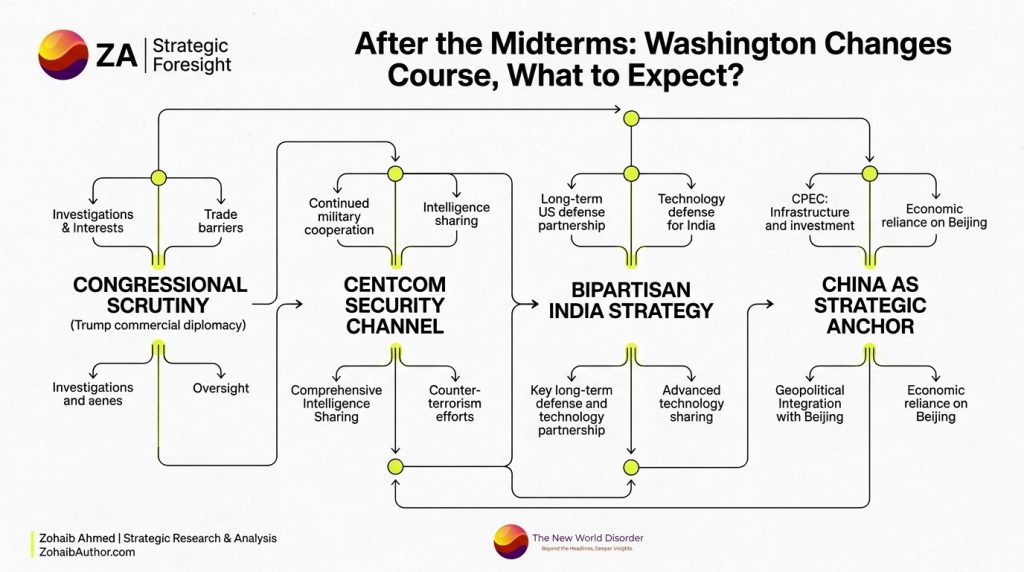
1. Trump’s commercial diplomacy will face congressional scrutiny
The first visible change will be the scrutiny of Trump-era commercial and diplomatic arrangements. Democratic control of Congress gives opposition lawmakers the authority to investigate agreements, summon administration officials, demand documents and influence federal spending. The Council on Foreign Relations has identified appropriations, oversight hearings, sanctions and Senate confirmations as major instruments through which the new Congress will constrain the administration. The International Institute for Strategic Studies has also highlighted the exposure of companies and projects that developed close relationships with the Trump White House.
For Pakistan, this matters because much of the recent diplomatic opening has revolved around critical minerals, energy, trade, cryptocurrency and investment financing. Initiatives involving American commercial interests, the Development Finance Corporation and EXIM Bank will face questions about their financial structure, transparency and political associations. Some projects will continue on their commercial merits. Others will encounter delays, additional conditions or political resistance.
The important distinction is that congressional scrutiny will not automatically terminate American economic engagement with Pakistan. It will, however, make personal access to the White House a less reliable foundation for securing long-term commitments.
2. Pakistan’s distrust of Democratic foreign policy
Islamabad will approach the Democratic-controlled Congress with considerable caution. Pakistan’s strategic perception of the Democratic Party is shaped by what it considers a recurring gap between American democratic rhetoric and the selective application of those principles in foreign policy.
Democrats frequently emphasise human rights, democratic governance and institutional accountability in their international messaging. Yet Pakistan has often viewed Washington’s application of these standards as inconsistent, particularly when strategic partnerships, military interests and regional calculations take precedence. This perception is not limited to one political party, but Democratic administrations have often made governance and human rights more prominent features of their engagement with Islamabad.
Pakistan therefore has little reason to assume that a Democratic Congress will offer a more accommodating or predictable relationship. The language may change, the diplomatic conditions may become more explicit, and scrutiny of Pakistan’s internal political environment may intensify. But the strategic calculations behind American policy will remain the deciding factor.
Islamabad will engage both parties, but it will not mistake ideological language for strategic reliability.
3. CENTCOM will remain a central institutional channel
The most durable area of engagement will remain security cooperation. This is where the United States Central Command (CENTCOM) becomes particularly important.
Counterterrorism, intelligence cooperation, Afghanistan-related security threats, regional stability and military-to-military engagement represent interests that extend beyond the political preferences of a president or congressional majority. The August 2026 Pakistan-US Counterterrorism Dialogue reaffirmed cooperation against ISIS-Khorasan, al-Qaeda, the TTP and the BLA and its affiliates. Both governments explicitly committed to strengthening collaboration and disrupting terrorist networks.
These interests will not disappear when Democrats take control of Congress. American security institutions will continue to assess Pakistan through the country’s geographic position, intelligence capabilities and relevance to regional stability.
Pakistan’s engagement through CENTCOM therefore carries greater long-term significance than temporary diplomatic warmth at the presidential level. It provides an institutional channel through which cooperation can continue even when political relations become complicated.
The next phase will reinforce the distinction between Washington’s political leadership and its permanent security interests. Pakistan’s objective will be to make this institutional relationship more consistent, functional and mutually beneficial.
4. India will retain its position in American strategy
A Democratic-controlled Congress will not dismantle the bipartisan foundations of US-India relations. India’s importance to Washington’s Indo-Pacific strategy, defense cooperation, technology partnerships and broader competition with China will remain intact.
Pakistan must recognise this reality rather than interpret every diplomatic opening with Washington as a shift away from New Delhi. The United States has different reasons for maintaining relations with both countries. India’s economic scale and Indo-Pacific position serve one set of American interests; Pakistan’s geography, counterterrorism role and connections to South, West and Central Asia serve another.
The May 2025 conflict also demonstrated the importance of external diplomatic engagement in managing escalation between two nuclear-armed states. Washington will retain an interest in crisis management and regional stability regardless of which party controls Congress.
Pakistan’s strategic relevance will therefore depend on what it brings to the relationship, not on whether Washington temporarily changes its diplomatic emphasis between Islamabad and New Delhi.
5. China will remain Pakistan’s strategic anchor
The Democratic victory will also bring renewed attention to America’s competition with China. Congressional Democrats have historically supported a strong focus on strategic competition with Beijing, particularly in technology, critical minerals, trade and supply chains. This will create additional pressure on countries that maintain substantial economic and security relationships with China.
Pakistan’s position, however, is unlikely to change. Its relationship with Beijing rests on decades of defense cooperation, strategic coordination, infrastructure investment and regional connectivity. CPEC remains central to Pakistan’s economic and geographic calculations.
Islamabad will continue engaging Washington where interests converge, particularly in energy, minerals, technology and counterterrorism. It will not treat that engagement as a reason to compromise its relationship with China or accept a binary geopolitical alignment.
This is consistent with the strategic hedging framework outlined in my 2025 paper: use American engagement for immediate economic and diplomatic gains while retaining the deeper institutional relationship with Beijing as the primary strategic anchor.
6. Pakistan has learned the American political cycle
There is a historical lesson behind Pakistan’s current approach. General Muhammad Zia-ul-Haq is widely associated with the observation:
“Being friends with America is like living on the banks of a great river. Every four years it changes course, and leaves you either flooded or high and dry.”
The quotation appears in Margalla Papers (2012), in its discussion of how Pakistan negotiates with the United States. Its relevance has not diminished. Pakistan experienced American engagement during the Soviet-Afghan war, the post-9/11 period and the subsequent withdrawal from Afghanistan. Each phase demonstrated how quickly Washington’s priorities could change once its immediate strategic requirements had been met.
Pakistan has learned that lesson. The current opening under Trump is being treated as an opportunity, not a permanent alignment. The Democratic victory will reinforce this institutional memory. Islamabad will continue to negotiate, secure commercial benefits and maintain security cooperation, but it will remain cautious about long-term dependence on American political commitments.
The river has changed course before. Pakistan’s foreign policy will no longer be built around the assumption that it will keep flowing in the same direction.
Strategic Forecast: Continuity of Interests, Volatility of Politics
The next two years will bring more congressional scrutiny of Trump-era agreements, renewed emphasis on governance and human rights in diplomatic engagement, and greater political friction over commercial initiatives. At the same time, counterterrorism cooperation, CENTCOM engagement and regional security interests will continue to provide institutional foundations for Pakistan-US relations.
The central argument of my 2025 analysis remains intact. The relationship is transactional, politically exposed and shaped by a limited convergence of interests. Its value lies in what Pakistan can secure from it, not in the appearance of a renewed strategic alliance.
Islamabad will engage the Democratic Congress, maintain channels with the Trump administration and continue its strategic partnership with Beijing. It will judge Washington through policy actions, financial commitments and institutional cooperation rather than presidential praise or party rhetoric.
The midterms have changed the balance of power in Washington. They have not changed the fundamentals of Pakistan’s foreign policy. Pakistan will work with America where interests align, hedge where they diverge, and avoid placing its long-term strategic future in the hands of an American election cycle.
The Leviathan’s Trap: Iran, Israel and the Fracturing of the American-Led Middle East
The American midterm elections have exposed a strategic problem that extends well beyond the Republican Party’s electoral defeat. Washington entered the confrontation with Iran alongside Israel, expecting military pressure to produce a decisive strategic outcome. Instead, the conflict has become a political liability for the Trump administration, destabilised the wider region, disrupted energy markets and intensified questions about the direction of American policy in the Middle East.
The consequences are particularly significant for Pakistan, Saudi Arabia and Türkiye, whose emerging security cooperation represents an alternative regional arrangement. The developments also bring the argument developed in The Leviathan and the Shield: How the Hexagon Alliance and the Sunni Shield Are Reshaping the Indo-Mediterranean Order into sharper focus.
The central question is no longer simply whether the United States can contain Iran. It is whether Washington has allowed itself to become committed to a regional confrontation whose strategic benefits are disproportionately concentrated in Israel’s calculations.
1. Israel’s Trap: Washington’s Strategic Exposure
The February 28, 2026, US-Israeli military campaign against Iran has become one of the most consequential decisions of Trump’s second presidency. What began as a joint military operation developed into a regional conflict, drawing in Gulf infrastructure, energy shipments and maritime security.
Israel’s strategic calculations extended beyond degrading Iranian military capabilities. The confrontation placed Washington directly inside a regional conflict in which Israel’s security priorities, its calculations regarding Iran and its regional ambitions became closely connected to American military and diplomatic commitments.
This is the central feature of the Israeli trap: Washington assumed the costs of a confrontation whose strategic architecture was designed primarily around Israeli security objectives.
The consequences have been visible in the American domestic arena. Reuters reported that the Iran war, rising energy costs and public dissatisfaction contributed significantly to Republican losses in the November midterms. Trump himself acknowledged the political consequences of the conflict. The administration now faces a Democratic-controlled Congress, increased scrutiny and a more complicated path for continuing its military agenda.
The United States entered the war with overwhelming military capabilities. It has not emerged with an equally clear political outcome.
2. Iran as the Instrument of Regional Disruption
The Iran confrontation also needs to be understood through the changing balance between the emerging Sunni security architecture and Israel’s regional ambitions.
Iran’s military and political networks had already suffered significant setbacks following the collapse of Bashar al-Assad’s government in December 2024. Syria’s political transition under Ahmad al-Sharaa removed a major component of Tehran’s former regional infrastructure. The subsequent American engagement with Damascus further altered the regional equation.
Trump’s May 2025 decision to lift Syrian sanctions and his November 2025 White House meeting with al-Sharaa represented a major diplomatic development. It offered Syria a route back into regional diplomacy, opened the possibility of American investment and strengthened the prospects of a new relationship between Damascus, Ankara, Riyadh and Washington.
For Israel, this development presented a different strategic reality. A post-Assad Syria moving towards the Sunni regional system, with American acceptance and Turkish and Saudi involvement, represented a potential shift in the regional balance.
In this interpretation, the Iran confrontation served a wider Israeli strategic purpose. Iran became the central battlefield through which regional attention, military resources and diplomatic priorities were redirected. The resulting conflict weakened the space for an independent Sunni security arrangement to consolidate and forced regional capitals to concentrate on immediate threats to their territory, infrastructure and energy routes.
Israel’s strategy therefore produced two connected effects: it drew Washington deeper into confrontation with Iran and disrupted the momentum behind a regional configuration that could increasingly operate outside Israeli influence.
3. The Al-Sharaa Factor: A Message to Trump
The American acceptance of Ahmad al-Sharaa was an important diplomatic development that should not be separated from the wider regional confrontation.
Trump’s decision to engage the new Syrian leadership challenged the previous regional assumptions surrounding Syria. It opened a path for Damascus to develop relations with Washington, Riyadh and Ankara while distancing itself from Tehran’s former network.
Israel had its own security calculations concerning southern Syria, its military presence and the future of the Golan frontier. Trump’s engagement with al-Sharaa introduced an American diplomatic direction that did not necessarily correspond with Netanyahu’s preferred regional arrangements.
The subsequent confrontation with Iran can therefore also be read as a strategic message to the Trump administration: American accommodation of a new regional order would not automatically translate into Israeli acceptance of its consequences.
The timing and strategic effects of these developments raise a larger question about whether Israel’s regional calculations were also intended to punish Trump for opening diplomatic space for al-Sharaa. In this reading, the Iran operation became a means of reasserting Israeli influence over the regional agenda and making Washington’s independent diplomatic choices considerably more difficult.
4. Netanyahu’s Political Reckoning
Benjamin Netanyahu’s political position has entered a decisive period. Israel’s October 27 election deprived his right-wing coalition of its parliamentary majority. His bloc secured 53 of the Knesset’s 120 seats, while opposition parties secured a collective 67 seats. On November 7, President Isaac Herzog tasked opposition leader Gadi Eisenkot with attempting to form a government.
Netanyahu remains caretaker prime minister, and the opposition’s internal divisions mean that a transfer of power is not yet guaranteed. Nevertheless, the political direction has changed. His ability to govern is under serious pressure, and the consequences of the Gaza campaign, the October 7 security failures and the wider regional war remain central to his political future.
Netanyahu’s leadership has become inseparable from the destruction in Gaza and the humanitarian catastrophe experienced by its civilian population. The scale of the devastation has generated sustained international condemnation and legal scrutiny. Political and diplomatic support from powerful allies cannot indefinitely insulate a leader from domestic accountability, international legal processes and the consequences of prolonged military decisions.
The political system in Israel is now confronting the cost of Netanyahu’s leadership. His loss of a parliamentary majority is already a significant setback. Whether through coalition formation, further elections or continuing institutional pressure, his ability to remain in power will face increasingly difficult constraints.
No government can indefinitely separate its political legitimacy from the consequences of its actions.
5. Pete Hegseth and the American Blame Game
The American political consequences are also reaching the Pentagon.
Defense Secretary Pete Hegseth has become one of the most exposed members of the Trump administration following the Iran campaign. The war’s cost, its strategic outcome, military decision-making and the administration’s public communication have placed his leadership under increasing scrutiny.
The Republican electoral defeat has accelerated this process. Hegseth will increasingly become a convenient target for criticism from within the Republican Party itself. Some lawmakers will blame the Pentagon’s handling of the war, others will question the administration’s strategic objectives, and others will focus on the political damage caused by the conflict.
This process has already begun. Republican Representative Thomas Massie introduced articles of impeachment against Hegseth, while calls for his removal intensified after the midterms. Axios reported that Republican defections could complicate the effort to protect him, while The Washington Post described the growing pressure surrounding his position.
The political challenge will extend beyond the impeachment question. Hegseth’s public credibility, his relationship with congressional Republicans and his ability to retain Trump’s confidence will all face pressure. He is likely to become one of the central figures in the administration’s internal blame game.
The distinction between being responsible for the war’s execution and being responsible for its political consequences will become increasingly difficult for the Pentagon leadership to maintain.
6. The Leviathan and the Shield: Two Competing Regional Architectures
These developments return us to the central framework of The Leviathan and the Shield.
The Leviathan represents a regional architecture built around maritime dominance, technological superiority, surveillance networks, strategic corridors and control over critical infrastructure. Its power derives from its ability to influence access, movement and the security environment across the Indo-Mediterranean system.
The Sunni Shield represents a different configuration. Pakistan, Türkiye and Saudi Arabia bring together territorial depth, military capacity, economic resources, geographic connectivity and strategic autonomy. Their cooperation offers the foundations for a regional security structure that is not entirely dependent on external powers.
The August 7, 2026, Mecca Joint Defense Agreement between Pakistan, Saudi Arabia and Türkiye gave this framework an institutional dimension. Its mutual-defense provisions, intelligence cooperation and defense-industrial commitments marked an important development in regional security relations. Türkiye’s parliamentary approval of the agreement further demonstrated that the arrangement was moving beyond diplomatic symbolism.
The Iran war has complicated this development, but it has also demonstrated why regional powers require independent security mechanisms.
The Leviathan’s advantage lies in its control of technological and maritime systems. The Shield’s potential lies in its geographic reach, military depth and ability to connect the Gulf, Anatolia, South Asia and the wider Indo-Mediterranean region.
The competition is therefore not simply between Israel and Iran. It concerns who will shape the security, connectivity and strategic arrangements of the region after the fragmentation of the previous order.
7. Pakistan’s Strategic Position
Pakistan enters this phase with a distinct advantage: it has maintained strategic relationships across competing power centres without formally surrendering its independence of action.
Its relationship with China remains foundational. Its engagement with Washington continues through diplomacy, economic cooperation and CENTCOM. Its defense cooperation with Türkiye and Saudi Arabia has acquired a more formal regional dimension.
The Mecca Agreement gives Pakistan an institutional framework through which its security relationships can develop beyond bilateral arrangements. The participation of a nuclear-armed state, a major regional economic power and a NATO member creates a configuration with considerable strategic significance.
The agreement also changes the regional conversation. Gulf security is no longer being discussed exclusively through the framework of American protection. Regional states are increasingly examining their own defense-industrial capabilities, intelligence arrangements and collective security requirements.
Pakistan’s role will be determined by its ability to connect these developments without becoming an instrument of another country’s regional agenda.
8. The Next Phase: American Retrenchment and Regional Recalibration
The Democratic takeover of Congress will constrain Trump’s political room, but it will not immediately remove his constitutional authority over foreign policy. The Iran war will remain a central issue during the transition to the new Congress in January 2027.
Washington will face pressure to define an exit strategy, explain the costs of the conflict and reassess its regional commitments. Israel will face the consequences of a political and military strategy that has generated substantial international opposition and increased uncertainty over its relationship with the United States.
Netanyahu’s political future remains unresolved, Hegseth’s position is under pressure, and the Republican Party is entering a period of internal accountability.
Meanwhile, the regional architecture is changing. Saudi Arabia, Türkiye and Pakistan are building institutional mechanisms for defense cooperation. Syria is repositioning itself after the collapse of the Assad government. China remains a major regional economic and diplomatic actor, while Iran’s future position will depend on the outcome of the ongoing conflict and its domestic political trajectory.
The Middle East is moving towards a more fragmented and competitive order in which regional powers will increasingly seek strategic autonomy.
Strategic Assessment: The Shield Will Not Wait for Washington
The American midterm defeat has exposed the political cost of a regional war whose objectives were closely tied to Israeli strategic priorities. It has also demonstrated the limits of assuming that military superiority automatically produces a sustainable political outcome.
The central argument of The Leviathan and the Shield remains relevant: the emerging regional order will be shaped by competing systems of military cooperation, technology, geography, infrastructure and strategic autonomy.
Israel’s attempt to contain the emerging regional balance through the Iran confrontation has drawn the United States deeper into a conflict with consequences for its own political stability. The disruption of the Sunni Shield’s consolidation has not eliminated the underlying interests that brought Pakistan, Türkiye and Saudi Arabia closer together.
Pakistan has already learned the cost of depending on external political cycles. Its relationship with Washington will remain transactional, its strategic relationship with Beijing will remain foundational, and its regional security cooperation will increasingly acquire institutional depth.
The next phase will not be decided by presidential statements or temporary military victories. It will be determined by which regional actors can build lasting security arrangements, protect their economic corridors and maintain strategic independence.
The Leviathan may command the maritime system, but the Shield is developing the territorial and institutional depth to contest the regional order.
References
1. Zohaib Ahmed / Zohaib Author (November 14, 2025). Pakistan-USA Relationship 2025: Strategic Foresight Analysis. Original paper.
2. Margalla Papers (2012). How Pakistan Negotiates with the United States of America? National Defence University, Islamabad, p. 118. The paper reproduces the Zia-ul-Haq quotation in its discussion of American electoral cycles and Pakistan’s diplomatic experience. Margalla Papers PDF.
3. Council on Foreign Relations (November 4, 2026). Democrats Win Control of Congress. Here’s How That Could Affect U.S. Foreign Policy. Congressional oversight, appropriations and confirmation powers.
4. International Institute for Strategic Studies (November 6, 2026). The Consequences of the US Midterm Elections. Analysis of the new congressional balance and scrutiny of Trump-era relationships and commercial arrangements.
5. Government of Pakistan, Ministry of Foreign Affairs (August 5, 2026). Joint Statement on the Fourth Round of Pakistan-US Counterterrorism Dialogue.
6. Reuters (November 4, 2026). Patricia Zengerle, Explainer: Five ways US foreign policy may change with a Democratic Congress.
7. Carnegie Endowment for International Peace (November 4, 2026). Jennifer Hendrixson White, Three Ways the New Democratic Congress Could Constrain Trump on Foreign Policy.
1. Zohaib Ahmed (2026). The Leviathan and the Shield: How the Hexagon Alliance and the Sunni Shield Are Reshaping the Indo-Mediterranean Order and the Great Fragmentation of the Middle East (2024–2026).
2. Reuters, November 4, 2026. Democrats seize Congress in sweeping midterm repudiation of Trump. Reports on the electoral consequences of the Iran war, economic concerns and Republican losses.
3. Reuters, November 4, 2026. Beaten at home, Trump faces stark choice on Iran: deal or escalation. Analysis of the military and political consequences of the conflict.
4. The Soufan Center, November 9, 2026. After Trump’s Midterm Setback, Middle East on Edge for What Happens Next. Regional reactions, Iran, Israel, Saudi Arabia and the implications of the American electoral result.
5. The American Presidency Project, May 14, 2025. Readout of Meeting with President Trump, Crown Prince Mohammed bin Salman, President Erdogan, and President Ahmad Al-Sharaa. Official account of Trump’s engagement with al-Sharaa and the decision to lift sanctions.
6. Axios, November 10, 2025. Trump holds first-ever White House meeting with Syrian leader. Background on the diplomatic normalisation of relations and the discussions concerning Syria’s future.
7. Reuters, November 7, 2026. Israel’s president taps opposition candidate Eisenkot to form a government, in setback for Netanyahu. Electoral results and the process of forming a new Israeli government.
8. U.S. Congressional Research Service, October 30, 2026. Israel: 2026 Elections and Government Formation. Detailed parliamentary results and constitutional process following the Israeli election. Every CRS Report
9. Axios, November 8, 2026. House poised to impeach Pete Hegseth after GOP midterm defeat. Republican defections, congressional pressure and the political exposure of the defense secretary.
10. The Washington Post, November 5, 2026. Hegseth defends Iran war, assails critics as calls mount for his removal. Hegseth’s public defense and the growing pressure following the midterms.
11. Associated Press, November 6, 2026. Turkish lawmakers approve a 3-nation defense pact with Saudi Arabia and Pakistan. Parliamentary approval and the institutional development of the Mecca defense agreement.
12. Stockholm University, Swedish Institute for Turkish Studies (2026). The Mecca Alliance for Defence and the Emergence of a Tripolar Middle East? Analysis of regional security arrangements and the emerging regional blocs.
How to Cite This Article
APA Style
Ahmed, Z. (2026, November 10). After the Midterms: Washington Changes Course, What to Expect? Zohaib Author. https://zohaibauthor.com/2026/11/10/after-the-midterms-washington-changes-course-what-to-expect/
Chicago Manual of Style (Author-Date)
Ahmed, Zohaib. 2026. “After the Midterms: Washington Changes Course, What to Expect?” Zohaib Author, November 10, 2026. https://zohaibauthor.com/2026/11/10/after-the-midterms-washington-changes-course-what-to-expect/
MLA Style
Ahmed, Zohaib. “After the Midterms: Washington Changes Course, What to Expect?” Zohaib Author, 10 Nov. 2026, zohaibauthor.com/2026/11/10/after-the-midterms-washington-changes-course-what-to-expect/.