
By Zohaib Ahmed | 13th February 2026
In the ever-evolving landscape of 21st-century naval warfare, the debut of the SMASH (Supersonic Missile Anti-Ship / P282) at the World Defense Show (WDS) 2026 has sent shockwaves through the global defense community. By successfully fielding a ship-launched, hypersonic-class anti-ship ballistic missile (ASBM), Pakistan has leapfrogged several traditional military powers.
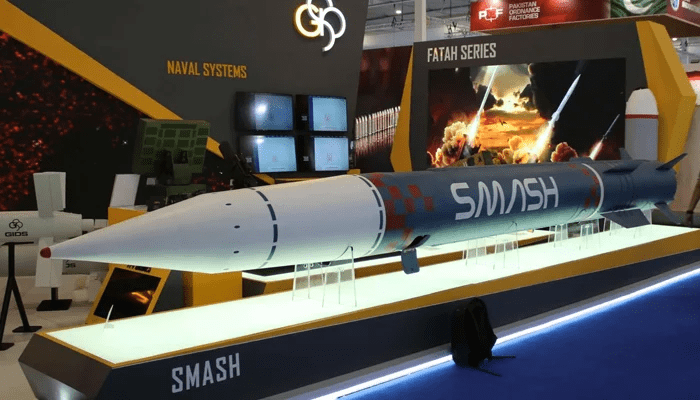
The SMASH is not just a missile; it is a strategic statement. It represents a paradigm shift where medium-sized navies can now wield the kind of high-kinetic, “carrier-killing” power previously reserved for the world’s two largest superpowers.
The Technical Anatomy of the SMASH
The SMASH is a dual-role, single-stage, solid-fuel ballistic missile designed for both maritime interdiction and precision land attack. Its technical features reveal a weapon optimized for the “contested” environments of the modern Middle East and the Indian Ocean.+1
- Guidance & Navigation: The missile uses a sophisticated HD-GNSS assisted Inertial Navigation System (INS). For the terminal phase, it employs an Active Radar Seeker with high-resolution imaging, allowing it to distinguish between civilian vessels and high-value military targets even in heavy clutter.
- The “Near-Vertical” Attack: Unlike cruise missiles that fly level with the ocean (sea-skimmers), the SMASH follows a quasi-ballistic trajectory. It climbs into the upper atmosphere before performing a terrifying, near-vertical dive. This exploits the “zenith” blind spots of most shipborne radar and Aegis-class defense systems.
- Payload Versatility: * Anti-Ship Version: Carries a 384 kg warhead optimized for kinetic penetration and high-explosive blast.
- Land-Attack Version: Features a heavier 444 kg warhead for neutralizing hardened bunkers or command centers.
- Propulsion: A Single Stage Dual Thrust Solid Rocket Motor (SRM) provides the initial boost to reach hypersonic speeds in the mid-course phase, while maintaining stability during the atmospheric re-entry.
The Global Hierarchy: Russia, China, and the ASBM Gap
To understand why the SMASH is a “wonder,” one must look at who else is in the room. As of 2026, the world of operational ship-launched hypersonic ASBMs is a very small, exclusive club.
China: The Pioneer
China’s YJ-21 (Eagle Strike 21) is currently the gold standard. It boasts a range of 1,500 km and terminal speeds of Mach 10. However, the YJ-21 is a massive missile. It is primarily deployed on the Type 055 “Renhai” cruiser, a 13,000-ton beast that is more like a mini-battleship than a standard frigate.
Russia: The Scramjet Master
Russia’s Zircon (Tsirkon) is a masterpiece of engineering, but it is a Hypersonic Cruise Missile (HCM), not a ballistic one. It uses a scramjet engine to maintain Mach 9 throughout its flight. While incredibly lethal, Zircons are notoriously expensive and require high-maintenance cryogenic fuels or advanced solid-state boosters, making them difficult for smaller nations to sustain.
The USA: The Strategic Missing Link
Surprisingly, the United States does not have a “proper” hypersonic ASBM in service today.
- The “Dark Eagle” (LRHW): While the U.S. Army’s Dark Eagle is a hypersonic wonder, it is a Ground-Launched strategic weapon with a range of 2,700 km. It is not an ASBM designed for shipboard VLS launch.
- The “CPS” (Conventional Prompt Strike): The U.S. Navy is currently refitting Zumwalt-class destroyers to carry these, but the program has faced years of delays. Furthermore, the CPS is a massive missile that requires specialized, oversized launch tubes, it cannot fit into a standard VLS cell.
The Pakistan “Wonder”: Hypersonic Power in a Frigate’s Footprint
The real breakthrough of the SMASH is miniaturization.
The Pakistan Navy and GIDS have achieved what the U.S. and even Russia have struggled with: fitting a hypersonic-capable ballistic missile into a standard Vertical Launch System (VLS) cell on a 4,000-ton frigate like the Tughril-class (Type 054A/P).
Why it is Unique Compared to Russia & China
While China needs a 13,000-ton cruiser and Russia needs a dedicated Gorshkov-class frigate with specialized tubes, Pakistan has integrated the SMASH into the Universal VLS already found on its versatile frigates.
- Cost-Effectiveness: It turns a “standard” frigate into a strategic platform capable of threatening a carrier strike group.
- Operational Density: Because the SMASH fits in standard VLS cells, a Tughril-class frigate can carry a mix of anti-air (LY-80N) and hypersonic anti-ship (SMASH) missiles in the same launcher. This “multirole” capability is something the larger Chinese and Russian platforms often lack in a compact format.
The Perfect Export Weapon
At WDS 2026, the SMASH is the most talked-about item for a reason. For nations like Saudi Arabia, the SMASH is the “Great Equalizer.”
- Sovereign Deterrence: It allows Middle Eastern navies to protect their coastlines (like the Red Sea or the Gulf) against much larger, technologically superior fleets.
- Ease of Use: Because it uses solid fuel and standard VLS infrastructure, it doesn’t require the specialized “rocket scientist” maintenance crews that high-end Western or Russian systems often demand.
- Localization: Pakistan has signaled its willingness to partner with SAMI (Saudi Arabian Military Industries) for local assembly, aligning perfectly with Saudi Vision 2030.
FAQs: The Speed and the Science
Q: How is it “Hypersonic” if the flyer says its terminal speed is Mach 2.0? A: This is a common point of confusion. In physics, a missile is classified as “Hypersonic” based on its peak speed during its flight. The SMASH reaches speeds of Mach 5 to Mach 8 during its descent from the high atmosphere (the mid-course/terminal re-entry). However, as it hits the thick air near the ocean surface (where the air is “soupy”), it naturally slows down due to friction. Its impact speed (terminal speed) is Mach 2.0+, which is still supersonic and provides enough kinetic energy to tear through a ship’s hull like paper.
Q: Can it be intercepted? A: Current naval defenses (like the Phalanx or RAM) are designed for sea-skimming cruise missiles. The SMASH attacks from a near-vertical angle at hypersonic re-entry speeds. By the time a ship’s radar “sees” the SMASH coming from above, it usually has less than 15 seconds to react.
Comparison: The Top Contenders (2026)
| Feature | SMASH (Pakistan) | YJ-21 (China) | Zircon (Russia) | CPS (USA) |
| Launch Platform | Standard Frigate (VLS) | 13k-ton Cruiser | Dedicated Frigate/Sub | Zumwalt Destroyer |
| Peak Speed | Mach 5–8 | Mach 10 | Mach 9 | Mach 5+ |
| Type | Ballistic (ASBM) | Ballistic (ASBM) | Cruise (HCM) | Glide Vehicle (HGV) |
| Range | 290–350 km | 1,500 km | 1,000 km | 2,700 km |
| Primary Role | Regional Sea Denial | Global Power Projection | Strategic Naval Strike | Prompt Global Strike |
The Final Word
The SMASH is the ultimate “Asymmetric Hammer.” While the U.S. has focused on extremely expensive, long-range hypersonic “silver bullets,” Pakistan has focused on Tactical Utility. By making a hypersonic missile that is small enough to fit on a frigate but fast enough to kill a cruiser, Pakistan has democratized the hypersonic era.
For the Middle East, the SMASH represents the end of naval vulnerability. It is a weapon that ensures that even a smaller navy can hold the world’s most powerful fleets at bay. At WDS 2026, the message is clear: The sky is no longer the limit, it is the launchpad.