
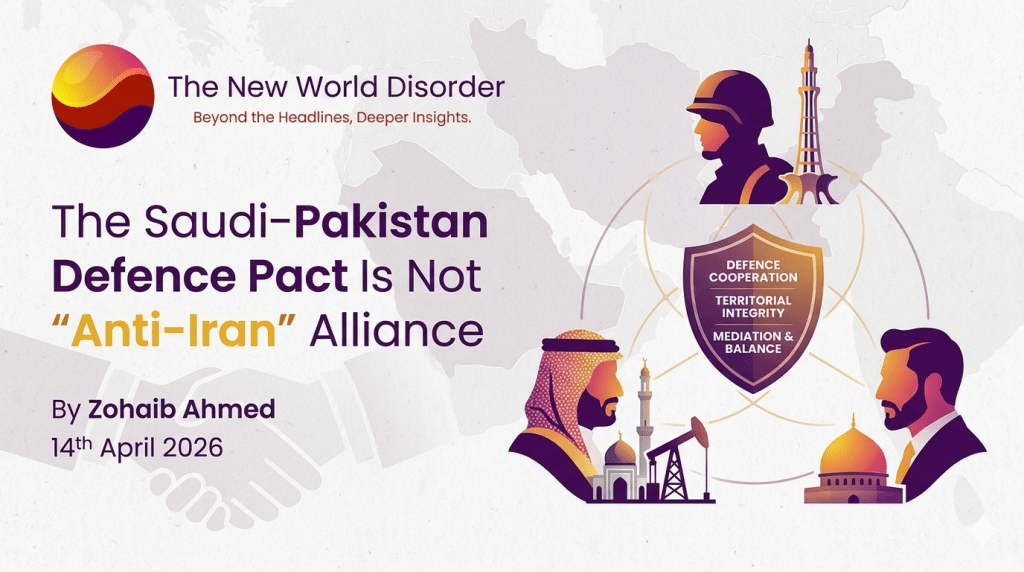
By Zohaib Ahmed | 14-April-2026
When Pakistan and Saudi Arabia formalised a Strategic Mutual Defence Agreement (SMDA) in 2025, the geopolitical reading in many global capitals was immediate and simplistic:
“Pakistan is now part of an anti-Iran security bloc.”
But that interpretation misunderstands not just the agreement, but the entire architecture of Pakistan’s foreign policy.
Because Pakistan is not entering a bloc.
It is reaffirming a principle.
And that principle is simple, consistent, and deeply embedded in its history:
Pakistan does not stand against Islamic countries. It stands with them.
Despite external assumptions, Islamabad has never treated its relationships in the Muslim world as zero-sum alignments. It has consistently resisted the logic of choosing sides between brotherly states—even when geopolitical pressure, regional wars, or proxy tensions attempted to force that choice.
In that sense, the SMDA is not a pivot away from Iran.
It is an extension of the same doctrine that has defined Pakistan’s regional posture for decades:
A defence commitment without hostility, and friendship without exclusion.
The result is not alignment against Iran.
It is continuity of a philosophy where Pakistan remains engaged with Saudi Arabia, connected with Iran, and committed to both as part of a broader Islamic strategic fabric.
Historical Context: Why the Anti-Iran Narrative Doesn’t Hold
A significant amount of misinformation circulating around the SMDA ignores Pakistan’s historical record in the region.
Foundational Diplomatic Reality
Iran was the first country to recognize Pakistan after independence. Since then, despite periods of tension, Pakistan has never formally entered any military alliance directed against Iran.
Pattern of Defensive, Not Offensive, Regional Engagement
Pakistan’s military role in the region has historically been:
- Defensive assistance to Saudi Arabia during internal crises
- Territorial protection during Gulf conflicts
- Training and advisory support to allied states
For example:
- During the 1979 Grand Mosque seizure, Pakistani special forces contributed to advisory and operational support in a counter-insurgency context
- In the First Gulf War, Pakistani forces were deployed for defensive and engineering roles, not offensive operations
- Pakistani pilots historically supported multiple Arab air forces in defensive air engagements during regional wars
These cases demonstrate a consistent pattern: supporting state stability, not participating in expansionist coalitions
Note: Notes in the Background Section were researched and crafted by respectable Amir Hussain.
Iran–Pakistan Wartime Cooperation
Even during the Iran–Iraq War, Pakistan played a behind-the-scenes facilitative role in logistics and spare parts support for Iran, reflecting a pragmatic rather than adversarial relationship.
This historical continuity is central:
Pakistan’s Iran policy has remained structurally consistent across civilian and military governments.
No administration—regardless of political ideology—has formally altered this baseline.
Policy Consensus: A Rare Case of Strategic Continuity
One of the most overlooked aspects of Pakistan’s Iran policy is its cross-party consensus.
Across governments, the position has remained stable:
- Non-participation in any anti-Iran coalition
- Maintenance of diplomatic engagement regardless of regional tensions
- Opposition to ideological framing of Iran relations
Even during periods of Gulf crisis alignment pressure, Pakistan has consistently resisted formal entry into anti-Iran security architectures.
The 2015 parliamentary decision to avoid involvement in Yemen remains a defining example: it was not an executive decision, but a national consensus against entanglement in a proxy war environment.
Pakistan’s Strategic Identity: Balancing Multiple Alliances Without Block Entry
Pakistan simultaneously maintains:
- Deep strategic ties with Saudi Arabia
- Expanding cooperation with Türkiye
- Functional diplomatic engagement with Iran
This triadic balancing act is not contradiction, it is design.
Pakistan’s strategic doctrine is best described as:
“Active balancing without bloc captivity.”
The objective is not to choose sides between Muslim powers, but to prevent fragmentation of the Muslim geopolitical space into permanent rival camps.
Regional Vision: From Bilateral Pacts to Integrated Security Frameworks
At a deeper level, Pakistan’s long-term strategic thinking is not about aligning against any one country, including Iran.
Instead, it is about:
- Reducing intra-regional conflict
- Preventing proxy escalation cycles
- Encouraging multilateral Islamic security cooperation
Frameworks like ECO and earlier RCD initiatives reflect this ambition: regional integration over bloc formation.
The SMDA, in this reading, is not a wedge—it is a stabilizer.
The Core Misread: Why the Pact Is Not Anti-Iran by Design
The Pakistan–Saudi defence agreement is built on a simple clause:
an attack on one is considered an attack on both.
At face value, this appears binary. But geopolitically, it is deliberately non-specific deterrence, not targeted hostility.
Analysts note the pact lacks:
- Any named adversary
- Any operational war doctrine against Iran
- Any automatic deployment clause
- Any explicit regional theatre definition
This matters.
Because modern defence alliances that are anti-specific—like NATO during the Cold War—are structured around identified adversaries.
This one is not.
Instead, it reflects what strategists call:
“deterrence through ambiguity.”
Pakistan gains strategic leverage. Saudi Arabia gains reassurance. But neither side formally declares Iran—or any state, as the target.
The Architecture of “Defensive Alignment”
The core of the Pak-KSA pact is built on the principle of territorial integrity rather than regional power projection. While the agreement includes a “mutual defense” clause—stating that an attack on one is an attack on both—the operational reality remains strictly protective.
Defensive Assets
The reported deployment of Pakistani personnel and air assets in Saudi Arabia is structured around defensive coordination, not offensive capability expansion. The emphasis remains on:
- Airspace surveillance and early warning systems
- Integrated air defense coordination
- Protection of critical infrastructure
- Training and interoperability exercises
Pakistani officials have consistently framed these deployments as non-combat, non-aggressive, and stabilisation-oriented, explicitly aimed at safeguarding Saudi energy infrastructure and sensitive religious sites from non-state threats and escalation spillovers.
This is consistent with Pakistan’s historical posture: it does not export force projection; it exports security stabilization frameworks.
A “Red Line” Strategy
For Islamabad, the pact serves as a deterrent mechanism rather than an alignment tool.
The logic is simple:
A stable Saudi Arabia reduces regional volatility, which directly limits spillover risks into Pakistan’s western frontier.
From this perspective, the agreement is not about confrontation with Iran—it is about preventing regional fragmentation that could destabilize multiple borders simultaneously.
The Islamabad Mediation: A Proof of Neutrality
Perhaps the strongest evidence that the pact is not anti-Iran is Pakistan’s simultaneous role as a diplomatic bridge.
Even as military assets were being integrated into Saudi defence infrastructure, Islamabad remained engaged in backchannel diplomacy involving U.S. and Iranian interlocutors.
The Quadrilateral Initiative
Alongside Turkey and Egypt, Pakistan has been associated with mediation frameworks aimed at de-escalation in the broader Gulf region.
This dual-track posture is critical:
- Defence cooperation with Saudi Arabia
- Diplomatic engagement with Iran
- Active de-escalation messaging across regional forums
This is not contradiction—it is intentional dual balancing.
Economic & Geographic Imperatives
Pakistan’s nearly 900-km border with Iran is not just geography—it is strategic constraint.
Key realities include:
- Cross-border security sensitivity in Balochistan
- Energy and trade corridor potential
- Smuggling and insurgency spillover risks
- Long-term regional connectivity ambitions
For Islamabad, an anti-Iran posture is not simply undesirable—it is structurally impractical.
Strategic planners instead view the SMDA as something that reduces Saudi anxiety, thereby decreasing the probability of unilateral escalation in the Gulf—creating more space for diplomacy, not less.
Strategic Decoupling: Defense vs. Hostility
The SMDA clearly separates institutional defense cooperation from geopolitical targeting.
Pakistan’s historical military engagements reinforce this pattern. Islamabad has consistently avoided participation in offensive coalitions, most notably:
- Declining a combat role in Yemen (2015)
- Focusing on territorial defense in Gulf deployments
- Prioritizing training and advisory roles over expeditionary warfare
Operational Reality Table
| Aspect | Pak-KSA Pact Focus | Status vs. Iran |
|---|---|---|
| Military Role | Training, Air Defense, Coordination | Non-combat / Non-offensive |
| Political Objective | Regional Stability | Mediation & De-escalation |
| Strategic Posture | Defensive Assurance | Open diplomatic channels |
This separation is not accidental—it is doctrinal.
Pakistan’s foreign policy tradition is built on avoidance of permanent enemy designations in the Middle East, even during high-pressure regional conflicts.
Pakistan’s Historical Baseline: Neutrality as a Strategic Tool, Not a Moral Position
Pakistan’s foreign policy toward Iran and the Gulf has never been ideological.
It has been structural.
Historically, Islamabad has:
- Maintained working ties with Iran
- Maintained deep security and financial ties with Saudi Arabia
- Avoided direct involvement in Iran–Arab conflicts
- Supported mediation in Gulf crises
Even during past regional wars, Pakistan has often avoided military alignment.
As one foreign policy analysis notes:
Pakistan’s neutrality is not legal neutrality in the international law sense, but a “functional balancing doctrine.”
In practice, this means:
- Pakistan avoids defining enemies in binary terms
- It hedges between competing regional blocs
- It converts geography into diplomatic leverage
And crucially:
Pakistan’s geography forces it to maintain ties with both Iran and Saudi Arabia simultaneously.
It shares:
- A long land border with Iran
- Deep labour and remittance dependence on Gulf states
- Strategic military cooperation with Saudi Arabia
That triangle defines everything.
The Structural Constraint: Pakistan Cannot Afford an Anti-Iran Posture
Even if political pressure existed to interpret the pact as anti-Iran, Pakistan’s internal constraints make that posture unsustainable.
(a) Geography
Pakistan shares a volatile 900 km border with Iran.
Any adversarial alignment would immediately expose:
- Balochistan instability risks
- Cross-border militant spillover
- Smuggling and insurgency escalation
(b) Energy dependency
Iran remains a latent energy corridor option for Pakistan, especially in long-term gas and trade scenarios.
(c) Domestic sectarian balance
Pakistan’s internal sectarian composition makes overt anti-Iran alignment politically sensitive.
(d) Economic reliance on Gulf states
Saudi Arabia and Gulf allies remain critical for:
- Oil financing
- IMF-linked liquidity support
- Worker remittances
Pakistan is not choosing between Iran and Saudi Arabia.
It is managing both simultaneously.
What the Pact Actually Signals: Saudi Hedging, Not Pakistani Alignment
The deeper reality is that the pact is less about Pakistan shifting ideology—and more about Saudi Arabia diversifying its security dependencies.
Riyadh has increasingly sought:
- Reduced reliance on the US security umbrella
- Secondary deterrence partnerships
- Flexible response architecture
Pakistan provides:
- Conventional military manpower
- Nuclear-armed deterrence symbolism (without explicit transfer)
- Strategic depth in the Muslim world
But importantly:
The pact is still framed as defensive cooperation, not expeditionary war planning.
That distinction is critical.
Because defensive pacts:
- Deter escalation
- Do not automatically initiate conflict
- Require political activation at each step
Which means:
Pakistan is not structurally bound to participate in any Saudi-Iran conflict unless politically activated.
The Iran Question: Why Tehran Interprets It Differently Than Islamabad
Iran’s strategic perception is shaped by three concerns:
1. Encirclement anxiety
Iran sees multiple overlapping Gulf security frameworks evolving without its inclusion.
2. Saudi-Pakistan military proximity
Joint exercises and deployments create optics of alignment.
3. Nuclear ambiguity
Even without formal nuclear guarantees, Pakistan’s deterrence capability is part of regional calculations.
However, Islamabad’s position is different:
Pakistan insists:
- The pact is not anti-Iran
- It does not change Iran bilateral policy
- It does not mandate participation in Iran-specific conflicts
This divergence creates what analysts call:
“asymmetric interpretation of the same agreement.”
The Real Risk: Not War with Iran — But Strategic Entanglement
The biggest misunderstanding is assuming the pact triggers immediate military alignment.
It does not.
The real risk is slower and more structural:
Scenario 1: Incremental activation
- Crisis in Gulf escalates
- Saudi Arabia requests defensive support
- Pakistan deploys limited assets
- Iran interprets it as alignment
Scenario 2: Proxy misinterpretation
- Non-state actors escalate border incidents
- Both sides perceive indirect state involvement
- Diplomatic space shrinks
Scenario 3: Diplomatic compression
- Pakistan’s mediator role weakens
- Neutrality becomes operationally difficult
- External pressure increases
In all cases:
The danger is not declared war—it is shrinking neutrality space.
Why Pakistan Is Still Acting as a Mediator (and Not a Party)
Despite the defence pact, Pakistan has simultaneously positioned itself as a diplomatic bridge.
Recent developments show:
- Islamabad hosting US–Iran discussions
- Active shuttle diplomacy between Gulf states
- Public emphasis on de-escalation messaging
Even senior Pakistani leadership has repeatedly framed its role as:
“stability facilitator, not conflict participant.”
This dual-track strategy is not contradictory—it is intentional.
Pakistan is trying to maintain:
- Defence alignment with Gulf security concerns
- Diplomatic credibility with Iran
- Strategic relevance to global powers
This is classic multi-vector diplomacy under pressure.
Why the “Anti-Iran Bloc” Narrative Is Strategically Incorrect
Calling the pact anti-Iran ignores three realities:
1. Pakistan has no declared adversarial doctrine against Iran
Unlike formal alliances, there is no structured enemy framing.
2. Iran–Pakistan relations remain functional
Despite tensions, trade, border security cooperation, and diplomatic engagement continue.
3. Pakistan’s strategic doctrine is balance, not bloc formation
Islamabad historically avoids permanent alignment in Middle Eastern conflicts.
Even during past regional wars, Pakistan avoided taking sides.
Historical Neutrality Under Pressure: Pakistan’s Iran–Iraq War Posture (1980–1988)
The historical record of the 1980–1988 Iran-Iraq War provides several clear instances where Pakistan’s “leaning neutrality” favored Tehran, even when such a stance ran counter to Cold War alignments and Pakistan’s deep security relationship with Saudi Arabia.
At the time, most regional actors were drifting toward Iraq. Pakistan, however, chose a different path—one defined less by ideology and more by strategic containment of regional instability.
Diplomatic and Political Shielding
Pakistan’s support for Iran during this period was not declarative—it was procedural. Islamabad’s influence was primarily exercised through blocking isolation mechanisms rather than overt alignment.
UN and OIC Mediation
Pakistan played a central role in shaping OIC discourse through the “Ummah Peace Committee”, pushing for ceasefire-oriented language rather than bloc-based condemnation of Iran.
This mattered because several regional and Western powers were attempting to reframe the conflict as a containment effort against the post-revolution Iranian state.
Pakistan resisted that framing.
By refusing to formally label Iran as the aggressor, Islamabad effectively ensured that the OIC did not evolve into an anti-Iran institutional platform.
The 1981 Taif Summit Dynamic
At the Taif Summit, Pakistan helped steer outcomes away from punitive resolutions and toward de-escalation language.
In practical terms, this neutralized attempts to convert Islamic multilateral institutions into instruments of geopolitical alignment against Tehran.
Strategic and Logistics Assistance
Beyond diplomacy, Pakistan’s geography created a structural reality: Iran was not isolated.
The Land Link
Despite sanctions pressure and regional polarization, Pakistan’s border remained one of Iran’s few consistent overland access routes.
While official trade fluctuated, the corridor allowed:
- Essential civilian goods movement
- Limited barter-based exchanges
- Indirect continuity of supply chains during maritime disruption in the Gulf
Western intelligence assessments of the era also noted the existence of informal dual-use goods flows, although Islamabad never officially acknowledged such channels.
Refusal of Airspace Militarization
Even as U.S. influence expanded in the region during the Soviet-Afghan War, Pakistan consistently avoided granting operational access to its territory for any activity that could be construed as hostile surveillance or staging against Iran.
This included:
- Denial of offensive or intelligence-use air corridors
- Restriction of base utilization for regional escalation scenarios
- Maintenance of formal non-participation in Iran-targeted operations
This was a deliberate containment of escalation pathways, not alignment politics.
Economic and Security Cooperation
Despite war-driven fragmentation in the Gulf, Pakistan and Iran maintained a pragmatic economic relationship anchored in necessity rather than ideology.
Counter-Cyclical Trade
Even during the peak of the “Tanker War,” bilateral trade mechanisms persisted, including:
- Pakistani wheat and rice exports
- Iranian oil barter arrangements
- Emergency supply stabilization mechanisms
This trade functioned as a pressure-release valve for Iran’s wartime economic constraints.
Internal Security Coordination
Both states also shared an overlapping concern: sectarian spillover.
Military-to-military communication channels were reportedly used to:
- Contain sectarian polarization risks in Pakistan
- Prevent cross-border ideological escalation
- Stabilize sensitive border regions
Importantly, Pakistan avoided joining broader regional coalitions that leaned heavily toward Iraq, preserving its non-aligned operational posture.
Resistance to External Pressure
Perhaps Pakistan’s most consequential role during the Iran–Iraq War was not what it did—but what it refused to do.
Defying Coalition Logic
Despite being a frontline state in the anti-Soviet Afghan jihad—funded heavily by Saudi Arabia and the United States—Pakistan resisted pressure to extend that alignment logic to Iran containment.
The strategic calculation was clear:
A destabilized Iran on Pakistan’s western border would create a long-term security liability exceeding any short-term alliance benefit.
Non-Participation in Offensive Support to Iraq
Unlike several regional actors, Pakistan:
- Did not deploy combat advisors to Iraq
- Avoided manpower contributions to Saddam Hussein’s forces
- Limited its engagement to neutral diplomatic positioning
This reinforced a consistent doctrinal boundary: defensive cooperation is permissible; offensive coalition warfare is not.
Post-Cold War Frictions: Saudi Expectations vs. Iranian Rivalry
Pakistan’s neutrality has historically created friction with both Saudi Arabia and Iran—though for very different reasons.
On one side, Saudi Arabia has often perceived Pakistan’s neutrality as strategic ingratitude, given decades of financial assistance and labour-market integration.
On the other, Iran has viewed Pakistan’s alignment fluctuations through the lens of proxy competition and regional corridor rivalry, especially as infrastructure competition intensified in the 21st century.
The result is not alignment with either side—but persistent pressure from both.
The Saudi Friction: The 2015 Yemen Crisis
The most visible rupture came during the Yemen conflict.
Parliamentary Refusal
When Saudi Arabia requested direct Pakistani military participation in Operation Decisive Storm, Pakistan’s Parliament responded with a unanimous resolution rejecting involvement.
The reasoning was strategic, not ideological:
- Risk of sectarian spillover into Pakistan
- Overextension in a multi-theatre conflict
- Domestic political fragility
Regional Reaction
The response from Gulf partners was sharp.
Saudi and allied officials reportedly expressed deep frustration, temporarily tightening financial and diplomatic cushioning.
The IMCTC Compromise
To preserve strategic ties without entering the war, Pakistan later facilitated the appointment of former Army Chief General Raheel Sharif to lead the Islamic Military Counter-Terrorism Coalition (IMCTC) in Riyadh.
This became a classic Pakistan workaround model:
Strategic reassurance without operational entanglement.
The Chabahar–Gwadar Structural Rivalry
Iran’s infrastructure strategy has introduced a long-term structural competition in the region.
Competing Corridors
- Gwadar: China-backed maritime gateway under CPEC
- Chabahar: India-backed Iranian access point to Central Asia
While Iran publicly frames Chabahar as complementary, its strategic utility is clear: it reduces Pakistan’s geographic monopoly on Afghan and Central Asian access.
Strategic Messaging
Iran’s positioning has consistently emphasized:
- Alternative access to Central Asia
- Reduced dependency on Pakistani transit routes
- Greater regional connectivity flexibility
This introduces a permanent structural hedge against Pakistan’s geographic leverage.
Afghanistan Corridor Dynamics
Through Chabahar, India has been able to maintain trade and humanitarian access into Afghanistan without reliance on Pakistani territory.
Post-2025 dynamics suggest continued Iranian facilitation of limited Indian logistical access, reinforcing the corridor’s strategic relevance even under shifting Afghan political conditions.
Sub-Conventional Tensions and Proxy Layers
Despite formal diplomatic engagement, the Pakistan–Iran relationship is repeatedly strained by security externalities and proxy dynamics.
Balochistan Insurgency
Pakistan has long alleged that militant groups such as:
- Balochistan Liberation Army (BLA)
- Balochistan Liberation Front (BLF)
operate with varying degrees of cross-border facilitation from Iranian territory.
The 2016 arrest of Kulbhushan Jadhav remains a central reference point in Islamabad’s claims of external intelligence involvement in Balochistan instability.
Zainabiyoun Brigade
Pakistan has also raised concerns regarding the Zainabiyoun Brigade, a group of Pakistani-origin fighters who participated in Middle Eastern conflicts under Iranian-aligned structures.
Security agencies view returning fighters as a reintegration and radicalization risk vector, contributing to heightened internal monitoring and, in 2024, its designation as a terrorist entity by Pakistan.
2024 Cross-Border Strikes
The most significant escalation occurred in early 2024:
- Iranian strikes targeted militant positions in Pakistan
- Pakistan responded with Operation Marg Bar Sarmachar
- Both sides conducted limited kinetic actions on each other’s territory
This marked an unprecedented moment: two states with a declared “brotherly relationship” engaging in direct military exchange.
Analysis: The Dual-Pressure Geography of Pakistan–Iran Relations
The 2026 strategic environment reveals a structural paradox:
- Saudi Arabia–Pakistan defence cooperation is expanding
- Iran–Pakistan relations remain diplomatically functional but operationally tense
- India–Iran connectivity via Chabahar introduces strategic bypass routes
Yet none of these dynamics convert Pakistan into an anti-Iran actor.
Instead, they reinforce a more complex reality:
Pakistan is not positioned within a bloc architecture. It is positioned at the intersection of competing regional corridors.
The Pak–KSA defence framework adds stability to one side of this triangle, but it does not dissolve the structural tensions on the other.
Iran’s engagement with India via Chabahar, meanwhile, ensures that Pakistan’s western corridor remains strategically contested, not controlled.
Stability Built on Overlapping Contradictions
The prevailing misconception in regional discourse is that defence cooperation equals geopolitical alignment.
Pakistan’s historical record suggests otherwise.
From the Iran–Iraq War to modern Gulf security arrangements, Islamabad’s posture has consistently followed one principle:
Prevent regional wars from locking Pakistan into permanent adversarial blocs.
The result is a strategic identity built on contradiction:
- Defence cooperation with Saudi Arabia
- Functional engagement with Iran
- Strategic hedging across both sides
The SMDA with Riyadh does not erase that history.
It extends it.
And in doing so, it reinforces a central geopolitical reality:
Pakistan is not choosing between Iran and Saudi Arabia. It is attempting to remain structurally indispensable to both, without becoming an enemy of either.
The Hidden Layer: Deterrence Psychology, Not Military Planning
The most important function of the pact is psychological:
It signals:
- To Saudi Arabia: “You are not alone”
- To Iran: “Escalation has consequences”
- To global powers: “Pakistan is a strategic stakeholder in Gulf security”
But signalling is not war planning.
It is deterrence architecture.
And deterrence, by design, is meant to prevent conflict, not initiate it.
Conclusion
Across decades of regional turbulence, from the Iran–Iraq War, to Gulf realignments, to modern corridor competition between Gwadar and Chabahar, the consistent thread in Pakistan’s foreign policy has not been alignment against any Islamic country, but steadfast refusal to become part of intra-Muslim confrontation frameworks.
The Pakistan–Saudi defence pact is therefore often misread through a geopolitical lens that assumes exclusion.
But Pakistan’s reality is built on inclusion.
Pakistan has stood with Saudi Arabia in moments of security need, just as it has stood with Iran in moments of diplomatic isolation and regional pressure. It has refused to participate in military coalitions against Iran, even under intense external expectations. It has facilitated dialogue when others opted for division. And it has maintained channels of cooperation with both sides even when the regional environment incentivised rupture.
This is not contradiction.
It is character.
Pakistan’s position is not that of a state choosing between Riyadh and Tehran.
It is the position of a state that sees both as part of a shared regional and civilizational space—bound by geography, faith, and strategic interdependence.
So the question is not:
“Is Pakistan aligned against Iran?”
Because history, policy, and practice already answer that clearly.
The real understanding is simpler:
Pakistan does not see Islamic states as opposing poles of alignment. It sees them as parallel pillars of the same regional order, and it stands with both accordingly.
And that is why the SMDA with Saudi Arabia does not redefine Pakistan’s relationship with Iran.
It reflects the same enduring principle that has guided it for decades:
Friendship is not conditional. And standing with one brother has never meant standing against another.