
By Zohaib Ahmed | 9th February 2026
The Pakistan Navy’s induction of the ALBATROS NG (New Generation) naval air defense system marks one of the most consequential shifts in Pakistan’s maritime combat doctrine in decades. Designed by MBDA, Europe’s premier missile consortium, ALBATROS NG is a modern Naval Based Air Defence (NBAD) solution built to counter the realities of contemporary naval warfare, where saturation attacks, low-observable threats, and compressed engagement timelines dominate. As of early 2026, Pakistan has emerged as the first export customer and a primary operational user of the system, integrating it into its newest surface combatants to reinforce air defense coverage across the North Arabian Sea.
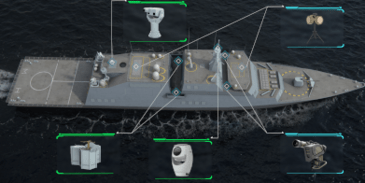
At its core, ALBATROS NG is designed to provide both self-defense for the host ship and local area defense for task groups, protecting nearby vessels against anti-ship cruise missiles, combat aircraft, unmanned systems, and precision-guided munitions. This dual-role capability is essential for a navy that increasingly operates in multi-ship formations under persistent aerial surveillance and missile threat.
CAMM-ER as the System’s Centerpiece
The defining element of ALBATROS NG is the CAMM-ER (Common Anti-air Modular Missile – Extended Range). CAMM-ER represents a decisive break from the semi-active radar-guided missile philosophy that dominated naval air defense for decades.
First, the missile uses an active RF seeker, meaning target acquisition and terminal guidance are handled by the missile itself rather than continuous shipboard radar illumination. This allows true fire-and-forget engagement and removes the single-target tracking bottleneck that plagued older systems such as HQ-16 or Sea Sparrow variants. In practical terms, a Pakistan Navy corvette can now engage multiple incoming threats from different azimuths at the same time without saturating its fire control radar.
Second, CAMM-ER employs Soft Vertical Launch (SVL). Instead of igniting its rocket motor inside the launcher, the missile is cold-ejected using a gas generator before the motor lights at a safe distance from the deck. This reduces thermal stress on the ship, lowers infrared signature during launch, and allows installation on lighter platforms without reinforced deck structures. For Pakistan’s MILGEM-derived corvettes, this was a critical integration advantage.
Third, the missile is equipped with a two-way data link, enabling mid-course updates from the ship’s combat management system. This allows the missile to receive refined target data from sensors such as the SMART-S Mk2 3D radar or off-board sources via datalink, improving interception probability against maneuvering or low-observable targets.
Performance Envelope and Engagement Capability
CAMM-ER extends the baseline CAMM design to an intercept range exceeding 40 kilometers, compared to approximately 25 kilometers for the standard variant. The missile weighs roughly 160 kilograms, reaches supersonic speeds above Mach 3, and can engage targets from very low altitude sea-skimmers to high-altitude aircraft.
This wide engagement envelope directly addresses one of the most dangerous modern naval threats: high-speed sea-skimming missiles that remain below radar horizon until the last moments of flight. CAMM-ER’s active seeker and vertical launch geometry allow near-instantaneous reaction, reducing dependence on ship orientation or launcher alignment.
The system is also designed to defeat saturation attacks, where multiple missiles or drones are launched simultaneously to overwhelm defenses. Unlike legacy systems that could only guide one or two interceptors at a time, ALBATROS NG can prosecute several targets in parallel, limited primarily by missile inventory rather than fire control capacity.
Why the System Matters Strategically
The shift to ALBATROS NG is not incremental. It reflects an understanding that naval combat has entered an era where reaction time is measured in seconds, electronic warfare is persistent, and attackers assume defenders will be jammed, distracted, or overloaded.
Older semi-active systems forced ships into predictable radar emission patterns and created single points of failure. Active guidance and distributed engagement logic reduce vulnerability to jamming and decoys. The use of sealed canister missiles with no scheduled maintenance over their service life also lowers long-term operational costs and increases readiness rates, which is critical for sustained deployments.
Pakistan Navy as the First Export Operator
Pakistan became the first export customer for ALBATROS NG under an agreement signed in March 2021, as announced by MBDA. The system was selected for integration on Babur-class MILGEM corvettes and future Jinnah-class frigates.
Initial induction began with PNS Babur in 2023, followed by PNS Khaibar between 2024 and 2025. This timeline placed Pakistan ahead of several NATO users in operational deployment of the extended-range variant.
The decision was also political and strategic. While Pakistan continues to rely heavily on Chinese platforms, the Navy deliberately sought a Western-compatible, compact, and electronically resilient air defense system for its premium surface combatants. The MILGEM design, developed with Turkish collaboration, required a system that could integrate cleanly with NATO-standard combat management architectures and operate effectively in dense electronic warfare environments.
Comparison with Legacy Chinese Systems
Previously, Pakistan relied on the LY-80N (HQ-16) naval derivative for medium-range air defense. While capable, HQ-16 remains a semi-active system with higher radar dependency and lower saturation resilience.
ALBATROS NG addresses these gaps by offering:
- Greater simultaneous engagement capacity
- Reduced radar emission requirements
- Faster reaction cycles
- Better survivability against electronic countermeasures
This transition represents a doctrinal move away from quantity-focused defense toward quality-centric, network-enabled protection.
Implications Beyond the Navy
There are strong indicators that Pakistan intends to extend CAMM-ER technology beyond naval platforms through EMADS (Enhanced Modular Air Defence Solutions), the land-based counterpart of the system.
For the Pakistan Army, EMADS offers a mobile, soft-launch solution to protect high-value assets such as command nodes, logistics hubs, and strategic infrastructure. It provides an alternative or supplement to HQ-16 units, with improved deployability and lower signature.
For the Pakistan Air Force, CAMM-ER integration would enable a layered air defense grid capable of sharing data with JF-17 Block III, AEW aircraft, and future stealth platforms such as the J-31. This supports a shift toward joint air defense, where all three services operate common interceptors across shared networks.
Toward a Joint Air Defense Doctrine
The broader implication of ALBATROS NG adoption is doctrinal. Common missile technology across Navy, Army, and Air Force reduces training complexity, simplifies logistics, and enables shared sensor-shooter architectures.
This approach strengthens Pakistan’s ability to create a mobile and resilient A2AD posture, particularly against high-speed cruise missiles such as BrahMos, which compress decision cycles and punish slow or centralized defenses.
Official Signaling and Strategic Intent
During naval exercises in early 2026, Chief of Naval Staff Admiral Naveed Ashraf emphasized that the induction of emerging technologies is essential to maintaining balance as warfare shifts toward unmanned systems and rapid missile exchanges. That statement reflects a clear understanding of where naval conflict is headed and why passive or legacy defenses are no longer sufficient.
Strategic Assessment
The transition to ALBATROS NG is not simply a platform upgrade. It is a deliberate shift away from dependence on semi-active, radar-bound defenses toward an active-guidance, low-signature, network-enabled architecture. It improves survivability under saturation attack, reduces exposure to electronic warfare, and supports joint force integration across domains.
In a region where precision strike capability is expanding and engagement windows are shrinking, ALBATROS NG gives Pakistan a defensible margin. It signals intent, technological awareness, and a willingness to diversify defense partnerships where it matters most.
This is not about parity through numbers. It is about control through capability.