
By Zohaib Ahmed | 9th February 2026
The South Asian skies are approaching a definitive threshold in aerial warfare. As the Pakistan Air Force (PAF) accelerates its transition into a next generation force, the induction of the Shenyang J-35 stealth fighter stands as the most critical pillar of this evolution. Often referred to in defense circles as the Grey Falcon, the J-35 is not merely a replacement for aging airframes but the centerpiece of a multi billion dollar strategic modernization program designed to secure air dominance well into the mid century.
The acquisition of the J-35 is part of a comprehensive 12 billion dollar defense package that includes advanced surface to air missile systems, unmanned combat aerial vehicles, and electronic warfare suites. This massive investment serves the PAF Vision 2030, a doctrine focused on transitioning from a legacy force to a technology driven, network centric aerospace power. The J-35 represents the tip of the spear in this vision, providing the stealth penetration capabilities required to operate within highly contested anti access and area denial environments.
The Reality of the Timeline: Maturity Over Hype
Recent discourse regarding the J-35 induction has been clouded by social media hype and premature reports suggesting an earlier arrival. However, credible analysis indicates that a 2026 to 2027 arrival was always the baseline. The rumors of a 2024 or 2025 induction were largely driven by enthusiast accounts rather than procurement realities.
The reason for this measured pace is a deliberate preference for mature performance over early induction. The J-35 is currently undergoing a rigorous refinement phase. While the naval variant (J-35J) progressed quickly due to the immediate needs of the Chinese carrier program, the land based variant (J-35A) intended for the PAF and PLAAF is being optimized for superior land based strike and air superiority roles.
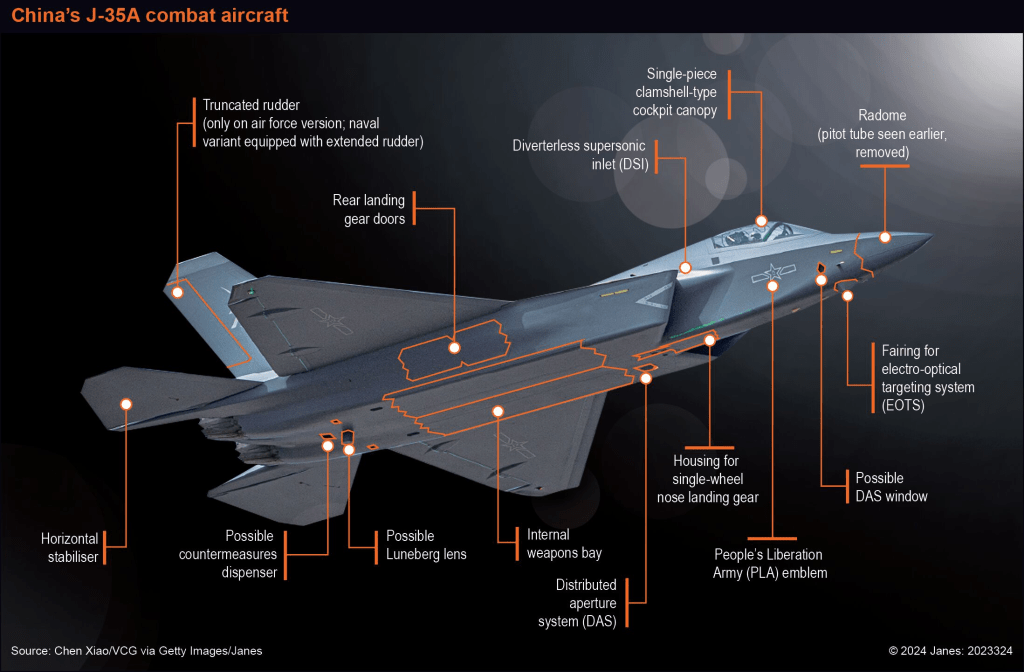
Current redesign work focuses on critical areas including redesigned air intakes for better airflow management, serrated engine nozzles for reduced infrared signatures, and a revised landing gear configuration. Furthermore, the cockpit architecture is being finalized to ensure peak sensor fusion and pilot interface efficiency. For the PAF, receiving a platform that has moved past its initial production teething issues is more valuable than being an early tester of an unrefined airframe. First deliveries are realistically expected around mid 2026, aligning with the completion of specialized production facilities in China.
Technical Architecture and Stealth Philosophy
The J-35 is a twin engine, medium weight fifth generation fighter that utilizes a distinct stealth philosophy. Its airframe design features a continuous curvature surface, aligned edges, and a diverterless supersonic inlet (DSI) that hides the engine blades from incoming radar waves. The use of advanced Radar Absorbent Material (RAM) further reduces its Radar Cross Section (RCS) to a level comparable to the world’s most elite stealth platforms.
Unlike fourth generation fighters that rely on external pods, the J-35 utilizes an internal weapons bay to maintain its low observable profile. This bay is designed to house a variety of munitions, most notably the PL-15E long range air to air missile and the upcoming PL-16, which features folding fins to allow for a higher density of internal carriage. This allows the J-35 to perform first day access missions, where it can penetrate enemy radar screens undetected to eliminate high value assets such as AWACS or ground based radar installations.
Comparing the J-35 Variants: Naval vs. Land Based
Understanding the difference between the J-35 variants is essential to grasping Pakistan’s specific requirements. The naval variant, designed for carrier operations, features a larger wing area and folding wingtips to facilitate storage and lower approach speeds during carrier landings. It also utilizes a reinforced twin wheel nose gear to handle the stresses of catapult launches and arrested recoveries.
The land based J-35A variant, which Pakistan is set to acquire, features a streamlined single wheel nose gear and a more optimized wing structure for high altitude, high speed maneuvers. By removing the heavy navalization hardware, the J-35A gains a higher thrust to weight ratio and increased internal fuel capacity. This makes it a more potent interceptor and long range strike platform, perfectly suited for the land based geography of the South Asian theater.
Global Competitors: J-35 vs. F-35 and Su-57
The J-35 is frequently compared to the American F-35 Lightning II and the Russian Su-57. While the F-35 remains the gold standard for sensor fusion, the J-35 offers a twin engine configuration which provides a higher safety margin and potentially superior kinematic performance in a dogfight.
Compared to the Russian Su-57, the J-35 features a more cohesive stealth design. The Su-57 has faced criticism for its exposed engine components and visible rivets, which compromise its stealth from various angles. The J-35 follows the more stringent stealth shaping conventions seen in the F-22 and F-35, making it a more effective platform for deep penetration into modern integrated air defense systems.
Read Detailed Comparison: https://zohaibauthor.com/2026/02/08/j-35-vs-f-35-vs-su-57-a-technical-analysis-of-modern-fifth-generation-fighters/
Strategic Impact on the Pakistan Air Force
The induction of the J-35 will fundamentally alter the balance of power in the region. Currently, no other air force in South Asia operates a true fifth generation stealth fighter. While competitors rely on 4.5 generation platforms like the Rafale or Su-30MKI, these aircraft remain visible to the J-35’s Active Electronically Scanned Array (AESA) radar long before they can detect the stealthy J-35.
The J-35 will act as a force multiplier for the existing fleet of J-10C and JF-17 Block III aircraft. In a network centric combat scenario, the J-35 can fly ahead of the main strike package, using its stealth and advanced sensors to identify targets and relay data to the rest of the fleet via secure data links. This allows the PAF to engage targets from standoff distances without exposing its main force to enemy fire.
Technology Transfer and the PFX Alpha Connection
One of the most significant aspects of the J-35 deal is the potential for technology transfer. While full access to stealth coating formulas or source codes is unlikely, partial transfer of avionics architecture and sensor fusion logic is a strong possibility. This exposure will be invaluable for Pakistan’s own National Aerospace Science and Technology Park (NASTP) and the PFX Alpha program.
Learning how a fifth generation platform manages massive amounts of data from various sensors (radar, infrared, and electronic support measures) will provide a blueprint for Pakistan’s indigenous fighter development. This is a long runway decision aimed at building national self reliance in high end aerospace engineering rather than just a quick hardware purchase.
Analysis from AeronautIR: The Kinetic Edge
In a recent detailed briefing by Squadron Leader (Retd) Ali Hamza on his channel AeronautIR, critical insights into the J-35’s operational capabilities were revealed. He emphasized that the J-35 is not just a stealth platform but a high performance kinetic interceptor. A key highlight is the integration of ultra long range Beyond Visual Range (BVR) missiles such as the PL-17 and PL-21.
The PL-17 is a massive missile designed to destroy high value aerial assets like tankers and AWACS from distances exceeding 300 to 400 kilometers. While such a large missile would typically be carried externally in “beast mode,” Ali Hamza noted that firing these weapons at extreme ranges allows the J-35 to maintain its mission objective before reverting to its clean stealth profile for the remainder of the engagement. This capability forces an adversary’s air force to operate much further back from the border, effectively creating a “no fly zone” for support aircraft.
Furthermore, Ali Hamza highlighted that while India discusses the AMCA or potential Rafale 114 deals, these remain 4.5 generation solutions or distant 2035 goals. The PAF leadership’s vision, as stated on January 1 2024, has already laid the ground work for J-35 induction, ensuring that by the time mass production hits its stride in 2026, Pakistan will be the first regional operator of these game changing systems.
Conclusion
The J-35 Grey Falcon represents the most sophisticated aerospace asset ever considered for the South Asian theater. By integrating this platform, the Pakistan Air Force is not merely buying a new aircraft but is adopting a new way of warfare. The J-35’s ability to operate in the shadows, combined with its ultra long range BVR capabilities including the PL-17 and PL-21, ensures that the PAF maintains a qualitative edge. The transition to a fifth generation force is a complex journey, but the disciplined approach of prioritizing technological maturity over premature induction proves that the PAF is focused on long term strategic victory rather than short term optics.
10 Frequently Asked Questions About the J-35
Why is the J-35 called the Grey Falcon? The name Grey Falcon reflects the aircraft’s low visibility grey stealth coating and its role as a high speed, predatory interceptor within the PAF hierarchy.
Is the J-35 a copy of the F-35? While the J-35 shares some aerodynamic similarities with the F-35 due to the laws of stealth physics, it is a unique twin engine design with different internal systems and mission profiles.
What is the range of the J-35? The J-35 has an estimated combat radius of over 1,200 kilometers on internal fuel, which can be extended significantly with aerial refueling.
Can the J-35 carry the PL-15E missile? Yes, the internal weapons bay is specifically designed to carry the PL-15E and the newer PL-16 missiles to maintain a stealth profile during combat.
What is the maximum speed of the J-35? The aircraft is capable of reaching speeds in excess of Mach 1.8, with some reports suggesting it has limited supercruise capability.
How many J-35s is Pakistan expected to buy? Initial reports suggest a requirement for two squadrons, totaling roughly 36 to 40 aircraft, as part of the initial phase of Vision 2030.
Does the J-35 have vertical takeoff capability? No, unlike the F-35B, all J-35 variants are conventional takeoff and landing or carrier based (CATOBAR) aircraft.
What kind of engines does the J-35 use? The production version is expected to use the WS-19 engine, which provides higher thrust and better fuel efficiency than previous prototypes.
Will the J-35 replace the F-16? The J-35 is intended to complement the F-16 and J-10C by handling high end stealth missions, rather than acting as a direct one for one replacement for the entire fleet.
Is the J-35 visible to current Indian radars? While no aircraft is 100% invisible, the J-35’s RCS is so small that it can get within lethal missile range of current 4th generation radars before being detected.