
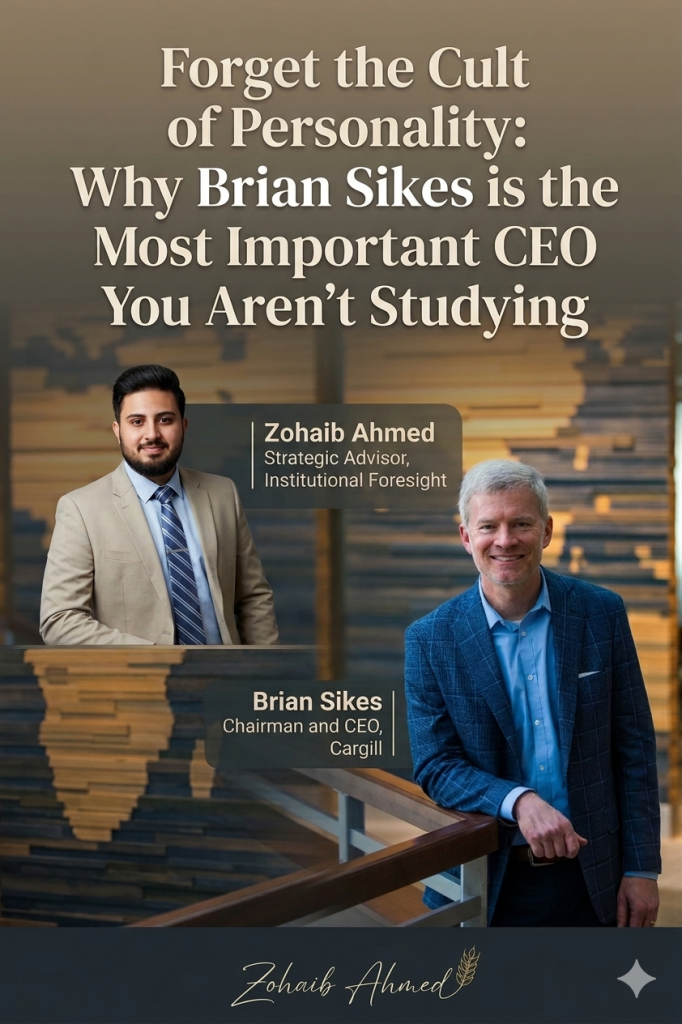
By Zohaib Ahmed | 1st June 2026
The modern tech world thrives on personality worship. It is built on the visual theater of disruption, the mythology of billionaires, and the constant narration of “changing the world.” We are repeatedly told to study Elon Musk’s spectacle of reinvention or Bill Gates’ structured philanthropy as the highest expressions of leadership.
But from the vantage point of someone who studies systems, institutions, and long-term structural power, I find myself drawn to a very different kind of leader.
Not the ones who dominate headlines.
But the ones who dominate supply chains.
That is why I am more inspired by Brian Sikes, the Chairman and CEO of Cargill, than by the loud icons of Silicon Valley.
Because influence is not always loud. Sometimes it is buried deep inside the systems that keep civilizations alive.
The Myth of Loud Leadership
We live in an age where visibility is mistaken for importance.
Tech billionaires have become cultural symbols. Their influence is undeniable, but their narrative is often amplified by media ecosystems that reward disruption over durability.
Elon Musk represents acceleration, risk, and public experimentation at scale. Bill Gates represents structured philanthropy and institutional funding models for global health and education.
Both are significant figures in their own domains.
But both operate in worlds where outcomes are visible, metrics are financialized, and impact is often abstracted from physical survival systems.
Food is different.
Energy is different.
Agriculture is different.
These are not sectors of influence that can be “rebranded” overnight. They are slow, physical, and unforgiving.
That is where Brian Sikes operates.
What Brian Sikes Actually Did
To understand why Sikes matters, you have to understand the kind of organization he leads.
Cargill is not a typical corporation. It is one of the largest privately held companies in the world, operating across grain trading, meat production, agricultural supply chains, logistics, and food systems that span continents.
Brian Sikes is not a symbolic CEO. He is an operational architect.
A 30-year veteran of Cargill, he rose through the internal machinery of the company rather than entering through external spectacle. That matters, because it shapes the kind of decisions he makes.
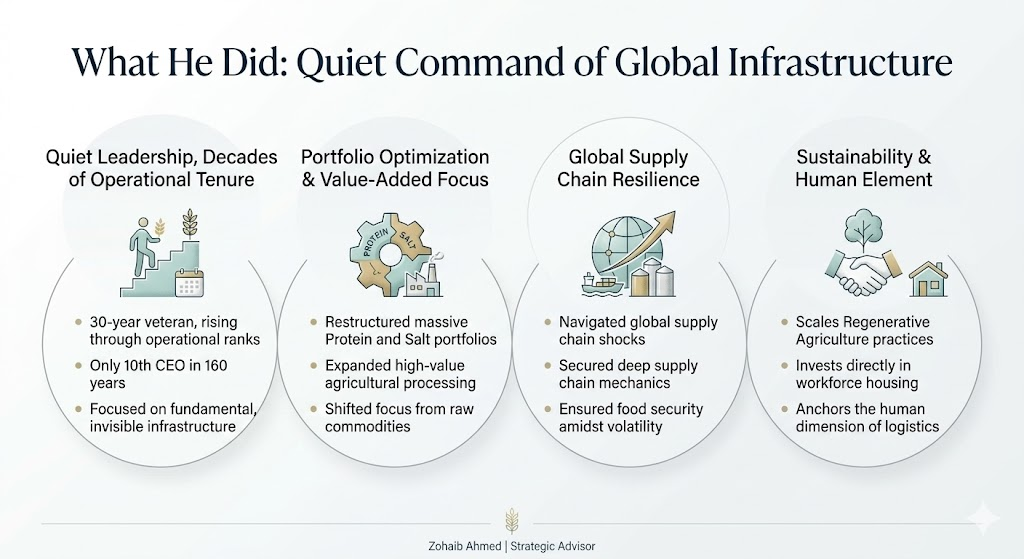
When he became CEO, he did not reposition the company as a “tech-enabled disruptor” or attempt to reinvent its identity for market appeal. Instead, he focused on strengthening what most leaders ignore: the invisible architecture of global food security.
Under his leadership, Cargill has emphasized three key strategic shifts:
First, strengthening core protein and agricultural supply chains, ensuring that volatility in global markets does not collapse physical food availability.
Second, expanding value-added agricultural processing rather than relying solely on commodity trading. This means transforming raw agricultural inputs into more stable, higher-margin, and more resilient food systems.
Third, investing in regenerative agriculture and supply chain resilience, including initiatives that support farmers directly and improve long-term soil and production stability.
There is no spectacle in this.
There is only system design.
And that is precisely why it matters.
What Makes His Leadership Different
Brian Sikes represents a category of leadership that modern discourse often overlooks: infrastructure leadership.
This is not leadership that seeks attention. It is leadership that seeks stability.
In a world obsessed with innovation cycles and digital acceleration, Sikes operates in a domain where failure is not measured in market share, but in hunger, scarcity, and systemic breakdown.
What separates him from most celebrated CEOs is not charisma or visibility, but orientation.
He is not building platforms for attention.
He is reinforcing systems for survival.
This creates a very different definition of success.
In Silicon Valley, success is often measured in valuation curves and cultural influence.
In global agribusiness, success is measured in continuity.
Can food move across borders during geopolitical crises.
Can supply chains withstand climate disruption.
Can populations be fed when systems are under stress.
Sikes’ leadership is fundamentally aligned with these questions.
The Core Lesson: Power Is Structural, Not Performative
The most important lesson from Brian Sikes’ leadership is deceptively simple.
True power is not loud. It is structural.
It does not depend on public narrative. It depends on operational depth.
This is a concept that modern digital culture often fails to grasp.
We are conditioned to equate visibility with impact. But the systems that actually determine civilizational stability are often invisible.
Agriculture is one of them.
Water systems are another.
Energy infrastructure is another.
And global food logistics sits at the center of all three.
Sikes operates within this hidden architecture.
While tech leaders optimize attention economies, leaders like Sikes optimize survival economies.
One is optional.
The other is foundational.
Why This Matters for Pakistan
For Pakistan, this distinction is not theoretical. It is existential.
Pakistan is an agricultural country with enormous potential, but also structural fragility. Climate volatility, water stress, inefficient supply chains, low-value exports, and fragmented storage systems all contribute to chronic instability in the agricultural sector.
The lesson from Sikes is not about imitation. It is about reorientation.
Pakistan does not need another “tech disruption narrative” in agriculture.
It needs structural redesign.
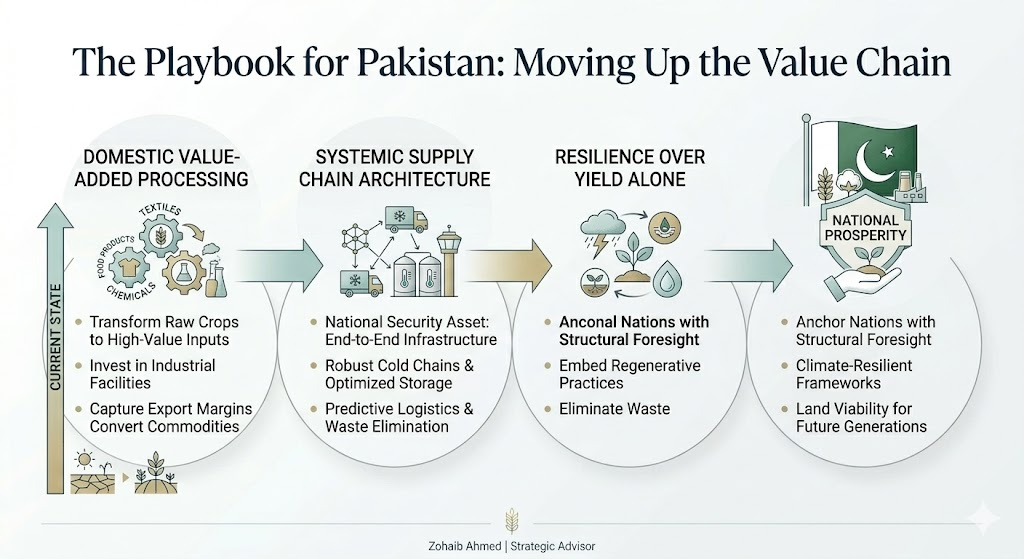
The first shift required is moving from raw commodity dependency to value-added agricultural processing. Today, a significant portion of agricultural output is exported or consumed in raw form, meaning the country captures only a fraction of its true value. The Cargill model demonstrates that real power lies in processing, refining, and integrating agricultural output into higher-value systems.
The second shift is supply chain architecture. Agriculture in Pakistan is still treated as a rural production activity rather than a national logistics system. Cold storage, warehousing, predictive distribution, and export-grade logistics remain underdeveloped. This creates massive inefficiencies and post-harvest losses that quietly drain the economy.
The third shift is climate resilience. Agriculture is no longer a predictable seasonal system. It is a climate-sensitive, volatility-driven ecosystem. Leaders like Sikes understand that resilience is not optional. It must be engineered into the system itself through regenerative practices, soil management, and adaptive production models.
These are not cosmetic reforms.
They are structural imperatives.
The Strategic Blind Spot in Developing Economies
One of the biggest strategic failures in developing economies is the obsession with visible sectors.
Tech startups, digital apps, fintech platforms, and AI solutions often receive disproportionate attention compared to foundational systems like agriculture, logistics, and energy.
But the reality is simple.
A country cannot build a digital economy on top of a broken physical economy.
No amount of innovation can compensate for weak supply chains.
No amount of branding can compensate for food insecurity.
This is where Brian Sikes becomes relevant not just as a corporate leader, but as a strategic model.
He represents the idea that the most important systems are often the least glamorous ones.
And that true leadership is measured not in attention, but in stability under pressure.
What Pakistan Must Unlearn
If Pakistan is to evolve its agricultural future, it must first unlearn certain habits.
It must unlearn the idea that agriculture is only a rural or traditional sector.
It must unlearn the belief that raw exports are sufficient economic strategy.
It must unlearn the assumption that technology alone can fix structural inefficiency.
Instead, it must begin to think like system architects.
Not farmers alone.
Not traders alone.
But designers of national-scale agricultural infrastructure.
This shift requires institutions that think in decades, not quarters.
It requires policy that understands logistics as power.
It requires leadership that values continuity over visibility.
The Real Contrast with Tech Leadership
Elon Musk builds futures that are visible in real time.
Bill Gates builds frameworks that influence global policy and funding systems.
But Brian Sikes builds something more fundamental.
He builds continuity.
There is no public performance in that role.
No viral moment.
No ideological branding.
Just the quiet management of systems that ensure food reaches people across continents, even under global stress.
This is not less important than tech leadership.
In many ways, it is more important.
Because without it, nothing else functions.
Final Reflection
The reason I am not inspired by the most visible names in technology is not because they lack impact.
It is because impact itself is often misunderstood.
We have been conditioned to look upward at visibility rather than downward at infrastructure.
But civilizations are not built on visibility.
They are built on systems that work when no one is watching.
Brian Sikes represents that category of leadership.
Not disruptive theater.
Not ideological branding.
But operational permanence.
And for someone studying strategy, systems, and the future of national resilience, that is where real inspiration lies.
Not in how loudly a person can change the world.
But in how silently they can keep it running.